Lisa Guernsey
Senior Director, Birth to 12th Grade Policy; Co-Founder and Director, Learning Sciences Exchange

For many years, advocates of early education have focused on reaching children and their families. Getting more four-year-olds into pre-K, for example, has been an important and increasingly successful rallying cry. But as pre-K expansion accelerates and the science of children advances, we are at a new fork in the road. Brain science is continuously showing just how much children鈥檚 growth and development is affected by their interactions with people around them. It is time to get real about what young children, especially the most vulnerable, truly need from the teachers and other caregivers with them every day.
The early education policy and advocacy community is now turning more attention to the adults who work with young children. What kinds of skills do they possess? What are their working conditions? Do they have what it takes to support children鈥檚 growth and learning? If not, many聽of today’s聽children will聽not have what they need聽to grow into successful adolescents and adults. What must be done?
This is the focus of a long-awaited report released last week by the National Academies of Science,聽. 聽The report was written by study director Bridget Kelly and La Rue Allen, who chaired a 19-member committee brought together by the Institute of Medicine and the National Research Council of the National Academies of Science. (Full disclosure: I had the incredible privilege of being part of the committee.) A four-page聽聽is here.
At the report鈥檚 heart is the recognition that supporting the growth and development of young children from birth through age eight鈥攊ncluding their cognitive development, their social-emotional development, and so much more鈥攊s complex and challenging work. Parents, of course, are primary in children鈥檚 development, and a聽聽will examine the parenting side of early childhood. But last week鈥檚 report addresses the skills of adults who are paid for working with and teaching young children. It recognizes that helping to develop children鈥檚 bodies and minds requires much more than putting out snacks and coloring books. 聽Yet many parts of today鈥檚 early education system, or in many cases, its聽non-system, do not help adults provide much more than that.
鈥淔or too long,鈥� the report states, 鈥渢he nation has been making do with the systems and policies that聽补谤别听rather than envisioning the systems and policies that 补谤别听needed, and committing to the strategies necessary to achieve them.鈥�
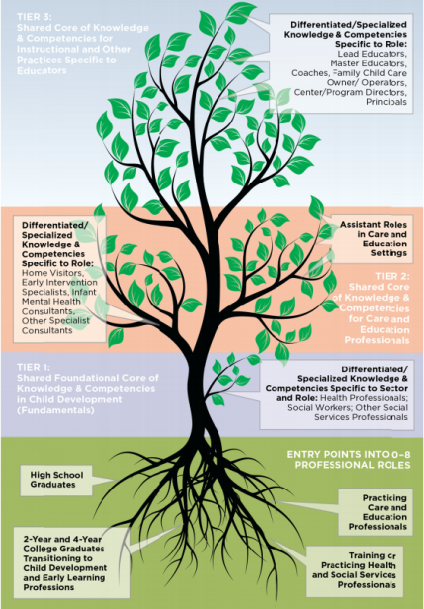
In five parts and 571 pages, the report lays out that vision for a new era for early education. Some of that vision is displayed metaphorically as a tree, in a聽graphic that graces page 430.
Each chapter offers integrated science-based insights for the field to absorb and consider. Here are its 13 recommendations, which are explained in far more detail in the report itself:
Recommendation 1:聽Strengthen competency-based qualification聽requirements for all care and education professionals working with children聽from birth through age eight.
Recommendation 2:聽Develop and implement comprehensive pathways and聽multi-year timelines at the individual, institutional, and policy levels for聽transitioning to a minimum bachelor鈥檚 degree qualification requirement,聽with specialized knowledge and competencies, for all lead educators working with children from birth through age eight.
Recommendation 3:聽Strengthen practice-based qualification requirements,聽including a supervised induction period, for all lead educators working with聽children from birth through age eight.
Recommendation 4:聽Build an interdisciplinary foundation in higher聽education for child development.
Recommendation 5:聽Develop and enhance programs in higher education for聽care and education professionals.
Recommendation 6:聽Support the consistent quality and coherence of聽professional learning supports during ongoing practice for professionals聽working with children from birth through age eight.
Recommendation 7:聽Develop a new paradigm for evaluation and assessment of professional practice for those who work with children from birth through age eight.
Recommendation 8:聽Ensure that policies and standards that shape the聽professional learning of care and education leaders (elementary school聽principals and directors in early care and education settings) encompass the聽foundational knowledge and competencies needed to support high-quality聽practices for child development and early learning in their organizations.
Recommendation 9:聽Improve consistency and continuity for children from聽birth through age eight by strengthening collaboration and communication聽among professionals and systems within the care and education sector and聽with closely related sectors, especially health and social services.
Recommendation 10:聽Support workforce development with coherent聽funding, oversight, and policies.
Recommendation 11:聽Collaboratively develop and periodically update聽coherent guidance that is foundational across roles and settings for care and聽education professionals working with children from birth through age eight.
Recommendation 12:聽Support comprehensive state- and local-level efforts to transform the professional workforce for children from birth through age eight.
Recommendation 13:聽Build a better knowledge base to inform workforce聽development and professional learning services and systems.
鈥淐omprehensive implementation of these recommendations will not happen overnight and will not come cheaply,鈥� the report says. 鈥淚t will require a strategic, progressive trajectory of change over time to transform the professional landscape, accompanied by significant commitment and investment of financial and other resources.鈥�
The report synthesizes the latest findings in brain science and child development to build its case.聽, for example, provides an update on the outdated 鈥渘ature versus nurture鈥� debate by explaining 鈥渉ow genes and environments work together to produce鈥攐r to protect from鈥攊llness and disorder.鈥� It also includes many examples from new studies on what enables the development of literacy, math, social-emotional skills, and more. (The report groups children鈥檚 development into four categories: cognitive development, general learning competencies, socioemotional development, and health and physical well-being.)
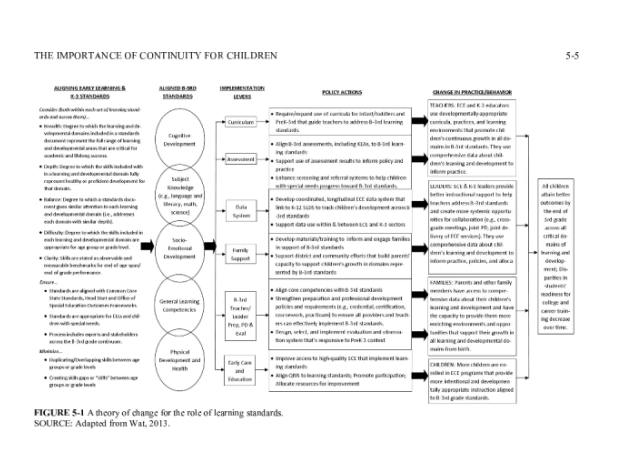
聽delves into the implications of that science for our current system, or non-system, of early care and education. It goes beyond what the American public typically considers the pre-K years, ages three to five. Instead it starts at the very beginning, with the days and months after a child is born, and it continues into the early elementary grades, through the third grade. See, for example, the flow chart聽聽(below), a theory of change for aligning early learning and K-3rd grade standards, adapted from work by Albert Wat of the National Governors Association. 聽聽
Working within a 0-8 age span is incredibly welcome to us here in the Early Education Initiative at 国产视频, where we focus on birth-through-third-grade strategies and are often reminding policymakers not to forget the K-3 grades. It is unfair to expect that children will somehow acquire the critical skills of learning how to learn in just one year of pre-K or kindergarten without parents, caregivers, and early learning teachers paying attention to their development in the years before and the years thereafter. Ignoring the developmental stages that span early childhood鈥檚 eight formative years is a recipe for grade-to-grade backsliding, wasted resources, painful transitions, and children flailing in school.
What kinds of skills must be possessed by professionals in each of these years? of the report has answers. One part identifies the knowledge and competencies that should be present in all professionals who work with young children. The larger part of the chapter focuses on the specialized knowledge needed by professionals with direct, daily or near-daily responsibilities for the care and education of these young children in child care settings and in pre-K and elementary schools, as well as principals and center directors. 聽See and ask yourself: How do today鈥檚 educators attain these competencies? 聽No doubt the answer will vary wildly depending on the professionals鈥� working conditions, not to mention prior preparation or access to continuing education. Overcoming these disparities 鈥� made worse by entrenched fragmentation and funding inequities between settings and programs along the age span 鈥� will be among the toughest challenges for our education system in this and coming decades.
Fortunately, delves deeply into what kinds of changes will be needed and provides the for how to meet that challenge with the 13 recommendations listed above. Each one聽gives us much to review and consider, and the report and its ideas will no doubt be part of future writing here in the Early Ed Initiative. But I’ll end here with a reflection on that “tiered” tree analogy above, with branches for differentiated and specialized knowledge for different children at different ages in different settings, but with a strong 鈥渢runk鈥� or core of fundamentals for working with children in general. It is a聽vision of tiered professionalism with聽similarities to聽other more mature fields, such as the medical and health profession.
It鈥檚 exciting to imagine a transformation like this taking shape. Now it is up to policymakers, educators, and the entire field of early education to make it happen.
UPDATE 4/9: You can watch video of the public briefing announcing the report .
Senior Director, Birth to 12th Grade Policy; Co-Founder and Director, Learning Sciences Exchange