
Aaron Loewenberg
Senior Policy Analyst, Early & Elementary Education
Dismantling ED would be devastating for the country鈥檚 children from their earliest years of learning through graduation
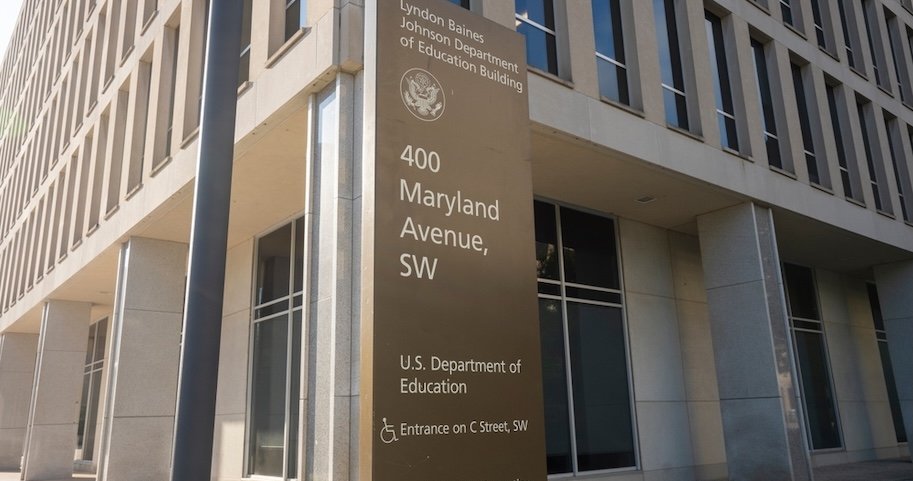
There is growing concern that the U.S. Department of Education (ED) is being weakened and dismantled by the Trump administration. While fully abolishing ED is unlikely in the short-term since it would require an act of Congress, (something Linda McMahon during her confirmation hearing), an executive order is expected soon that would aim to limit federal involvement in education by shutting down agency functions that aren鈥檛 explicitly written into statute.
While most public school funding comes from local and state governments, the federal government provides of annual funding for public schools. What would be the real-world impact on students of significantly curtailing ED鈥檚 role or even ending it altogether?
The Department of Education is responsible for the two largest federal funding streams for public schools: Title I and IDEA (Individuals with Disabilities Education Act) programs. Title I refers to the first title of a landmark education law, the Elementary and Secondary Education Act of 1965, which has taken on many names over the years as it has been altered, expanded, or amended by Congress. The most recent version is the Every Student Succeeds Act (ESSA), which received strong bipartisan support . Title I鈥檚 purpose, , is 鈥渋mproving the academic achievement of the disadvantaged.鈥�
Title I grants provide each year to states and districts to fund services for students from low-income families, including pre-K . IDEA grants provide each year to states and districts to help them better serve students with disabilities starting at birth, such as funding the salaries of support staff that provide services required by a student鈥檚 Individualized Education Program (IEP).
As , revenue responsibility for Title I funding would pass to the states over a ten year period. Phasing out federal support and passing the responsibility of Title I and IDEA funding to the states would have devastating impacts on both the education received by some of the most vulnerable students and on the bottom lines of state and local governments.
At the recent for Linda McMahon, there was no mention of phasing out funding over ten years, but instead a reference to granting the money directly to states. This type of block granting has of leading to funding declines over time. Because Title I funds to districts on the basis of the number of economically disadvantaged children living in the district, the result of block granting those funds will be less support for some of our most under-resourced communities, including rural areas. In fact, the locales with the highest total Title I allocations per eligible student are .
Take Ohio as an example. Ohio about $677 million in Title I funding and $558 million in IDEA funds. According to calculations made by 国产视频鈥檚 Education Funding Equity Initiative provided by the U.S. Census Bureau, the wealthiest ten percent of the state鈥檚 districts receive an average of about $185,000 in total Title I funding compared to an average of about $4.2 million for the poorest ten percent of districts. With state budgets in the coming years, it鈥檚 unrealistic to expect that states will be able to provide the same level of support for children with disabilities and children from low-income families as the federal government.
ED is also responsible for distributing funding intended to support English learners, something you can learn about here. And you can learn more about the purpose and distribution of IDEA funds for students with disabilities here.
ED also plays an important role via its (OCR) in enforcing civil rights laws鈥攆or students in public schools and post-secondary education鈥攖hat prohibit discrimination in federally funded educational institutions on the basis of race, color, national origin, sex, disability, and age. For example, last year OCR that school administrators in a California district failed to respond to sexual assaults of students at the hands of employees and other students. As a result of the investigation, the district agreed to overhaul its compliance process to improve how it handles allegations of sexual assault. Without a federal watchdog to enforce civil rights laws, the responsibility would fall on individual states and districts that might not be prepared to aggressively investigate alleged violations.
ED also has an integral role to play when it comes to data collection. The is responsible for collecting, analyzing, and disseminating education data. These data allow for informed decision making when it comes to education issues. For example, it is thanks to data from the National Assessment of Educational Progress (NAEP) that we鈥檙e able to understand in terms of recovering from pandemic-related learning loss. (Also see 国产视频鈥檚 post on the department鈥檚 role in supporting research and data collection).
And while many important federal early learning programs are the responsibility of the U.S. Department of Health and Human Service (HHS), ED plays an important role as a partner in administering those programs. For example, ED works with HHS to administer the , a competitive grant program that has sent to aid them in improving access to high-quality child care and pre-K education while improving data collection. The program has been a bipartisan success, from governors of both parties. And a key goal of the program is in selecting an early education program that best meets their needs. It also has funded activities focused on strengthening the early educator workforce and better serving dual language learners and children with disabilities in early education programs.
In recent years, ED has also made a concerted effort to improve the quality of kindergarten and the early elementary grades that follow through its . It also plays an important role in helping low-income college students access on-campus child care services through the .
Republicans have been calling for the elimination of ED basically since . What鈥檚 different now is that, almost 50 years since its founding, the department鈥檚 very existence is under serious threat of either being shuttered entirely or dismantled piece by piece. It鈥檚 an idea that some might like in theory, but the reality would be devastating for the country鈥檚 children from their earliest years of learning through their graduation from high school and beyond.
To read more of 国产视频鈥檚 Education & Work teams research, analyses, and commentary in support of the Department of Education, click here.
Senior Policy Analyst, Early & Elementary Education


