
Leslie Villegas
Senior Policy Analyst, Education Policy


On May 2, Russell T. Vought, director of the Office of Management and Budget (OMB), sent a to Senator Susan Collins, chair of the Senate Committee on Appropriations, outlining President Trump's recommended changes to discretionary spending for fiscal year (FY) 2026. One of the administration鈥檚 recommendations is to eliminate Title III funding鈥攖he only federal grant program specifically geared towards supporting English learners (ELs) and recent immigrant students. The n was provided as justification for the recommended reduction:
鈥淭o end overreach from Washington and restore the rightful role of State oversight in education, the Budget proposes to eliminate the misnamed English Language Acquisition program which actually deemphasizes English primacy by funding NGOs and States to encourage bilingualism. The historically low reading scores for all students mean States and communities need to unite鈥攏ot divide鈥攃lassrooms using evidence-based literacy instruction materials to improve outcomes for all students.鈥�
Given the would have on communities across the country, it is crucial to clear up the baseless claims at the center of the President鈥檚 justification for eliminating this discretionary grant program.
Ensuring that students identified as English learners are provided with the services they need to develop English proficiency is central to the purpose of Title III. The law specifies that ELs must be provided access to effective language instruction educational programs (LIEPs) that allow them to become proficient in English and meet high academic standards. However, Title III state and local education agencies to develop certain types of LIEPs.
School systems are leveraging research-based best practices to support EL students across early learning and K-12. Research finds that and providing can result in stronger academic achievement in reading and math. Indeed, decades of research prove that bilingual education programs and provide them with an over the long term.
For example, a of Portland Public Schools鈥� dual language immersion program found that ELs in these programs were less likely to still be classified as a language learner in middle school than their non-immersion peers. These findings are significant given the barriers that ELs in secondary schools face in , and credit bearing courses necessary to graduate high school. The Portland study also confirms that dual language immersion programs provide academic benefits, particularly in English language arts, to ELs and non-ELs alike.
Claims that treat bilingualism and English proficiency as mutually exclusive are fueled by outdated misconceptions that have forced generations of EL children to abandon their home languages in favor of English. And since the President鈥檚 budget proposal mentioned reading scores, it should be noted that evidence-based instructional practices emphasize that English learners鈥� oral language abilities in their home language and English should be the starting point for literacy instruction.
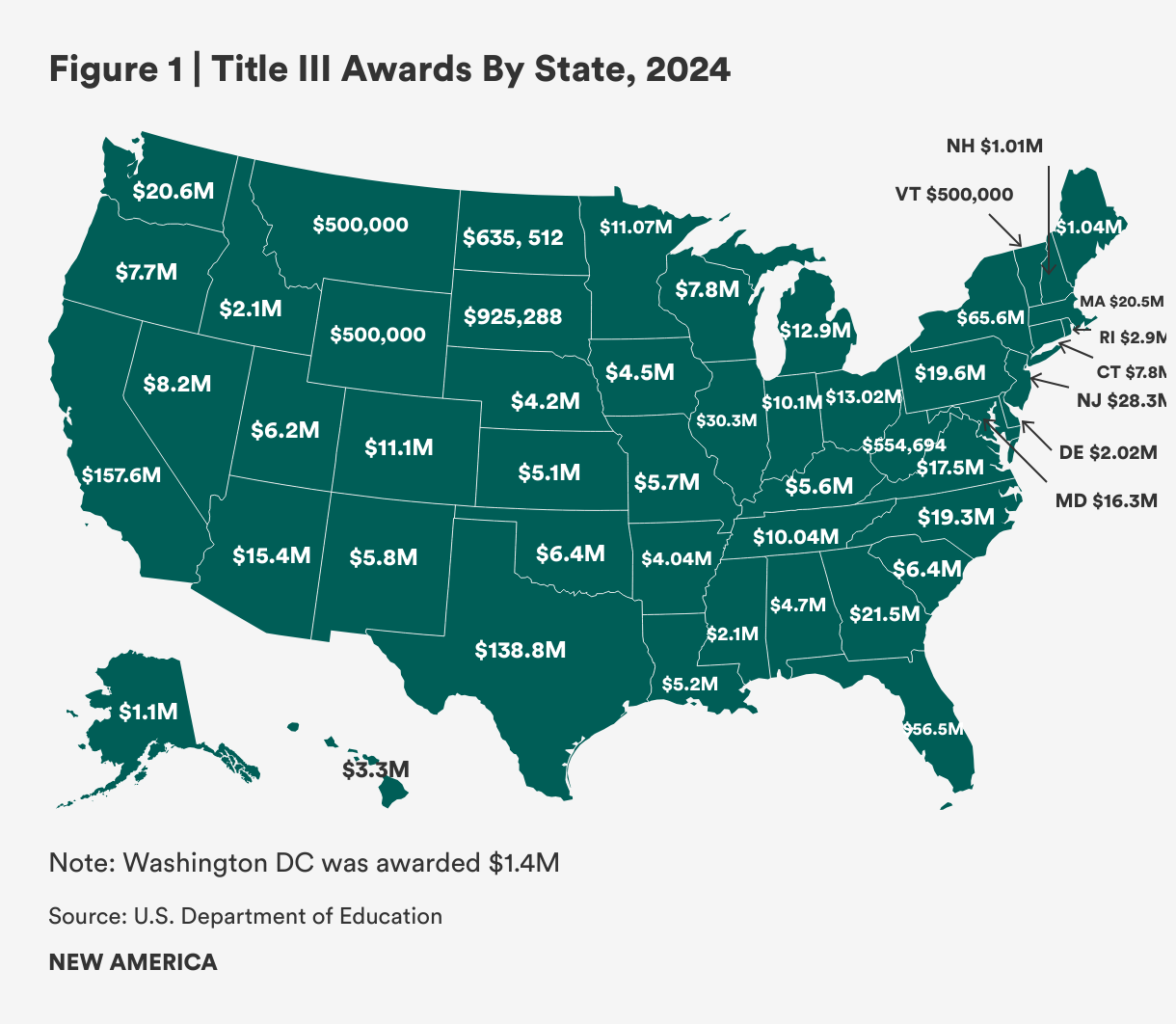
Title III funding is not awarded to non-governmental agencies. Rather these funds are provided to state education agencies that distribute the funding to local education agencies. Funding is awarded based on the number of EL students and immigrant children and youth enrolled. National Title III appropriations have remained flat at $890 million for the previous two fiscal years (FY 2023 and 2024). The amount awarded to each state ranged from a high of $157 million in California to a low of $500,000 in Montana, Vermont and Wyoming.
The administration misleadingly claims to be 鈥渞estoring鈥� state oversight, when in fact states and localities already have discretion to make decisions regarding key aspects of ELs鈥� education. The Every Student Succeeds Act (ESSA) of 2015 that the U.S. Secretary of Education cannot 鈥渕andate nor preclude the use of a particular curricular or pedagogical approach to educating English Learners.鈥� Title III funds supplement state and local revenue to provide ELs with the services they are entitled to under Title VI of the Civil Rights Act of 1964, the Equal Educational Opportunities Act of 1974, and other state and local requirements. Specifically, these funds must be used to provide:
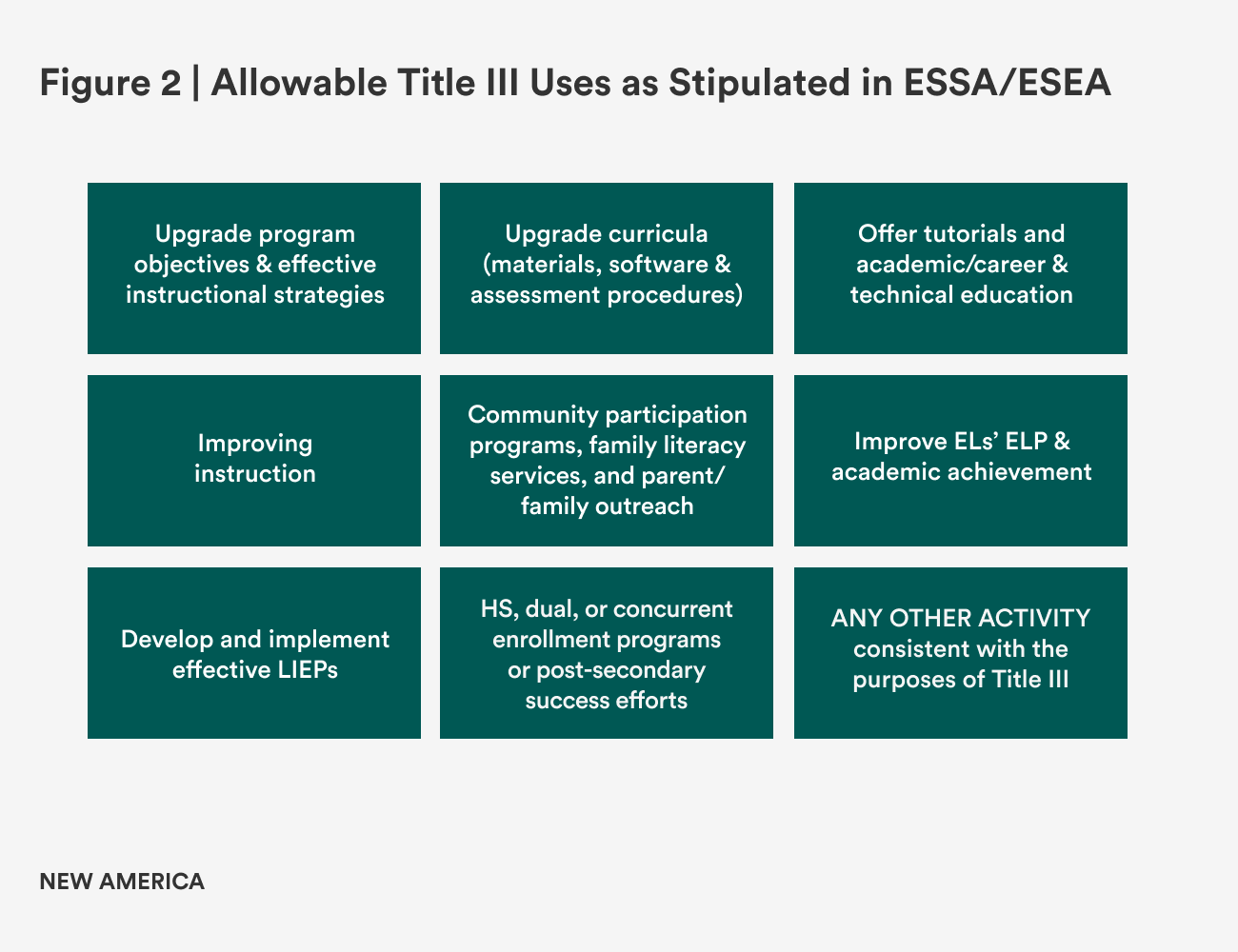
Grantees are allowed to use their Title III funds towards activities and efforts that fall under the following nine categories:
The President鈥檚 budget proposal reflects his priorities and desires, but is just that, a proposal. Congress has the final say in determining the federal budget. Threats to Title III funding only add to the growing financial pressure schools are under given the rising cost of food, equipment and construction supplies potential of pandemic funding extensions, and . Coupled with the weakening of federal civil rights protections and oversight, and the , English learners likely face a reduction in essential services and supports.
Senior Policy Analyst, Education Policy
Director, PreK-12 Research and Practice