
Want to Make America Great Again? Start with Students
At the University of Virginia鈥檚 Law School, a student named Erich Reimer is running a parody Trump campaign for vice president of the Student Bar Association. : “The ‘Make UVA Law Great Again’ campaign was an idea a few friends at the law school and I thought would add some fun to what otherwise might be a very unnoticeable and stale student government campaign season here at the law school.” Apparently, Trump has rejiggered student government politics as well as the American electoral system.
But to Reich鈥檚 point, student government campaigns are for the most part stale. There鈥檚 not much substantive discussion of issues or platforms. Campaign money is mostly wasted on tchotchkes and giveaways. Debates, if they occur, are usually milquetoast resume recitations.
Student governments are important. They train future politicians, including at least four of this cycle鈥檚 candidates for president: , , , and (in high school). Student governments also coordinate collegiate campus culture and student policy for the more than college students across the country. They ignite and inform national political discourse, by passing condemning resolutions or organizing protests, on topics including , , , and . The influence of student government should be matched by a thorough electoral process, not only so the above issues are managed deftly, but also so they train effectively our future , , 鈥攁nd voters.
There are, of course, obvious differences between student government campaigns and their national counterparts (besides that the winner of the latter gets the nuclear codes while the victor of the former negotiates dining hall policy). On most traditional campuses, every four years a student government has a completely new set of constituents. Transient membership means that many prominent positions in student government are not up for reelection. More often than not, rising seniors are elected student body president, and once they are elected, reelection interests do not motivate them because they鈥檙e graduating.
Student government policies are often resource driven鈥攁 new campus bike program, eatery, or arts event are all encumbered by financing and space. This, not policy platforms, drives their elections. The lack of ideological difference is exacerbated when external forces, like state legislatures or administrators, hold ultimate decision-making authority, constraining experimentation and would-be policy entrepreneurs, who, as 国产视频鈥檚 Lee Drutman has argued, . At many universities, student governments act more like lobbying organizations to the administration, as opposed to an actual body with decision-making clout. While this may mirror the , it certainly does not imitate the one we鈥檇 like to see.
Student governments rear many of our country鈥檚 leaders. They鈥檙e often the first taste young people get of civic efficacy and involvement. They can鈥檛 cultivate the type of leadership we hope to see decades ahead if it only takes a viral comedic video to get elected. And at the moment, there are unfortunate similarities between student governments and their national counterparts. Which raises the questions: Are student elections inherently different from real elections, and different in a way that prevents them from being substantive? And if not, why have candidates鈥� personas and antics driven the national conversation, both on and off campus, more than policy proposals? Why are student governments replicating (and perhaps, in time, perpetuating) some of what are arguably the worst aspects of national campaigns?
The difficulty, at least for student governments, is holding elected students to their promises despite transient membership, and distinguishing candidates from each other despite a lack of ideology. Voters cannot make informed decisions if they can鈥檛 compare campaign promises, differing platforms, and leadership styles. Does a model exist on a campus somewhere that resolves these issues? Consider these two cases.
The University of North Carolina at Chapel Hill: Candidate-Centered Campaigns
In the 2011 student body president race at the University of North Carolina in Chapel Hill (UNC), candidates approached the UNC Board of Elections with , seeking to get them disqualified. But while the race itself was very adversarial, with candidates , the winner of the race, Mary Cooper, was the candidate who stayed out of the bickering. One of the losing candidates, Ian Lee,, 鈥淚t鈥檚 sad that this story became about the candidates and not the issues that students are going to be facing鈥ary was able to stay out of the negativity that surrounded this election, and students connected with that.鈥�
At UNC, as at many universities, including Duke, student government campaigns are candidate-driven. Prominent individuals on campus, in student organizations and in Greek groups, they believe will advance their aims best. Candidate-centered elections are attractive because they purge from the political process the stereotypical smoke-filled salons where parties plot, and it鈥檚 believed that candidates without party attachments are more independent and thoughtful. Constituents are able to connect with an authentic individual, not the archetype the party wants the candidate to be. Without partisan bickering, and with nuanced focus on leadership style and the candidate鈥檚 qualifications, the election appears fair and more evaluative of individual agency and capacity.
But a dearth of partisanship does not yield substantive policy, or even discussion, on the campaign trail. In the Cooper vs. Ingram vs. Lee race at UNC, the candidates had platforms that were . Time was spent calling out campaign malfeasance, so little effort was made by any candidate to distinguish qualifications and background. And since opponents were not campaigning on how they were different, but rather on the recitation of their resume, candidates鈥� policy weaknesses went unexplored. Cooper won without proper vetting of her platform, and as a result, many of her campaign pledges .
The University of California, Berkeley: Party-Centered Campaigns
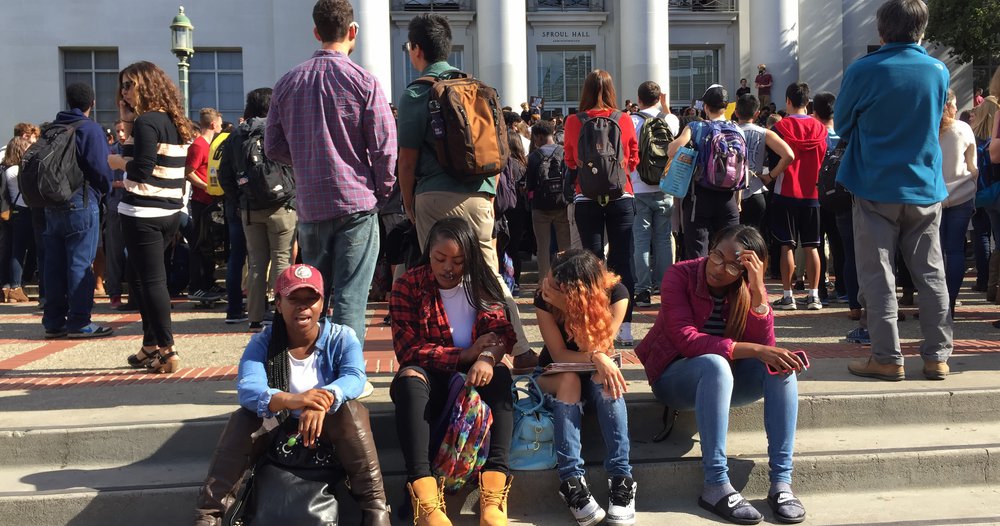
Unlike many universities, Berkeley has a prolific and focused student government. Berkeley itself is a very activist campus, so the attention to student politics is unsurprising, but emerging from this long history of student activism is a student government model that is unlike any elsewhere. As covered previously in, Berkeley鈥檚 student government campaigns are party-centered.
Berkeley has three student government political parties: , , and . The policy objectives of these parties don鈥檛 vary much. Instead, party identity and solidarity is developed through the parties鈥� ability to organize and rally supporters. Two of the parties are more than 20 years old, and the party controlling the executive and senate intermittently switches. is tracked and the . As a result of these parties鈥� archived histories, campaigning has expanded beyond facile promises to targeted outreach and actionable policy ideas, generating raucous political enthusiasm at and driving turnout that tops 12,000 votes cast. And because political parties carry reputations, transient membership is rectified, as candidates are held to the promises they or their parties pledged. The party system at Berkeley has even led to political satire and commentary, , a joke campaign that proved so successful in organizing it morphed into a respected presence on campus.
However, student political parties at Berkeley have often taken their power and the need to win too far. Berkeley students have told me stories of candidates being asked to change their clothing and hairstyles as a caveat for endorsement, and some party leaders have asked candidates to stop dating students who are members of other parties. As parties build political legacies, rivalries develop, ratcheting up the stakes for winning, sidelining the standards for acceptable and sportsmanly behavior.
In Order to Form a More Perfect Student Union
There are obvious parallels to UNC鈥檚 candidate-centered and Berkeley鈥檚 party-centered models in the 2016 presidential race. Trump and Sanders鈥� campaigns are candidate-centered, bucking the establishment, highlighting their candidate鈥檚 persona, and emphasizing vague mantras like 鈥溾�� and 鈥�.鈥� The more party-centered figures, Kasich and Clinton, have campaigned on their proposals and downplayed their personalities. Despite this distinction, it makes little sense to rule one model better than the other yet, especially since the presidential primaries are still in flux, let alone the general election.
Making student government campaigns more substantive is not about finding the best model, but rather, seeking solutions that improve the model already on campuses. When candidate-centered elections race to the bottom of the popularity barrel, the press and other candidates should point out that promises to ban homework, for example, go further than what鈥檚 feasible. Improper party behavior can be resolved through similar transparency via a proactive press鈥攁s is theoretically true in the country as a whole. Strong parties comprised of smart individuals are but one facet of a healthy political system. Maybe the best solution is a mixture of models, and what we have presently, at least in theory, in real government: elections for candidates, not parties, but candidates who are endorsed by a party with feasible policy goals.
If debating institutional design of student governments seems highfalutin, then it should at least be recognized that this extracurricular is a classroom for future politicians and advocates to practice their craft. It鈥檚 also where many young people learn what it means to be involved in civic life, and we know they鈥檙e open to effective government when they participate in it. It鈥檚 important that the lessons learned in student government cultivate the type of politicians we want for the public. Candidates in the present presidential campaign haven鈥檛 been the best examples鈥攏one of us want to see students arguing over who has the biggest hands.
More 国产视频 the Authors
Related

“Getting the Golden Ticket”: Participants’ Perspectives on Lexington’s First Assembly

Civic Assemblies: A Framework for Community Colleges

Don鈥檛 START Now
