
David Sterman
Deputy Director, Future Security
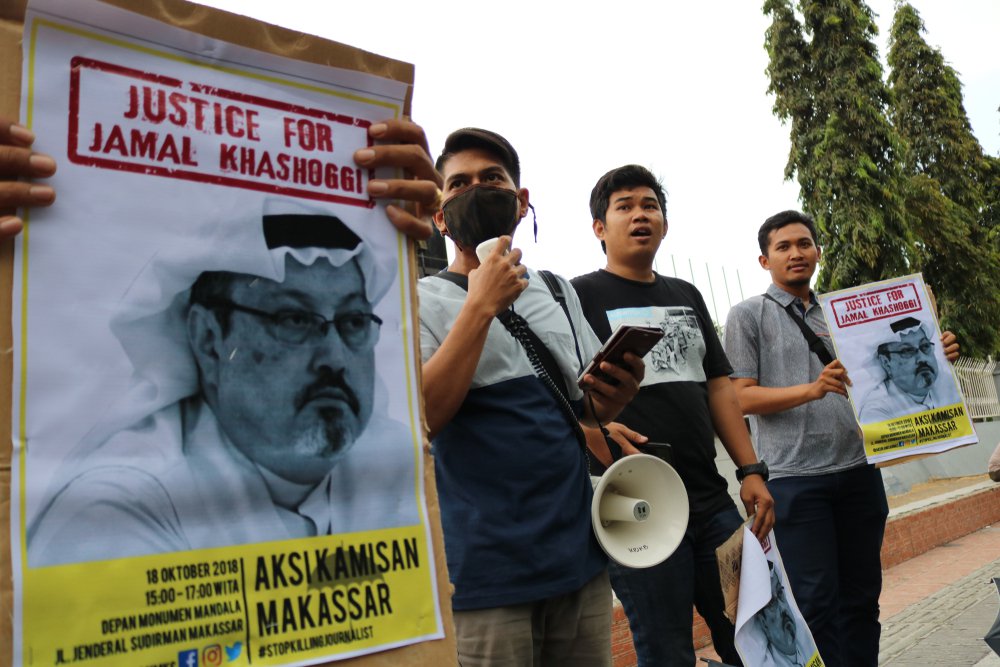
After weeks of increasingly absurd stories, Saudi Arabia has that Jamal Khashoggi鈥攁n American permanent resident, Saudi citizen, and Washington Post columnist鈥攚as killed inside the Saudi consulate in Istanbul, Turkey, on October 2, and Saudi Arabia鈥檚 public prosecutor has even that it was premeditated, though the country still denies any high-level involvement.
On the one hand, Khashoggi鈥檚 death comes as a shock: It鈥檚 brazen to do this to an American resident at Saudi Arabia鈥檚 own consulate鈥攁nd within the borders of a country that鈥檚 a NATO ally of the United States, no less. And yet, perhaps this isn鈥檛鈥攐r at least shouldn鈥檛 be鈥攕o jaw-dropping. After all, the United States has consistently chipped away at the norms that may have discouraged such actions in the region鈥攏ot only since President Donald Trump entered the White House, but ever since embarking on the War on Terror in 2001.
In 2017, the Trump administration voiced for the actions of Saudi Crown Prince Mohammed bin Salman, even as Saudi Arabia with Qatar, the Lebanese prime minister, and waged a in Yemen. In September of this year, Secretary of State Mike Pompeo reportedly the concerns of U.S. State Department specialists to certify that Saudi Arabia was sufficiently avoiding civilian casualties in its war in Yemen鈥攁 requirement for continued U.S. military assistance to the Saudi coalition. This has, in consequence, only telegraphed to Saudi Arabia approval of its foreign policy.
Likewise, until recently, the Trump administration had remained mostly in comment and action regarding Khashoggi鈥檚 death, with Trump sending Pompeo to meet with Saudi King Salman and 鈥攚ithout evidence and, as has become clearer since, 鈥攖he claim that the killing was carried out by rogue officials. It was only this week that Trump took a firmer stance, that the plot was 鈥渙ne of the worst in the history of cover-ups.鈥�
But there are other reasons that Saudi Arabia might not have been all that concerned about allegedly targeting an American resident. More specifically, it鈥檚 important to remember that Trump is infamous for his anti-immigration鈥攕pecifically anti-Muslim鈥攙iews. In fact, when his administration鈥檚 travel ban was first implemented, in 2017, it permanent residents. It was only after confusion and opposition that the administration clarified that the policy doesn鈥檛 apply to permanent residents. Following Khashoggi鈥檚 disappearance, Trump repeatedly made it a point to that Khashoggi wasn鈥檛 a U.S. citizen.
Meanwhile, U.S. relations with Turkey have in a number of ways in the years leading up to Khashoggi鈥檚 death: the Obama administration鈥檚 to support Kurdish groups in Syria that Turkey considers a threat, U.S. in the aftermath of a failed coup attempt and the resulting crackdown, and a recent . In this light, Saudi Arabia鈥檚 actions against a NATO ally aren鈥檛 quite the affront that they may have been in the past.
Just as relevant, though under-addressed, is the fact that the death arguably reflects the acceptance of torture and targeted killing as a strategy that the United States itself brought to the Middle East and its periphery as part of the War on Terror. Last week, Saudi Arabia that Khashoggi died as a result of a mistake during an interrogation鈥攁 questionable claim that, even if accepted, would suggest that rather than setting out to kill him, Saudi officials set out to harshly interrogate him, and he died as a result. When it finally acknowledged Khashoggi鈥檚 killing, Saudi Arabia it as a rendition gone wrong.
More than a decade before Khashoggi鈥檚 killing, the CIA took a similar approach, having aggressively pursued rendition operations and torture as part of its post-9/11 counterterrorism strategy. This resulted in detainee deaths, according to the U.S. Senate on CIA torture. And even though by the end of 2008 the CIA reportedly its use of torture and detention of suspects, it wouldn鈥檛 be surprising if Saudi Arabia didn鈥檛 fear retaliation for comparable actions, considering that Trump has torture and appointed an individual in the torture program to head the CIA, and that the United States under the Obama administration declassified only a redacted summary of the Senate report on torture, which suggests an unwillingness to enforce even the barest accountability for such acts.
And, when it comes to targeted killing, the United States has given an even clearer, though still unspoken, green-light via its actions conducting drone strikes in multiple countries鈥攊ncluding in countries where the United States doesn鈥檛 consider itself actively engaged in military hostilities, let alone war. The expanded willingness of states to engage in this kind of activity could be seen even prior to Khashoggi鈥檚 death, in the proliferation of armed drones and their use.
This isn鈥檛 to suggest that the final responsibility for Khashoggi鈥檚 killing rests with anyone other than with the Saudi officials who appear to have authorized and carried out the assassination. Rather, it鈥檚 to underscore how the Trump administration鈥攁nd the United States more broadly鈥攈as, over the years, weakened several important norms and signals that may have discouraged such violent actions. That fact should stand as a warning: that threats to stability in the Middle East can come from American policy itself鈥攏ot just from rival nations.
Deputy Director, Future Security


