
Aaron Loewenberg
Senior Policy Analyst, Early & Elementary Education
As governor, Walz oversaw the creation of a paid leave program and increased funding for child care
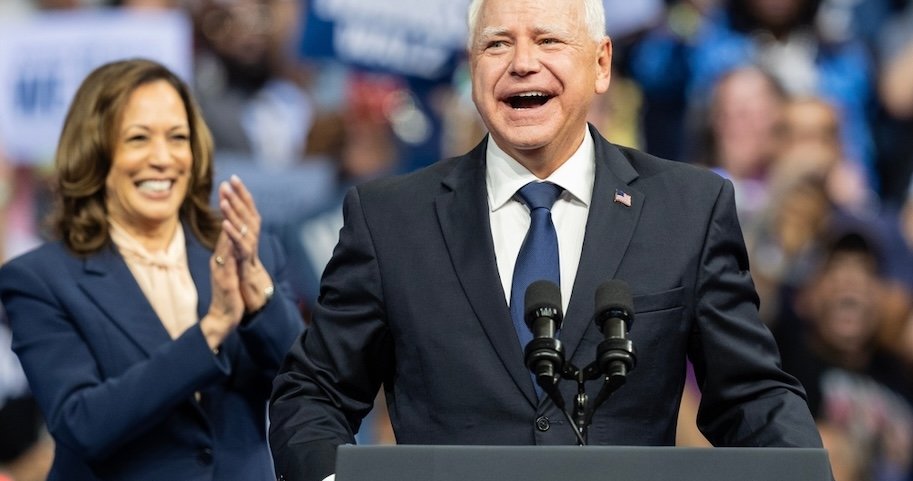
On Tuesday, Vice President Kamala Harris picked Minnesota Governor Tim Walz to be her running mate. A former high school teacher, football coach, and member of Congress who spends much of his free time hunting and fishing, Walz is expected to help the Harris campaign win vitally important states in the region, such as . We wrote last week about Vice President Harris鈥� record on early care and education, but what does Tim Walz鈥檚 tenure as governor tell us about where he stands on this issue?
After serving five terms in Congress, Walz was elected governor in 2018 and in 2022. The 2022 election resulted in Democrats holding in state government for the first time since 2014. The subsequent 2023 legislative session in Minnesota was by many policymakers. Democratic Governor Tim Walz called it 鈥渢he most successful legislative session, certainly in many of our lifetimes and maybe in Minnesota history.鈥� (For a helpful overview of the specific investments directed at young children, check out from the PN-3 Coalition).
Perhaps the legislative achievement that has generated is the creation of a paid leave program, making Minnesota the first state in the Midwest to enact a paid leave law. Starting in January 2026, nearly all employees in the state will be eligible to receive up to 12 weeks of paid medical leave as well as 12 weeks of paid family leave, with benefits capped at 100 percent of the state鈥檚 average weekly wage. This will allow workers with serious caregiving or health needs, such as bonding with a new child, to take necessary time away from work without taking a major financial hit, a major win for families and young children. Minnesota now joins that have enacted paid family and medical leave.
Under Walz鈥檚 tenure, Minnesota lawmakers also took an important step towards reducing the persistent fragmentation that often exists in early care and education programs. Previously, early education funding and programming was governed by two agencies: the Minnesota Department of Human Services and the Department of Education. Between July 2024 and July 2025, a new will go into effect in an effort to consolidate programs related to early learning and other programming related to child care, food assistance, youth opportunity, and child protection. In making this consolidation, Minnesota joins other states, , that have recently made similar changes in an effort to better align and coordinate their efforts on behalf of young children.
Under Walz鈥檚 leadership, lawmakers also heavily invested in existing programs so that more children can be served. For example, Democratic lawmakers invested an additional $252 million over two years for . The state鈥檚 early learning scholarships help pay for child care and early education for families with low incomes by providing parents with an annual scholarship worth up to $8,500 to use at the child care or early education program of their choosing. The state is also investing $316 million to boost the wages of child care providers as part of the . 鈥淗e [Walz] didn鈥檛 just sit back and sign bills into law, but he actually was out there working to get these bills taken care of,鈥� , a child care director in a suburb of Minneapolis.
Minnesota lawmakers also took steps to raise the reimbursement rate for providers participating in to the . This change means the state no longer has some of in the country and should enable providers to offer higher quality care and education.
Other highlights of Walz鈥檚 tenure include passage of for families with low incomes that is expected to cut child poverty in the state by one-third.
Overall, the 2023 session resulted in about $750 million in new funds for child care and early learning programs throughout the state. Much of this new funding was made possible by the fact that Minnesota was sitting on , along with decades of activism by early childhood advocates throughout the state.
In May of this year, Governor Walz over $6 million in new grants that are expected to increase the state鈥檚 child care capacity by over 2,200 spots. 鈥淎ccessible, quality child care is critical not only for strong child development, but also for the economic wellbeing of the families in our state,鈥� said Walz.
The unusual circumstances of the current presidential election means that the policy specifics of a potential Harris-Walz administration are yet to be finalized. However, with many insiders that Harris is well-positioned to aggressively pursue a caregiving agenda if elected, it鈥檚 clear that the addition of Walz is of that commitment.
Senior Policy Analyst, Early & Elementary Education


