
Rachel Rush-Marlowe
Founder and Executive Director, ResearchEd

When you think of a college student, you probably don鈥檛 envision a 26-year-old who works close to full time and is raising a child. And yet 40 percent of today鈥檚 undergraduate students are over the age of 24, and more than a quarter of them have children. One third of undergraduate students work 35 hours per week, and almost half work at least part time. Moreover, an estimated 45 percent of undergraduates have household incomes of less than $30,000.
The Federal Work- Study program was initially created to provide an opportunity for these low-income students to offset costs while in school by working.听Federal Work-Study participants are听听more likely to earn a bachelor鈥檚 degree than nonparticipants, and听听shows that the outcomes for participants who are low income and/or attend public institutions are even better. This may seem to bode well for today鈥檚 students, but the Federal Work-Study program is relatively small, serving only about 700,000 students per year. And just as today鈥檚 college students look different than one might expect, so do Federal Work-Study recipients. This is largely due to an archaic funding formula.
The below graph shows undergraduate enrollment numbers broken out by institution type on the left, and on the right the percentage of total Federal Work-Study dollars that are allocated to each type of institution.
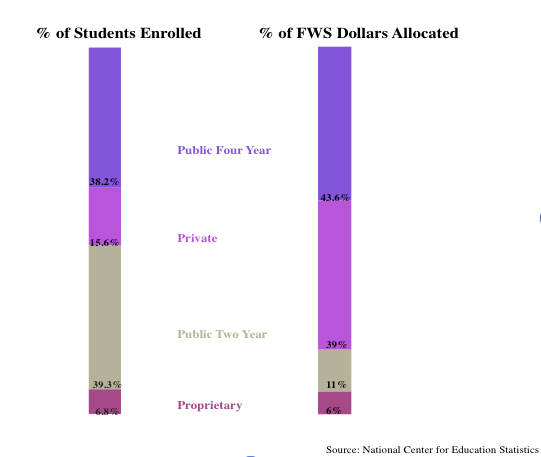
Although the majority of America鈥檚 students are enrolled in public two- or four-year colleges, private nonprofit four-year colleges receive a substantial amount of Federal Work-Study dollars. At these private four-year institutions, 90 percent of work-study recipients are dependent, and of these dependent students 25 percent have adjusted gross incomes of $93,777 or higher. The average adjusted gross income for a student receiving Federal Work Study who attends a private, nonprofit four-year institution is $64,431.
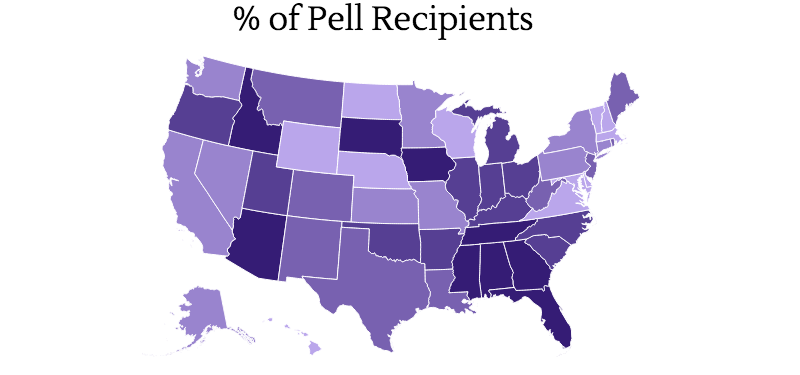
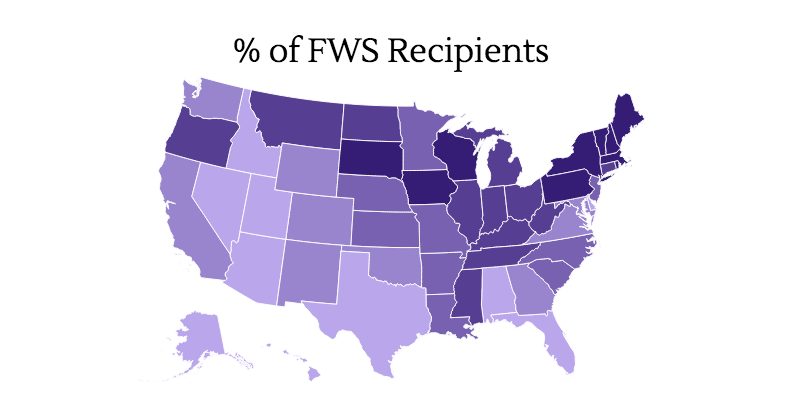
This inequitable distribution of funding can be seen across the country. The maps below show the distribution of Federal Work-Study dollars in comparison to the distribution of Pell Grants. Pell eligibility is often used as a metric to identify low-income students. If Federal Work-Study dollars were being distributed to the neediest students, the two maps would likely look similar. Instead, Federal Work Study dollars are concentrated in the Northeast, while the percentage of students receiving Pell Grants is most concentrated in the South.
To understand why federal dollars are being distributed this way, it is necessary to understand the program鈥檚 origins. The Federal Work-Study program was created in 1958 under the Economic Opportunity Act, but was later transferred following the passage of the National Defense Education Act in 1965, and became a part of the Higher Education Act. The program was created to provide an opportunity for low-income students to offset costs while in school, while simultaneously providing them with work experiences related to their educational goals. According to the Act:
听
听
But the program鈥檚 admirable goals were soon lost to a change in the funding formula. From the program鈥檚 initial implementation through 1979, a panel of听听reviewed institutional requests for funding and made appropriation decisions. The panel reviewed each institution鈥檚 request individually, making this method both incredibly inefficient, and subject to bias. In 1979, in the interest of fairness and efficiency, the panel was replaced with a two-part funding formula. The decision to change the formula was met with outcry from institutions, unsure of how it would affect their funding levels. The first part of the formula, the campus base guarantee, was a placating response to the institutional upset, and ensured that each participating institution would receive 100 percent of the total they received in 1979, or 鈥渢he base year.鈥� With each reauthorization of HEA, the base year is moved forward; the current base year is 1999-2000.
The campus base guarantee presents a problem to equitable funding because it does not reflect changing demographics among and across institutions that affect student need. This point is highlighted in the state level Pell and work-study distribution maps above. The campus base guarantee was instituted as a temporary solution to prevent a shock to the system, with the intent that it would eventually be phased out. It never was.
Today the base guarantee remains part of the funding formula, and accounts for听. Because the campus base guarantee was never phased out, older private institutions, particularly in the Northeast and Mid-Atlantic continue to receive the majority of Federal Work-Study dollars, despite the fact that financial need tends to be more concentrated in community colleges,听.
However, the campus base guarantee is only part of the problem. The 鈥渇air funding formula鈥� is also designed in a way that rewards expensive, elite institutions and prevents the Federal Work-Study program from effectively serving students in need.
After the campus base is distributed, the fair share formula calculates 鈥渋nstitutional need鈥� by looking at an institution鈥檚 average expected family contribution per student in relation to cost of tuition, and then compares this to all other institutions. After the campus base guarantee is distributed, if an institution鈥檚 fair share formula amount is higher than the amount already allocated through the campus base guarantee, they will be allocated extra funds to make up the difference.
At institutions with high tuition there there are larger gaps between cost of attendance and average estimated family income, so regardless of enrollment of low income students, these institutions have higher 鈥渋nstitutional need鈥� and are appropriated more money. But 鈥渉igh need鈥� students at high tuition schools are often not low-income (think back to the students with AGI鈥檚 of $93,000).
The Federal Work-Study program has great potential, but given how far it has deviated from its goal, policy makers must be committed to serious reforms if the program is to be successful in supporting low-income students.听听proposed reforming the formula to be based primarily on institutions that enroll and graduate high numbers of Pell eligible students. Over the past few years many other groups such as听,听, and听听have also come out with their own proposals on how the program could be reimagined to better serve students in need. Later this month, I will be coming out with a report that compares the current landscape of recommendations, and looks at the implications of each on future funding distributions.
In 1979, policy makers examined the function of the Federal Work-Study program and determined that it needed to be changed. Today as we approach HEA reauthorization, the time is ripe to again remake FWS as a program with funding that is fairly distributed and achieves its original intended goals of providing career development and helping defray tuition costs for students who need it the most.
Founder and Executive Director, ResearchEd


