Andr茅s Martinez
Future Tense Fellow
I moved from Mexico to the United States when I was 15, though I didn鈥檛 suspect I would suffer much culture shock or struggle to adapt. After all, my mom was a gringa who鈥檇 always insisted we speak English at home and taken us to visit relatives in Texas. Moving to the U.S. would be a piece of cake, I thought.
I was mostly right, with one glaring and unexpected exception. When it came to sport, which was rather important to my 15-year-old self, I felt suddenly cut off from the known world, trapped behind a sporting iron curtain, where no one knew鈥攐r cared about鈥攖he world鈥檚 most popular game: soccer. I had either played or watched soccer obsessively around the clock with my middle-school mates in Chihuahua. It was a game that taught us about the world beyond our own. I mean, how else could I have learnt about Munich, Barcelona, or Buenos Aires, if not through soccer?
Back then, in the early 1980s, America鈥檚 prevailing attitude towards the world鈥檚 default sport oscillated between casual neglect and xenophobic hostility. Americans were as allergic to soccer as they were to the metric system, and for similar reasons. For me, that meant no pick-up games to be had; no one to talk to about my favorite teams; and no domestic league to follow. Even catching a World Cup on TV in this country where domestic sport champions were unironically proclaimed 鈥渨orld champions鈥� was a struggle.
Ever since, I have appreciated how central sport is to how many of us connect with our geography, to each other, and to our identity. America鈥檚 approach to sport encapsulates the two timeless and conflicting American approaches to the rest of the world: 1) the impulse to set ourselves apart (and play our own games); and 2) the desire to (democracy, Coca-Cola, baseball, and all the rest of it) to every corner of the world.
Over time, the big three American sports鈥斺�攄eveloped to reinforce our national identity, and separation from the outside world. More recently, riding the coattails of American pop culture, these games have become cultural exports in their own right. But our historic reluctance to join the global game means that the global sports industry has not revolved around the United States in the same way film or music have. We don鈥檛 control sport鈥檚 reserve currency.
At least not yet. Soccer has made inroads in the U.S. in ways and at a speed I had not previously dared to imagine.
A few years ago, I started researching and writing about what I understood to be a between (mostly) European soccer and our big three U.S. sports, vying for hearts and minds鈥攁nd valuable eyeballs鈥攊n markets across Asia, Africa, and Latin America.
It鈥檚 still an intriguing contest, but one increasingly overtaken and overshadowed by a couple of interrelated plot twists I hadn鈥檛 anticipated: the rise of soccer within the United States, and the rise of the United States within the world of soccer.
A global zero-sum contest between (mostly) European soccer and our big three U.S. sports.
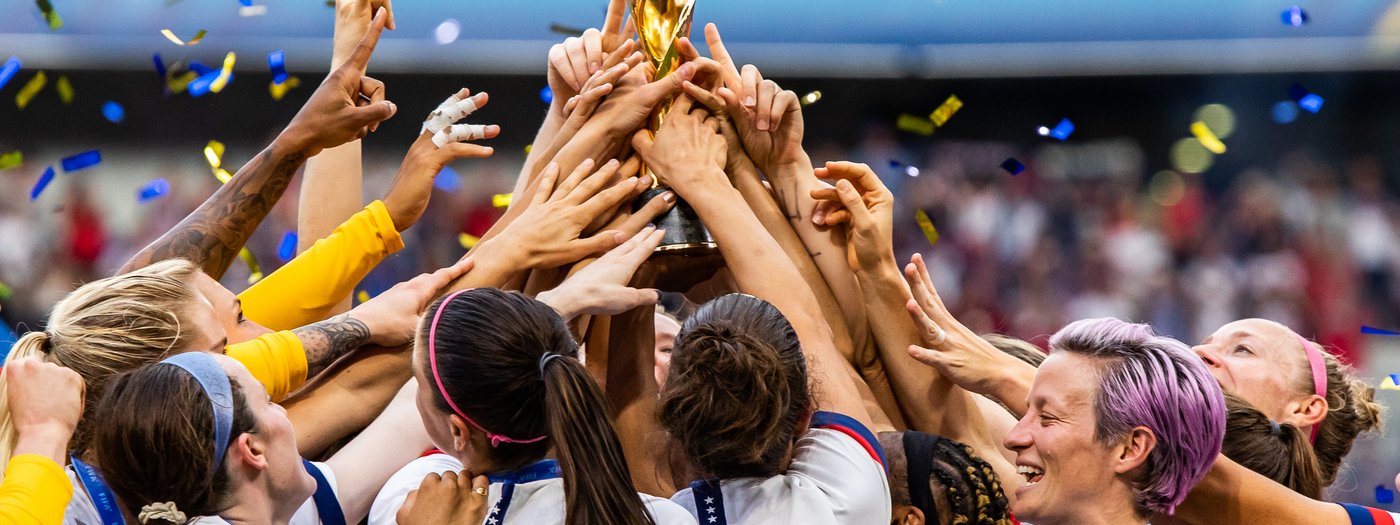
The game that was once seen as a dodgy, foreign affectation was naturalized in America by women and immigrants. The unintended consequences of unrelated historical events helped make this possible. U.S. higher education鈥檚 improbable role in producing world-class athletes was an outgrowth of America鈥檚 sports exceptionalism, but it also meant that when Congress passed 50 years ago, it would unknowingly open the spigot to a level of investment in women鈥檚 sport (women鈥檚 soccer, in particular) unimaginable elsewhere in the world. This propelled the United States to the forefront of the women鈥檚 game internationally. And the of the late 鈥�90s teams of Briana Scurry, Mia Hamm, Julie Foudy, Brandi Chastain, and their successors, ushered the sport into the mainstream for millions of American families, including their boys.
These women helped prove the viability of the sport in America, but the rise of America within the sport is also a matter of capitalistic imperatives. U.S. sporting interests finally decided to go global the same way Hollywood and music labels had done so long ago. Movie blockbusters typically earn about three-quarters of their box office receipts overseas, whereas the vast majority of a Super Bowl鈥檚 global TV audience is still to be found within the United States. So, while our sports leagues will continue to seek international growth, their investors are opting for a shortcut to overseas markets: buying into the world鈥檚 game.
The past decade has witnessed a proliferation of multinational, multi-sport conglomerates. Americans now have ownership stakes (not all controlling) in a . Four of the so-called 鈥淏ig Six鈥濃�擜rsenal, Manchester United, Liverpool, and Chelsea鈥攁re now fully owned by U.S. sports operators. Think of them as subsidiaries, respectively, of the Los Angeles Rams, the Tampa Bay Buccaneers, the Boston Red Sox, and the Los Angeles Dodgers, though subsidiaries with more global followers.

This year鈥檚 FIFA Men鈥檚 World Cup kicked off yesterday: While played in Qatar, the United States is already FIFA鈥檚 commercial MVP. Soccer may have a long way to reach NFL levels of casual TV fanfare, but it has come far enough that the U.S. is already one of the most important sources of TV revenue for the World Cup and will become more valuable as popularity for the sport continues to grow. The U.S. also ranks #1 in terms of FIFA鈥檚 sponsoring brands, the number of fans traveling to World Cups, and the number of youth players now playing the game recreationally. If the 1994 Men鈥檚 World Cup played in the United States felt like a desperate attempt to kickstart the game, the 2026 World Cup 鈥� scheduled to be played across the three North American nations 鈥� should feel a bit like a coronation.
My 15-year-old self would have found it hard to imagine the day would come when the U.S. would be a cosmopolitan hub of soccer. My son is just slightly older than I was when I moved to this country, and together we can easily watch games from all over the world: the English Premier League on NBC, Spain鈥檚 La Liga and Germany鈥檚 Bundesliga on ESPN, Italy鈥檚 Serie A on Paramount, and my childhood favorite, Mexico鈥檚 Liga MX on FS1 and Univision. We can also attend games of our well-established Major League Soccer teams or catch pre-season tours of any number of European and Mexican clubs eager to grow their U.S. fan bases.
With a little luck, we can even stumble upon pick-up games here and there.
Future Tense Fellow