A Chapter of: America鈥檚 Counterterrorism Wars
The War in Yemen
U.S. Drone Strikes in Yemen
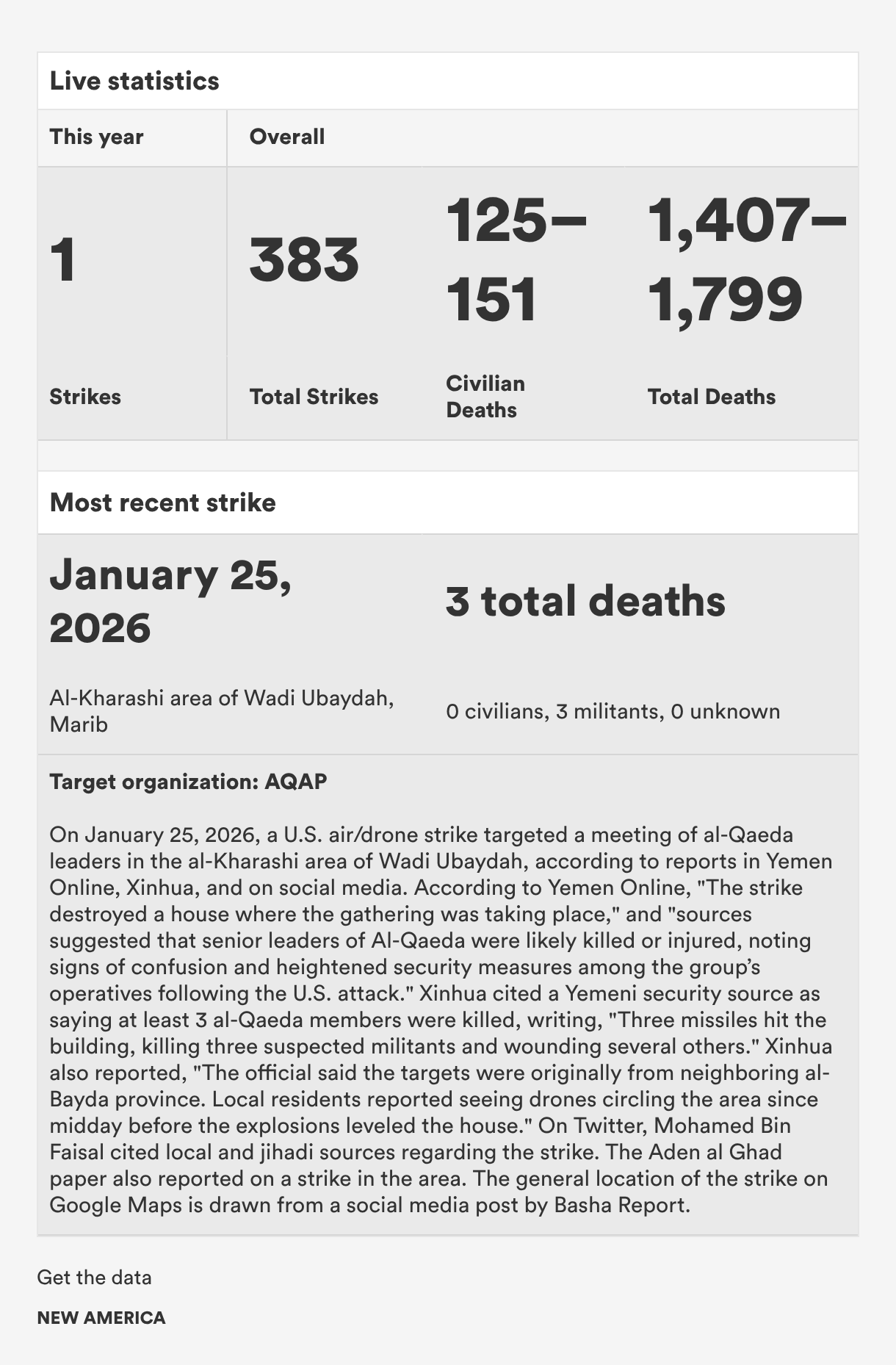
On Sunday, November 3, 2002, six men, packed into a sedan, rolled east of Yemen鈥檚 capital through the sparse desert of Marib province, where they were struck and killed by a hellfire missile sent to meet them from a U.S. Predator drone. The U.S. targeted killing program was in its infancy鈥攐nly one other strike had reportedly ever been conducted鈥攁nd this was a precedent-setting success.
The strike targeted and killed Qaed Salim Sinan Al-Harithi, who was believed to have devised the 2000 terrorist attack on the USS Cole that killed 17 American sailors and wounded 39. The five other passengers, though not the original target, also perished鈥攐ne of which was an American citizen.
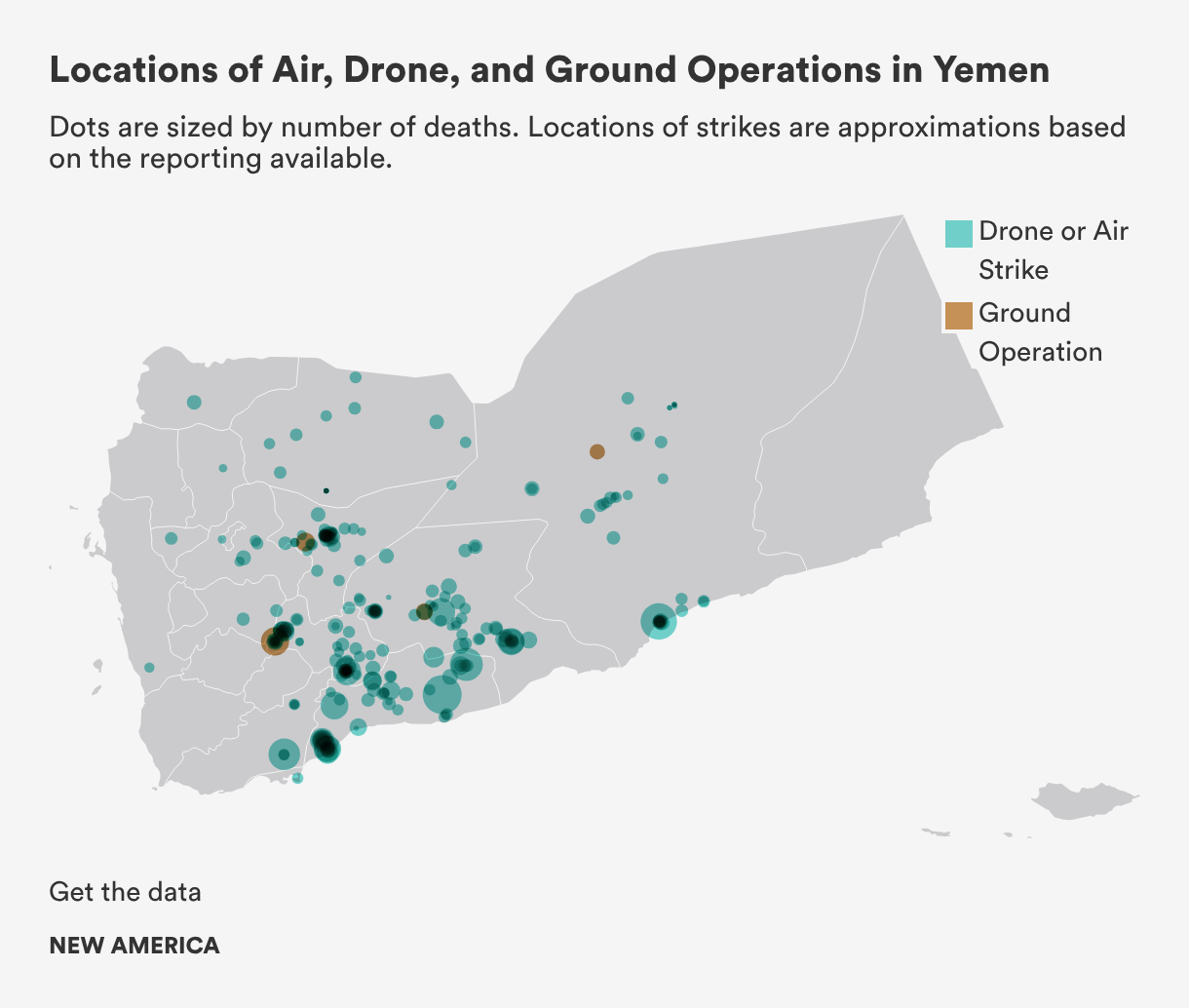
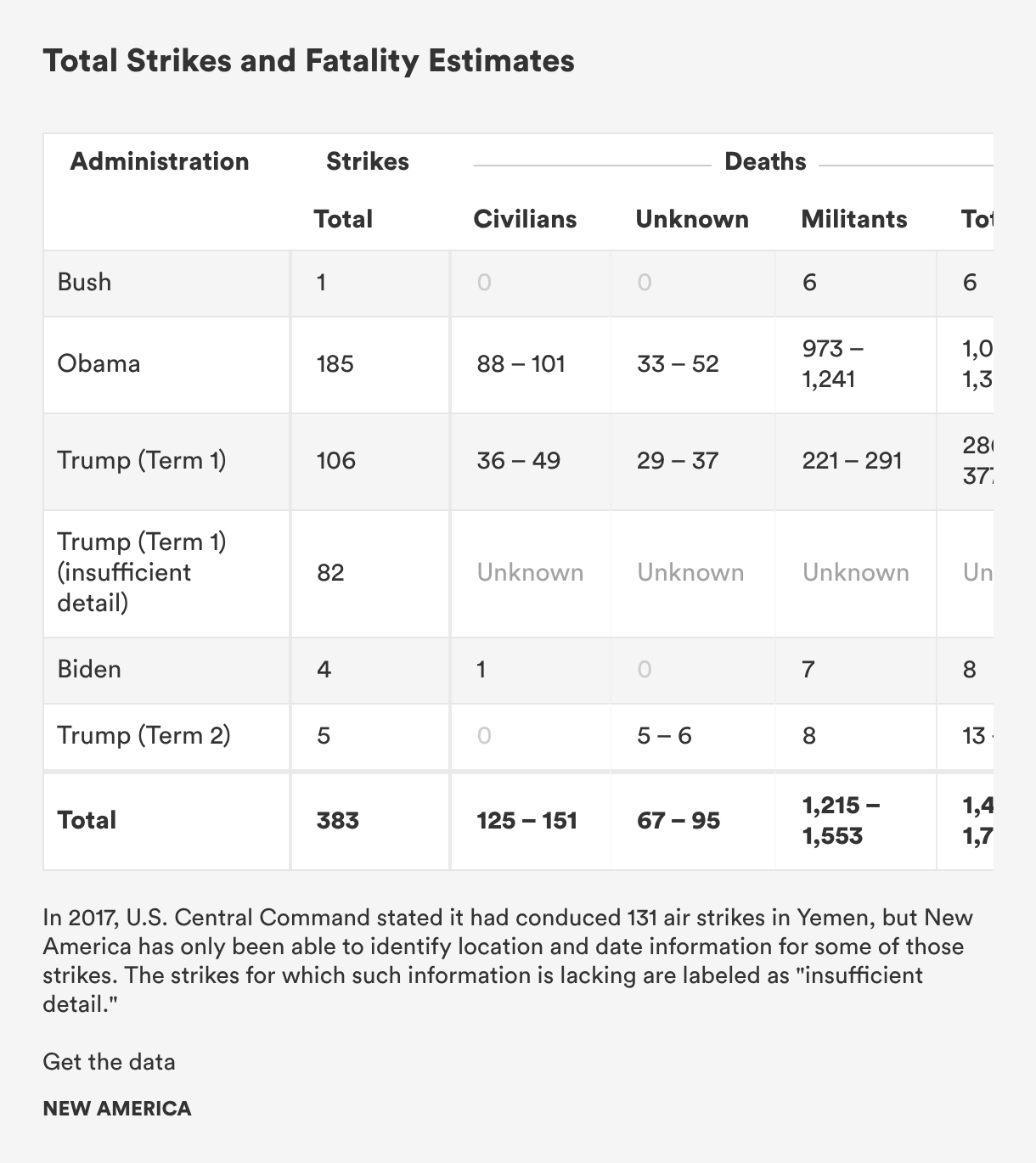
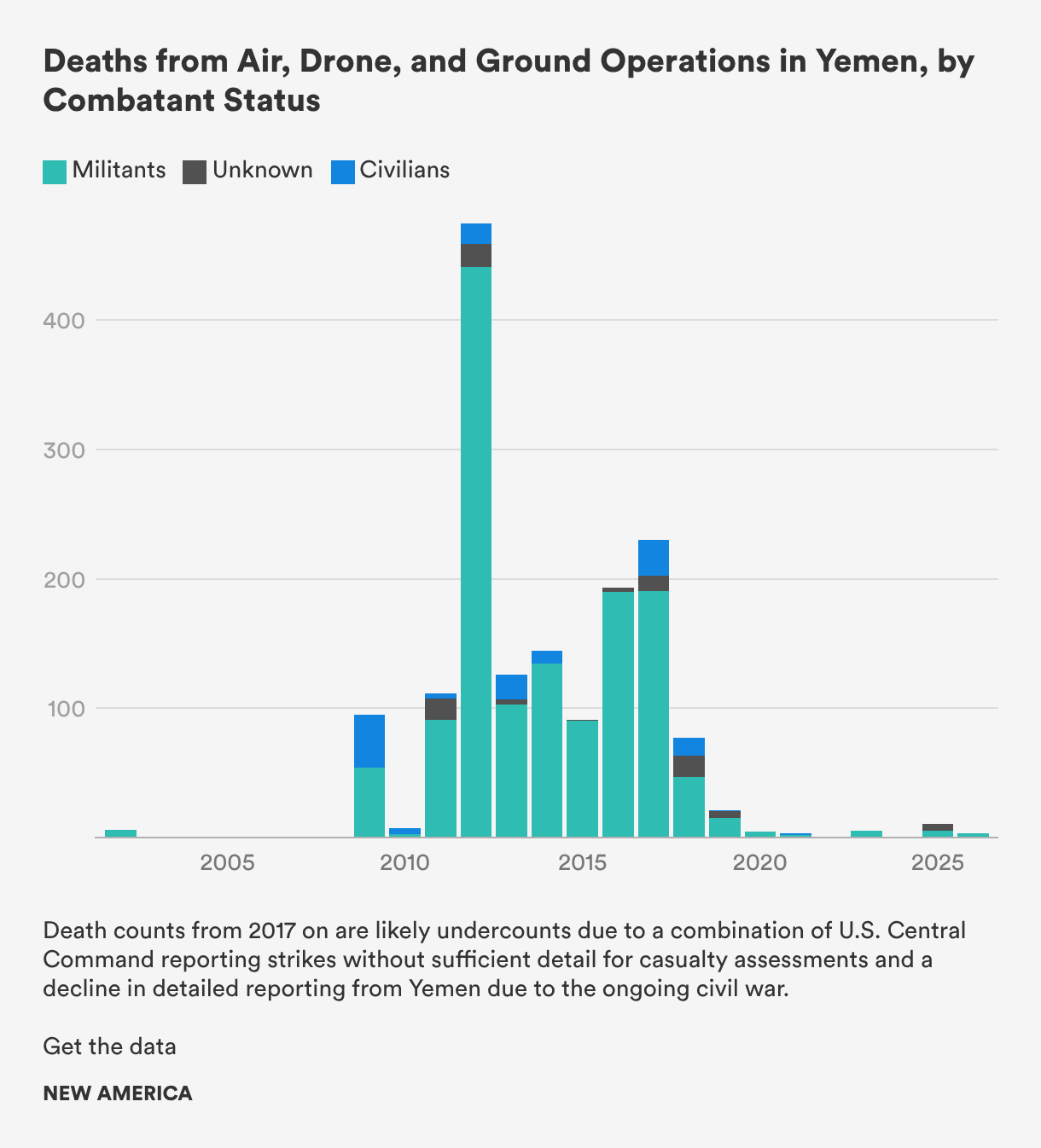
Since that strike, the United States has killed more than 1,000 people in counterterrorism operations in Yemen.
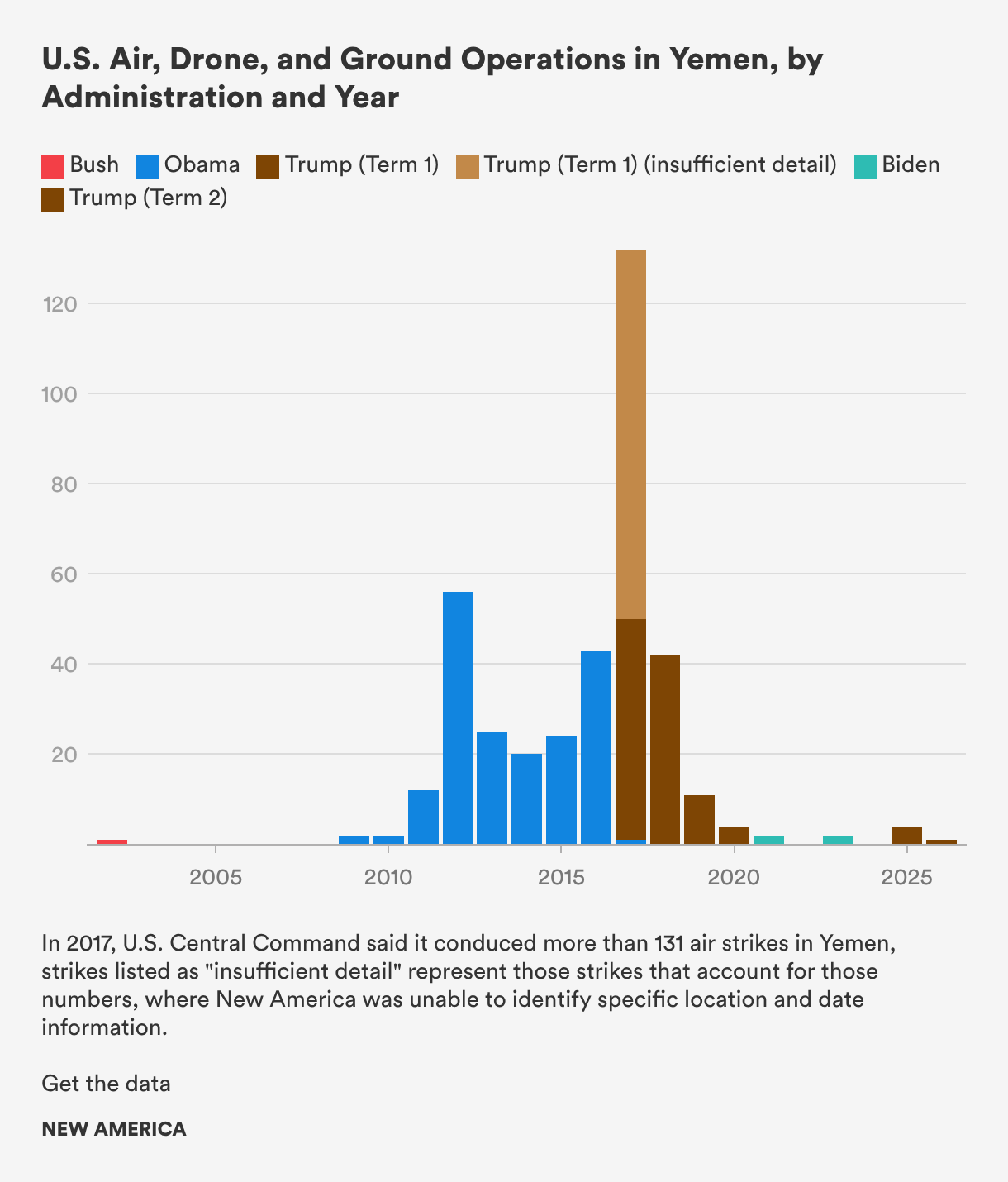
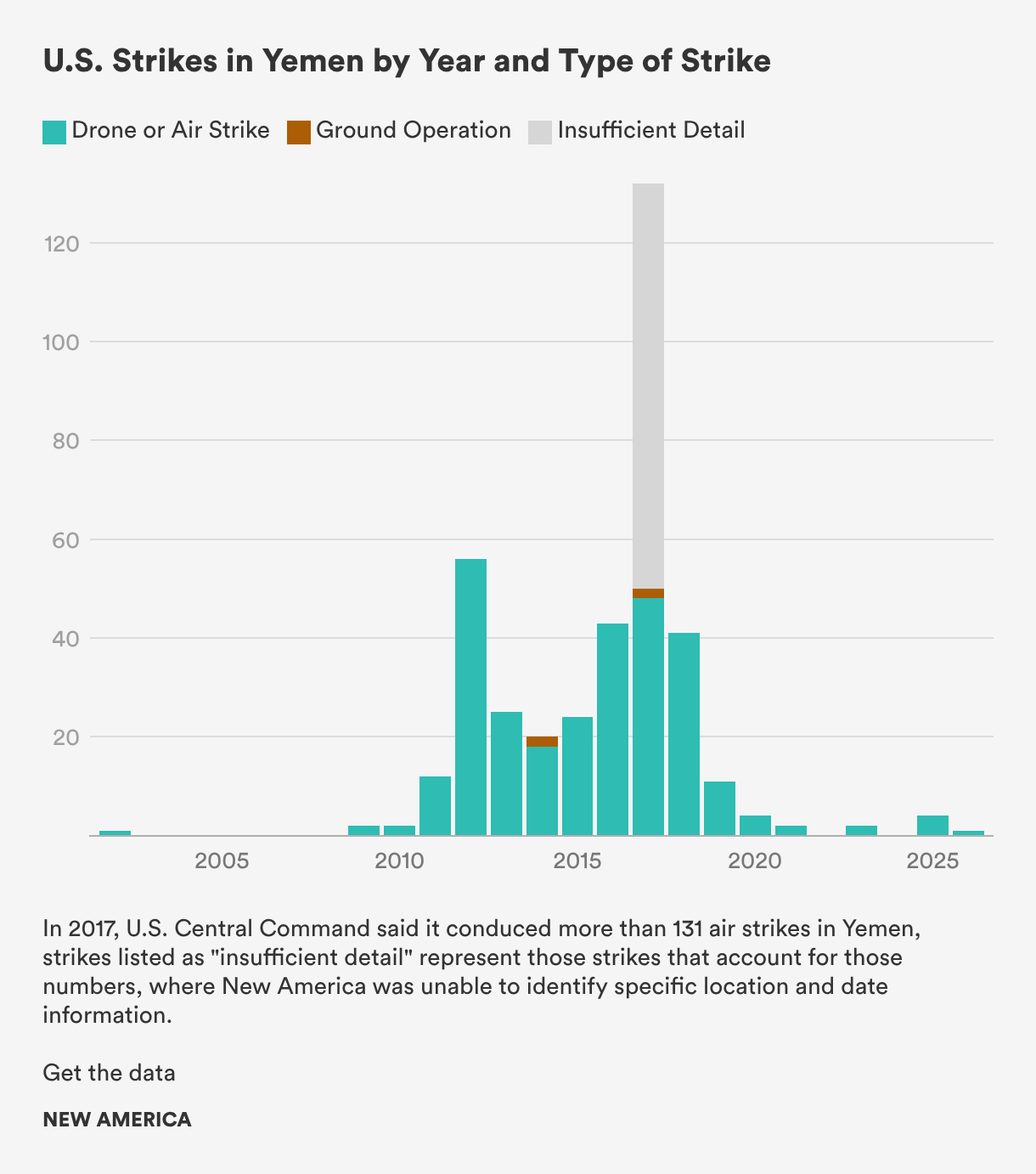
The conduct of American counterterrorism operations in Yemen has varied over time. For seven years after the United States鈥� first strike, which was carried out under the Bush administration, the United States refrained from conducting further strikes in Yemen. The U.S. drone program would not commence in Yemen in earnest until 2009, when Barack Obama took office.
Trump's War
On January 20th, 2017 Donald Trump was inaugurated as president, inheriting an already escalating counterterrorism war in Yemen. As president, he proceeded to further loosen the restraints on conducting airstrikes, drone strikes, and ground raids in the country.
In 2017, the United States conducted more individually identifiable strikes than in any other year except 2012. In February 2018, the military it conducted 131 strikes in 2017.
In March 2017, President Trump designated three provinces in Yemen as 鈥渁reas of active hostilities,鈥� as part of the administration鈥檚 efforts to loosen the battlefield restrictions of the Obama-era drone wars, raising the risk of civilian casualties, such as the reported dozens incurred in the first ground raid Trump authorized as president.
January 29, 2017
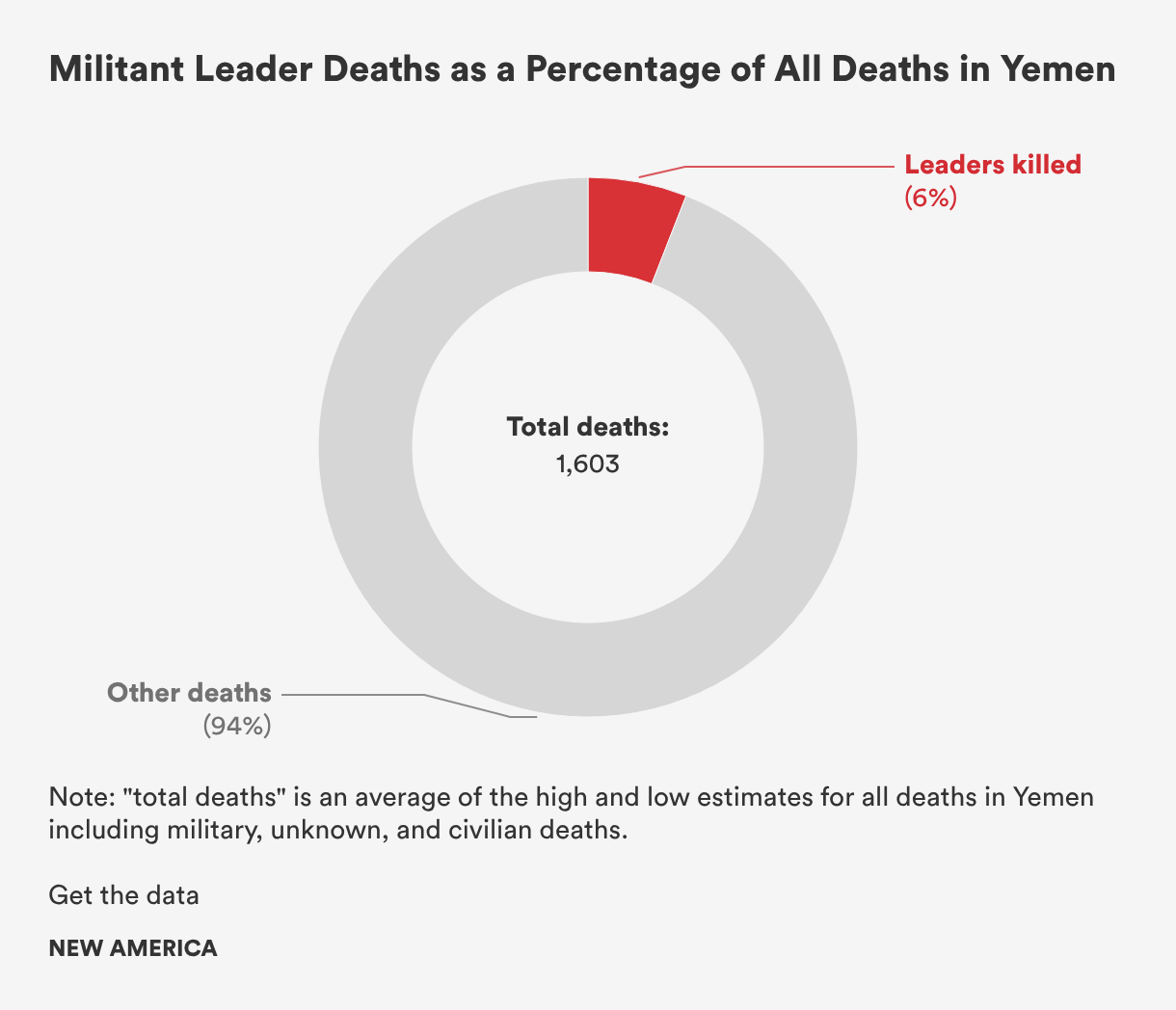
Trump authorized a military operation on January 29, 2017, conducted in the Yakla district of Yemen鈥檚 al-Bayda province, targeted several AQAP members, and reportedly killed between 13-14 militants. Three AQAP leaders were killed in the operation: senior leader Abdul Raouf al-Dhahab and his brother Sultan al-Dhahab, both of the infamous Dhahab clan which established influence in Bayda through its relationship to al-Qaeda, and Seif al-Nims (also referred to in reports as Saif Alawai al-Jawfi).
The raid was in the planning stages for months under President Obama, but was not executed. Trump's authorization of the raid was costly, resulting in the death of several Yemeni and Saudi civilians, the death of Chief Petty Officer William Owens, and injuries to an additional three special operations officers. The devastation of civilian deaths, which included women and children, among them the eight-year-old daughter of the late Anwar al-Awlaki, resulted in the suspension of U.S. commando activities by Yemeni officials, though officials backtracked in days following.
March 2-6, 2017
On March 2-6, 2017, the U.S. military conducted a combination of drone and airstrikes, with reported numbers ranging from 25 strikes by Pentagon estimates to as many as 40, according to reports. Pentagon spokesman Navy Capt. Jeff Davis denied local reports that troops were involved in the multi-pronged attack, but acknowledged U.S. forces were deployed to that location during that period.
Obama's War
Although the Trump administration vastly escalated the counterterrorism war in Yemen, the war began under President Obama. Over his entire presidency, President Bush had conducted only a single strike in Yemen in 2002.
In January 2009, as Obama took office , dispersed Qaeda militants鈥攑ushed out of Saudi Arabia by its relatively successful counterterrorism campaign鈥攁nd Yemeni militants merged and announced the formation of Al-Qaeda in the Arabian Peninsula (AQAP). AQAP conducted aggressive operations against local security forces between 2009 and 2010. But at the same time, the group still held ambitions of a global jihad.
In the early afternoon of November 5, 2009, Nidal Hasan, a military psychiatrist preparing to deploy with his unit, abruptly opened fire on other servicemen at Fort Hood Army Base, killing 13 people and wounding 30 others. 鈥淣idal Hassan [sic] is a hero,鈥� wrote his guide, Anwar al-Awlaki, a popular American terror propagandist who had fled the U.S. in 2002 under suspicion of terror activity.
Awlaki, born and raised in the fertile valley of Las Cruces, New Mexico鈥攚here his father was studying agriculture on a Fulbright award鈥� had been on the FBI鈥檚 radar for a decade by the time he published his blog post on the Fort Hood shooting. However, his enigmatic connections to three 9/11 hijackers would set the U.S. government on his trail for years to come, apparently fueling his radicalization and prompting him to leave the U.S. for London, and eventually Yemen.
2009 Christmas Day Bomb Plot
On Christmas day in 2009, AQAP mounted an attack on a United States airliner. Umar Farouk Abdulmutallab, a Nigerian-born graduate student attending school in Europe, had sought out Awlaki and received from him a martyrdom mission: take down a passenger plane over U.S. soil. If not for a defect in the bomb, which was tucked into Abdulmutallab鈥檚 undergarments, he would have succeeded.
This near miss precipitated an escalation in Obama鈥檚 counterterrorism campaign in Yemen.
The Arab Spring in Yemen
In January 2011, demonstrations broke out in the country, as was occurring at the time in other nations across North Africa and the Arabian peninsula. As the fledgling, but capable, AQAP made territorial gains amidst the chaos, the United States responded by substantially escalating air and drone strikes.
While the tectonic plates of poor governance, tribal cleavages, and Islamic extremism ground together beneath Yemen鈥檚 rumbling uprising, AQAP and the Obama administration were entrenched in separate efforts to gain momentum. Osama bin Laden, monitoring the group鈥檚 rise in Yemen鈥攖he country he deemed 鈥渕ost suitable for jihad鈥濃�攆rom his Pakistan hideout, urged the Qaeda-offshoot to focus on filling the gap in governance and winning over the civilian population.
Heeding this admonition, AQAP continued to accumulate territory, administering Sharia law where it raised its flags and providing much-needed services and order to the suffering populations. Digging in their heels, they ensured their longevity and prominence by allying with the tribes, even into them.
But that would be the last bit of advice to AQAP from the central al-Qaeda leader. Finding momentum in his own campaign, Obama approved the Navy SEAL operation to kill Bin Laden, giving him room to turn his attention to a rising threat in Yemen.
September 30, 2011
Anwar al-Awlaki was killed in a drone strike by the U.S. government on September 30, 2011. This is the first known case of the American government targeting and killing a citizen since the Civil War. Another American jihadist, Samir Khan, was killed alongside Awlaki, but was not the target of the strike, though he鈥檇 risen to prominence in the terror network as the editor and publisher of Al-Qaeda鈥檚 Inspire magazine. Two weeks later, Awlaki鈥檚 son, 16-year-old Abdulrahman al-Awlaki, was killed in collateral damage from a strike reportedly targeting Egyptian Al-Qaeda leader Ibrahim al-Banna.
Awlaki would be one of many militant leaders killed over the course of the war in Yemen.
Strikes would continue to rise and peak in 2012, but slowly began to de-escalate through 2014.
However, the fall in strikes would not last. In September 2014, Yemen鈥檚 Houthi rebels made a strong advance into the country taking the capital of Sana鈥檃. In January 2015, the Houthi rebels sparked a renewed conflict. While many assumed the instability would pose challenges for American counterterrorism operations, the United States began to re-escalate its war in 2015 in part due to renewed AQAP advances, including its seizure of the port city of al Mukalla in April 2015.
When the Obama administration would hand over the 鈥榙rone playbook鈥� to the incoming administration, counterterrorism activities were already on a precipitous rise in Yemen.