A Chapter of: Bringing Americans Home 2021
4. Perceptions of the U.S. Government’s Hostage Recovery Enterprise
This report builds upon the 2019 and 2020, Bringing Americans Home reports, providing a nongovernmental assessment of the implementation of EO 13698 and PPD-30.1 This section analyzes the efficacy of EO 13698 and PPD-30 by drawing upon interviews conducted with and survey responses from:
- Former U.S. hostages and unlawful or wrongful detainees
- Families of current and former U.S. hostages and unlawful or wrongful detainees
- Family representatives and advocates
- Third-party intermediaries, interlocutors, and human rights lawyers
This section also draws upon interviews with the following participants but they were not included in the survey response sample, as the survey’s aim is to convey the views of hostages, detainees, and their families.
- Current and former U.S. government officials
- Former senior military officials
This section will discuss how accessible the agencies and offices that make up the U.S. government’s hostage recovery enterprise are to the families of hostages and unlawful or wrongful detainees. In addition, this section will examine how well the U.S. government shares information with these families and how clear the roles of these agencies and offices are to them. This section also discusses the partnership between families and the U.S. government for recovery efforts, the priority that families perceive the U.S. government assigns to their cases, and how well families understand U.S. hostage policy. Each of these discussions will address the perspectives of both hostage participants and unlawful or wrongful detainee participants.
For the purpose of this report, the evaluation of the State Department’s support to unlawful or wrongful detainees will focus on interactions with Consular Affairs and the SPEHA’s office. It will exclude interactions between families and U.S. embassies, since unlawful or wrongful detentions do not always occur in regions where the United States has an open or existing embassy.
Access to the U.S. Government’s Hostage Recovery Enterprise
A hostage-taking event or an unlawful or wrongful detention is a difficult and traumatic experience that launches families into a crisis where they have to orient themselves within the hostage recovery enterprise and navigate the geopolitical landscape where their loved one is being held. While access to U.S. government agencies may not be essential for a small number of cases,2 it is “absolutely critical”3 for the majority of families advocating for the release of their loved ones.
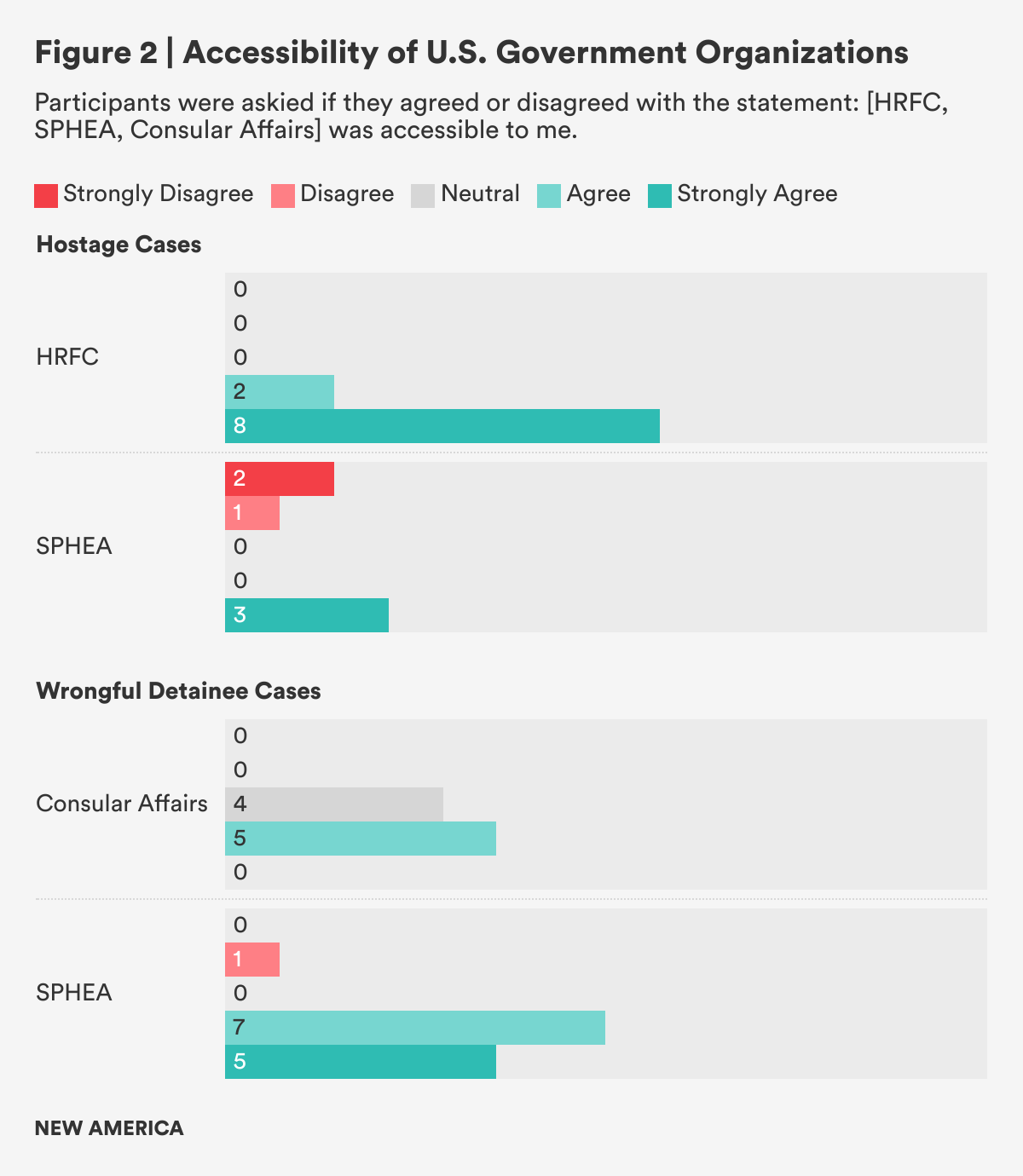
JWFLF asked its participants to what degree the HRFC, Bureau of Consular Affairs (hereafter Consular Affairs), and SPEHA’s office was accessible to them after learning of their loved one’s captivity. Hostage participants generally agreed that the HRFC was accessible. However, fewer hostage participants interacted with the SPEHA’s office than from previous participants in Bringing Americans Home reports. 4 Unlawful or wrongful detainee respondents reported gaining more access to the SPEHA’s office than in the 2019 and 2020 reports.5 Overall, the data from the 2020 and 2021 reports supports the assertion that reforms to the SPEHA’s office have improved families’ ability to access the government.
Hostage Case Participant Responses
All hostage participants agreed (two) or strongly agreed (eight) that the HRFC was accessible to them. When asked about their ability to access the SPEHA’s office, three participants strongly agreed that the SPEHA’s office was accessible, whereas one participant disagreed, and two participants strongly disagreed (Figure 2).
Fewer than half of the hostage participants interviewed reported working with the SPEHA’s office. The other participants interviewed who were not accessing the SPEHA’s office indicated that they or their loved ones were no longer actively held in captivity and their cases were being handled under the direction of the Federal Bureau of Investigation (FBI) rather than the SPEHA. On the one hand, this drop in engagement with the SPEHA’s office represents the fact that there are fewer active hostage cases than in years past. At the same time, however, there were concerns among hostage participants and advocates that the SPEHA’s office was spending less time reaching out to hostage families because of its current engagement with unlawful or wrongful detainee cases.6
Hostage participants, in addition to discussing their access to the HRFC and the SPEHA’s office, shared the importance of having access to their senators and representatives, who were described as “essential” advocates for their cases. One hostage and unlawful or wrongful detainee family advocate described Congress as a “very important tool for hostage and detainee families.”7 Specifically, they highlighted that families are able to access their loved ones’ two senators and congressional representative, as well as their own senators and representative, providing each family with a potential for up to six advocates whose social media presence and ability to write letters to the president of the United States can raise the profile of their case.8
Outside the U.S. government, hostage participants also shared the importance of working with organizations such as the Richardson Center, which provides support to negotiations for U.S. hostages; Hostage US, which provides day to day support for families of Americans taken hostage or wrongfully detained abroad and supports hostages and detainees when they return home; and the James W. Foley Legacy Foundation, which advocates for the freedom of all Americans held hostage and wrongfully detained abroad through research aimed at strengthening U.S. policy. An advocate interviewed for this report agreed with the importance of these organizations, commenting that while it is important for families to understand they have a central team working on their case inside the government (the HRFC), it is also important that they are aware of other potential advocates who can also be of assistance to their case and work on their behalf.9
Unlawful or Wrongful Detainee Case Participant Responses
A slight majority, (five of nine) unlawful or wrongful detainee participants agreed that Consular Affairs was accessible to them while the remaining participants neither agreed nor disagreed (four). Families who shared mixed reviews of Consular Affairs commented that their concerns generally derived from issues with the respective consular officer’s ability to access their loved ones. When U.S. citizens are unlawfully or wrongfully held by foreign countries, having consular access is a high priority for family members since their loved ones often experience life threatening medical conditions, poor nutrition, inhumane treatment, and in some cases, torture.10 Families shared that foreign governments were not allowing consular officers access to the detained Americans due to COVID-19 restrictions or other issues stemming from poor relations between the United States and the foreign country holding their loved one. From their perspective, they felt these issues were very likely excuses by the foreign government to prevent access to the detained Americans and wanted to see a more concerted effort made by the consular officer to gain access to their loved ones.
Participant responses regarding access to the SPEHA’s office were more favorable, with the majority (twelve of thirteen) of participants either agreeing (seven) or strongly agreeing (five) that the SPEHA’s office was accessible to them. Only one participant disagreed that the SPEHA’s office was accessible (Figure 2).
It is important to note that having a loved one’s case classified as an unlawful or wrongful detention, and thus gaining access to the SPEHA’s office, is not a simple process. A family’s belief that their loved one is being held by a foreign government unlawfully or wrongfully does not immediately gain them access to the SPEHA’s office. This access, something that is a high priority for these families, requires each case to be evaluated and approved by Consular Affairs, the Bureau of Democracy, Human Rights, and Labor, various legal offices and regional desks within the State Department as applicable, and then by the SPEHA’s office itself. Once all these offices have agreed it should be designated a wrongful detention, the case then gets elevated to the secretary of state for a final determination.11
Access to the SPEHA’s office, much like in the 2020 report,12 remains the number one issue for unlawful or wrongful detainees and their families. In fact, the individual who disagreed that the SPEHA’s office was accessible did so because their case was not classified as an unlawful or wrongful detention by the State Department. In addition, over the course of the interviews and drafting of this report, three respondents changed their responses from disagree to agree because they ultimately made it through the lengthy process to gain access to the SPEHA’s office. Access to the SPEHA’s office, especially for incoming families, remains a concern because families perceive that working with the SPEHA’s office “adds more credibility to their case.”13 Not only does it make their loved one’s case a "real" case, but it also allows families to work with an ambassador who can develop and lead diplomatic engagements on behalf of their loved one. This level of attention is what families believe is necessary to work toward their loved one’s release.
One participant shared, “When my [loved one] was first wrongfully detained, the State Department would send Consular Affairs to deal with our case, with no SPEHA representation… it took two and a half years to get any recognition from the SPEHA’s office. It wasn’t until the transition over to Ambassador Roger Carstens where [the Office] was more hands on. Ambassador Carstens made himself available to us saying if we need anything that we could call or email him at any time. There have been times where we’ve had to call and ask for help. It’s much better… [we] feel like he’s really there for the families.” Another family member shared similar sentiments, “I have felt that Roger Carstens has been completely available for my family. I feel like they’re [State Department] definitely going in the right direction.”14
JWFLF participants shared that it took between eight months to two and a half years to gain access to the SPEHA’s office, and that official certification that their loved one’s cases was an unlawful or wrongful detention was often missing. While all but two participants shared that the State Department categorized their case as an unlawful or wrongful detention, many family members indicated that they have not received any official documentation stating that their loved one has been unlawfully or wrongfully detained from the State Department. This makes some families nervous that their support from the SPEHA’s office is not necessarily durable. “The thing is,” one participant said, “we don’t know why they [the SPEHA’s office] are working with us or how long they’ll be working with us. It could all end tomorrow, we don’t know!”15 On the other hand, families report that documentation from the State Department acknowledging their loved one’s case is an unlawful or wrongful detention provides a level of support. Not only does such documentation give families or returning detainees “credibility needed to gain better access to their state Senators or state Representatives,”16 it also gives them the “capability to work with the IRS regarding unpaid taxes, creditors and/or debt collectors after defaulting on payments or loans while being unjustly held in captivity.”17 Some participants reported having written documentation acknowledging their unlawful or wrongful detention; they also commented that “it didn’t have the same effectiveness that returning hostages receive.”18
One of the issues with access to the SPEHA reported by family members, as well as family representatives, was their initial lack of knowledge that the SPEHA’s office even existed. “Currently, there isn’t a [specific] mechanism in place [to raise cases to the SPEHA] for family members whose loved ones are being held for political purposes.”19 A few participants reported that they only learned of the SPEHA’s office through NGOs or by a consular officer who independently reached out to the SPEHA’s office signaling that there was a potential unlawful or wrongful case. Families, as well as advocates, indicated that “there needs to be a better way to access the SPEHA’s office,” or to “contact the SPEHA’s office directly” so they can be made aware of a potential case. Most often families find themselves stuck in Consular Affairs where their cases can potentially sit alongside more than 3,000 lawful overseas detentions.20For comparison, there are currently over 50 publicly disclosed unlawful or wrongful detentions of Americans overseas.21 Separating this small number of unlawful or wrongful cases from the thousands of lawful detentions is a complicated task and, without a clear process to elevate these cases from Consular Affairs, will continue to remain a challenge.
Lawful detentions occur in countries all over the world, even in allied countries of the United States. However, unlawful or wrongful cases are generally different from lawful detentions because
- They typically occur in countries where the foreign government is hostile towards the United States.22
- The detainees in question are being held for the purpose to affect change in U.S. policy and its national security decision making processes, force prisoner exchanges, and/or extract other forms of concessions from the United States.23
While with lawful detention cases, the probability that the offence can be adjudicated through the foreign government’s judicial system is high, unlawful or wrongful detentions are far less likely to receive due process or even a fair trial. Therefore, these cases “must receive high-level U.S. engagement because they require more diplomacy and engagement with top-level government officials, something that Consular Affairs does not do.”24
Access to the President of the United States, National Security Advisor, and Secretary of State
Families work tirelessly to gain access to the government’s hostage recovery enterprise, but “nothing replaces having access or getting the attention of the President of the United States or the Secretary of State.”25 Families of hostages and unlawful or wrongful detainees, including third-party intermediaries and interlocutors, shared that they had relative success in gaining access to former President Trump and then National Security Advisor Robert O’Brien likely owing to the latter’s previous role as the SPEHA.
During the transition to the current administration, family members, third-party intermediaries, and interlocutors saw the outreach of National Security Advisor Jake Sullivan, and Secretary of State Antony Blinken to family members on behalf of their loved ones’ cases as a signal that they would have access to higher levels of government and that their cases would receive presidential priority. While families remain hopeful that there will be continued engagement and progress on their cases, some families have expressed concerns that Sullivan has become less available, which is perceived as hindering their ability to obtain access to President Biden. All hostage and unlawful or wrongful detainee participants stressed the importance of maintaining access to the highest levels of government for the purpose of advocating for the release of their loved one.
Consistency, Accuracy, and Coordination of U.S. Government Briefings
A common concern amongst family members was the importance of consistency and accuracy of information shared during meetings with the U.S. government regarding their case. In addition, remaining in constant communication to receive updates, as well as observing a well coordinated flow of information across the different agencies and third-party intermediaries, was also of great importance to family members. During interviews for this report, there were a variety of responses, both favorable and unfavorable, with satisfaction with the consistency and accuracy of information shared during meetings and briefings with the U.S. government. For a more in-depth discussion on information sharing during briefings, see the following section.
Hostage Case Participants Responses
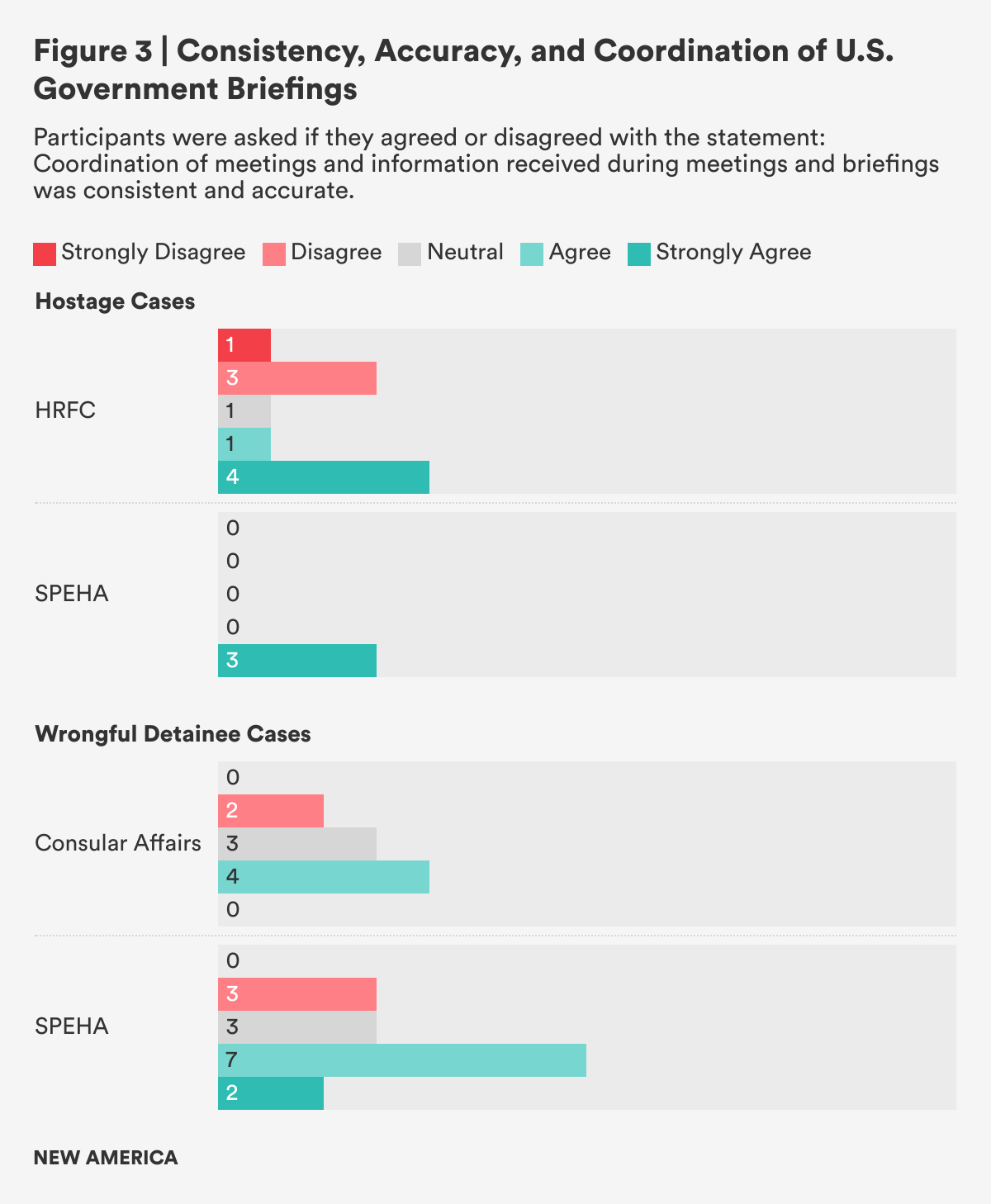
All the hostage participants (three) that had access to the SPEHA’s office strongly agreed that U.S. officials communicated clearly and were well-coordinated during meetings and briefings with the office (Figure 3). While all three participants strongly agreed that the SPEHA’s office was well coordinated and had communicated very well during briefings, one participant expressed concern over the new staff being brought on board. “It’s not the same” and “it’s starting to feel more bureaucratic.”26 However, the participant remained hopeful that the perceived shift was temporary while the new staff was settling into their new roles. Overall, participants commented on how much they look forward to engaging with the leadership of the SPEHA’s office regarding their case.
There are participants who expressed concern over not being able to access the SPEHA’s office. While they do have a working relationship with the HRFC, they know that their case requires “diplomatic engagement at the highest levels within the State Department” to work towards the release of their loved one.27 In addition, they raised concerns over whether the SPEHA’s office has focused more on unlawful or wrongful detention cases this year rather than hostage cases. In particular, “the issue bothering [the family member] is that it has become evident that the SPEHA is in regular contact with detainee families.”28 In addition the SPEHA “has never contacted us”29 in regard to handling their hostage case.
In another statement referring to the State Department as a whole, a participant commented that their “relationship with other components of the U.S. government, primarily the State Department, has been less favorable. As in prior years, little if any substantive information has been provided by the State Department, promises from senior officials have gone unmet, and ‘briefings’ have tended to be pro forma, or worse, media events.”30
For hostage case participants working with the HRFC, half of respondents (five of 10) strongly agreed (four) or agreed (one) that the HRFC communicated clearly and that officials were well-coordinated during meetings and briefings, whereas one participant neither agreed or disagreed, and four participants either disagreed (three) and strongly disagreed (one) (Figure 3).
One participant shared that “both the HRFC and SPEHA’s office have been excellent at reporting back to us and telling us information.”31 Another participant who’s been working with the HRFC for some time shared, “I’m actually astounded. They [the HRFC and victim’s specialist] are very good to me and have accomplished a great deal this year. They’ve been very open and frank and have shared a lot of information. They’ve been wonderful and have done way more than I would have ever asked.”32
Another participant shared that their FBI case agents and victim’s specialist were “exceptionally good to me, way more than I would ever have expected.” The participant was especially touched when their victim’s specialist and case agents would visit and “help me… all while COVID is going on. They are really, really good to me.”33
In addition, a participant said that sharing information across all the different agencies as well as coordinating as much as possible with third-party intermediaries was “most impactful.” “That’s what’s made the most difference!”34 Regarding coordination, a participant shared, “Initially, it was good to have several briefings with all the different parties involved, the FBI, State Department, Special Envoy, and so on. I got a sense that people were all on the same page. Previous to PPD-30, there was absolutely no coordination at all. People were not on the same page and did not share information. The State Department hardly talked to the FBI, it was pretty incredible. That changed very slowly, but it changed.”35
However, not all hostage participants shared positive experiences working with the HRFC. One hostage case participant shared that, while their initial meeting with the FBI agent investigating their loved one’s case was successful, unfortunately, from the perception of the family, all of the information gathered by the agent did not get communicated back to the HRFC. This led the family to believe that the “Fusion Cell doesn’t talk to each other as well as they should,” and that “their communication with each other was very poor.” It is important to note that the family working with the FBI agent thought that he was, “excellent, highly professional, and made several references to other hostage cases… he knew his stuff.” The agent was also “very respectful and knew not to ask long-winded questions… because [the family member] couldn’t handle any more than what they were asking.”36
Another issue raised regarding communication, coordination, and briefings with the HRFC was the pace with which families received regular calls and/or updates on their loved one’s case. Families feel intense pressure to act quickly when their loved ones are first taken hostage. According to one U.S. official, “It’s important to move quickly during the first two weeks of someone who has been taken hostage. After that the trail starts to go cold.”37 A participant whose loved one was in the early stages of a hostage-taking shared that the HRFC told them to wait “at a specific time [for] a clerk from the local field office to call [them] to give updates once a week.”38 Families have the expectation of working at a very rapid pace and, “being told to sit and wait around for somebody to call once a week, and then have them not give any new information, that was not going to work for us.”39 Ultimately, the family felt that the HRFC was “slowing [them] down” and they walked out of their meeting with the HRFC saying, “We’re on our own.”
Another participant shared challenges with working with their victim’s specialist. After receiving paperwork regarding their case, the participant noticed that their loved one’s name was incorrect. “They had the wrong name! [Even though], it was human error, it just showed a lack of caring, especially since it came from the victim’s specialist. It was just disheartening to me. I can’t explain why, because I know it was a human error…but it showed me that it wasn’t important to that person, I guess. I know [they] meant the right thing, sending us the information, all that was lovely, all that was great, but the fact that they didn’t even have [my loved one’s] name in there, was disheartening. It felt just very bureaucratic and insensitive.”40
Unlawful or Wrongful Detainee Case Responses
When asked about their interactions with Consular Affairs, four participants agreed that U.S. officials communicated clearly and were well coordinated during meetings and briefings, while two disagreed and three respondents neither agreed nor disagreed (Figure 3). With regard to the SPEHA’s office, the majority of respondents (nine of 15) either agreed (seven) or strongly agreed (two) that U.S. officials communicated clearly and were well coordinated during meetings and briefings. The remaining respondents neither agreed nor disagreed (three) or disagreed (three) that U.S. officials communicated clearly and were well-coordinated while engaging with that office (Figure 3).
Initially, the perception of the SPEHA’s office was more positive, with all respondents agreeing that the SPEHA’s office communicated clearly and was well coordinated during meetings and briefings. Throughout the course of the year, however, the interviewer was contacted by five participants to change their responses after their initial respective interviews. Of the five participants, three changed their response from agree to disagree, whereas, two participants changed their response from agree to neither agree nor disagree. These participants cited their perception of a change in policy resulting from the new administration and the addition of new staff at the SPEHA’s office. “We’re getting more bureaucratic responses now and less actionable information,” one family member stated, “it’s like we moved backwards four years.”41
In general, the majority of families were very happy with their interactions with the SPEHA’s office, specifically during the Trump administration. Several families expressed satisfaction with weekly calls, in-person meetings, being provided rough timelines, and being able to ask specific questions for which they received satisfactory responses. This was even the case when the SPEHA could not answer some of the questions due to classification concerns. “It’s been great actually,” was the response of one participant. “The SPEHA is very straightforward with us and we believe what they’re saying is what they are going to do. We don’t get the sense of getting pushed around or being paid lip service.”42
Similar to the 2019 and 2020 Bringing Americans Home reports, the turnover rate at the State Department remains a problem. For some participants, their loved ones’ cases have been going on for several years or more. While they know there will be a constant change in personnel, families expressed frustration over being asked basic questions about their loved ones’ cases time and time again. “We’re still being asked if [my loved one] is a dual national. It’s like they don’t share the information to the upcoming people, and we continue to have to start over. It’s least reassuring when these are the people taking over my [loved one’s] case. Overall, there is a lack of transfer of information to the incoming personnel.”43 Additionally, this same participant noted, referencing both the SPEHA’s office and Consular Affairs, “It takes a long time to build trust and relationships with State officials and once we’ve gained their trust, they’re off to their next job.”
Another participant raised a similar issue with staff members not reviewing their cases before meetings and briefings, saying, “We have been working our case for several years now and we are still being asked about [our loved one’s] nationality, who we’re working with, and other basic information. … [That is] great for a new case, but it raises many questions for cases like ours. Do they not have this information already in a file somewhere? It feels like they’re starting over. We’ve done this several times already, why not look at our file?”44
In addition, participants shared that in at least one instance, a large number of unlawful and wrongful detainee families were asked to participate in a large meeting with other families where they were asked questions regarding the health of their loved ones and about personal issues that they were experiencing. “These are private matters and are issues we don’t want to discuss in front of other detainee families. It can be very embarrassing and humiliating! Especially, when discussing certain medical issues [my loved one] is suffering from. There are also other detainee family members who are suffering from [their own medical issues], which I don’t feel should be our business and I feel bad for them that this was their way to share the struggles they are all facing. If the official looked at the files and had an individual phone call with us, it would have gone over much better, and they probably would have gotten more information from us.”45 Additionally, this participant shared, “If this official would have contacted us individually and was more proactive by saying, ‘I’ve reviewed your case,’ and then asked specific question about gaps that remained in our file, that would have been fine. Instead, we felt like they were starting from scratch.” The expectation for families to share personal information and medical information regarding their loved ones’ health conditions in a group setting, one participant stated, is not only “dehumanizing and humiliating, it’s demoralizing for family members,” it also showed a “lack of empathy and compassion.”46
Another important issue that was raised by participants revolved around needing representation from the broader State Department within the SPEHA’s office. The State Department manages a diverse and wide-ranging diplomatic portfolio, involving everything from conducting negotiations with foreign states to participating in discussions of providing foreign aid and the application of sanctions. These activities can, at times, occur at sensitive moments within negotiations to release unlawful or wrongful detainees. There is a perception among families that these diplomatic activities are often undertaken without consideration for their impact on their loved one’s case. If State Department officials are “talking to policymakers and discussing whether they’re going to pursue sanctions or not, we want [the SPEHA] to be part of those discussions because they have an impact on our case. We feel like they keep making decisions without taking [our loved one’s case] into consideration.”47
In addition, families shared concerns over the SPEHA’s office appearing to not know what is going on politically within Congress. Families feel that there has been missed opportunity to encourage bipartisan representation, which could potentially be important for their case. The lack of coordination with Congress is confusing to some family members who see the influence that U.S. lawmakers have as being an important tool to leverage in support of their loved one’s case. These families feel that coordinating recovery efforts with Congress should be a key function for the SPEHA’s office in unlawful or wrongful detention cases.
Information Sharing
As discussed above prior to the release of PPD-30, the U.S. government’s hostage policy was codified in NSPD 12, United States Citizens Taken Hostage Abroad. NSPD 12’s classification, however, made it difficult for U.S. officials to engage with hostage families and discuss what the United States was doing, or could do, on their behalf. With the issuance of PPD-30, a mostly unclassified document, family engagement and declassification of information became a higher priority across the hostage recovery enterprise.
The HRFC is mandated by EO 13698 to “provide a forum for intelligence sharing and, with the support of the Director of National Intelligence, coordinate the declassification of relevant information.”48 Further, PPD-30 directs the director of national intelligence to “provide for centralized management of hostage-related intelligence in order to coordinate the Intelligence Community's efforts on hostage-takings and provide synchronized intelligence support to the HRFC.” 49 The intelligence community broadly is also directed to “make proactive efforts to declassify relevant and reliable information or provide unclassified summaries to a hostage's family.”50
In response to this, an issue manager for hostage affairs position was established within the Office of the Director of National Intelligence. This position is responsible for declassifying information in support of hostage families, as well as working with the interagency to “ensure focused and prioritized intelligence support for hostage cases.”51 The declassification of information in support of hostage families is one area that family members consider extremely important and has been consistently raised by families in the previous 2019 and 2020 reports.52 Receiving information in a timely and consistent manner helps provide them the support they need to work on their loved one’s behalf. According to one senior U.S. official, however, getting the intelligence community to prioritize the issue is challenging. “This is the one area,” they said, “that [the hostage recovery enterprise] needs to continue to push on the interagency to make sure the interagency overall understands that they must work to declassify information.”53 “It’s [the HRFC’s] job [to support this],” they continued, “it’s the ODNI [Office of the Director of National Intelligence] Issue Manager’s job to go out across the interagency and get those declassified talking points [families can use].”54 One U.S. government employee noted, however, that the issue manager had limited influence within the interagency and that they had observed information get declassified much faster if the national security advisor engaged directly with the intelligence community.55
Declassifying information at a faster rate is also extremely important for hostage families in order to match the pace of the constant changes that occur in hostage cases. One hostage family shared that the HRFC became less relevant to their case because “they weren’t sharing information fast enough… we were operating at a much quicker pace while they were still trying to get information declassified.”56 In addition, one participant shared, “During the 2015 process resulting in PPD-30, the government spoke a lot about opening and speeding declassification of confidential information for families, even to the point of hiring staff specifically for this purpose. We’ve seen no evidence that this promise has been fulfilled.”
As in the 2019 and 2020 reports, information sharing remains a challenge raised by several participants in this year’s report. Hostage case participants, in particular, remain concerned about the level of completeness of the information they receive, while unlawful or wrongful detainee participants’ satisfaction with the level of information being shared from the U.S. government seems to have improved from the 2020 report.
Hostage Case Participant Responses
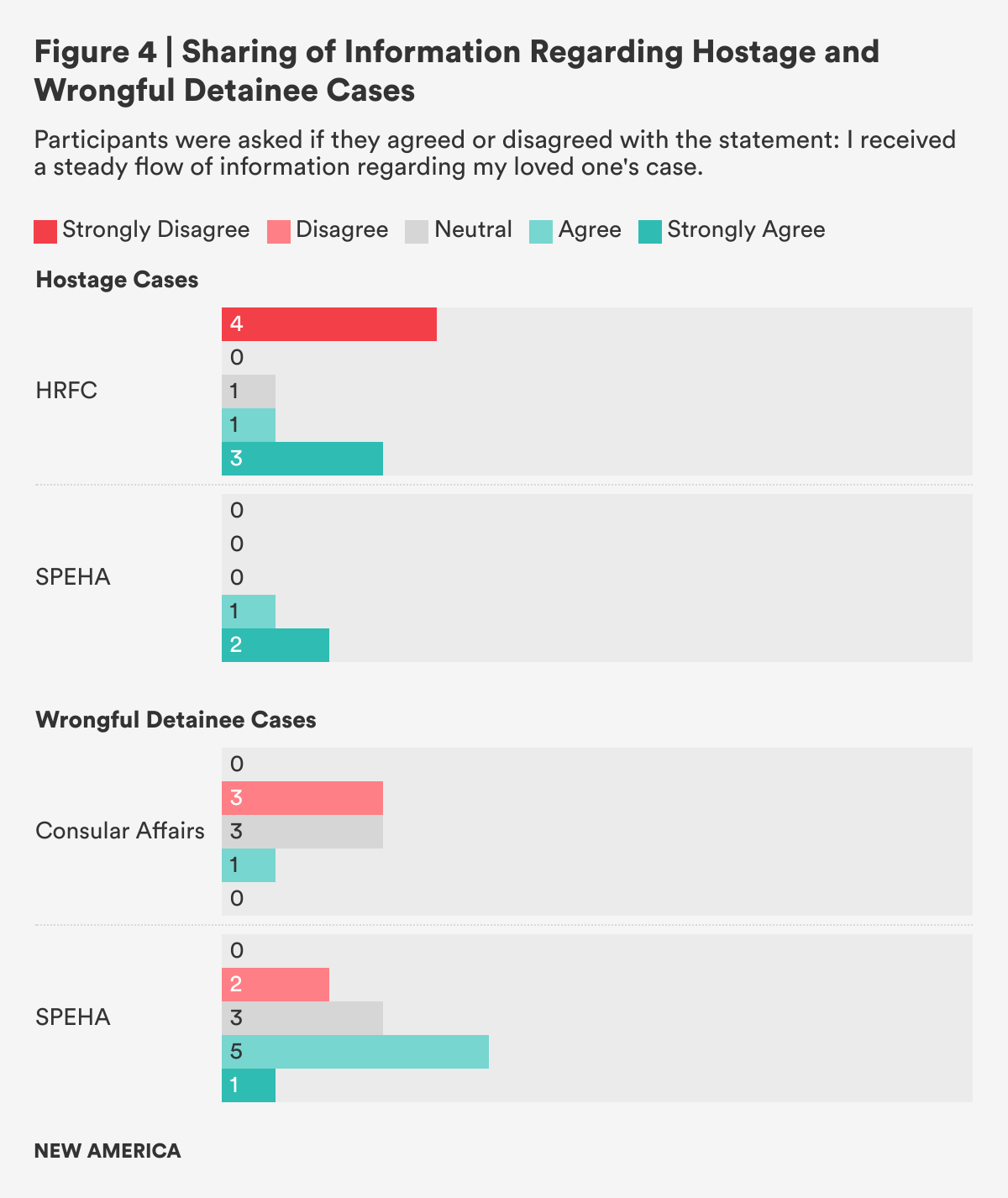
¹ú²úÊÓƵ half (four of nine) of participants who interacted with the HRFC strongly agreed (three) or agreed (one) that they received a steady flow of information regarding their loved one’s case, while the other half (four) strongly disagreed (one individual neither agreed nor disagreed). Usually, when there is a bimodal distribution in the data, there are common factors that relate to the disparity. However, in this case, there are no clear differences between the cases of those who agreed and those who did not, nor do the cases of those who agreed or disagreed all have common dynamics. Neither duration of the hostage case, whether the case was in its early to late stages, verification of proof of life, nor location of the hostage appear to have been determining factors for the discrepancy in responses (Figure 4). In contrast with the HRFC, hostage families working with the SPEHA’s office all had positive responses regarding their perceptions of information sharing. All participants either strongly agreed (two) or agreed (one) that they received a steady flow of information regarding their loved one’s case (Figure 4).
Information sharing between the U.S. government and families has remained a challenge, as seen in both 2019 and 2020 JWFLF reports.57 Family members expressed a continuing concern regarding the “overly strict” and “unnecessary withholding of information”58 by the U.S. government. Families report that information continues to be withheld from them and there continue to be limits on their ability to share information with their non-governmental primary advisor and/or negotiator.
Similar to the 2019 and 2020 reports, families perceived that while they continue to share information they generate with the U.S. government, the government “continues to withhold information from us.”59 In one case, the family directly asked the HRFC if the U.S. government’s inability to share the requested information was due to legal issues or administrative issues. An individual working for the HRFC reportedly commented that it was an administrative issue. Since it was not a legal issue, the family interpreted that as the “desire and position of the government” and that the government was choosing to withhold information when there was no legal requirement to do so.60
In another instance, a family was at a critical point in their case where they required information from the U.S. government in order to make important and timely decisions. The family knew that the U.S. government had information that could inform their decision-making process. Ultimately, the HRFC did not share the information. “We were told that the reason was that some of the underlying information came from a foreign government… However, it’s our position that [we] have demonstrated [years of trust] and that we present zero risk of disclosure of information.”61
One hostage advocate shared the importance for hostage families of having independent sources of information and support so they can make informed decisions on their own. “Regardless how well aligned the relationship is between a hostage family and the government, it’s important that hostage families have independent sources of information and support so they can make informed decisions that they own. And those choices have to be informed with independent information so they’re not just being fed something by one source.”62
Unlawful or Wrongful Detainee Case Participant Responses
Of the seven responses associated with unlawful or wrongful detainee cases, three participants disagreed that they received a steady flow of information from Consular Affairs and three other participants neither agreed nor disagreed. Only one participant agreed that they received a flow of information regarding their loved one’s case from Consular Affairs. When asked about information flow from the SPEHA’s office, results were more favorable. Over half of the unlawful or wrongful detainee participants (six of 11) agreed (five) or strongly agreed (one) that they received a steady flow of information from the office. Of the remainder, two of the 11 respondents disagreed and three neither agreed nor disagreed (Figure 4).
In contrast to the 2020 report,63 unlawful or wrongful detainee families shared an overall satisfaction with the flow of information they’re receiving from the SPEHA’s office. “Talking to [the SPEHA] has been great. We get the sense that he’s telling us all that we can know even though there’s information he can’t share due to classification issues.”64 In addition, “Roger Carstens is different from other SPEHA’s we’ve interacted with. He’s straightforward with what he can share with us and we get the sense that he’s working on our behalf.”65
One family member shared concerns with the declassification efforts of the SPEHA’s office, however. “When it comes to declassifying information,” they said, “I have asked to be read in on to classified information and was basically told with wrongful detentions and the way things are set up at the moment, they would have to go to the individual agencies and to get permission from each one of them to share the information… There’s still no formal methodology for families of wrongful detentions to obtain in any meaningful way classified information without an in-person visit with the SPEHA which isn’t going to happen every week. That said, I think they’re trying their best. Overall, there’s been improvement from the previous year and I’m happy to see that it’s going to continue to improve.”66
Understanding of U.S. Official and Departmental Roles
PPD-30 directs that the interagency responsible for coordinating the U.S government’s response to hostage-takings is the HRFC. Housed within the FBI, the HRFC consists of an intelligence section, an operational section to coordinate interagency action, a family engagement team, an external engagement component, and a legal team.67 Due to its responsibilities for coordinating the interagency’s activities on behalf of hostages, several agencies are represented within the HRFC. The Department of Defense, Department of Justice, State Department, Department of Treasury, the FBI, and intelligence community all have representatives within the HRFC’s operational section, all of whom are dedicated to bringing U.S. nationals home.68 Typically, the HRFC leads hostage cases where U.S. nationals are held by non-state actors such as terrorist organizations, other militant groups, criminals, and/or pirates. In addition, the HRFC also has the lead on cases where U.S. nationals are suspected of being detained by foreign governments, but where those governments have not acknowledged their detention (also known as an unacknowledged detainee). In addition to its role in coordinating interagency efforts on behalf of U.S. citizens, the HRFC is also responsible for developing and coordinating hostage recovery strategies, coordinating intelligence sharing and the declassification of information, and coordinating family engagement support for hostages and their families on behalf of the U.S. government.
The SPEHA, another innovation of PPD-30, is a presidential appointee who reports to the secretary of state and leads and coordinates all the government’s diplomatic engagements on overseas hostage-related matters. The SPEHA also coordinates diplomatic engagements supporting cases in which a foreign government acknowledges that it has detained a U.S. national but the U.S. government deems the detention to be unlawful or wrongful. The creation of the SPEHA’s office centralized hostage and unlawful or wrongful detainee issues within the State Department under a single leader, who, as a presidential appointee, effectively represents the president within the State Department.69 In addition to the SPEHA’s access to the secretary of state, the SPEHA has been given the authority to access senior leaders in foreign governments and negotiate on behalf of the U.S. government.70 The SPEHA also plays an important role in developing relationships with other governments and international organizations who can play key roles in assisting the United States in obtaining the release of a U.S. national held hostage or unlawfully or wrongfully detained abroad.71
However, access to these organizations over the years has been uneven and, in the past, there has been confusion over which entity was the lead for certain cases. In addition, each organization provides different types of support to hostage and/or unlawful or wrongful detainee families. This is further complicated, in the SPEHA’s office, by the cumbersome entry pathway which requires Consular Affairs to sift through the thousands 72 of detainee cases in order to identify unlawful or wrongful detainee cases.
JWFLF asked participants whether they felt they had a good understanding of the roles that U.S. officials and departments within the HRFC, SPEHA, and Consular Affairs played in support of bringing their loved one’s home. Hostage respondents for this year’s report generally said they understood the roles of the HRFC and SPEHA. Unlawful or wrongful detainee respondents, however, were somewhat more mixed in their assessment of whether they clearly understood the role Consular Affairs played in their case, though all understood the role of the SPEHA’s office. Frustrations over Consular Affairs roles were generally related to perceived inactivity on behalf of their loved ones and a lack of correspondence in dealing with their respective cases. While the majority of JWFLF’s participants shared that they understood the departmental roles across the hostage recovery enterprise, the conversation often shifted to personnel changeover, such as the position of the director of the HRFC, in particular.
Hostage Case Participant Responses
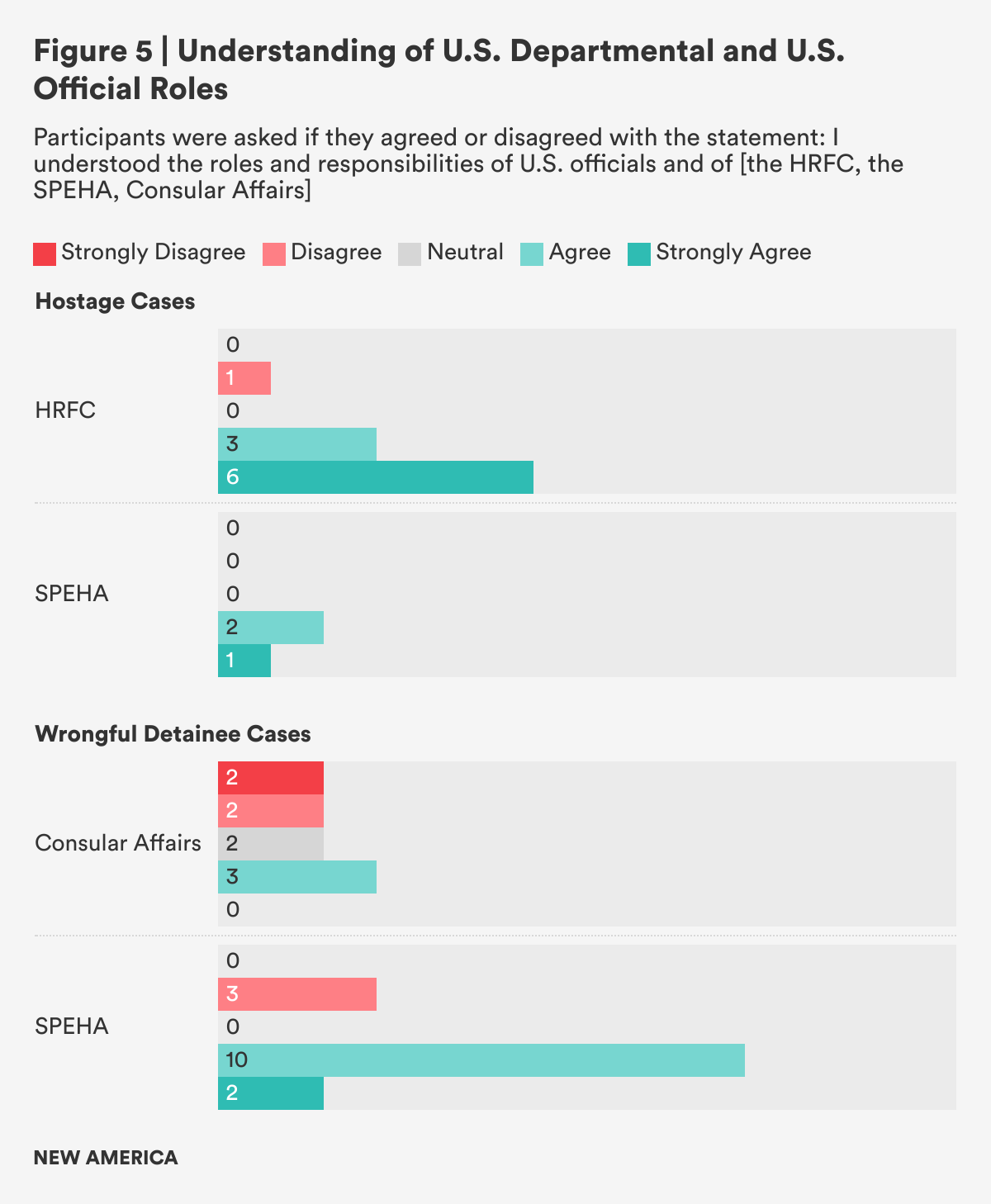
The majority (nine of 10) of hostage participants who interacted with the HRFC strongly agreed (six) or agreed (three) that they understood the role the HRFC plays in support of hostage recovery and family engagement (Figure 5). Only one participant disagreed that they had a clear understanding of the HRFC’s role.
One participant shared that they “especially found that the tenure of Kieran Ramsey as the Director of the HRFC brought an entirely different approach to interacting with us. He was refreshingly frank and honest.”73 In addition, another participant shared, “I have been extremely impressed by the professionalism and integrity and warmth of the people I work with in the FBI, my agents… the folks over at the FBI in Washington who handle the hostage cases are pretty outstanding people. I trust them a great deal. They’ve been very, very honest with me.”74 This honesty and frankness seems to have driven a better understanding of what families can expect from HRFC support and the role they are playing in the recovery of their loved ones.
During these discussions, however, the tenure of the HRFC’s director emerged as a concern. Families seem to have attributed, in part, their clarity on the HRFC’s role to the leadership of the director and are concerned that during the transition in leadership this may change. One participant commented that they thought “an important point for consideration is the FBI policy of rotating senior officials as frequently as they do.”75 In their perspective, the HRFC is a body within the U.S. government and that “having its leader rotate out routinely every two years or so robs the HRFC, families, and especially hostages of the institutional body of knowledge and the relationships each Director has developed.” While families understand that no individual is assigned permanently within the government, continuity is an important consideration for them when to feel confident that they understand the role the HRFC will play in the recovery of their loved ones.
All three hostage respondents working with the SPEHA’s office either agreed (two) or strongly agreed (one) that they understood official and departmental roles regarding the SPEHA’s office (Figure 5).
One issue related to the role of the SPEHA raised by hostage advocates in the interviews for this report revolved around its role in the negotiations with the Taliban regarding troop withdrawals in Afghanistan. Hostage advocates did not understand how the United States could negotiate with the Taliban while they likely held two Americans hostage and not address the issue. They were also concerned that once U.S. troops leave the country, it will become more difficult to generate the intelligence needed to find Americans currently being held hostage. These advocates were specifically confused by the SPEHA not having a role in the negotiations. “As the one official who is supposed to take the lead in negotiations to free hostages,” said one advocate, “you would think he would be involved if we were negotiating with a group holding Americans hostage.”76 Instead, according to advocates and U.S. officials, “everything is being handled by the Special Envoy to Afghanistan [now the Special Representative for Afghanistan Reconciliation (SRAR)].”77 According to these advocates, hostage issues were not prioritized nor was the return of U.S. hostages made a precondition for any settlement during the peace talks in Doha, Qatar with the Taliban.
Administration officials, in a recent Washington Post article, have refuted these claims, saying that discussions regarding hostages “were often one-on-one and behind closed doors.”78 They claimed that the release of American hostages were part of the discussions with the Taliban and that, as a result, the Taliban had taken custody of an American hostage who had previously been held by the Haqqani Network.79 It is beyond the scope of this report to adjudicate these different perspectives; however, it appears relatively clear, from the perspective of JWFLF's participants, that the SPEHA’s office has had limited involvement in the negotiations. Despite U.S. officials’ likely concerns about the precedent set by including a kidnapped U.S. citizen’s release in a major negotiation—for fear that it will encourage more kidnappings—that does not mean the SPEHA’s office should not be involved. Having the SPEHA’s office involved both provides the family a sense of being heard and offers the possibility that the office is able to find a creative solution to use the leverage created by the negotiations to recover any and all U.S. citizens being held by the Taliban.
Unlawful or Wrongful Detainee Case Participant Responses
Unlawful or wrongful detainee participants reported mixed levels of understanding of official and departmental roles of Consular Affairs. ¹ú²úÊÓƵ half (four of nine) of the participants who interacted with Consular Affairs strongly disagreed (two) or disagreed (two). Others neither agreed nor disagreed (two) or agreed (three) (Figure 5).
The main concern raised by unlawful or wrongful detainee participants regarding the role of Consular Affairs was a lack of clarity of the relationship between Consular Affairs and the SPEHA’s office. “How much do they communicate with the SPEHA’s office regarding our [loved one’s] case,” one participant asked.80 “What impact do they have on elevating our case to the SPEHA’s office?”81 “How can they prioritize our case if they’re dealing with several other [lawful] detention cases?”82 While the role of Consular Affairs differs case to case depending on where an unlawful or wrongful detainee is being held, it is clear that these relationships are not clearly understood.
Questions were raised over what family members can “ask Consular Affairs to do and the SPEHA to do.”83 Specifically, families reported confusion about the role of the Hostage Affairs Unit within Consular Affairs’ Office of America Citizens Services and Crisis Management and generally sought more clarity about the unit’s role. For example, one participant shared that during phone calls regarding their case with the SPEHA’s office, personnel from the Hostage Affairs Unit have been on the call. This participant was unclear why. “Are they some kind of liaison?” they asked, adding, “What kind of impact do they have on our case?”84 Another participant commented that they were “somewhat clear on what my rep [in the Hostage Affairs Unit] is supposed to do and how that interaction works. These people are wonderful in trying to tell me what they know.” “However,” they commented, speaking about relationships between the Unit, Consular Affairs, and the SPEHA’s officer “I don’t understand the nuance of how some of these people interact or how some of the information [gets disseminated].85
When asked about their familiarity with the roles and responsibilities of the SPEHA’s office and its personnel, most unlawful or wrongful detainee participants either agreed (10) or strongly agreed (two) that they understood the roles. Three participants, however, disagreed that they understood the office’s roles or those of its personnel.
Much like the hostage case participants, conversations about understanding roles turned to consistency and continuity in the leadership of the office. During these discussions, several families commented that they were happy the Biden administration retained Roger Carstens in the SPEHA position. “It’s important for consistency purposes,” said one participant. “Whenever there’s turnover it’s disappointing and we then we have to start over and share our story with an entire new team, which gets exhausting.”86
While pleased with the leadership of the SPEHA’s office, some participants raised concerns over understanding the role of the new staff within the SPEHA’s office, which is currently growing. The growth, families commented, has somewhat confused roles within the office. Families, in discussing the arriving staff members, suggested that “it would be more helpful if they presented what their roles are and what they can do.”87 Families shared specific concerns over the new family engagement coordinator’s position and its role in the office, despite being supportive of the growth overall. Their major concern is that it has the potential to create an additional layer between the SPEHA and the family, and whether they will continue to have the ability to directly contact and/or communicate with the SPEHA. Even though these comments came from the respondents who said they disagreed that they understood roles and responsibilities within the SPEHA’s office, this seems to be an increasing concern, with one individual reaching out in recent months to change their response from agree to disagree.
Family members expressed their satisfaction with Chief of Staff Carolee Walker and SPEHA Roger Carsten’s “sense of urgency,” “directness,” and their ability to “take charge.”88 One participant commented that “the people over at, both State and the SPEHA’s office, have really been wonderful and extremely motivated.” Overall, families remain hopeful that the incoming staff will reflect these attributes of the office’s leadership.89
While not specifically an issue in understanding the role of the SPEHA’s office, some participants raised a concern about the office’s title and wondered if it had a negative impact on the overall mission of the SPEHA’s office. Unlawful and wrongful detainee participants raised concerns about the use of the term hostage within the office’s title, wondering if it would hurt the ability of the SPEHA to gain access to foreign governments and advocate for their loved ones. “If you’re using the word hostage and you’re trying to get a wrongful detention resolved… it forces people to sit back on their heels [in terms of beginning negotiations].”90 Families worried about the perception of foreign countries and the impact on negotiations. “How will other countries respond to a meeting with a U.S. official with ‘hostage’ in their title? Will other countries be forced to reply with ‘we charged [the individual] properly, you’re supposed to respect our judicial process, [they’re] not a hostage… Therefore, we’re not going to talk to you.’?”91
Recovery Efforts Shared with Hostage and Unlawful or Wrongful Detainee Participants
Recovering American hostages or unlawful or wrongful detainees is a critical, but complicated effort that requires coordination across the interagency, strategic diplomatic efforts, third-party actors, and in some cases, law enforcement or military responses. Most often, hostage cases occur in war-torn countries or in areas where foreign governments are either hostile towards the United States or have minimal control over their sovereign territory.92
Similar to hostage-takings, unlawful or wrongful detentions occur in countries hostile towards the United States as well as countries who are in competition with the United States, and even in countries allied with the United States.93 These types of detentions are often conducted for the purpose to influence or change U.S. foreign policies towards the country or region, yet are also used to persuade the United States to engage in prisoner exchanges and/or pay concessions.94 Hostage-takings conducted by non-state actors also seek to tempt the U.S. government to concede through changes in its policies, release of prisoners, and/or pay ransoms.95 Additionally, terrorist actors have recently displayed a willingness to use hostages, specifically their executions, for propaganda purposes.96
In June 2015, PPD-30 and EO 13698 directed critical structural and organizational changes within the U.S. government needed to support a coordinated response to a hostage-taking event.97 With these new organizational changes, the U.S. government is better postured to handle the challenges in recovering a U.S. national held abroad.
Executive Order 13698 was also instrumental in restructuring the government’s hostage enterprise in an attempt to sync up what President Obama described as “sincere, relentless efforts within the government” with families whose loved ones were taken hostage. This was an important step in ensuring families were treated as “partners” in the effort to recover their loved ones.98
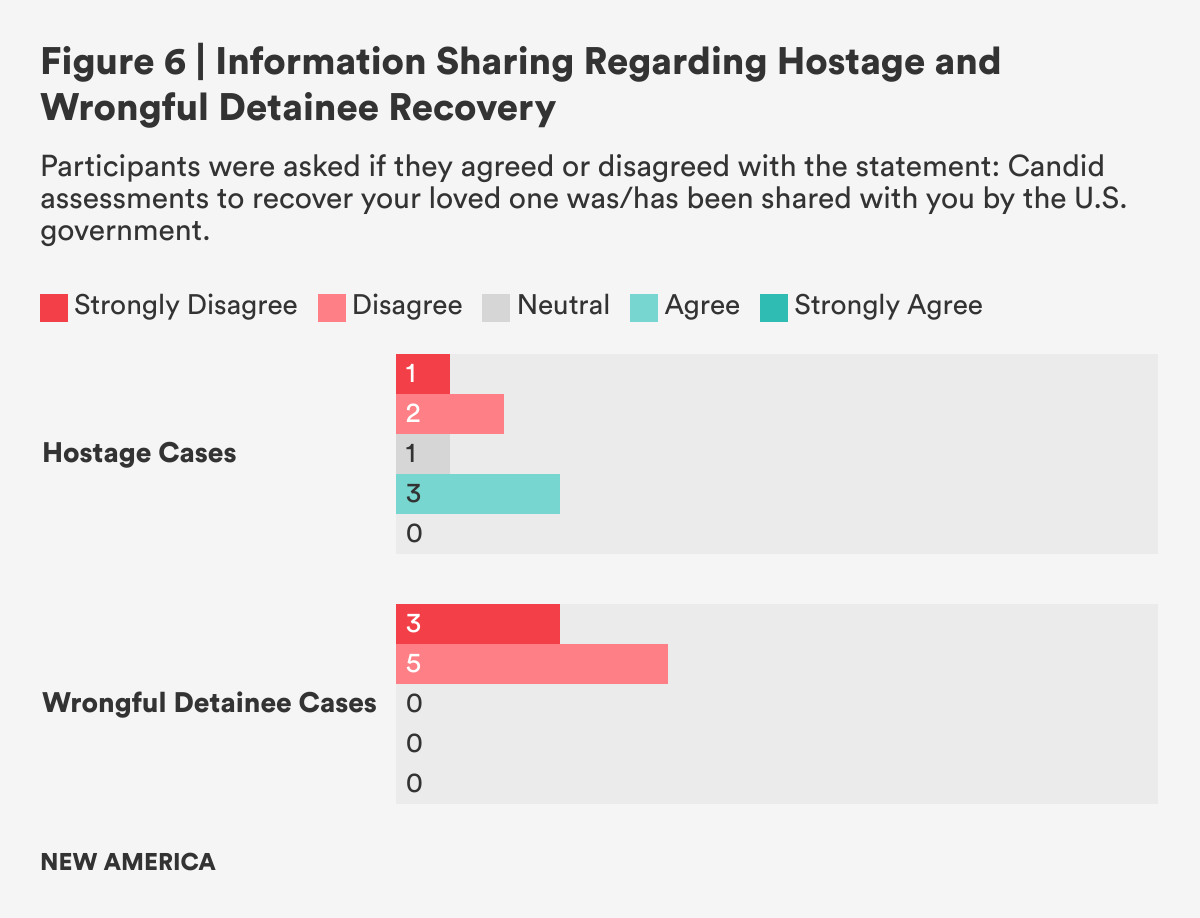
From the perspective of hostage and unlawful or wrongful detainee participants, receiving candid assessments about the U.S. government’s efforts to recover their loved one is one of the most vital ways the U.S. government can partner99 with families during the recovery phase.
In the 2019 and 2020 reports, responses varied when JWFLF asked questions about the level of information sharing regarding recovery efforts. In the 2019 report, pre-PPD-30 participants generally disagreed that the U.S. government shared information regarding hostage recovery plans while post PPD-30 participants generally agreed that they did.100 In the interviews conducted for the 2020 report, hostage responses were mixed, while wrongful detainee responses were overwhelmingly in disagreement that recovery plans were shared.101 2021 participants reported similar results to the 2020 report, indicating that hostage and unlawful or wrongful detainee participants would like more information about any candid assessments of recovery efforts for their loved ones.
Hostage Case Participant Responses
In order to gauge participants’ engagement with the U.S. government’s efforts focused on recovery of loved ones, JWFLF asked participants if the U.S. government shared candid recovery assessments for their loved ones and if they felt like they had a good partnership with the U.S. government during the recovery phase of their loved one’s case. In addition, participants were asked to share their personal recommendations on how the government could cultivate a better partnership with families during the recovery phase of a hostage case.
The seven hostage participant responses were mixed. Three hostage participants agreed, one neither agreed nor disagreed, and three participants either disagreed (two) or strongly disagreed (one) that the U.S. government shared candid recovery assessments and that they felt like partners (Figure 6).
Overall, participants, advocates, and family representatives expressed their concerns that steps toward recovering hostages appear to be taking longer under the new administration. “Things seem to be taking a bit longer,” one participant shared, adding, “There seems to be more steps to go through [under the current administration], more procedures.”102 Under the Trump administration, the participant commented that their experience was that “one person would have to sign off and we were able to move forward a lot faster.” Another participant shared similar sentiments: “We’re waiting on the new administration to pick up and start working. The national security advisor called and reached out and he was very supportive, but we’re still waiting for things to move forward.”103 While many of these families recognize that there tends to be a lull in progress for their cases when administrations change, early signs of outreach to the families indicated that recovery of their loved ones was a priority. Secretary of State Antony Blinken’s call with the families of hostages and unlawful or wrongful detainees in February 2021, for instance, was described as a promising signal.104 As of April 2021, however, families and advocates have expressed a growing consensus that there appears to be a decrease in activity by the U.S. government to bring Americans home.105 One hostage advocate shared, “There seems to be a pause on active cases, specifically, in terms of negotiations.”106
Discussing the U.S. government’s recovery efforts, almost half of this year’s hostage participants, including current U.S. officials, shared the importance of the government involving third parties. NGOs, third-party intermediaries, interlocutors, and former U.S. officials with regional expertise were all described as playing important roles in the recovery of U.S. hostages. “It is very complex to bring people home, that is a given,” said one participant.107 “That is why the government cannot do it alone. The government needs to be candid about what they’re willing to do and to do their part well and to work with other experts outside of government to support NGOs and other experts who can help make this a true priority so Americans can come home.” “That way,” this participant continued, “it’s not all on the government and it’s not all on the private sector. They [the U.S. government] need to recognize so that everyone plays a role, and everyone needs to do the best they can. It’s a complex issue—all the way from getting [U.S. hostages] home to supporting them in their reintegration.”108 Another participant shared a similar perspective. “It’s very important for the U.S. government to look at other experts outside the government,” they said. “The Soufan Center, Atlantic Media, and the Richardson Center have been a huge help, as have international human rights lawyers, Jason Poblete, president of the Global Liberty Alliance and Jared Genser, managing director of Perseus Strategies. In the view of this participant, “People need the help of other real experts because a lot of these hostage situations are really complicated.”109 Another hostage participant agreed, saying “families need the help of experts as well as the government.”110
Third-parties are important, according to one individual, for helping the families connect with the people and organizations that can support their cases. “I don’t know Washington [D.C.],” said this participant, adding, “I didn’t know who to reach out to, I didn’t know how to get into the White House. It’s very hard to do if you don’t have someone in the know.” Another benefit of working with outside experts, according to several participants, is that they can be “more transparent,” both on what they are doing on behalf of families as well as with the information they have uncovered. At the same time, however, one participant shared that third party assistance, in most cases, should be used as something to supplement U.S. government support, not replace it. “The U.S. government has a big role to play,” they said. “Trying to figure out how to get a loved one home on their own is very difficult for families and I think the [Hostage Recovery Fusion] Cell should be the first entity that helps families come up with a plan.”111
Unlawful or Wrongful Detainee Case Participant Responses
JWFLF also asked unlawful or wrongful detainee participants if the U.S. government shared candid recovery assessments with them and if they felt like they had a good partnership with the U.S. government during the recovery phase of their loved one’s case. Like hostage participants, JWFLF also asked participants if they could share personal recommendations on how the government could cultivate a better partnership with families.
All the unlawful or wrongful detainee participants either disagreed (five) or strongly disagreed (three) that they felt like partners in the recovery of their loved one, and that the U.S. government shared candid recovery assessments with them. (Figure 6).
Many of the participants indicated that the U.S. government has not shared recovery options with them in their respective loved one’s case. One participant, when asked this question, responded simply, “No, not at all.”112 Some respondents, due to the lack of sharing, questioned if the U.S. government had a plan. “To be honest, I don’t think they’ve ever had a plan,” one said. “If they do, the SPEHA’s office and/or Consular Affairs is not on the same page with the rest of the State Department.” From this participant’s perspective, there was a disconnect between those in the State Department working on their behalf and “the part [of the State Department] that discusses policy and whether or not to implement sanctions. … It seemed like every time there was some type of [negotiation] effort or window of opportunity, they [the broader State Department] didn’t seem to know it was happening and efforts were blocked.”113 Another participant commented that the lack of shared recovery options signaled that the interagency was not on board with any potential plans that have been discussed. In the words of another participant, “I have no clarity at this moment whether or not the State Department has a list of recovery options or preliminary items to approach the Department of Justice or Treasury, to get [my loved one] released.”114
Participants who disagreed that the U.S. government had shared recovery plans, however, commented that they had seen a recent shift. One participant said, “Until we started working with this team [in late 2020], people didn’t seem to be connected to what was going on in [the country where my loved one is being held] and who the key players are and why we were asking for certain things to get done. Now with this team, they have a little bit of experience with [the country where my loved one is being held] and they know who the players are, so we don’t have to explain ourselves as much.”115 In the past, the participant commented they felt like they were “constantly explaining the geopolitical situation to State Department officials who are dealing with my [loved one’s] case.”116
Another participant shared that they felt that whenever the United States put pressure on the country holding their loved one, there was a level of progress in their case. “For us,” they said, “we found that we were able to move the needle on our case after the U.S. government applied constant pressure in many different ways. It took [a long time] to get the government to do this, but that’s how we finally got [the country holding my loved one] to do anything because they were done with the attention from it.”117 Other participants expressed a desire for the U.S government to provide that same pressure in their cases through coordinated action across the interagency, including Department of Justice, Department of Treasury, the Secretary of State, and the White House. “We’ve seen all sorts of things that can be done, but [the U.S. government is] not doing things that we believe could open up the door to get [my loved one] released. We’d like to see them [the U.S. government] take more opportunities and leverage the country holding [our loved one].”118
Prioritization of Hostage and Unlawful or Wrongful Detainee Cases
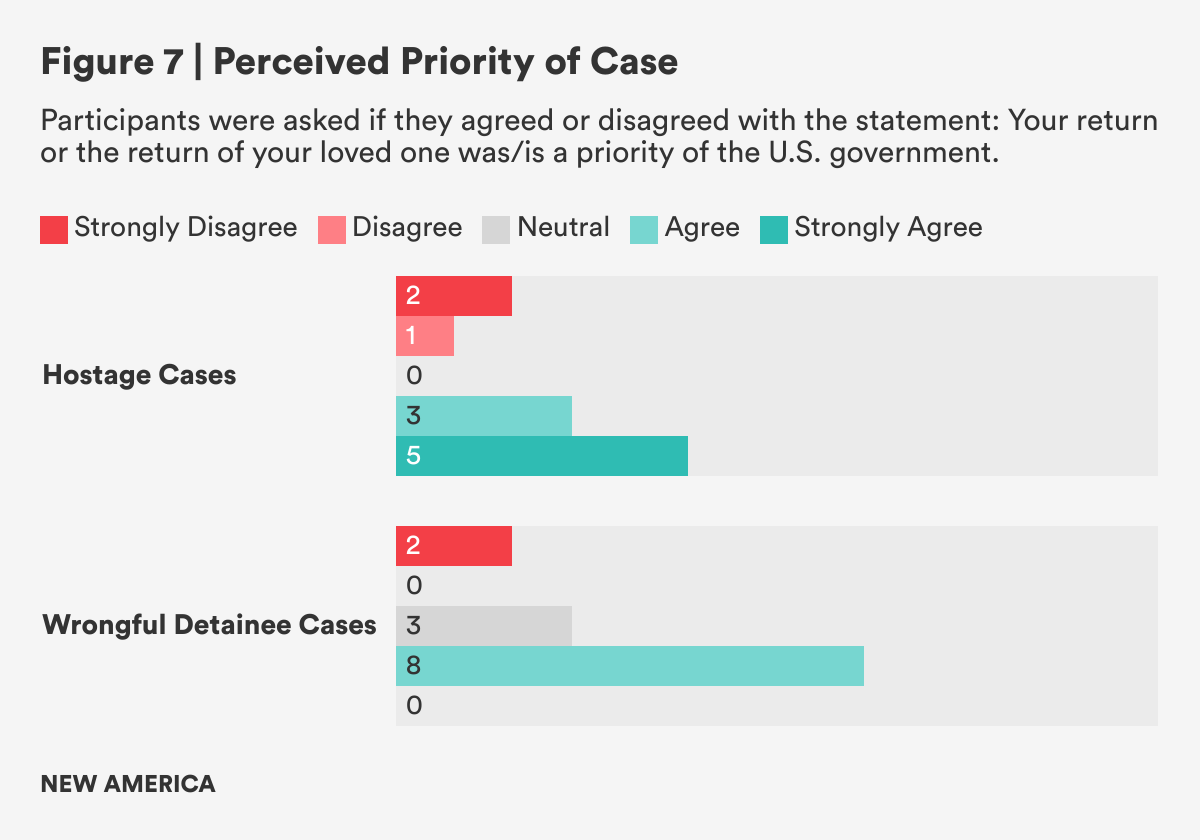
One of the most pressing concerns for hostage and unlawful or wrongful detainee families is the level of priority their cases get within the U.S. government. In large measure, it was a lack of priority on these cases that drove the 2015 reorganization of the hostage recovery enterprise. When asked whether they felt like their case was a priority for the U.S. government, the majority of both hostage and unlawful or wrongful detainee participants answered that they did feel their case was a priority. In the 2020 report, hostage participants generally agreed that the U.S. government considered their case a priority, yet unlawful or wrongful detainee responses this year are an improvement over the 2020 findings, when more than half, seven of 11, of detainee respondents reported feeling that the U.S. government did not prioritize their case.
Hostage Case Participant Responses
The majority (eight of 11) of hostage participants said that they agreed (three) or strongly agreed (five) that their loved one was a priority of the U.S. government. One respondent disagreed and two other respondents disagreed with the statement that they believed their loved one’s cases were a priority of the U.S. government (Figure 7).
As in the 2020 Bringing Americans Home report, hostage families generally agreed that the U.S. government prioritized their loved one’s case. One family member happily shared, “Yes, I would agree! We have seen that in terms of the amount of effort, time, and money the FBI has put into this, and for following every path and lead. All the people who are involved in the investigation are doing far more than what I would have ever expected. And the fact that they’re sharing their information with me and working with my third-party intermediary is much more than what I would have expected.”119Another participant, a former hostage, shared that they felt their case was “absolutely a priority.” “What I’ve gathered,” they continued, “was that the U.S. government put a lot of time and effort into bringing me home… [putting] a lot of time and energy, resources, and prioritized me. I don’t have any questions about that!120
One family member commented that while they felt their case was a priority overall, specifically for the HRFC, it was less of a priority for some departments and agencies across the interagency. “Overall I think the prioritization of [my loved one’s] case was appropriate, especially by the FBI and the HRFC,” they said. “The only times we felt that prioritization was a problem was when there were specific requests for other foreign governments that were addressed through State Department channels [outside the SPEHA’s office]. In those cases, we never received results and it appeared clear to us that the requests themselves were low priorities for the U.S. embassies in each of the countries.”
While prioritization across the interagency is important to JWFLF’s hostage participants, families also recognize the importance of their cases having the prioritization of the president of the United States. “The problem is that a lot of these issues come from the top. That’s where the president’s desire to prioritize this issue in the National Security Council is huge. Without [the President’s] decision, the military isn’t going to go and rescue anyone. They’re good at being ready and having a plan, they’re ready to go, but if the President doesn’t say go, it’s not going to happen.”121
The importance of presidential support for hostage issues highlights the role played by the Hostage Response Group and the special assistant to the president and senior director for counterterrorism. In order for issues to be raised to the president through the National Security Council system, they work their way up through a variety of committees. Prior to reaching the president, issues are taken up in a principals committee, “the senior interagency forum for consideration of policy issues affecting national security.”122 This committee consists of the heads of various agencies and departments, such as the secretary of state, secretary of defense, and the attorney general, among others.123 Before reaching the principals committee, these issues are discussed in the deputies committee, chaired by the principal deputy national security advisor. The day-to-day management of interagency coordination for national security policy occurs in a step below the deputies committee in a variety of interagency policy committees chaired by individuals designated by the national security advisor.
For hostage issues, this committee is the Hostage Response Group, created by PPD-30 and chaired by the special assistant to the president and senior director for counterterrorism. This committee is responsible for resolving disputes in the interagency regarding hostage policy, raising issues to the deputies committee as needed, and recommending hostage recovery options to the president through the deputies and principals committees.124 This makes the role of the special assistant to the president and senior director for counterterrorism a critical one for U.S. hostage policy, as they are responsible for raising issues out of the Hostage Response Group to the president through the National Security Council process. Without a senior director for counterterrorism committed to hostage recovery, there is a chance that fewer issues will reach a deputies committee meeting, or higher, for consideration.
Unlawful or Wrongful Detainee Case Participant Responses
The majority (eight of 13) of unlawful or wrongful detainee participants agreed that their loved ones were a priority of the U.S. government. An additional three participants neither agreed nor disagreed and two participants strongly disagreed (Figure 7). This year’s results are a substantial improvement from the 2020 Bringing Americans Home report, where the majority (seven of 11) participants either strongly disagreed (four) or disagreed (three) that the U.S. government prioritized their loved one’s case.125
This improvement was due to better access to and better relationships with the SPEHA and key personnel within the office. Families shared that having direct contact and communication with the SPEHA and having the SPEHA share candid information with them, “showed us their level of commitment” and “level of urgency.”126 To families, this improved their perception about the office’s prioritization of their loved one’s case. Families also reported that being able to meet with high-level U.S. government officials, including the national security advisor and president of the United States, showed the importance of their case. In addition, this year’s participants saw the U.S. government take significantly more action against regimes holding their loved ones, i.e., the application of sanctions and the designation of individuals associated with their loved one’s cases. “It was then when we thought the government was taking our case seriously. Until then, I don’t think our case was much of a priority.”127
Advocates and other participants interviewed for this report, raised the issue of reviving nuclear negotiations with Iran when discussing their perspectives on the U.S. government’s prioritization of the recovery of detainees. Both families and advocates mentioned their concerns that the chance to release those individuals held in Iran would decrease if the United States rolls back sanctions and pressure as part of an effort to resume talks on Iran’s nuclear program. They also expressed their concerns that Iran was detaining U.S. nationals specifically to achieve leverage during these negotiations and that U.S. and allied detainees needed to be released prior to any official negotiations.
Support for Returning Hostages, Unlawful or Wrongful Detainees
Returning hostage and unlawful or wrongful detainees face several challenges coming home after being held in captivity. Mental health, physical, and financial support are the areas where hostages and unlawful or wrongful detainees require the most support. One former unlawful or wrongful detainee shared, “Most often, these people come home with their credit scores ruined, face enormous fines for not paying their taxes or credit card bills while being held against their will, some can’t find jobs to support themselves right away or even have a difficult time finding a place to live… they’re often left on their own and are suffering from the trauma they endured from all of the physical and psychological torture they experienced while in captivity.”128
Psychological and physical torture is a common experience for hostages and unlawful or wrongful detainees, and it can often have life-long effects. One former hostage shared, “I’d wake up and there’d be marks drawn on my chest and abdomen, outlining where my organs were. They’d constantly threaten me to say that they were going to sell my organs on the black market, or ‘so and so’ needs a new kidney.”129 There were no anesthetics. “I’d also go through daily mock executions, they’d put a gun to my head or hold a knife to my throat… often telling me that America isn’t coming for you.”130 Another participant shared that they found comfort when they heard U.S. drones overhead. “It was comforting knowing that the U.S. was nearby. While it could have ended poorly… they [also] may not have been looking for me, but maybe they were.” One family member reported that their loved one’s captors called their home demanding a ransom, all while torturing their loved one in the background while on the call. One family member, interviewed for the 2019 report, shared that their loved one’s captors would continue to call and demand money even after they murdered their loved one. “They would call and call, demanding more and more money. All the while, they killed my [loved one] and we didn’t know… nobody would help us.”
Unlawful or wrongful detainees also shared similar experiences to hostages. They too experienced mock executions and were threatened to have body parts removed during what seemed like endless interrogations. Most were left in solitary confinement for several months with lights kept on for 24 hours a day. Several detainees were left sleeping on concrete floors with no access to any bedding and lived in unsanitary conditions surrounded by rats and their own waste. Due to the inhumane conditions and lack of medical treatment, several participants reported suffering from continued medical conditions developed or exacerbated while in captivity.
One former detainee shared, “There are so many situations when people come back and deal with severe depression, they have problems in their relationships, many marriages don’t make it through the initial months, and some may attempt or commit suicide. We’re a small group of people who are incredibly vulnerable when we come home. It’s not a huge expense to care for these folks and to get them on the right track.”131
One problem that was shared includes: “When a lot of these people come home, often because they’ve been held for many years, they have absolutely no medical insurance or insurance for any mental health services whatsoever. It takes too long for them to access medical insurance and mental health support. It would also be helpful to get some sort of welfare type support for a certain number of years or even just a year. Some returning hostages have been completely destitute. In some cases, people who held them stole their credit cards and funds and all they have. ”132
Another significant issue reported by returning hostages and unlawful or wrongful detainees was coming home to deal with the financial devastation that occurred while they were in captivity. “After [years] of being home, I’m still trying to get the IRS to reverse penalties against me that were amassed while I was being held hostage. And they won’t do it! They won’t do it because the State Department sends the IRS a list of hostages every year and I was never on that list.”
Similar to the previous JWFLF reports, former hostages and unlawful or wrongful detainees continue to report that they are still “on the hook for late fees and interests that were assessed” while being held hostage or detained. One participant shared, “People’s credit is often destroyed once they come home. It shouldn’t be something that they should have to work very hard at getting corrected. There should be a person or desk in the in the Office of the SPEHA that is dedicated to just these personal finance matters for when they’re gone and for when they return.”133
In addition, families of unlawful or wrongful detainees also need financial or legal support for their loved ones detained overseas. One former wrongful detainee shared, “We get no financial or legal support, and in fact, the U.S. government stays away from giving any guidance or advice to detainees… Some legal representatives were trying to charge us over $150,000, which we didn’t have… I can’t tell you how angry it makes me that my own personal resources have been depleted… It’s impossible for me to explain just how devastating this has been to our family and I’m sure to other families.”134

Bringing Americans Home 2021
- Foreword
- Executive Summary
- 1. Introduction
- 2. A Brief Examination of U.S. Hostage Policy: 1960’s–Today
- 3. Methods, Limitations, and Definitions
- 4. Perceptions of the U.S. Government’s Hostage Recovery Enterprise
- 5. Key Concerns Among Hostage and Unlawful or Wrongful Detainee Families
- 6. Conclusion
- Appendix A: Requests Regarding Mental Health, Physical, and Financial Support for Returning Hostages and Unlawful or Wrongful Detainees
- Appendix B: Hostage Interview Responses
- Appendix C: Unlawful or Wrongful Detainee Interview Responses
Citations
- Cynthia Loertscher, “Bringing Americans Home: The First Non-Governmental Assessment of U.S. Hostage Policy and Family Engagement,” James W. Foley Legacy Foundation and ¹ú²úÊÓƵ, June 2019; Cynthia Loertscher, “Bringing Americans Home: A Non-Governmental Assessment of U.S. Hostage Policy and Family Engagement,” James W. Foley Legacy Foundation and ¹ú²úÊÓƵ, April 2020.
- Author Interview, 2020; Author Interview, 2020.
- Author Interview, 2021.
- Cynthia Loertscher, “Bringing Americans Home: The First Non-Governmental Assessment of U.S. Hostage Policy and Family Engagement,” June 2019, pp. 18 – 26; Cynthia Loertscher, “Bringing Americans Home: A Non-Governmental Assessment of U.S. Hostage Policy and Family Engagement,” April 2020, pp. 16 – 19.
- Cynthia Loertscher, “Bringing Americans Home: The First Non-Governmental Assessment of U.S. Hostage Policy and Family Engagement,” pp. 57 – 61; Cynthia Loertscher, “Bringing Americans Home: A Non-Governmental Assessment of U.S. Hostage Policy and Family Engagement,” pp. 16 – 19.
- Author Interview, 2021; Author Interview, 2021.
- Author Interview, 2021.
- Author Interview, 2021.
- Author Interview, 2021.
- Author Interview, 2020; Author Interview, 2020; Author Interview, 2020; Author Interview, 2020; Author Interview, 2020; Author Interview, 2020.
- Author Interview, 2021; Author Interview, 2020.
- Cynthia Loertscher, “Bringing Americans Home: A Non-Governmental Assessment of U.S. Hostage Policy and Family Engagement,” pp. 18 – 19.
- Author Interview, 2021.
- Author Interview, 2020.
- Author Interview, 2020.
- Author Interview, 2020.
- Author Interview, 2021.
- Author Interview, 2021.
- Author Interview, 2021.
- During interviews for this report, U.S. officials and human rights lawyers commented that there can be up to 3,000 to 5,000 detentions overseas. It is important to note that the vast majority of these cases are lawful detentions. While the exact number of U.S. citizens lawfully and unlawfully detained is likely not easily ascertained, it is important to understand the scope of the detention issue and why it can be difficult for unlawful or wrongful detentions to move out of Consular Affairs and get the attention of the SPEHA’s office. Author Interviews, 2020.
- For an understanding of the current number of Americans unlawfully or wrongfully detained abroad see the JWFLF website: .
- Author Interview, 2020.
- Author Interview, 2020; Author Interview, 2021; Author Interview, 2020; Author Interview, 2020.
- Author Interview, 2020; Author Interview, 2020.
- Author Interview, 2021.
- Author Interview, 2021.
- Author Interview, 2021.
- Author Interview, 2021.
- Author Interview, 2021.
- Author Interview, 2021.
- Author Interview, 2021.
- Author Interview, 2020.
- Author Interview, 2020.
- Author Interview, 2020.
- Author Interview, 2020.
- Author Interview, 2020.
- Author Interview, 2020.
- Author Interview, 2020.
- Author Interview, 2020.
- Author Interview, 2021.
- Author Interview, 2021.
- Author Interview, 2020.
- Author Interview, 2021.
- Author Interview, 2021.
- Author Interview, 2021.
- Author Interview, 2021.
- Author Interview, 2021.
- Executive Order 13698 of June 24, 2015 Hostage Recovery Activities, Federal Register Vol. 80, No. 124 Monday, June 29, 2015,
- The White House, “Presidential Policy Directive — Hostage Recovery Activities.”
- Ibid.
- Jen Easterly, “Foreword,” p. 6.
- Ibid.
- Author Interview, 2020.
- Author Interview, 2020.
- Author Interview, 2020.
- Author Interview, 2020.
- Cynthia Loertscher, “Bringing Americans Home: The First Non-Governmental Assessment of U.S. Hostage Policy and Family Engagement,” pp. 31 – 33; Cynthia Loertscher, “Bringing Americans Home: A Non-Governmental Assessment of U.S. Hostage Policy and Family Engagement,” pp. 24 – 27.
- Author Interview, 2021.
- Author Interview, 2021; Author Interview, 2021.
- Author Interview, 2021.
- Author Interview, 2021.
- Author Interview, 2021.
- Cynthia Loertscher, “Bringing Americans Home: A Non-Governmental Assessment of U.S. Hostage Policy and Family Engagement,” p. 28.
- Author Interview, 2020.
- Author Interview, 2020.
- Author Interview, 2021.
- Seth Loertscher, “A View from the CT Foxhole: Rob Saale, Former Director, U.S. Hostage Recovery Fusion Cell,” p. 22.
- Author Interview, 2020; Author Interview, 2020.
- Author Interview, 2020.
- Author Interview, 2020.
- Author Interview, 2020.
- During interviews for this report, U.S. officials and human rights lawyers commented that there can be up to 3,000 to 5,000 detentions overseas. It is important to note that the vast majority of these cases are lawful detentions. While the exact number of U.S. citizens lawfully and unlawfully detained is likely not easily ascertained, it is important to understand the scope of the detention issue and why it can be difficult for unlawful or wrongful detentions to move out of Consular Affairs and get the attention of the SPEHA’s office. Author Interviews, 2020.
- Author Interview, 2020.
- Author Interview, 2020.
- Author Interview, 2021.
- Author Interview, 2021.
- Author Interview, 2021.
- Susannah George, “U.S. plan to withdraw from Afghanistan prompts fears that U.S. hostage held by Taliban will be left behind,” Washington Post, April 23, 2021.
- Ibid.
- Author Interview, 2020; Author Interview, 2020.
- Author Interview, 2020; Author Interview, 2020; Author Interview, 2020.
- Author Interview, 2020; Author Interview, 2020.
- Author Interview, 2020.
- Author Interview, 2021.
- Author Interview, 2020.
- Author Interview, 2021.
- Author Interview, 2021.
- Author Interview, 2021.
- Author Interview, 2021.
- Author Interview, 2021.
- Author Interview, 2020.
- Author Interview, 2020.
- Author Interview, 2020.
- Author Interview, 2020.
- Seth Loertscher and Daniel Milton, Held Hostage, pp. 45-46
- Judith Tinnes, Although the (Dis-) Believers Dislike it: a Backgrounder on IS Hostage Videos – August – December 2014. Perspectives on Terrorism. Feb. 2015, V.9, No. 1 Issue 1. Pg. 76-78.
- Jen Easterly, “Foreword.”
- “Statement by the President on the U.S. Government’s Hostage Policy Review” (White House Office of the Press Secretary, June 24, 2015),
- President Barack Obama, “Statement by the President on the U.S. Government's Hostage Policy Review,” The White House, June 2015.
- Cynthia Loertscher, “Bringing Americans Home: The First Non-Governmental Assessment of U.S. Hostage Policy and Family Engagement,” pp. 33 – 35.
- Cynthia Loertscher, “Bringing Americans Home: A Non-Governmental Assessment of U.S. Hostage Policy and Family Engagement,” pp. 27 – 30.
- Author Interview, 2021.
- Author Interview, 2021.
- Jennifer Hansler, “Blinken speaks with families of U.S. hostages and wrongful detainees,” CNN, February 2, 2021. .
- Author Interview, 2020; Author Interview, 2021; Author Interview, 2021.
- Author Interview, 2021.
- Author Interview, 2021.
- Author Interview, 2021.
- Author Interview, 2021.
- Author Interview, 2021.
- Author Interview, 2021.
- Author Interview, 2021; Author Interview, 2021; Author Interview, 2020; Author Interview, 2020; Author Interview, 2020.
- Author Interview, 2021.
- Author Interview, 2020.
- Author Interview, 2021.
- Author Interview, 2021.
- Author Interview, 2020.
- Author Interview, 2021.
- Author Interview, 2020.
- Author Interview, 2020.
- Author Interview, 2021.
- The White House, “Memorandum on Renewing the National Security Council System,” February 4, 2021.
- Ibid.
- The White House, “Presidential Policy Directive — Hostage Recovery Activities.”
- Cynthia Loertscher, “Bringing Americans Home: A Non-Governmental Assessment of U.S. Hostage Policy and Family Engagement,” p. 31.
- Author Interview, 2021; Author Interview, 2020.
- Author Interview, 2021.
- Author Interview, 2021; Author Interview, 2021.
- Author Interview, 2021.
- Author Interview, 2021.
- Author Interview, 2021.
- Author Interview, 2021.
- Author Interview, 2021.
- Author Interview, 2020.