A Chapter of: Defining Endless Wars
A Framework for Analyzing the Roots of Endless War
This report identifies four factors that lie behind the mismatch between objectives and capabilities responsible for America鈥檚 endless counterterrorism warfare: (1) a lack of an existential terrorist threat; (2) the adoption of unlimited and transformative objectives that are difficult or impossible to achieve; (3) a failure to clearly define objectives in measurable terms; and (4) a failure to sufficiently plan for the termination of war. This section describes the theoretical basis for viewing these factors as the root of endlessness in America鈥檚 counterterrorism wars and provides a framework for assessing the existence of these factors that can be applied to current or potential future wars.
Lack of an Existential Terrorist Threat
The first factor is the inability of America鈥檚 terrorist rivals to pose an existential threat to the United States.1 The United States has not faced a major threat to its territorial integrity since World War II鈥攅ven from other states, let alone non-state actors.2 Were groups like al-Qaeda and the Islamic State capable of defeating the United States rather than simply achieving limited objectives, the war might end with an American defeat. However, it is difficult to imagine a scenario in which jihadist terrorists militarily triumph over the United States or European countries. Indeed, defeating the United States outside of the Greater Middle East may not even be an objective for many jihadist groups.3
If jihadist terrorists do begin to pose an existential threat, it will most likely be because the United States and its Western allies overreacted to attacks and become too willing to sacrifice their values. Some analysts and commentators view existential social disintegration or the loss of core values as a danger, particularly in Europe.4 Yet even in Europe, where jihadists have demonstrated a far greater capability to mount sustained campaigns of terror, they have largely failed to generate such a crisis.5 Moreover, this fear raises questions of whether military responses and the rhetoric of existential threat are helpful or merely the vectors by which such social disintegration could occur.
Beyond Existential Threat: Evaluating the Starkness of the Strategic Context
In the absence of a total American defeat as a likely possibility, the focus must turn to the question of American objectives. The strategic theorist Lawrence Freedman has correctly criticized the concept of a 鈥渨ar of choice鈥� for lacking meaning, as in the end, all wars involve a choice to fight.6 While there may be no true wars of necessity, that does not mean that 鈥渢he strategic context鈥� within which the choices are made is constant.7 Freedman writes, 鈥渄ecisions facing previous generations were much starker than those facing our own, for the conflicts that mattered were between great powers. Now the choices are far more complicated, if perhaps less fateful, in a world of terrorists, failing states and delinquent regimes.鈥�8
The strategic context of America鈥檚 counterterrorism wars is one where the United States faces a wealth of possible choices, and jihadists have far fewer. Jihadists鈥� inability to carry out a sustained campaign of major attacks inside United States while the United States easily projects military power globally means the United States鈥� choice of objectives plays the primary role in defining the war鈥檚 character. Unlike members of al-Qaeda, who found themselves targeted by missiles, hunted across the globe, and imprisoned and tortured in black sites, for the vast majority of Americans, jihadist terrorism had very little personal impact on their daily lives. Even in 2001, the risk of dying in a terrorist attack was less than such accepted risks as death in industrial accidents, and between 1970 and 2016, the annual risk of an American dying in a terrorist attack was less than the risk of drowning in a bathtub.9
Even the spike of fear surrounding ISIS鈥檚 surge to prominence in the Middle East did not translate into the presence of a clear and direct terrorist threat to the United States. As the United States initiated its counter-ISIS war, it reiterated that it had no evidence of specific, credible plots by ISIS to strike the U.S. homeland.10 Two independent reviews of U.S. terrorism cases found no examples of returnees from the Syrian conflict committing violence in the United States, and only one publicly known plot to do so by a returnee from Syria.11 With the possible exception of the attack in Pensacola, Fla., no foreign terrorist organization has directed and carried out a deadly attack inside the United States in the post-9/11 era.12 The attack in Pensacola on December 6, 2019 that killed three American sailors was at least enabled by AQAP, but it is not clear to what extent AQAP provided material assistance to the plot beyond effectively branding it by communicating with the attacker prior to the attack and providing evidence of the communication. Nor is it clear whether military action can prevent such attacks over the long term. For further discussion of the Pensacola attack, see Appendix One.
It is certainly true that terrorist groups have managed to inspire and, in a select few cases, advise attacks inside the United States via online communication. ISIS took this approach to an unprecedented level.13 However, it is not clear that these so-called enabled plots are deadlier or more likely to succeed than attacks that are merely inspired by foreign terrorist groups.14 For more discussion of this report鈥檚 differentiation between inspired, enabled, and directed plots, see Appendix Two. Even if one includes all attacks motivated by jihadism interpreted broadly regardless of the existence of actual organizational direction since 9/11, the death toll is similar to the death toll from far-right wing terrorist attacks, a problem the United States does not see as requiring war.15
Given this strategic context, American objectives and decisions deserve greater focus than other factors in analyzing what gives rise to these wars and their endless character.16 Terrorist violence in the United States post-9/11 is more similar to other crimes, for example mass shootings, than a direct military threat that presents a stark context in which to make choices about waging war.
The less-than-stark context of America鈥檚 decisions regarding its counterterrorism wars reflects the protection provided by the United States鈥� distance from the conflict zones and the separation provided by oceans. As Julian Corbett noted in 1911, much strategic theory assumes a context of continental war distinct from that facing maritime powers like the United States.17 Corbett鈥檚 discussion of a continental vs. maritime context illuminates a problem with claims that focusing on U.S. decision-making constitutes a form of 鈥渟trategic narcissism.鈥� 18 Such claims presume the adoption of objectives requiring continental warfare. The decision to adopt such objectives is a choice, and obscuring that choice鈥攁s a turn away from U.S. decision-making processes does鈥攃onstitutes its own form of strategic narcissism because it assumes that one context for war is universal.19
The variety of choices available to the United States with regard to its response to terrorism also differentiates the endless wars the United States engages in from other cases that also might be considered endless. For example, in its confrontation with ISIS, the Iraqi government did not benefit from a strategic context in which it could view itself as being the primary determiner of the war鈥檚 character. ISIS demonstrated its ability to define the character of the war by seizing Iraq鈥檚 second largest city of Mosul and engaging in occasional further advances even after the U.S. intervened with airpower to support the Iraqi government.20 In Afghanistan, where United Nations data on civilian casualties attributed almost half of all civilian casualties in 2019 to the Taliban and another 12 percent to ISIS, it likewise would be narcissistic to contend the Afghan government plays an inordinately primary role in defining the character of the war.21
Unlike the United States, the Iraqi and Afghan governments could not just decide to retreat across the ocean back to their homeland and expect the threat to be manageable and minimal.22 These examples, however, only serve to show the immense importance of the original choice to intervene in continental wars and thereby surrender the benefits that geopolitics have endowed the United States with in terms of strategic distance.
Unlimited and Transformative American Objectives
America鈥檚 expansive objectives, which tend towards the unachievable, have contributed to the endlessness of America鈥檚 counterterrorism wars. In the wake of the 9/11 attacks, President George W. Bush defined America鈥檚 objective in the war on terrorism in remarkably broad terms, stating, 鈥淥ur war on terror begins with al-Qaeda, but it does not end there. It will not end until every terrorist group of global reach has been found, stopped and defeated.鈥�23 Since then, policymakers across the political spectrum have repeatedly presented the objective of America鈥檚 counterterrorism wars in more circumspect terms while still maintaining defeat as an objective, for example, seeking the defeat of al-Qaeda, ISIS, or other terrorist groups.24 However, the United States has never fully abandoned the broad aim that Bush presented in the days following 9/11 as illustrated by 国产视频 presentation during the 2020 campaign of his agenda were he to win, which included the statement that he would 鈥淲ipe Out Global Terrorists Who Threaten to Harm Americans,鈥� a line that evokes the breadth of Bush鈥檚 early comments despite 国产视频 stated commitment to ending endless war.25
In order to evaluate the role of American objectives in generating endless war, it is useful to divide objectives by their type. This report defines three types of objectives: Unlimited, Limited (Transformative), and Limited (Disruptive). While objective type alone does not determine the difficulty of achieving a chosen objective, when it comes to counterterrorism warfare they are related as shown in Table 1.
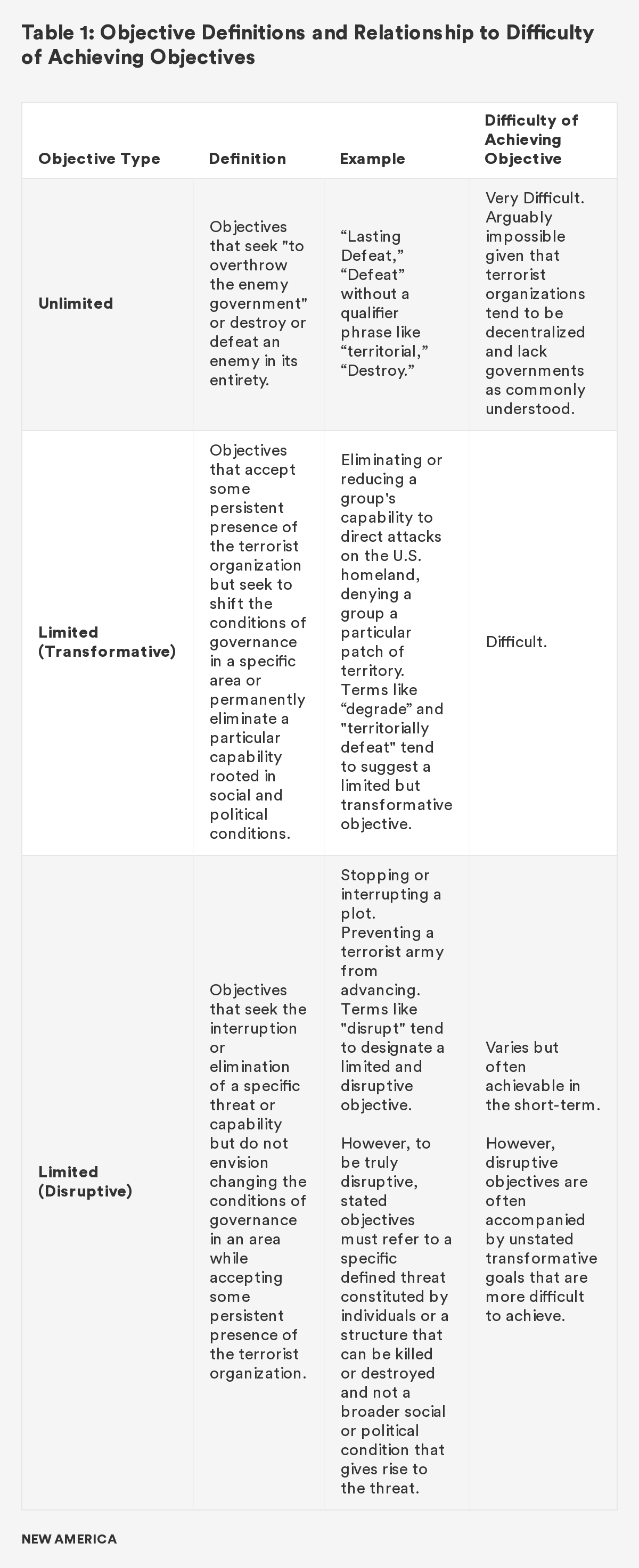
War objectives are either unlimited or limited. As Donald Stoker, professor of strategy and policy at the Naval Postgraduate School in Monterey, Calif., argues, the determination of whether a war is limited or unlimited is fundamentally a question of the limited or unlimited character of its objectives. For Stoker, channeling Julian Corbett, unlimited objectives are those that seek 鈥渢o overthrow the enemy government鈥� and anything that seeks 鈥渟omething less鈥� constitutes a limited objective.26
Stoker warns that definitions of limited war not based in this distinction blur means and ends in a way that deprives the term of analytical usefulness.27 Indeed, many of the United States鈥� post-9/11 wars waged for unlimited objectives have been shaped by limitations on means and a light footprint model that backfired.28 One prominent example is the American decision to adopt an unlimited objective of regime change in Libya along with transformative objectives regarding what would replace the Ghaddafi regime while refusing to commit significant troops, attention, or resources, helping fuel an internationalized civil war.29
In the context of America鈥檚 counterterrorism wars, Bush鈥檚 promise that the war 鈥渨ill not end until every terrorist group of global reach has been found, stopped and defeated,鈥� Obama鈥檚 statements that 鈥渨e鈥檝e sent a message from the Afghan border to the Arabian Peninsula to all parts of the globe: We will not relent, we will not waver, and we will defeat you鈥� regarding al-Qaeda and regarding ISIS, that 鈥渙ur objective is clear: We will degrade, and ultimately destroy, ISIL through a comprehensive and sustained counterterrorism strategy鈥� all constitute unlimited objectives.30 国产视频 statement that 鈥渢errorists who oppress and murder innocent people should never sleep soundly, knowing that we will completely destroy them. These savage monsters will not escape their fate, and they will not escape the final judgment of God鈥� puts forward an unlimited objective as did his administration鈥檚 more staid comment that 鈥渋t is the policy of the United States that ISIS be defeated.鈥�31 Joe Biden鈥檚 statement that we should 鈥渘arrowly define our mission as defeating al-Qaeda and the Islamic State (or ISIS)鈥� is also an unlimited objective even though he says the U.S. will pursue the aim narrowly.32
Limited objectives can be further divided into two types. Some objectives are limited but transformative in that they seek a broader change in social and political conditions via the use of military force.33 Unlike an unlimited objective, a transformative but limited objective would seek such transformation only in a particular area or with regard to a specific capability without defeating the enemy as a whole. Transformative objectives tend to be expressed with terms like 鈥渄egrade.鈥� Terms like 鈥渄estroy鈥� and 鈥渄efeat鈥� can also express transformative objectives when qualified by a particular object short of the enemy as a whole, as in 鈥渢erritorial defeat.鈥� When CENTCOM releases a press release describing counterterrorism strikes in Yemen while saying the strikes were meant 鈥渢o degrade these groups鈥� ability to hold territory and coordinate external attacks,鈥� those are limited but transformative objectives.34 The named aim does not mention the defeat of AQAP, but it does seek to reshape the conditions in Yemen to prevent AQAP from holding territory or organizing plots without mentioning a specific plot in need of disruption.
Transformative objectives can be contrasted with disruptive objectives that seek to merely interrupt or eliminate a rival鈥檚 capability to achieve a particular objective or outcome without reshaping the political and social conditions of an area.35 Limited and disruptive objectives are defined in terms of particular threats, for example an aim of rescuing particular hostages, killing the individuals plotting a particular attack or set of attacks on the United States, or halting a terrorist army from advancing.36 For example, the United States鈥� effort to track down and kill Anwar al-Awlaki constituted a disruptive objective. While the U.S. also pursued more transformative and even unlimited objectives in its counterterrorism war in Yemen, the killing of Awlaki was not viewed as a means of re-writing Yemeni governance. Instead it was justified mainly as a means of removing a figure thought to be particularly dangerous due to his role in specific plots that the U.S. believed would at least be interrupted or made less effective upon his death.37 Similarly, the attempted raid to rescue Americans held hostage by ISIS in Raqqa on July 3, 2014 was not viewed within the U.S. government as part of a campaign to defeat or degrade ISIS but as a specific effort to rescue Americans held hostage, a limited and disruptive objective.38
Assessing the Difficulty of Achieving Unlimited Objectives
An objective鈥檚 type does not inherently define the difficulty of achieving it. Some unlimited objectives may be easy to achieve. One examination of multiple databases of terrorist groups suggests that an average of 50 percent of terrorist groups across the databases do not survive past their first year.39 This finding would seem to suggest that it is far from impossible to destroy or defeat a terrorist group. In contrast, some limited objectives may be impossible to achieve. For example, it is likely impossible that the United States can degrade an entrenched terrorist group intent on striking the U.S. homeland鈥攍ike al-Qaeda鈥攕ufficiently to prevent it from successfully carrying out an attack in perpetuity.
However, there are general trends regarding the achievability of particular objective types that require examination. A failure to account for the type of objective being sought and its relationship to achievability contributes to the endless character of America鈥檚 wars.
Unlimited objectives in counterterrorism warfare tend to be unachievable. It is arguably not even possible to formulate an achievable unlimited objective in the context of counterterrorism, as terrorist organizations generally do not have governments that can be destroyed. A useful warning about expanding the definition of unlimited objectives to include the total extirpation of a movement can be extrapolated from Corbett鈥檚 discussion of naval strategy where he states, 鈥淣o degree of naval superiority can ensure our communications against sporadic attack from detached cruisers, or even raiding squadrons if they be boldly led and are prepared to risk destruction … By general and permanent control we do not mean that the enemy can do nothing, but that he cannot interfere with our maritime trade and oversea operations so seriously as to affect the issue of the war, and that he cannot carry on his own trade and operations except at such risk and hazard as to remove them from the field of practical strategy.鈥�40
Even if destroying a terrorist group as a whole is understood to be a coherent unlimited objective, data on terrorist group longevity suggests that achieving unlimited objectives is difficult. Thus, making an unlimited aim the objective of a counterterrorism war is usually a recipe for endless war.
A 2008 RAND study of post-1968 terrorist group fates by Seth Jones and Martin Libicki found that 鈥渕ilitary force has rarely been the primary reason for the end of terrorist groups.鈥�41 Studies like that by Jones and Libicki may still overestimate the potential for military defeat of terrorist groups. As Jonathan Powell, British Prime Minister Tony Blair鈥檚 former chief of staff and chief negotiator in the Northern Ireland peace process, has argued even these studies and ones like them tend to produce an inflated sense of the potential for victory by including small groups alongside more entrenched, larger terrorist groups when few if any entrenched, larger groups have been defeated or come to an end except via negotiations.42
A look at the terrorist groups the United States has fought its counterterrorism wars against suggests they tend to fall into the category of larger, more entrenched groups resilient to military defeat.43 The United States has been fighting various incarnations of ISIS for more than 17 years, and failed to defeat the group despite having 150,000 troops in Iraq, a cost Americans were unwilling to accept.44 Despite almost 20 years of war in Afghanistan, and more than a decade of drone strikes in Pakistan, al-Qaeda continues to exist in South Asia though in a substantially degraded form.45 In addition, al-Qaeda continues to operate across the Greater Middle East, is now at least 32 years old, and is more than 24 years into its declared war on the United States.46
Former government officials who have worked on counterterrorism policy are cognizant of the difficulty of achieving unlimited objectives like the defeat of al-Qaeda or ISIS. For example, former National Counterterrorism Center Director Nicholas Rasmussen has warned that words like 鈥渄efeat, destroy, or deny鈥� constitute 鈥渧ery ambitious objectives that, even if we were maximally resourced, even if everything broke our way in the international environment, even if every positive projection of the international environment you could develop came true, we still would have struggled to meet those objectives on the kind of timeline we were setting for ourselves.鈥�47 Similarly, Rosa Brooks, a former counselor to Under Secretary of Defense for Policy Michele Flournoy, wrote regarding terrorism, 鈥渨e need to 鈥� recognize it as an ongoing problem to be managed, rather than 鈥榙efeated.鈥欌��48
Two limits on the ability of the United States to defeat terrorist groups are worth exploring in particular. First, America鈥檚 jihadist enemies鈥� resilience is rooted in the fact that they draw upon and give voice to real grievances and socio-economic problems in the Greater Middle East.49 Second, jihadist groups have decentralized, giving rise to affiliates and front groups while also playing up their identity as brands so any individual can claim to act in their name.50 As a result, even in the rare cases where a jihadist terrorist organization might be defeated, it can reconstitute itself or serve as an inspiration for a new organization, and where groups are not eliminated, the networked nature of the jihadist movement can help sustain groups that are struggling due to counterterrorism pressure.
The selection of unlimited objectives can also militate against the pursuit of negotiations, which are critical to resolving conflicts. As noted above, entanglements with entrenched terrorist groups, like those the U.S. is currently fighting, tend to end only via negotiations that integrate them into political arrangements and resolve their grievances to some extent.51 Yet, the rhetoric that is used to emphasize the need to defeat or destroy terrorist groups tends to label the groups and those who join them as inherently evil 鈥� hence the need for destruction and not simply limited aims to protect specific interests.
President George W. Bush summed up his administration鈥檚 views regarding the United States鈥� negotiations with the Taliban after 9/11, saying, 鈥淭hese demands are not open to negotiation or discussion. The Taliban must act, and act immediately. They will hand over the terrorists, or they will share in their fate,鈥� continuing to assert, 鈥淓very nation, in every region, now has a decision to make. Either you are with us, or you are with the terrorists. From this day forward, any nation that continues to harbor or support terrorism will be regarded by the United States as a hostile regime.鈥�52 The tendency to dismiss negotiation and promote Manicheanism even when it came to states regarding their level of enthusiasm for the war on terror hardly left room to consider negotiation with the terrorists themselves. Of course, all governments deny they will negotiate with terrorists, but it is also worth noting how Bush administration figures like Vice President Dick Cheney sought to torpedo negotiations with the Taliban even over such matters as prisoners.53
The power of unlimited objectives to militate against negotiations has not disappeared even as the United States has pursued negotiations with the Taliban. Former Trump National Security Adviser Lieutenant General H.R. McMaster compared negotiations with the Taliban to Neville Chamberlain鈥檚 appeasement of the Nazis. Notably, the reason McMaster gives for this absurd analogy is that the process 鈥渞enders the war unjust, because we no longer have defined a just end,鈥� presumably because he describes the enemy as 鈥渟ome of the most horrible people on earth. These are the enemies of all civilized people鈥� who require defeat and destruction.54
The point about negotiations is not simply a matter of restating the difficulty of achieving unlimited objectives. Even where the United States is in the position to deal a terrorist group a substantial military defeat, the only true way to ensure that the tactical victories can be translated and consolidated into strategic victory is via negotiation and the other party鈥檚 acceptance of a new political arrangement. As Clausewitz warned, even where an enemy鈥檚 forces are entirely destroyed and their country occupied, 鈥渂oth these things may be done and the war, that is the animosity and the reciprocal effects of the hostile elements cannot be considered to have ended so long as the enemy鈥檚 will has not been broke: in other words, so long as the enemy government and its allies have not been driven to ask for peace, or the population made to submit.鈥�55 This is why Clausewitz emphasizes the concept of the 鈥減eace treaty,鈥� writing that 鈥渆ven if hostilities should occur again, a peace treaty will always extinguish a mass of sparks that might have gone on quietly smoldering.鈥�56
The unlimited objectives at work in counterterrorism warfare rarely countenance the possibility of a peace treaty even in victory with unconditional or highly favorable terms. As George W. Bush put it in 2005, 鈥淚n World War II, victory came when the empire of Japan surrendered on the deck of the USS Missouri. In Iraq, there will not be a signing ceremony on the deck of a battleship. Victory will come when the terrorists and Saddamists can no longer threaten Iraq's democracy, when the Iraqi security forces can provide for the safety of their own citizens, and when Iraq is not a safe haven for terrorists to plot new attacks on our nation.鈥�57 Ivo Daalder and James M. Lindsay similarly noted in December 2001 that 鈥渢he United States campaign against terrorism will not be like America鈥檚 effort to force Japan鈥檚 unconditional surrender.鈥�58 They added:
The campaign against terrorism is instead much more like the cold war of the past century. Like the fight against Soviet communism, today鈥檚 campaign against terrorism is likely to be nasty, brutish, and long. Because of the diverse nature of the threat, the United States has no clear vision of when or how the war will end. Complete success in the military operations in Afghanistan will not necessarily mean victory. Osama bin Laden鈥檚 Al Qaeda network of terrorists extends well beyond Afghanistan. It could easily reconstitute itself even if the United States captures or kills bin Laden and his lieutenants.59
That the United States and its allies failed to engage the Taliban in negotiations during and around the Bonn talks in 2001 and 2002 over the future of the Afghan government when the United States was at the peak of its relative power in Afghanistan, having destroyed the Taliban state illustrates the catastrophic consequences of rejecting negotiation to pursue unlimited aims of total destruction.60 Instead the United States left negotiations with the Taliban until much later. As General Nick Carter, the deputy commander of Western forces in Afghanistan put it in June 2013, 鈥淏ack in 2002, the Taliban were on the run. I think that at that stage, if we had been very prescient, we might have spotted that a final political solution to what started in 2001, from our perspective would have involved getting all Afghans to sit at the table and talk about their future …. The problems that we have been encountering over the period since then are essentially all political problems, and political problems can only ever be solved by people talking to each other.鈥�61
Even in the oft-cited unconditional surrender of Imperial Japan to the United States in World War II, there was still negotiation over the surrender terms (with the final acceptance of unconditional surrender) and not simply the elimination of everyone involved in the prior regime. Indeed, the United States deliberately chose to maintain the Emperor as a figure and integrate him into the new system because they feared not doing so would preclude the ability to consolidate the victory.62
A comparison of the Japanese case to today鈥檚 counterterrorism wars also helps reveal the definitional problem that haunts theories of unlimited objectives with regard to terrorists. In the Japanese case, the U.S. could claim the achievement of its unlimited objective because the referent point was the Japanese state, not every Japanese imperial figure as an individual. However, terrorists generally do not have the same kind of established state-like structures, meaning that unlimited objectives like 鈥渓asting defeat鈥� or 鈥渄estroy鈥� bleed into broader and more difficult-to-achieve aims, like making every terrorist or adherent of the movement disengage.63 The current politicized debate around Western ISIS detainees reveals the humanitarian dangers and counterproductive impact on security interests of tying these challenges too closely to military objectives, presumed guilt in atrocities, and preventive security fears.64 Many citizens of western countries including women and children have been left in poor conditions in Syria or even stripped of citizenship as their status is interpreted through the risks they may pose in a continuing conflict rather than as an issue of human rights and demobilization and disengagement of armed actors.
That terrorist groups are closer to a movement than to a state makes it essential to clearly specify the limited objectives being sought鈥攅ven if they are quite transformative or involve the destruction of specific organizational structures鈥攔ather than fueling a floating image of total defeat. The claim that destroying a particular terrorist structure is the same as destroying the terrorist group just does not ring true to people, nor should it, given how terrorist groups often strategically shift structure while maintaining continuity in a way states are rarely capable of.
At the same time, the moral power mobilized by and through the language of unlimited objectives imposes political constraints on admitting that the aim was always just a limited objective, such as denying territory to ISIS or degrading its ability to project power. One鈥檚 political rivals can launch accusations of failing to destroy the remaining adherents. If one has proclaimed defeat as the necessary aim, it then becomes difficult to credibly claim defeat really meant something more limited. This point is illustrated by the wave of public criticism of Trump for asserting that ISIS was 100 percent defeated. The claim became an oft-fact checked issue because 国产视频 own rhetoric about destroying ISIS signaled broader aims, even when he seemed to suggest that he might only mean territorial destruction.65
Meanwhile, the use of the language of unlimited objectives rather than the explicit definition and statement of limited objectives in measurable terms鈥攚hether it is ISIS鈥檚 territorial destruction or something else鈥攐pens the door for bureaucratic manipulation and invention of new objectives to maintain the presence. James Jeffrey, the former special representative for Syria Engagement and special envoy to the Global Coalition to Defeat Islamic State under Trump, appears to have admitted he took precisely this approach, saying: 鈥淲hen the situation in northeast Syria had been fairly stable after we defeated ISIS, [Trump] was inclined to pull out. In each case, we then decided to come up with five better arguments for why we needed to stay. And we succeeded both times. That鈥檚 the story,鈥� while going so far as to conceal the number of troops in Syria from Trump.66
Trump would have been better placed to mobilize support for a withdrawal if he had simply made the case that the specific, limited objectives that implicated U.S. interests had been achieved rather than invoking the moral mantle of destroying the enemy entirely, something he clearly had not done. While these examples are partially the result of 国产视频 particular style of decision-making and failure to lead, it also reveals how the proclamation of unlimited objectives is ripe for confusion and abuse in ways that promote endlessness.
Assessing the Difficulty of Achieving Limited Objectives
Limited objectives tend to be more achievable than unlimited objectives as they do not require the complete destruction of an enemy. But they also vary in the extent to which they are achievable.
Transformative objectives, despite being limited, still require a sufficient application of coercive power to eliminate effective challenges to the desired new order. While American history provides examples of the successful completion of transformative objectives, it is important to keep in mind that many of these successes were achieved through the use of significant violence and acceptance of illiberal means.67 The history of failure of U.S. regime change cautions against transformative aims, as do the substantial differences between today鈥檚 Middle Eastern context and the context of the oft-cited transformative efforts in the wake of World War II.68 In addition, the process of ordering another society tends to produce resistance from those who do not like the new order, even if they were not the original target of force. Too often, the United States has missed how its own interventions generate resistance.69 Where transformative objectives are set without a commitment to the expenditure of sufficient resources and use of sufficient force to effectively reorder society, war will become endless in the form of constantly fighting against the latest opponents of the new order.70 It is not even clear whether greater commitment could resolve the issue. Research on civil wars suggests that external intervention can prolong conflict by reshaping both domestic and international incentives regarding the conflict.71 Moreover, the inevitable civilian casualties that will come with a U.S. intervention of the sort capable of transforming Middle Eastern politics via military force will likely serve to fuel radicalization across the region, as occurred in Iraq.
In contrast to transformative objectives, disruptive objectives tend to be achievable for the United States. For example, the United States proved more than capable of demolishing Saddam Hussein鈥檚 regime. This is not to say that disruptive objectives are always achievable. For example, an operation to rescue hostages is a complex operation that can fail for many reasons, and it took almost a decade for the United States to track down and kill Bin Laden.72 The specifics matter, but disruption of specific threats tends to be more achievable than transformation.
The danger with embracing disruptive objectives is less that the specific objective will turn out to be unachievable, but more that mere disruption will prove unsatisfying. Wars initiated with limited and disruptive objectives can generate endless war in the form of continuous raiding when the capability to be disrupted arises from political and societal conditions that will continue even once the objective of disruption is achieved.73 In such a case, the unstated aim was not disruptive but transformative, seeking to change societal conditions so the threat would not arise again.
This danger is particularly likely to arise when disruptive objectives are not framed in terms of specific, imminent threats but as a means of preventing a rival actor from gaining a future capability. Preventive war logic is, at its root, the expression of a transformative objective鈥攃reate societal conditions that prevent the growth of a threat鈥攎asquerading as a disruptive objective of destroying a specific capability. Because the capability does not exist yet in a manner that poses an imminent threat, portraying the aim as disruptive is inaccurate, and produces a focus on capabilities that tends to miss how preventive war signals aggression, often making threats worse鈥攚hat West Point鈥檚 Scott Silverstone terms the 鈥減reventive war paradox.鈥�74 Moreover, once a state accepts prevention of future threats as a legitimate justification for war, the realm of imaginable scenarios that might justify military action in the future expands with few limits, either geographically or temporally.75
Unclear or Undefined Objectives
Unclear objectives have also contributed to the endlessness of American counterterrorism wars.76 The war in Afghanistan provides one example. As the Washington Post鈥檚 Craig Whitlock put it in his report on the so-called Afghanistan Papers:
In the beginning, the rationale for invading Afghanistan was clear: to destroy al-Qaeda, topple the Taliban and prevent a repeat of the 9/11 terrorist attacks … In hundreds of confidential interviews that constitute a secret history of the war, U.S. and allied officials admitted they veered off in directions that had little to do with al-Qaeda or 9/11. By expanding the original mission, they said they adopted fatally flawed warfighting strategies based on misguided assumptions about a country they did not understand. The result: an unwinnable conflict with no easy way out.77
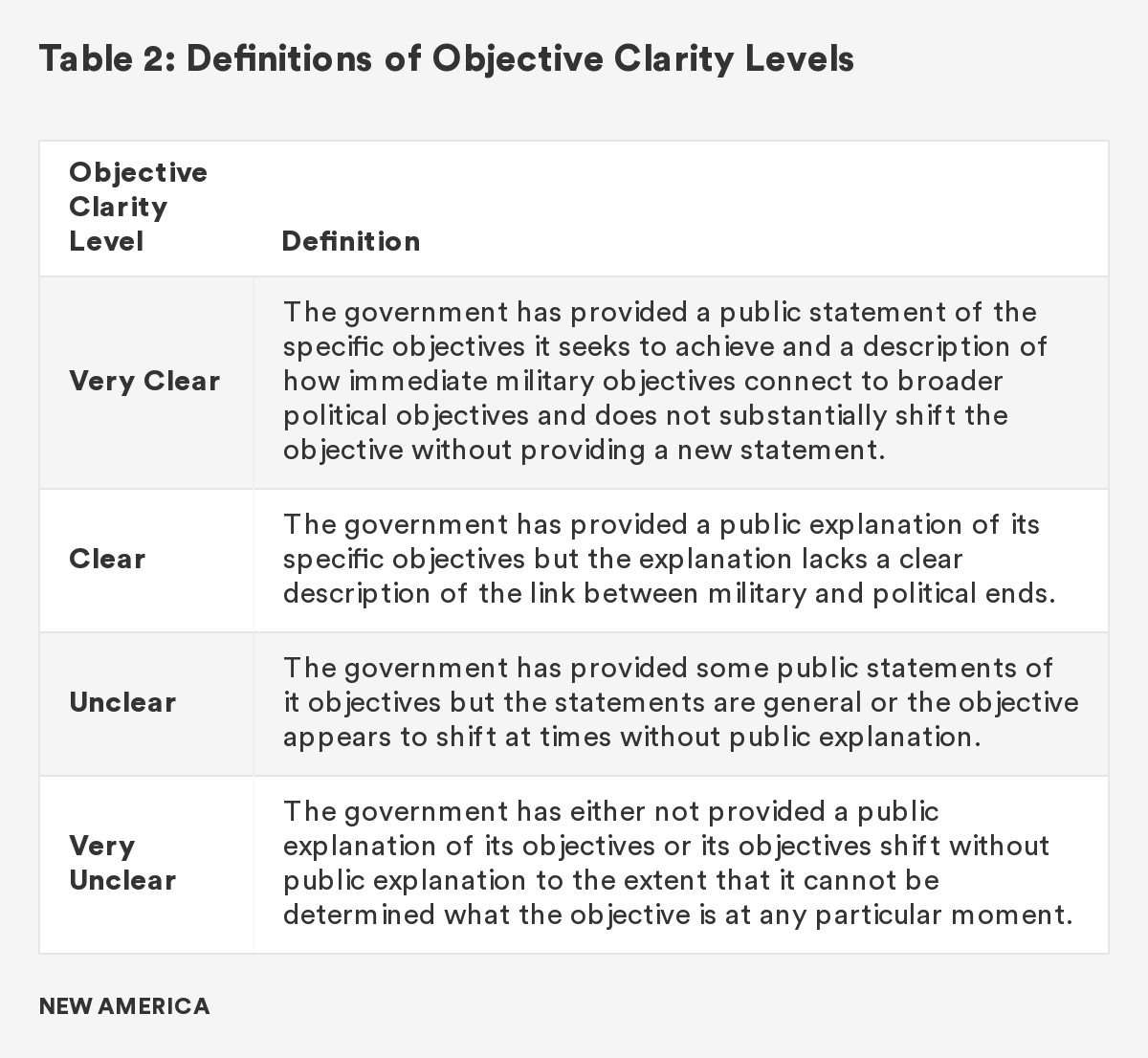
When the United States fails to publicly lay out what it seeks to achieve, it can produce endless war by resulting in constantly shifting objectives in reaction to the conflict, denying the clear ability to determine when the objectives have been achieved.78 Shifting or unclear objectives can also enable politicians to purposefully manipulate opinion to generate support for war.79
Further, without a clear statement of American objectives, a reduction or pause in the use of military force that signifies the end of a war cannot be meaningfully distinguished from a pause that merely denotes a tactical adjustment. For example, there has not been a drone strike in Pakistan in more than two years, yet it is difficult to assess whether the war has ended because it is not clear whether the United States views its objectives as having been achieved, has stopped pursuing its objectives, or just views a temporary pause as tactically beneficial.80 As this example demonstrates, even wars that are not being actively fought can take on an endless character when objectives lack clarity.
This report assesses the level of clarity on a scale of Very Clear, Clear, Unclear, or Very Unclear as defined in Table 2. These judgments are made based on the extent to which public statements lay out specific objectives and do not shift without public explanation and description of new objectives.
Absence of Exit Strategies and War Termination Plans
The pursuit of objectives without planning for an off-ramp or war termination has also contributed to the endless character of America鈥檚 wars.81 An objective may seem to have been accomplished, but only insofar as force continues to be applied, effectively accepting a state of permanent war.
Confronted with an apparent success combined with a failure to actually achieve the objective in a way that allows war termination, decision-makers will tend to expand the objective to transformative or unlimited ends to resolve the conundrum and achieve a lasting defeat. However, such an expansion will often鈥攁t least in the context of counterterrorism war鈥攏ot bring the United States closer to having achievable objectives and a meaningful plan for war termination.
Alternatively, policymakers sometimes respond to such a situation by developing a strategy of repeated raiding as a form of militarized management. Victory is declared only to see such victory turn to dust in a few years.82 Such a strategy may acknowledge that it is unable to sustainably terminate the war beyond the short-term, but view permanent low-level war as an acceptable approach. An example of this strategy is the 鈥渕owing the grass鈥� theory prominent in Israeli strategic circles.83 The discourse of mowing the grass has already emerged among top U.S. policymakers, as illustrated by Secretary of Defense Mark Esper鈥檚 use of the phrase regarding counterterrorism strikes in Libya.84
The importance of planning for war termination should not be understood as requiring a mechanistic and fully mapped out plan for how to withdraw troops upon initiation of the war. Calls for the importance of having an exit strategy have long received criticism for their ability to distract from the political objectives being sought, over-rationalizing the complex interactions that occur once a war starts, promoting overconfidence in one鈥檚 intelligence regarding the war鈥檚 character, and establishing weak plans that fall apart upon contact with the enemy.85 However, simply dismissing the importance of considering exit strategies and developing war termination options at all stages of a war misunderstands how such efforts can clarify political objectives and has a tendency to explicitly legitimize endless war by accepting an unresolved stalemate as the successful completion of an objective, which in the final analysis it is not.86
War termination is particularly difficult when it comes to wars against jihadist terrorists. The gold standard for war termination is the holding of negotiations with the opposing party that produce an agreement to halt the war.87 Across history, states have been reticent to engage in negotiations with terrorists.88 States tend to fear granting legitimacy to non-state groups, and also tend to view terrorism鈥攕pecifically targeting civilians鈥攁s a sign that a group has maximal ends and will not negotiate.89 In addition, some of the jihadist groups the United States is at war with do actually have unlimited or at least transformative objectives of their own that makes negotiation to terminate a war difficult.
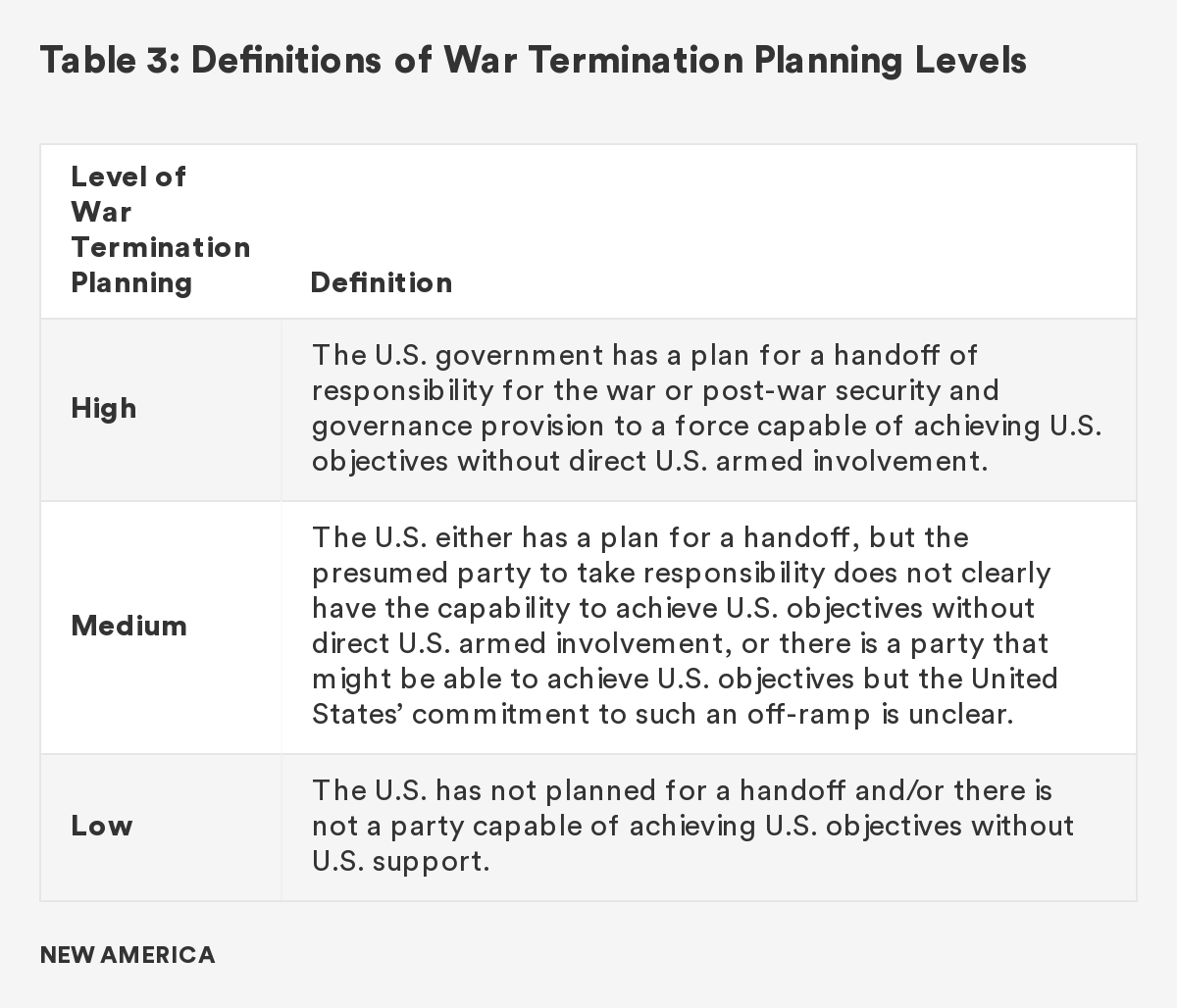
As a result, states waging counterterrorism wars鈥攁nd particularly states like the United States that are fighting primarily outside of their own territory where the enemy lacks the capability to threaten the power鈥檚 homeland in a major way鈥攐ften find themselves relying on a different form of off-ramp for war termination.90 That off-ramp is shifting the waging of the war to a partner or other entity that can take over security provision. For many counterinsurgency theorists, this is the very definition of victory.91
In order to allow for comparison of the extent of war termination planning and capabilities across and within cases, this report rates the level of planning and capability as High, Medium, or Low (See Table 3).
Citations
- On the lack of an existential threat and general limitations to the terrorist threat see: Peter L. Bergen, United States of Jihad: Investigating America鈥檚 Homegrown Terrorists, First edition (New York: Crown Publishers, 2016); John E. Mueller and Mark G. Stewart, Chasing Ghosts: The Policing of Terrorism (Oxford鈥�; New York: Oxford University Press, 2016); John Mueller and Mark G. Stewart, 鈥淢isoverestimating ISIS: Comparisons with Al-Qaeda,鈥� Perspectives on Terrorism 10, no. 4 (August 2016), ; 鈥淩emarks by National Security Advisor Susan Rice on the 2015 National Security Strategy鈥� (White House Office of the Press Secretary, February 6, 2015), .
- Even in the case of World War II, there is debate over the extent to which the United States saw its homeland as threatened. On this point see: Stephen Wertheim, Tomorrow, the World: The Birth of U.S. Global Supremacy (Cambridge, Massachusetts: The Belknap Press of Harvard University Press, 2020); Daniel Immerwahr, How to Hide an Empire: A History of the Greater United States, First edition (New York: Farrar, Straus and Giroux, 2019); Patrick Porter, The Global Village Myth: Distance, War and the Limits of Power (Washington, DC: Georgetown University Press, 2015), 64鈥�76.
- There are two ways that jihadists might hold objectives that do not include the defeat of the West. One possibility is that an organization does not view the West as part of the historical territory of Islam and views its war objectives as defensive and limited to expelling the United States from specific territories. Such an argument is made with regard to al-Qaeda in Michael Scheuer, Imperial Hubris: Why the West Is Losing the War on Terror (Washington, DC: Potomac Books, 2005). There are also a number of groups (or even individuals) that might be described as part of a broader jihadist movement but that have adopted even more limited objectives that are less extensive than al-Qaeda鈥檚. For an examination of the many disputes over these issues as viewed through the prism of the fight over how to interpret the legacy of one of the jihadist movement鈥檚 major figures, see: Thomas Hegghammer, The Caravan: Abdallah Azzam and the Rise of Global Jihad, 2020, 463鈥�92. For a comparative look at the extent to which unlimited objectives and apocalyptism feature in al-Qaeda and ISIS鈥� ideology, see: William F. McCants, The ISIS Apocalypse: The History, Strategy, and Doomsday Vision of the Islamic State, First Edition (New York: St. Martin鈥檚 Press, 2015). The second possibility is that jihadists do not have political objectives but instead have glorified the means of suicide terrorism as an aesthetic of radical revolt; goals that appear to be unlimited objectives may be referenced but they do not function as a driver of strategy so much as a reference point for the expression of identity. On this possibility, see: Olivier Roy and Cynthia Schoch, Jihad and Death: The Global Appeal of Islamic State (New York: Oxford University Press, 2017). Different jihadist groups will likely have different objectives, and any one group or individual will likely be influenced by multiple visions of what jihadism鈥檚 objectives might be that can change over time.
- See, for example: Frederick W. Kagan et al., 鈥淎l Qaeda and ISIS: Existential Threats to the U.S. and Europe鈥� (Institute for the Study of War, January 2016), ; Walter Russell Mead, 鈥淭he Threats From Within,鈥� Wall Street Journal, February 1, 2016, .
- See, for example: Gilles Kepel and Antoine Jardin, Terror in France: The Rise of Jihad in the West, Princeton Studies in Muslim Politics (Princeton; Oxford: Princeton University Press, 2017), xii.
- Donald J. Stoker, Why America Loses Wars: Limited War and US Strategy from the Korean War to the Present (Cambridge, United Kingdom; New York, NY, USA: Cambridge University Press, 2019), 66; Lawrence Freedman, 鈥淥n War and Choice,鈥� The National Interest, April 20, 2010, .
- Freedman, 鈥淥n War and Choice.鈥�
- Freedman.
- John Mueller and Mark G. Stewart, 鈥淭errorism and Bathtubs: Comparing and Assessing the Risks,鈥� Terrorism and Political Violence, October 29, 2018, 1鈥�26, .
- Sterman, 鈥淒ecision-Making in the Counter-ISIS War: Assessing the Role of Preventive War Logic.鈥�
- David Sterman, Peter Bergen, and Melissa Salyk-Virk, 鈥淭errorism in America 19 Years After 9/11鈥� (国产视频, September 11, 2020), source; Sterman, 鈥淒ecision-Making in the Counter-ISIS War: Assessing the Role of Preventive War Logic鈥�; Alex Meleagrou-Hitchens, Seamus Hughes, and Bennett Clifford, Homegrown: ISIS In America (London: I.B. Taurus, 2020), 80.
- Sterman, Bergen, and Salyk-Virk, 鈥淭errorism in America 19 Years After 9/11鈥�; David Sterman, 鈥淲e Need More Oversight on US Counterterrorism Policy in the Wake of AQAP鈥檚 Confirmed Involvement in the Pensacola Attack,鈥� Responsible Statecraft, May 22, 2020, .
- For a detailed examination of this dynamic that emphasizes ISIS鈥� role in structuring the threat via online communication between operatives acting as virtual enablers and attackers, see: Meleagrou-Hitchens, Hughes, and Clifford, Homegrown: ISIS In America.
- John Mueller, 鈥淭he Cybercoaching of Terrorists: Cause for Alarm?,鈥� CTC Sentinel 10, no. 9 (October 2017), .
- Sterman, Bergen, and Salyk-Virk, 鈥淭errorism in America 19 Years After 9/11.鈥�
- Some have argued more broadly that scholarly work on U.S. foreign policy has overemphasized the importance of factors outside the United States and underestimated domestic politics as a core cause given the vast concentration of power in the United States and its role in ordering the international system. This author is sympathetic to this view, but regardless of its broader applicability and questions of what constitutes scholarly value, it holds particular importance when it comes to the assessing how scholarly and semi-scholarly products interpret the threat from terrorists and the causes of the war on terror. See: Daniel Bessner and Fredrik Logevall, 鈥淩ecentering the United States in the Historiography of American Foreign Relations,鈥� Texas National Security Review, Spring 2020, .
- Julian Stafford Corbett, Principles of Maritime Strategy (Project Gutenberg, 2005), .
- For claims of strategic narcissism, see: Joscelyn, 鈥淓ndless Jihad: The Problem with Pledging to End Our 鈥楨ndless Wars.鈥欌��
- On the power of individual leader choices and views of how to understand threats and their origins in shaping U.S. policy, see: Elizabeth N Saunders, Leaders at War How Presidents Shape Military Interventions, 2011.
- Martin Chulov, 鈥淚sis Insurgents Seize Control of Iraqi City of Mosul,鈥� The Guardian, June 10, 2014, ; Ash Carter, 鈥淎 Lasting Defeat: The Campaign to Destroy ISIS鈥� (Belfer Center, October 2017), .
- 鈥淎fghanistan Protection of Civilians in Armed Conflict 2019鈥� (United Nations Assistance Mission in Afghanistan / United Nations Human Rights Office of the High Commissioner, February 2020).
- That noted, states like Iraq and Afghanistan that lack the protection of oceans and are fighting on their own national territory may be able to replicate similar, if lesser, dynamics of strategic distance over parts of their territory that could justify a return to focusing on governmental decision making as the primary factor in shaping the character of war.
- 鈥淪tate of the Union: Text of George W. Bush鈥檚 Speech,鈥� Guardian, September 21, 2001, .
- David Sterman, 鈥淔or Effective Counterterrorism, Abandon the Language of Defeat,鈥� Responsible Statecraft, February 7, 2020, .
- 鈥淭rump Campaign Announces President 国产视频 2nd Term Agenda: Fighting For You!,鈥� DonaldJTrump.Com, August 23, 2020, .
- Stoker, Why America Loses Wars, 5.
- Stoker, Why America Loses Wars.
- Brad Stapleton, 鈥淭he Problem with the Light Footprint: Shifting Tactics in Lieu of Strategy鈥� (CATO, June 7, 2016), .
- Frederic M. Wehrey, 鈥溾�楾his War Is Out of Our Hands鈥� The Internationalization of Libya鈥檚 Post-2011 Conflicts from Proxies to Boots on the Ground鈥� (国产视频, September 14, 2020), source; Frederic M. Wehrey, The Burning Shores: Inside the Battle for the New Libya, First Edition (New York: Farrar, Straus and Giroux, 2018). While the United States鈥� initial stated objective could be viewed as limited 鈥� preventing Ghaddafi from committing atrocities in Benghazi 鈥� it was generally understood as being in actuality an unlimited aim of deposing Ghaddafi. On this, see: Philip H. Gordon, Losing the Long Game: The False Promise of Regime Change in the Middle East, First Edition (New York: St. Martin鈥檚 Press, 2020), Kindle Location 3071-3087.
- 鈥淪tate of the Union: Text of George W. Bush鈥檚 Speech鈥�; 鈥淩emarks by the President in State of Union Address鈥� (The White House Office of the Press Secretary, January 25, 2011), ; 鈥淪tatement by the President on ISIL鈥� (The White House Office of the Press Secretary, September 10, 2014), 10, .
- 鈥淩emarks by President Trump on the Death of ISIS Leader Abu Bakr Al-Baghdadi鈥� (The White House, October 27, 2019), ; 鈥淧residential Memorandum Plan to Defeat the Islamic State of Iraq and Syria鈥� (The White House, January 28, 2017), .
- Biden Jr., 鈥淲hy America Must Lead Again.鈥�
- This distinction between transformative and disruptive objectives expands on the description of the importance of such a distinction in proxy warfare described by Nate Rosenblatt and David Kilcullen, 鈥淭he Tweet of Damocles: Lessons for U.S. Proxy Warfare鈥� (国产视频, April 6, 2020), source. It also draws upon work by George Washington University Assistant Professor Elizabeth Saunders whose book on presidential leadership in war emphasizes the distinction鈥檚 importance and shows how even with the challenges of drawing a bright line, transformative objectives can be distinguished from non-transformative ones in a way conducive to analysis. Saunders, Leaders at War How Presidents Shape Military Interventions.
- 鈥淯.S. Air Strikes Kill Senior AQAP Militants鈥� (U.S. Central Command, January 10, 2018), .
- Any use of military force will transform a targeted area鈥檚 politics and society, introducing an element of instability into this distinction. However, the inevitable existence of some transformative effect does not eliminate the difference when it comes to whether transformation is an effect of the intervention or a guiding aim.
- Sometimes an effort to deny or remove an enemy from territory can be considered disruptive if the group does not exercise substantial control and has not established sustained governance structures. For example, the effort to break the siege of Mt. Sinjar can be considered a disruptive objective as ISIS鈥� hold of the area was not based in societal conditions that would require transformation so much as the presence of its military forces. However, in most cases the removal or rollback of territorial gains by a terrorist group constitutes a transformative objective.
- Eric. H. Holder Jr., 鈥淟etter to Patrick J. Leahy, Chairman Committee on the Judiciary, United States Senate,鈥� May 22, 2013, ; Thomas Hegghammer, 鈥淭he Case for Chasing Al-Awlaki,鈥� Foreign Policy, November 24, 2010, .
- Author鈥檚 Interview with a former senior government official. On the rescue attempt see: Karen DeYoung, 鈥淭he Anatomy of a Failed Hostage Rescue Deep in Islamic State Territory,鈥� Washington Post, February 14, 2015, .
- Notably, this percentage is lower than the oft-cited 90 percent first year die-off rate statistic, leading Brian Phillips, the author of the analysis to note that 鈥淭his suggests terrorist groups are more durable than the conventional wisdom indicates.鈥� Brian J. Phillips, 鈥淒o 90 Percent of Terrorist Groups Last Less than a Year? Updating the Conventional Wisdom,鈥� Terrorism and Political Violence 31, no. 6 (November 2, 2019): 1255鈥�65, .
- Corbett, Principles of Maritime Strategy, 105.
- Seth G. Jones and Martin C. Libicki, How Terrorist Groups End: Lessons for Countering Al Qa鈥檌da (Santa Monica, CA: Rand, 2008).
- Jonathan Powell, Terrorists at the Table: Why Negotiating Is the Only Way to Peace, First Palgrave Macmillan Trade edition (New York: Palgrave Macmillan Trade, 2015), 30.
- One indicator of this is that the jihadist movement broadly has generated foreign fighter flows that are unprecedented in their combination of transnational-ness and size compared to Marxist, Palestinian, and other groups of the past. The scholar Thomas Hegghammer calls the jihadist movement the 鈥減reeminent rebel movement of the post-Cold War era鈥� noting, 鈥渢ransnationalism has provided flexibility and redundance, allowing the movement to survive the loss of individual leaders and organizations 鈥� it is a fair bet that it will keep moving well into the twenty-first century.鈥� Hegghammer, The Caravan, 2鈥�3, 508.
- Brian Fishman, The Master Plan: ISIS, Al Qaeda, and the Jihadi Strategy for Final Victory (New Haven: Yale University Press, 2016), 252; Brian Fishman, 鈥淏e Honest: ISIS Fight Will Be a Long One,鈥� CNN, May 23, 2015, ; Peter Beinart, 鈥淭he Surge Fallacy,鈥� The Atlantic, September 2015,
- Asfandyar Mir, 鈥淎l-Qaeda鈥檚 Continuing Challenge to the United States,鈥� Lawfare, September 8, 2019, .
- Peter Bergen, David Sterman, and Melissa Salyk-Virk, 鈥淭errorism in America 18 Years After 9/11鈥� (国产视频, September 18, 2019), source; Dominic Tierney, 鈥淭he Twenty Year鈥檚 War,鈥� The Atlantic, August 23, 2016, . The question of when al-Qaeda was founded is a subject of debate, but it is generally believed that it had been founded at least by August 1988 and perhaps before. For a summary of discussions on when al-Qaeda was founded, see Hegghammer, The Caravan, 352鈥�57.
- David Sterman, 鈥淭he Success and Foreboding of American Counterterrorism,鈥� 国产视频 Weekly, May 9, 2019, source.
- Rosa Brooks, 鈥淭he Threat Is Already Inside,鈥� Foreign Policy, November 20, 2015, .
- Hegghammer, The Caravan; Aisha Ahmad, Jihad & Co: Black Markets and Islamist Power (New York, NY: Oxford University Press, 2017); Stathis N. Kalyvas, 鈥淚s ISIS a Revolutionary Group and If Yes, What Are the Implications,鈥� Perspectives on Terrorism 9, no. 4 (August 2015), .
- See for discussion of these dynamics: Christopher Blair et al., 鈥淭he Death and Life of Terrorist Networks,鈥� Foreign Affairs, October 5, 2020, ; Brian J. Phillips, 鈥淭errorist Group Cooperation and Longevity,鈥� International Studies Quarterly 58, no. 2 (June 2014): 336鈥�47, .
- Powell, Terrorists at the Table.
- 鈥淪tate of the Union: Text of George W. Bush鈥檚 Speech.鈥�
- Powell, Terrorists at the Table.
- Josh Rogin, 鈥淢cMaster Says 国产视频 Taliban Deal Is Munich-like Appeasement,鈥� Washington Post, October 19, 2020, .
- Carl von Clausewitz, Michael Eliot Howard, and Peter Paret, On War, First paperback printing (Princeton, N.J: Princeton University Press, 1989), 90. While an important point, Clausewitz鈥檚 theories may underplay how maritime powers can end wars in different ways than powers waging war in a context like continental Europe. See the discussion of Julian Corbett鈥檚 theories in the above section on the starkness of the terrorist threat.
- Clausewitz, Howard, and Paret, 90.
- George W. Bush, 鈥淭ranscript of Bush Speech鈥� (CNN, November 30, 2005), .
- Ivo H. Daalder and James M. Lindsay, 鈥淣asty, Brutish and Long: America鈥檚 War on Terrorism,鈥� Brookings Institution, December 1, 2001, .
- Daalder and Lindsay.
- Powell, Terrorists at the Table; David Sterman, 鈥淭he Essential Lessons of Terrorists at the Table,鈥� Foreign Policy, August 7, 2015, .
- Emma Graham-Harrison, 鈥溾�榃e Should Have Talked to Taliban鈥� Says Top British Officer in Afghanistan,鈥� Guardian, June 28, 2013, ; Jonathan Powell, Terrorists at the Table: Why Negotiating Is the Only Way to Peace, First Palgrave Macmillan Trade edition (New York: Palgrave Macmillan Trade, 2015), 289.
- John W. Dower, Embracing Defeat: Japan in the Wake of World War II, First Ed. (New York: W.W. Norton & Co, 1999).
- For a relevant examination of the slow and complex processes of individual disengagement from terrorism when it comes to terrorist groups who lack the structures and ability (or will) to enforce disengagement on members, see: Julie Chernov-Hwang, Why Terrorists Quit: The Disengagement of Indonesian Jihadists (Ithaca: Cornell University Press, 2018).
- 鈥淲omen and Children First: Repatriating the Westerners Affiliated with ISIS,鈥� Middle East Report (International Crisis Group, November 18, 2019), .
- On the claim itself and the criticism and fact checking of it, see: Katie Rogers, Rukmini Callimachi, and Helene Cooper, 鈥淭rump Declares ISIS 鈥�100%鈥� Defeated in Syria. 鈥�100% Not True,鈥� Ground Reports Say.,鈥� New York Times, February 28, 2019, ; Ellen Mitchell, 鈥�16 Times Trump Said ISIS Was Defeated, or Soon Would Be,鈥� Hill, March 23, 2019, . On Trump using defeat language after making such statements see: 鈥淭ext of a Letter from the President to the Speaker of the House of Representatives and the President pro Tempore of the Senate鈥� (The White House, June 9, 2020), ; 鈥淩emarks by President Trump on the Death of ISIS Leader Abu Bakr Al-Baghdadi.鈥�
- Bo Williams, 鈥淥utgoing Syria Envoy Admits Hiding US Troop Numbers; Praises 国产视频 Mideast Record.鈥�
- Patrick Porter, The False Promise of Liberal Order: Nostalgia, Delusion and the Rise of Trump (Cambridge鈥�; Medford, MA: Polity, 2020).
- Gordon, Losing the Long Game; Lindsey A. O鈥橰ourke, Covert Regime Change: America鈥檚 Secret Cold War, Cornell Studies in Security Affairs (Ithaca: Cornell University Press, 2018).
- Porter, The False Promise of Liberal Order.
- Porter.
- Schulhofer-Wohl, Quagmire in Civil War; Patrick M. Regan, 鈥淭hird-Party Interventions and the Duration of Intrastate Conflicts,鈥� Journal of Conflict Resolution 46, no. 1 (February 2002): 55鈥�73, .
- Peter Bergen and David Sterman, 鈥淲hy Hostage Rescues Fail,鈥� CNN, December 9, 2014, ; Peter L. Bergen, Manhunt: The Ten-Year Search for Bin Laden from 9/11 to Abbottabad, 1st pbk. ed. (New York: Broadway Paperbacks, 2012).
- Not all capabilities that might be the subject of limited, disruptive objectives arise directly out of the broader social and political conditions of a country in a way that would make success dependent on the accomplishment of transformative objectives. For example, a war with the disruptive objective of rescuing specific hostages could end successfully with the rescue of the specific hostages even if the group in question continued to operate in the area and even if the group held the opportunity to potentially take future hostages. However, capabilities tend to emerge out of political conditions, so such disruptive objectives tend to be susceptible to generating endless wars via an embrace of continuous raiding.
- Scott A. Silverstone, From Hitler鈥檚 Germany to Saddam鈥檚 Iraq: The Enduring False Promise of Preventive War (Lanham, MD: Rowman & Littlefield, 2019), 77.
- Charles S. Maier, Among Empires: American Ascendancy and Its Predecessors (Cambridge, Mass.: Harvard Univ. Press, 2006), 61; Jack Snyder, 鈥淚mperial Temptations,鈥� The National Interest, Spring 2003, .
- Stoker, Why America Loses Wars.
- Craig Whitlock, 鈥淪tranded Without a Strategy,鈥� Washington Post, December 9, 2019, .
- For discussion of the challenges that come from having unclear or contested objectives in the context of the U.S. response to Syria鈥檚 civil war see: Radha Iyengar and Brian Fishman, 鈥淭he Conflict in Syria: An Assessment of US Strategic Interests鈥� (国产视频, March 2013), ; Nate Rosenblatt and David Kilcullen, 鈥淭he Tweet of Damocles: Lessons for U.S. Proxy Warfare鈥� (国产视频, April 6, 2020), source.
- Chaim Kaufmann, 鈥淭hreat Inflation and the Failure of the Marketplace of Ideas,鈥� International Security 29, no. 1 (Summer 2004), .
- On this see: Farooq Yousaf, 鈥淯.S. Drone Campaign in Pakistan鈥檚 Pashtun 鈥楾ribal鈥� Region: Beginning of the End under President Trump?,鈥� Small Wars & Insurgencies 31, no. 4 (May 18, 2020): 751鈥�72, ; David Sterman, 鈥淧akistan Set to Mark One Year with No U.S. Drone Strikes: Is the War Over?,鈥� 国产视频, July 3, 2019, source; David Sterman, 鈥淭he Drones in Pakistan Are Silent,鈥� 国产视频, June 13, 2018, source.
- Stoker, Why America Loses Wars, 173. On the question of off-ramps in the case of the counter-ISIS war as well as Turkey鈥檚 approach to the Syrian conflict see: Nate Rosenblatt and David Kilcullen, 鈥淭he Tweet of Damocles: Lessons for U.S. Proxy Warfare鈥� (国产视频, April 6, 2020), source.
- Dudziak, 鈥淭his War Is Not Over Yet.鈥�
- Efraim Inbar and Eitan Shamir, 鈥溾�楳owing the Grass鈥�: Israel鈥檚 Strategy for Protracted Intractable Conflict,鈥� Journal of Strategic Studies 37, no. 1 (January 2, 2014): 65鈥�90, ; T.X. Hammes, 鈥淚srael and the Demise of 鈥楳owing the Grass,鈥欌�� War on the Rocks, August 19, 2014, .
- Shawn Snow, 鈥淓sper Says US Forces Combating ISIS in Libya 鈥楥ontinue to Mow the Lawn,鈥欌�� Military Times, November 14, 2019, .
- See, for example: David Kampf, 鈥淲hen Are Exit Strategies Viable?,鈥� War on the Rocks, October 14, 2019, ; Fen Osler Hampson and Tod Lindberg, 鈥溾�楴o Exit鈥� Strategy,鈥� Hoover Institution, December 1, 2012, ; Gideon Rose, 鈥淭he Exit Strategy Delusion,鈥� Foreign Affairs 77, no. 1 (1998): 56, .
- Adam Wunische, 鈥淭he Lost Art of Exiting a War,鈥� War on the Rocks, October 21, 2019, .
- Clausewitz, Howard, and Paret, On War, 90.
- Powell, Terrorists at the Table.
- Stoker, Why America Loses Wars, 210; Max Abrahms, 鈥淲hy Terrorism Does Not Work,鈥� International Security 31, no. 2 (Fall 2006), ; Max Abrahms, 鈥淭he Political Effectiveness of Terrorism Revisited,鈥� Comparative Political Studies 45, no. 3 (March 2012): 366鈥�93, ; Max Abrahms, Rules for Rebels: The Science of Victory in Militant History, New product edition (New York, NY: Oxford University Press, 2018); Erica Chenoweth et al., 鈥淲hat Makes Terrorists Tick,鈥� International Security 33, no. 4 (April 2009): 180鈥�202, .
- This echoes the points that Julian Corbett made regarding the context of war and specifically his references to colonial warfare. Corbett, Principles of Maritime Strategy.
- Stoker for example quotes the counterinsurgency theorist David Galula on this point as saying 鈥渧ictory is won and pacification ends when most of the counterinsurgent forces can safely be withdrawn, leaving the population to take care of itself with the help of a normal contingent of police and Army forces.鈥� Since Galula is speaking of the Algerian war, where France鈥檚 objective was to maintain lasting control, his comments presume some level of continued French presence, but the concept of victory as a turning over of responsibility for security is clear in the quote. Stoker, Why America Loses Wars, 170.