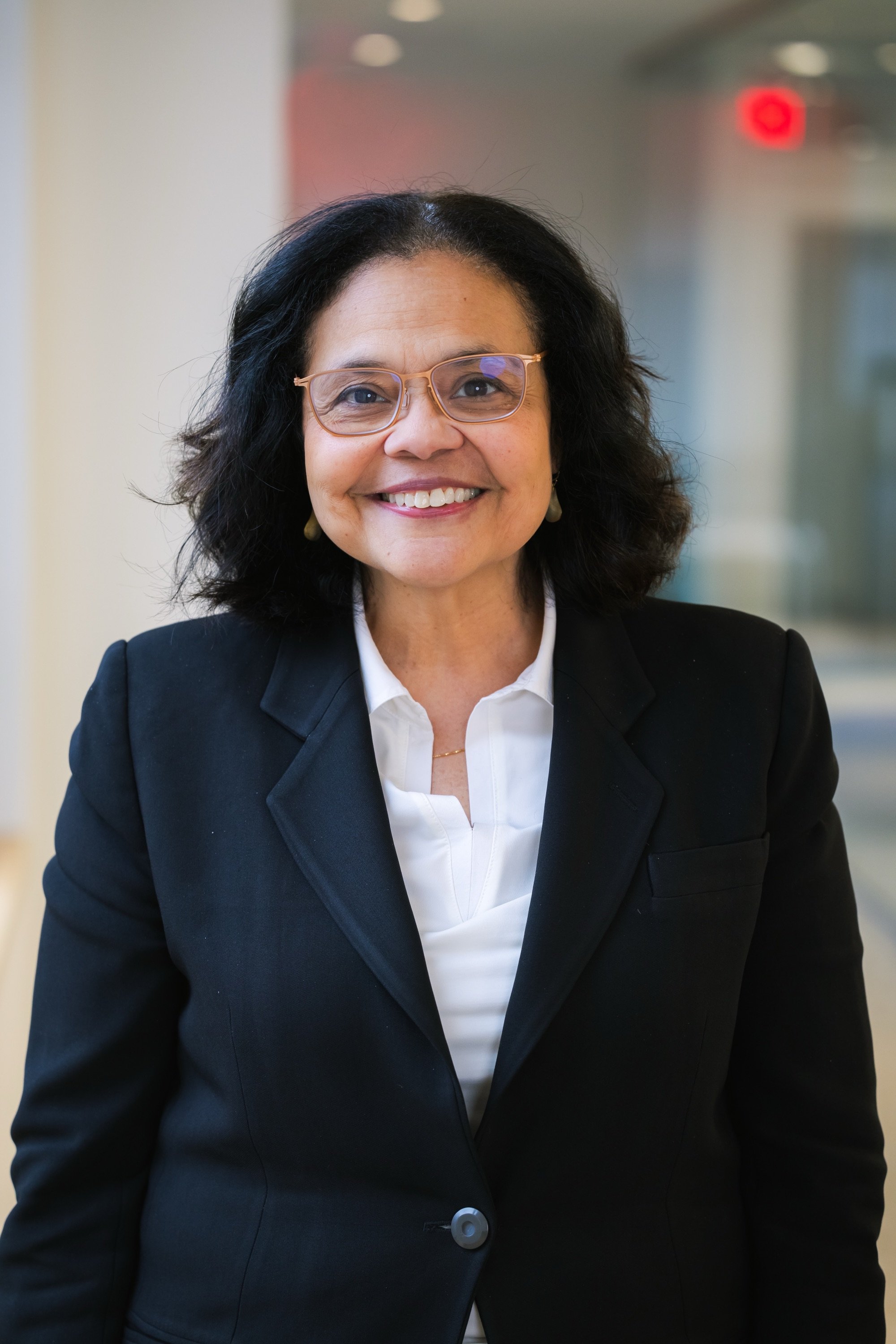
Kimberlyn Leary
Senior Fellow and Senior Advisor, Political Reform

As someone who moves between institutions鈥攁 professor, a former government official, and a nonprofit executive鈥擨 spent the spring attending multiple conferences. Like many who work across public, private, and civic spheres, I found myself moving between multiple rooms. Big ones, quiet ones, virtual ones, rooms with people trying to make sense of the moment we're in and what it might demand.
I was struck by how the conversations across these rooms turned out to be exploring similar questions albeit in different ways. One was a summit focused on Black economic futures. Another was an investment conference with every kind of capital and credential in play. The third was a smaller public conversation about libraries and trust.
But by the time I left that final Zoom room, I realized the same idea was circling in all three spaces: Who's doing the work of designing what comes next? And what does that work look like in real time?
A pattern emerged: the people with the most resources to design at scale often are least affected by the consequences, while those closest to the problems typically have the least power to redesign the systems creating them.
The Design You Can't Not Do
At the , design wasn鈥檛 about aesthetics. Instead, it was focused on structure鈥攈ow institutions function and who gets to shape the systems people move through.
The mayors, private sector investors, and data scientists speaking on-stage were already implementing solutions, redesigning procurement pipelines, and building investment tools that don't just include Black communities but shift decision-making closer to them.
These leaders were experts in how complex systems function under pressure. Many were seasoned by experience, often working under less than ideal conditions and where the stakes can be unforgiving.
One Black mayor described the challenge with painful clarity: "We're navigating white fears and Black expectations鈥攚ith no margin for error."
There was no illusion that leading change was anything other than dangerous business. Those with the most urgent need to redesign large systems had the least room for failure. Every innovation brought personal and political risk.
Darren Walker, President of the Ford Foundation, named what this demands: real courage鈥攖he kind many systems don鈥檛 reward, but penalize.
Sherrilyn Ifill, former President of the NAACP Legal Defense Fund, spoke about holding on as resistance: "We may not live to see the harvest. But we are still called to plant."
Right as she began that line, the technology failed.聽Ifill had joined remotely; her screen froze. Without missing a beat, Samantha Tweedy, CEO of the Black Economic Alliance, pulled out her phone, put Ifill on speaker, walked to the stage, and held the phone to the podium mic.
Neither could have managed the challenge alone. Tweedy without Ifill would've been left holding a silent phone in front of the audience. Ifill without Tweedy would've been speaking to herself. But together, they innovated鈥攊n real time, and delivered a second message; inventing under constraint is the job.
That became a fitting metaphor for the broader effort of making democracy work with whatever tools are actually available, not the ones we wish we had.
At the BEA Summit, the question wasn't whether the future needed redesigning. The question was who had the proximity, and the stamina, to do it.
Design for Opportunity
The is an annual gathering of investors, policymakers, and business leaders. It operates on a single premise: rather than debating whether disruption is coming, focus on how to navigate and leverage it.
Where BEA had been intimate and tactical, Milken was bigger, noisier, and faster. It was an ecosystem built to answer the question: "What advantage is possible?"
Some would see this approach as profit-driven, maybe even exploitative. Others as a practical way to adapt and find opportunity in a changing landscape.
Milken approached institutional design in a distinctive way. Rather than starting with problems to solve, some sessions began with trying to understand the ecosystems that were already generating solutions to some prior set of problems.
Take podcasting. A panel on the podcast economy noted that podcasting is now a $7.3 billion industry, and one that rivals traditional media in reach and influence.
But the real insight wasn鈥檛 just the market size鈥攊t was how podcasts succeed by creating authentic communities and serve as sources of trust.
People are drawn to podcasts because they offer intimacy and a felt sense experience of proximity. One panelist described podcasts as "eavesdropping on a conversation I wasn't supposed to hear." They disrupt the loneliness that has been called . Communities grow up around them, often serving people with specific needs that traditional institutions miss.
Still, even this space isn鈥檛 immune to manipulation.聽Emotional trust creates the conditions for people to try on new ideas and that can be exploited. Conservative podcasts were cited as a case study鈥攎any built audiences on apolitical topics, only to "flip the switch" to political content, weaponizing community.
At Milken, executive authority surfaced as a 鈥渟olution,鈥� particularly because consensus-building is slow. When democratic processes seem gridlocked, executive control can seem like a way to move at the pace disruption demands. But this reasoning, which emphasizes control and efficiency carries costs for democratic legitimacy that the conference didn't fully reckon with.
Not everyone was looking to scale authority upward, though. Jim Shelton, President of Blue Meridian Partners, pointed in a different direction鈥攖oward dense, coordinated investment in local communities. "Capital has largely bypassed the communities most in need," he said. "Fixing that is not charity鈥攊t's strategy."
Shelton's intervention suggested that the choice between speed and democracy is a false one鈥攖hat proximity and relationship actually accelerate meaningful change.
At Milken, design was happening at high altitude. Most participants had access to capital and policy influence. But from that distance, urgency flattens into abstraction.聽The people making decisions were typically far from the people living with the consequences. That distance shaped what counted as a problem, what passed as a solution, and who got to decide.
The Design That Shows Up Anyway
The final room was smaller, quieter, and virtual. In our public conversation with Shamichael Hallman, hosted by 国产视频's Political Reform program, we spoke about libraries鈥攂ut the conversation was really about civic stabilizers.
A lot of what libraries do now wasn鈥檛 part of their original job. Today they support unhoused patrons, offer small business support, help people apply for jobs, and sometimes hand out public health supplies.
This makes library staff drivers of civic design. Every time they adapt space for a new community need or make a policy about open hours or expanded services, they offer a design solution based on a notion that belonging is a public good.
Hallman described it best: "We design for whoever's already here."
Libraries, he suggested, are notable for their quiet refusal to gatekeep or require performance in exchange for care. They are real-time test cases in democratic practice鈥攕till trusted, still proximate, and still doing integrative work that institutions many times their size can't鈥攐r won't鈥攈old.
"Designing for whoever's already here" offers an alternative to the executive authority model discussed at Milken. Rather than concentrating power to move faster, libraries distribute access to move deeper. Belonging isn鈥檛 contingent. Libraries start with the assumption that everyone belongs.
Of course, that openness comes with trade-offs. When we consistently ask existing institutions to absorb new functions, often without new funding, we may be avoiding harder conversations about the democratic infrastructure needed for communities to thrive.
The Work Across Rooms
How do we design systems that can hold the present moment?
At BEA, design was simply a necessity, especially as leaders grappled with the loss of hard-won gains. Design took the form of ambition at Milken, with attendees favoring speed and scale. For libraries, design reflected a daily practice of making decisions to expand the social infrastructure.
What would it look like to bridge these approaches? To bring the proximity and relationship-building of libraries into conversation with the scale and resources of Milken? To ensure that the innovation happening in communities like those represented at BEA informs broader institutional design and makes them more inclusive?
The most promising moments in each room鈥擳weedy and Ifill's impromptu innovation, Shelton's community-centered investment approach, Hallman's inclusive design practice鈥攁ll demonstrated that workable solutions emerge from relationship and trust, not just resources and authority.
For those working within 国产视频's network鈥攚hether convening citizen assemblies, supporting embattled university leaders, or designing new democratic institutions through civic tech鈥攑roximity and relationship accelerate rather than slow meaningful change.
After the last panel at BEA鈥攁nd technically after the reception had ended鈥攑eople stayed, holding the thread just a little longer.
It felt like planting even if no one called it that.
In lingering, and in refusing to let the conversation end, was perhaps the most important design principle of all: the future depends on relationships, and relationships take time
Kimberlyn Leary is a senior advisor and senior fellow at 国产视频, an Emma Bloomberg Lecturer at the Harvard Kennedy School, and an associate professor at Harvard Medical School. She writes about systems change and institutional response.
Senior Fellow and Senior Advisor, Political Reform