A Closer Look at the Lower Mekong Region

Population dynamics, economic indicators, government models, pursuits of cooperation and competition, and the complexities of outside involvement are foundational elements to consider when gauging the region鈥檚 potential for digital transformation.
More than 245 million people live in the Lower Mekong Region. Cambodia, Laos, Myanmar, Thailand, and Vietnam are connected by the Mekong River, which drives the region鈥檚 extraordinary agricultural and fishery productivity and provides the economic livelihood for tens of millions of people. Even as the region modernizes away from the dominance of river-powered economies, the countries remain deeply connected. Altogether, there is a reliance on foreign direct investment and assistance, export-focused production and manufacturing, travel and tourism revenue, trade, agritech, education, and sustainability measures.
While there is a wide variety of development and digital transformation across the five countries, Thailand and Vietnam tend to follow similar paths of development and capacity with significant urban populations and advanced commercial and innovation pursuits. Cambodia and Laos follow behind with larger percentages of rural populations and a stronger reliance on foreign investment and aid. Myanmar鈥檚 development has regressed since the military coup in February 2021.
Population
Demographic trends in the Lower Mekong Region are marked by increased urbanization, with the region鈥檚 populations generally skewing younger and slightly more female. The region鈥檚 population growth is characterized by substantial urbanization driven by economic development, which has led to greater access to and . Most growth is centered in urban areas where there is greater access to education and jobs. The age breakdown across the region , as approximately a fifth of the population is under the age of 14. The population over the age of 65 is lower in the Lower Mekong Region than the average across Asia. Recent data shows that in Cambodia, Myanmar, Thailand, and Vietnam, .
Economic Development
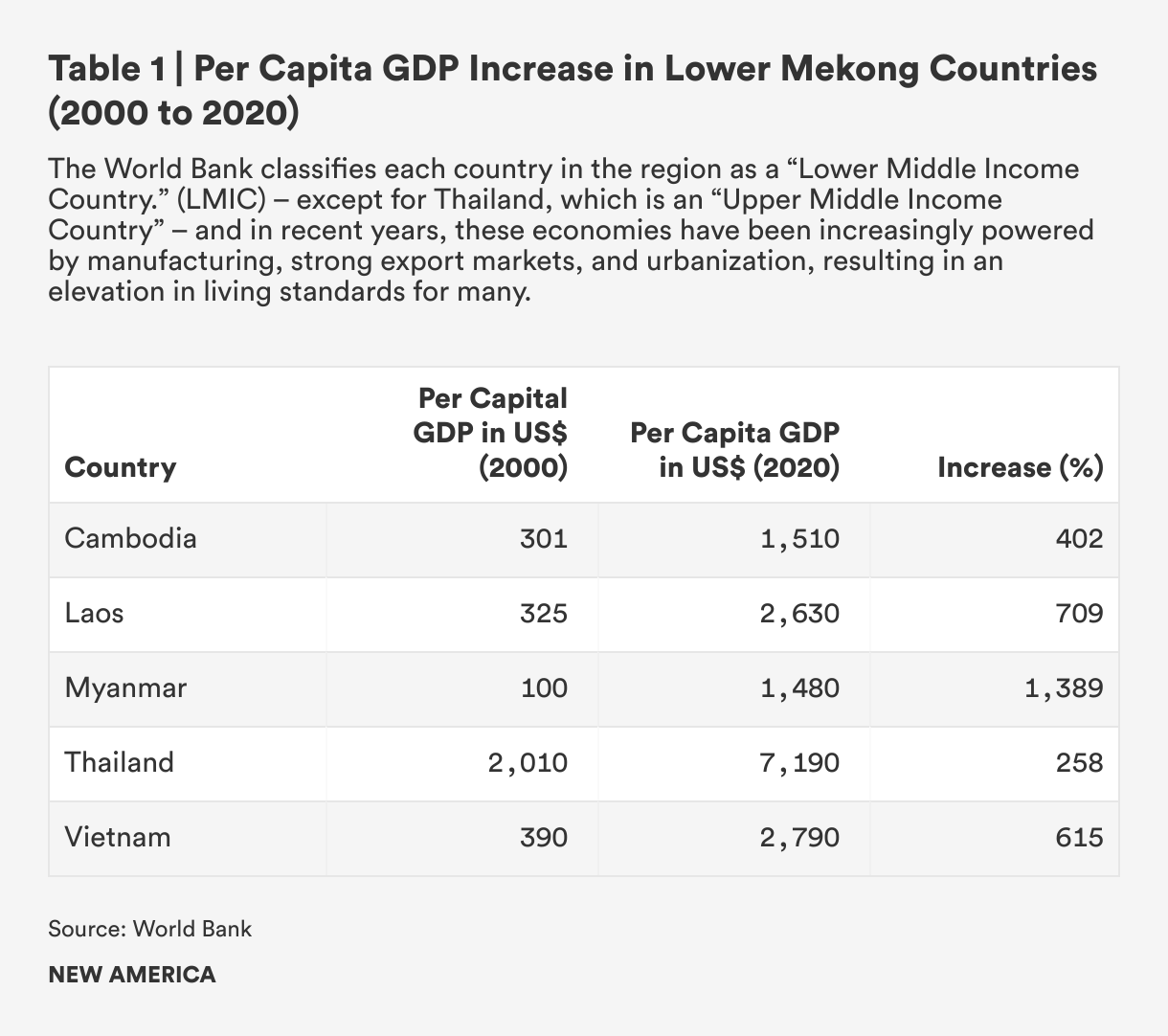
The classifies each country in the region as a 鈥淟ower Middle Income Country鈥� (LMIC)鈥攅xcept for Thailand, which is an 鈥淯pper Middle Income Country.鈥� In recent years, these economies have been increasingly powered by manufacturing, strong export markets, and urbanization, resulting in an elevation in living standards for many. Thailand and Vietnam have seen greater poverty alleviation than Cambodia, Laos, and Myanmar, in part because the two countries are industrializing at a rapid pace, as demonstrated in Table 1. Both nations have focused on high-tech manufacturing in hopes of avoiding the 鈥�.鈥� This happens when a nation鈥檚 development stalls because its major industries revolve around producing basic goods that face extensive global competition instead of higher-technology goods that require greater skills and technical expertise. Over the past twenty years, both Thailand and Vietnam have doubled the concentration of high-technology production as a share of manufacturing. In comparison, both Cambodia and Laos have lost some share over the last twenty years.
Government Models
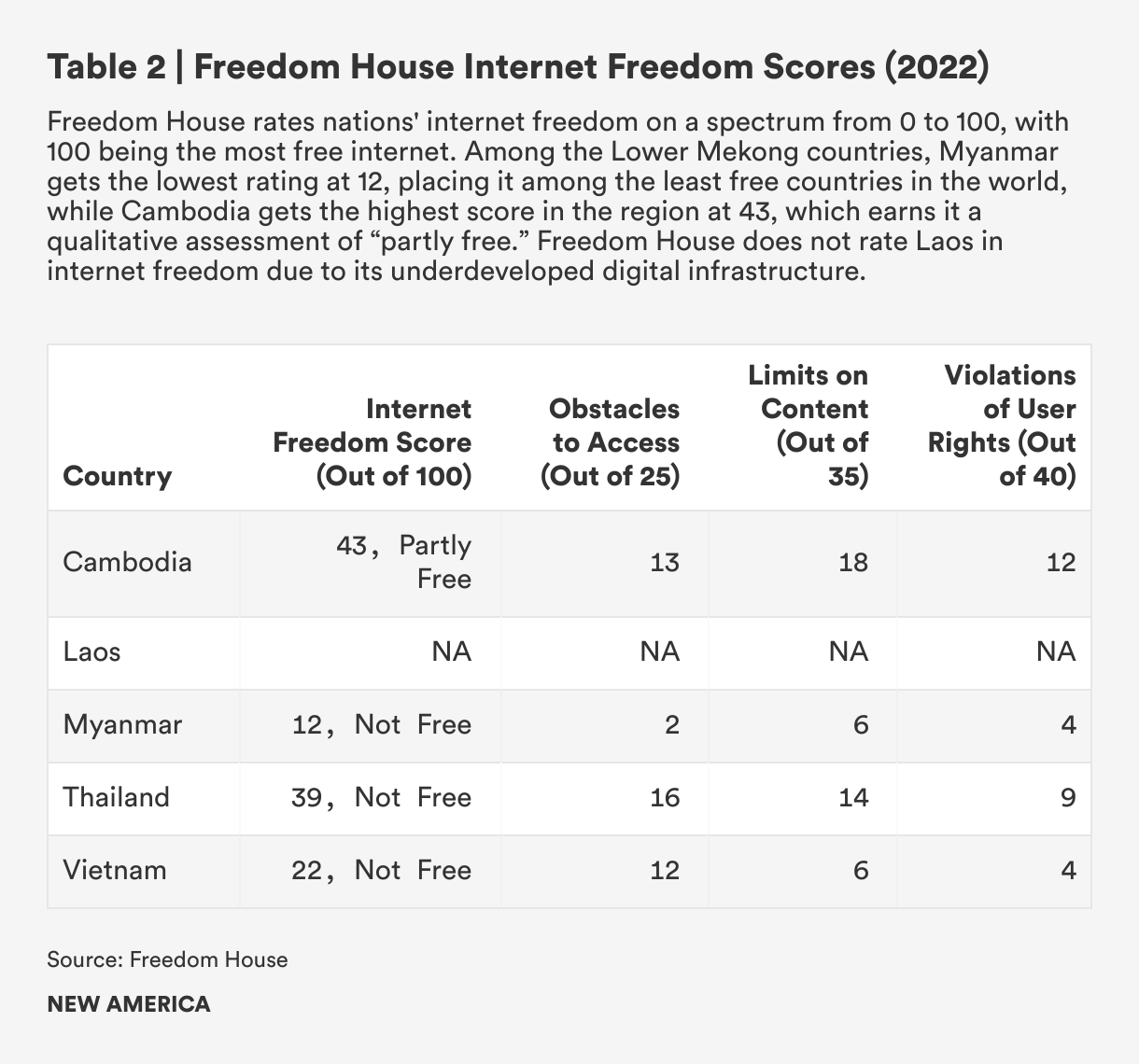
Forms of public administration vary across the region, but all populations are navigating increasingly authoritarian governments. Laos and Vietnam are with . Thailand is a . Cambodia is more complicated, with a self-defined multiparty democracy under a . Myanmar has been under a series of dictatorships since 1962, with a brief semi-parliamentary democracy period from 2010 to 2020, and has been under since a 2021 coup. While there are different forms of government in the region, none of the countries are considered to be open and free societies with strong legal protections of individual liberties and political rights . See Table 2 for each country鈥檚 Internet Freedom Scores from Freedom House.
Competing Global Influences
Geopolitical influences play an outsized role in how this region cooperates internally and with other global players. Countries in this region are often pushed and pulled in different geopolitical directions, making them accustomed to balancing external pressures and influence against internal development priorities. Sources of foreign direct investment often help shape and drive government priority areas for development and action in the region, which are further complicated when navigating competing outside influences surrounding technological advancements. As one international cyber policy expert noted when interviewed, some of the Lower Mekong governments are hesitant to partner with China despite the attractiveness of Chinese foreign investment due to suspicions of strings-attached deals and incidents of hacking and surveillance. Conversely, the same governments are also wary of partnering with Western nations, given the democracy-related obligations and expectations that come with development money.
United States
Beyond the longstanding cultural, historical, and political ties, there are deep innovation and commercial links between the United States and the Lower Mekong Region. The United States is the top trading partner for Thailand and Vietnam. Enhancing U.S. ties with this region is a priority of . U.S. foreign assistance to the subregion totaled more than $4.3 billion over the past 12 years. There are over 1,000 U.S. companies active in the region, with many U.S. companies looking to decrease their manufacturing costs and dependencies, strategically navigate tariffs on goods, diversify their supply chains, and identify new customers.1 The U.S.-based Big Tech giants鈥擜mazon, Apple, Google, Meta, and Microsoft鈥攁re active in the region, offering popular platforms, e-commerce, gaming, products, cloud services, and jobs at regional office hubs and manufacturing sites. Facebook (Meta) is often the only internet known in some regional communities. Apple has diversified production lines to be less dependent on China, many AirPods Pro are now stamped with: 鈥淒esigned by Apple in California. Assembled in Vietnam.鈥� In addition, one of the largest high-tech investments in Vietnam is from a U.S. company, Intel, which has invested nearly $1.5 billion to build a state-of-the-art chip assembly and test manufacturing facility in Saigon Hi-Tech Park, creating thousands of jobs.2
China
Despite periodic strained political relations, China and the five countries share natural resources, trade ties, and investment for major traditional and digital infrastructure systems. While China is highly influential across the Lower Mekong, international conflicts鈥攕uch as the South China Sea dispute鈥攁nd other political and economic divides drive tensions in the region. In fact, the administration of the Mekong River is a particular concern, complicated by allegations that upriver dams in China are negatively affecting the health of the Mekong downriver. China continues to participate in the , created in 1992 with support from the Asian Development Bank. In addition, China remains the of Myanmar, the in Thailand and Vietnam, and the in Cambodia and Laos.3 seeks to place Chinese technology鈥攐f which the United States has raised concerns about high-risk vendors such as Huawei and ZTE鈥攁t the center of rapidly developing digital infrastructure worldwide. In addition, the brings the promise of jobs and updated infrastructure that are sorely needed in the region.
China鈥檚 Huawei is the world鈥檚 largest supplier of 5G infrastructure technology. While Lower Mekong governments seek 5G investment, they have generally not agreed to exclusive arrangements with Chinese companies. Thailand was one of the first Asia-Pacific countries to launch its own 5G network. Thailand moved quickly to reallocate spectrum for 5G and begin auctions for service providers. Similar to other Southeast Asian countries, such as Malaysia, Thailand also chose to base its 5G network on the open radio access network (ORAN) standard and courted all of the major global suppliers. Vietnam is working on a phased deployment of their 5G network while seeking to strengthen its own technology firms in hopes they will become global exporters. Vietnam's largest telecom group, the military-run mobile network operator Viettel, is already active in 11 countries serving 110 million customers.4
Bilateral Relationships
Geopolitical influences in the region are not limited to the United States and China. Tech heavyweights such as South Korea鈥檚 Samsung, Japan鈥檚 SoftBank, and Singapore鈥檚 Shopee have major economic and digital development ties to the region. Companies from other Southeast Asian nations such as Taiwan, Malaysia, Indonesia, and the Philippines are also looking for trade opportunities, market share, manufacturing and parts, and tech talent. Furthermore, there are significant diplomatic agreements, technical and digital development support, and cooperation frameworks between Lower Mekong countries, countries, and regional neighbors such as , , , and . Although the strategies, agreements, or partnerships may have different amounts of aid and investment attached, each shares a similar intent to further regional development, cooperation, connectivity, and socioeconomic growth.
Regional Cooperation
Beyond bilateral relationships, regional cooperation is facilitated by development projects and multilateral organizations. With oversight and support from the local , the governments collaborate on river maintenance projects such as flood and drought management, hydropower, and climate change. The region also works together to further collaborations and with global partners. All countries are members of the United Nations (UN), the Association of Southeast Asian Nations (ASEAN), and the Asian Development Bank (ADB). They are also signatories to the Regional Comprehensive Economic Partnership and members of China鈥檚 Belt and Road Initiative (BRI). ASEAN helped facilitate the (AMBDC) platform, which includes the five Lower Mekong countries and China, with the mission to 鈥渆nhance the economically sound and sustainable development of the Mekong Basin.鈥� The ADB provides loans, technical assistance, grants, and equity investments to promote social and economic development. In addition, it facilitates the Greater Mekong Subregion Economic Cooperation Program. In March 2021, the ADB issued regional priorities including .
Digital Transformation Opportunities and Challenges in the Lower Mekong Region
- Overview
- Introduction
- A Closer Look at the Lower Mekong Region
- Factors Affecting the Development, Deployment, and Acceptance of Digital Solutions
- A Brief Landscape of the Regional Digital Ecosystem
- Broad Recommendations for People-Centered Digital Transformation
- Conclusion
- Appendix 1: Country Briefs
- Appendix 2: Catalog of Digital Solutions in the Lower Mekong Region
- Additional Readings
Citations
- Raymond Zhong, 鈥淵our Next iPhone Might Be Made in Vietnam. Thank the Trade War,鈥� New York Times, July 30, 2019, .
- 鈥嬧�� 鈥淚ntel Invests Additional $475 Million in Vietnam,鈥� Intel, January 26, 2021, .
- 鈥淭hailand鈥檚 foreign trade up 23.1 pct in 2021,鈥� Xinhuanet, January 21, 2022, ; Phayboune Thanabouasy, 鈥淐hina Remains the Largest Foreign Investor in Laos,鈥� Laotian Times, August 17, 2021, .
- Richard Javad Heydarian, 鈥淪E Asia fragments on pro and anti-Huawei lines,鈥� Asia Times, July 9, 2021, ; Matthew Strong, 鈥淪outheast Asia expands 5G to replace China as world鈥檚 factory,鈥� Taiwan News, August 20, 2021, .