A Chapter of: The Emerging Millennial Wealth Gap
Public Policy Implications of the Millennial Wealth Gap
Liz Hipple
A broad array of social science research鈥攑resented in this volume and elsewhere鈥攑resents a clear but troubling picture of the economic state of the Millennial generation. Young adults in America today have not achieved the same financial milestones as recent past generations. Whether measured in terms of income, assets, or net worth, Millennials are behind. If they were likely to catch up, public policy could perhaps stay agnostic. But given the combination of an economy characterized by depressed wages and shrinking benefits with a rising student debt burden, it seems more likely that their window for economic mobility is in danger of prematurely closing and public policy should respond.
The Millennial wealth gap should garner the increased attention of policymakers for a number of reasons, but especially because it is happening alongside trends of declining intergenerational mobility and rising economic inequality. These developments are interrelated and together have long-term consequences that will not only exacerbate existing racial and economic disparities but also limit the human capital development of future generations, which in turn has negative implications for future economic growth.
Recently, popular press attention has focused on the challenges Millennials face in the economy and their evolving relationship to the traditional markers of adulthood.1 For instance, marriage, child rearing, and homeownership rates among 25- to 34-year-olds today lag behind those of the previous generation.2 These are not merely the preferred reordering of life milestones established by their parents and grandparents. Rather, these are visible symptoms of the decline in intergenerational mobility, driven by the lack of financial resources among today鈥檚 young adults. Since today鈥檚 disadvantages accumulate over time and are passed down to future generations, it is essential for young families with children to be able to access economic resources to invest in their children鈥檚 development. The presence or absence of money in a household has huge implications for children鈥檚 later-in-life outcomes.
In a recent report, 鈥溾�� my co-author, Elisabeth Jacobs, and I document the accumulating social science research that attests to the relationship between a family鈥檚 economic resources and a child鈥檚 subsequent outcomes. We further explore the role of parents鈥� economic resources in the development of children鈥檚 human capital, and how economic inequality is undermining not only the development of that potential, but also children鈥檚 ability to fully and effectively deploy that human potential, thereby depressing their future upward mobility.3 While the report presents a thorough analysis of research to date, our findings in each of these areas establish a strong foundation for a significant public policy response.
Intergenerational Mobility
It may be helpful to begin by reviewing recent findings about intergenerational mobility in America, as declining mobility is the backdrop against which the emerging generational wealth gap is playing out.
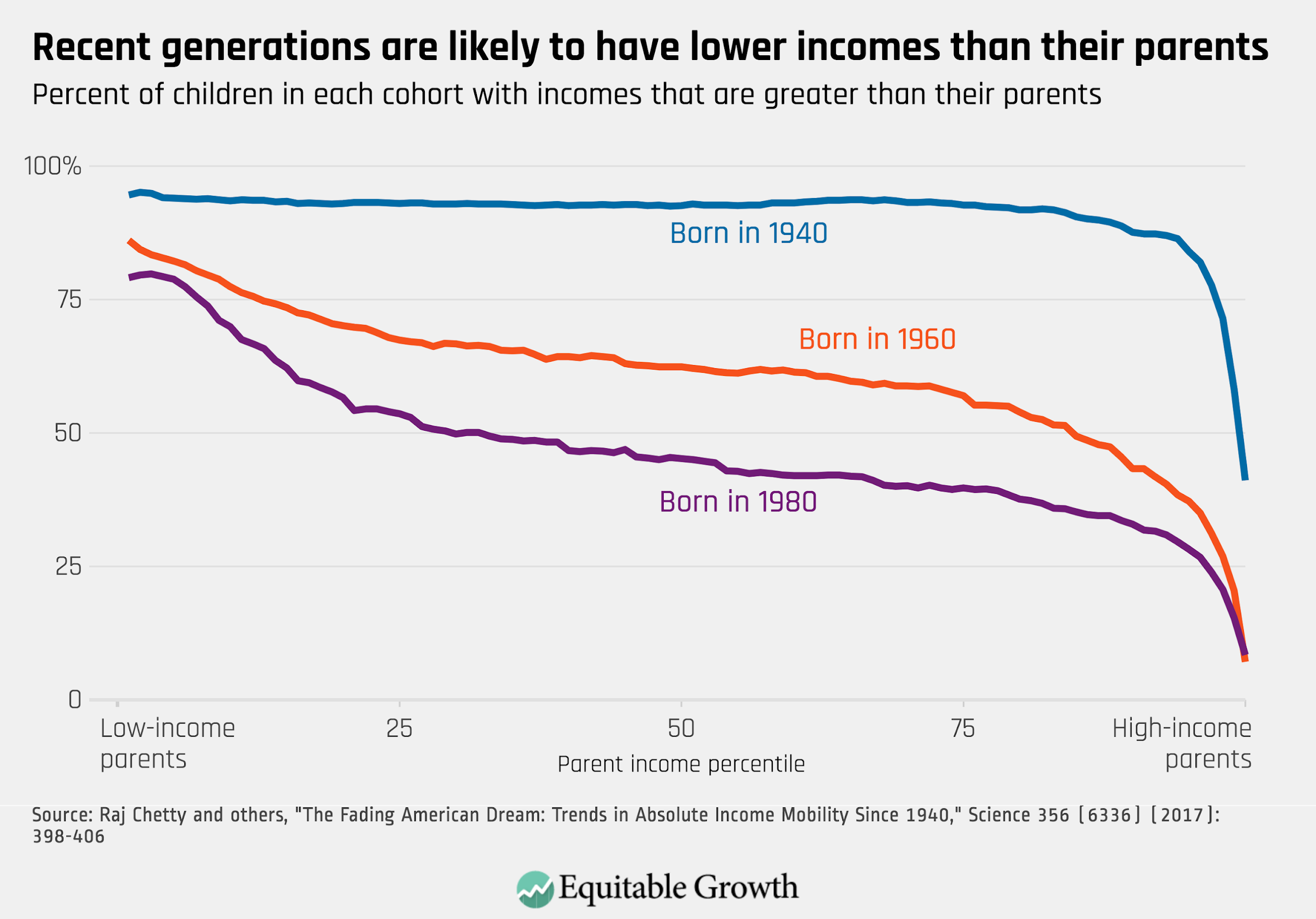
Intergenerational mobility is the relationship between a parent鈥檚 and a child鈥檚 economic position. It鈥檚 an important metric of economic well-being because it indicates whether economic outcomes reflect individual merit and hard work, or whether parental advantage (or disadvantage) dictates outcomes. It鈥檚 also a meaningful indicator of whether or not there鈥檚 been economic growth, and if that growth has been equitably distributed. If growth has been stagnant, it can tell us if any gains have accrued disproportionately to a small group. Unfortunately, recent and compelling research has found that mobility in the U.S. has been declining. While more than 90 percent of children born in 1940 grew up to earn more than their parents did at age 30, the same could be said at the same age for only about 50 percent of children born in 1984, according to economist Raj Chetty and his co-authors,4 as illustrated in Figure 1.
Figure 1. Intergenerational Mobility.
Furthermore, mobility differs significantly between different racial and ethnic groups in the United States, with black Americans in particular experiencing unusually high rates of downward mobility and low rates of upward mobility. For example, black children born into the bottom household income quintile (the lowest 20 percent ranked by income) have a 2.5 percent chance of going on to be in the top income quintile as adults, whereas white children of the same economic status have a 10.6 percent chance. And while white children born into the top income quintile are almost five times as likely to still be in the top income quintile as adults as they are to fall to the bottom, black children born to parents in the top income quintile are just as likely to fall to the very bottom as they are to stay at the top.5
Despite the prevalence of explanations for these differences that emphasize factors that supposedly represent individual choices or hard work鈥攕uch as marriage patterns or educational attainment鈥擟hetty and his co-authors find that differences in family characteristics, including wealth, explain very little of this gap in intergenerational mobility for black and white Americans. In other words, all else equal, these findings of mobility outcomes indicate that racial discrimination clearly plays a role in explaining why these differences persist.
In our full paper, Jacobs and I explore more of the facts and statistics on intergenerational mobility in the United States, including how it has changed over time and manifests in different places and geographies. For the purposes of this discussion, though, the key takeaways to keep in mind are that the decline in mobility from the 1940 to the 1980 cohort means that young adults today are entering adulthood with lower earnings than previous generations. Consequently, they have less to save from. Additionally, the opportunity to save and build wealth in America is distributed differentially depending on your race and ethnicity. This should be the context for any policy discussion of the Millennial wealth gap.
Economic Inequality and Wealth Gaps Limits the Development and the Deployment of Human Potential
A large body of research indicates that in the U.S. the extent of economic resources at a family鈥檚 disposal impacts their children鈥檚 economic outcomes later in life. To give just one example, research has found that even just $1,000 in additional income from the EITC increases a host of positive indicators, including higher reading and math scores; increased probability of high school graduation, college completion, and employment; and increased earnings.6 While this example uses income, rather than wealth, as the measured financial resource, it demonstrates the importance of financial resources today on outcomes tomorrow.
To understand the connection between parental economic resources and children鈥檚 adult outcomes鈥攁nd how economic inequality could be intermediating that relationship鈥擩acobs and I developed a framework for making sense of the channels linking the two concepts. One of those channels is the development of human potential. On a fundamental level, every individual is born with a certain amount of human potential, but the opportunity to develop that potential to its fullest varies dramatically based on the circumstances of family, community, institutional factors, and myriad other structural constraints. These inequalities of opportunity are often compounded across multiple realms, with major lines of research demonstrating the links between inequality and access to health, parental investments of time and money in their children, and the quality of early childhood education, as well primary and secondary schooling鈥攁ll of which are critical pathways for the development of the human potential necessary for upward mobility.
As families have fewer resources to invest in their children today, the consequences of the Millennial wealth gap will extend into the generations of tomorrow. This dynamic has already been apparent in the relationship between wealth, educational opportunities, and the realization of long-term human potential. A case in point is the unfortunate reality that in the United States, buying a home in a 鈥済ood鈥� school district is often the single biggest way a parent invests in their child鈥檚 human capital development. In this process, it is wealth, rather than income, that is the means through which the home is purchased, making it especially consequential in determining the future outcomes of the next generation.
This dynamic reflects how the Millennial wealth gap risks exacerbating existing economic and racial inequalities. If, as explained in the chapter by William Emmons, Ana Kent, and Lowell Ricketts, Millennials have lower than expected wealth by a certain age, then it will be more difficult to self-finance a first home purchase. Those who can tap down payment assistance from their parents are at a distinct advantage. Winning the birth lottery takes on a whole new significance, as only those lucky enough to be born into families with enough wealth to be able to pass it along can get their own start in the wealth accumulation process.
It also means that policies that have historically and systemically blocked black Americans from building wealth continue to have consequences that reverberate today for black Millennials. For example, federal redlining7 denied black Americans access to traditional mortgages and therefore forced them into contract buying,8 which did not build equity. This means that racist policies that prevented the purchase of a house by grandparents or parents 50 years ago continue to have an impact. Not only is there less wealth to transfer directly, there is less wealth to invest in their children鈥檚 human capital development, whether it is through supporting education or jump-starting wealth building through the purchase of a home. Indeed, while 34 percent of white adult children receive financial support from their parents for higher education and 12 percent for homeownership, the same is true for only 14 percent and 2 percent of black adult children, respectively.9 Discrimination in the past, reflected in the racial wealth gap, continues to reverberate today and into the future.
But even if there were true equality of opportunity to fully develop one鈥檚 human potential, the development of human potential is insufficient on its own if individuals are not able to fully deploy their talents. And family economic resources鈥攑articularly wealth鈥攁lso play a vital role in young adults鈥� ability to fully deploy their potential. For example, in addition to the relevance of parental resources for attendance and completion of postsecondary education, wealth can shape how an individual is able to get the most out of a college education and make use of that investment. Family wealth may provide an insurance function, allowing those with greater access to the cushion of family assets (and the absence of debt) to take risks that ultimately pay off with greater rewards. As sociologists Fabian Pfeffer of the University of Michigan and Martin H盲llsten of Stockholm University explain:
[C]hildren who are able to fall back on their parents鈥� wealth when, for example, they drop out of college or experience a prolonged school-to-work transition period, or have early episodes of unemployment, are more likely to opt for long-term human capital investments, such as college attendance, or choose particularly competitive or protracted career paths that they may be able to sustain even in the face of early set-backs.10
These findings show that wealth may shape the behavioral choices of the next generation, thereby shaping opportunity by providing some with a soft cushion for a slip down the economic ladder and others with no cushion at all. Indeed, economist Greg Kaplan finds that the ability to live with one鈥檚 parents allows young people to search longer for jobs that have better prospects for future earnings growth, increasing their chances of upward mobility and of successfully beginning to build wealth of their own.11
Another roadblock to Millennials鈥� ability to fully deploy their human potential is the structural changes in the labor market over the past 30 years, which have depressed wages and thereby delayed wealth building. For example, young adults who replicate their parents鈥� educational and occupational backgrounds and end up in the same type of work and in the same relative place in the economic distribution earn less in inflation-adjusted terms than their parents did a generation ago.12 There are a number of reasons for these changes, including the fissuring of the workplace and the decline in job ladders, which we consider in depth elsewhere.13 What is relevant here is that these structural changes, coupled with the fact that Millennials entered the labor market during the Great Recession, threaten to cause long-term and persistent negative effects for Millennials鈥� earning potential, which will further weaken their ability to build wealth down the road.14
Policy Implications
Policymakers need to take these structural changes into account鈥攁nd acknowledge this history of discrimination鈥攁s they craft future public policies to promote wealth building. Traditionally, the pillars of wealth building in America have been grounded in being able to access education, skills, and training; secure steady employment; increase ownership of assets over time; and receive family gifts, transfers, and inheritances. We鈥檝e seen how these pathways are not open to everyone, and how the current cohort of young adults is faring poorly. For Millennials, education and skills have increased, but steady employment has gotten more precarious, especially for those who graduated into the Great Recession, which limits the income with which to increase ownership of assets over time. This leaves the fourth pillar鈥攖he receipt of family transfers鈥攖o take on a larger and increasingly disproportionate role in future wealth accumulation.
It is a problem for our democracy and our economy if family wealth determines long-term child outcomes. If the cushion of family assets (and the absence of debt) allows young adults to disproportionately take risks that can ultimately pay off with greater rewards, then those without such assets are needlessly disadvantaged. This creates a feedback mechanism in which privilege begets privilege. To prevent such a scenario from gaining momentum, policymakers must work to level the playing field. In doing so, they should push beyond solutions that emphasize merely equalizing access to activities that support human capital development, such as education and skills attainment. As we have seen, the development of human potential is insufficient on its own to address the forces depressing economic mobility and opportunities for wealth accumulation. Rather, policymakers must grapple with ways to remove the roadblocks young adults face when they seek to deploy their potential in the economy.
A forward-looking policy agenda should be grounded in a recognition that the structure of the U.S. labor market has changed in ways that fundamentally thwart upward mobility. Wage stagnation, fissuring of the workplace, and a decline in job ladders depress workers鈥� earning power. Discrimination, particularly racial discrimination, persists in ways that run afoul of basic principles of equity, disempowering some workers and advantaging others. Growing inequalities in household balance sheets shape behavior and risk preferences, allowing those born into wealth to accumulate additional advantages over a lifetime while those who enter the labor market further down the economic ladder face limited pathways upward.
None of these dynamics are inherently natural. Many have the potential to be fundamentally reshaped by policy. Familial advantage鈥攐r disadvantage鈥攃an be passed along to children in multiple ways. While this might seem daunting to policymakers contemplating solutions, it also means that there are multiple angles from which to tackle the problem. There will be no silver bullet or quick fixes, but the emerging Millennial wealth gap is too large to ignore. Instead, there should be a concerted effort to develop and implement policies to ensure that access to opportunity is truly equitable. Our collective goal should be to ensure that all members of our society are able to fully deploy their potential. To do so requires that wealth is not passed along mechanically from generation to generation, but that our collective resources support an economy where the human capital, innovation, and dynamic economic growth are unleashed rather than left by the wayside.

The Emerging Millennial Wealth Gap
- The Emerging Millennial Wealth Gap: Opening Note
- Building Ladders of Success for the Rising Millennial Generation: An Initiative Funded by the Citi Foundation
- Part 1: Generational Wealth and Financial Health
- Framing the Millennial Wealth Gap: Demographic Realities and Divergent Trajectories
- Trends, Origins, and Implications of the Millennial Wealth Gap
- The Millennial Racial Wealth Gap
- The Young and (Economically) Restless: The Nature of Work for American Millennials
- The Financial Lives of Millennials: Evidence from the U.S. Financial Health Pulse
- Part 2: Components of the Millennial Balance Sheet: Assets and Liabilities
- Wealth and the Credit Health of Young Millennials
- Millennials and Student Loans: Rising Debts and Disparities
- Young Adults and Consumer Debt: The Quiet Crisis Next Time
- Homeownership and Living Arrangements among Millennials: New Sources of Wealth Inequality and What to Do about It
- Part 3: Implications for Social Policy
- Public Policy Implications of the Millennial Wealth Gap
- Addressing the $1.5 Trillion in Federal Student Loan Debt
- Policy Responses to the Millennial Wealth Gap: Repairing the Balance Sheet and Creating New Pathways to Progress
Citations
- Roni Caryn Rabin, 鈥淧ut a Ring on It? Millennial Couples Are in No Hurry,鈥� The New York Times, May 29, 2018.
- Andrew J. Cherlin, The Marriage-Go-Round: The State of Marriage and the Family in America Today (New York: Vintage, 2010); Andrew J. Cherlin, Elizabeth Talbert, and Suzumi Yasutake, 鈥淐hanging Fertility Regimes and the Transition to Adulthood: Evidence from a Recent Cohort鈥� (Baltimore, MD: Johns Hopkins University, 2014); Andrew J. Cherlin, Labor鈥檚 Love Lost: The Rise and Fall of the Working-Class Family in America (New York: Russell Sage Foundation, 2014); Jung Hyun Choi et al., 鈥淢illennial Homeownership鈥� (Washington: Urban Institute, 2018).
- Elisabeth Jacobs and Liz Hipple, 鈥淎re Today鈥檚 Inequalities Limiting Tomorrow鈥檚 Opportunities?: A Review of the Social Sciences Literature on Economic Inequality and Intergenerational Mobility鈥� (Washington, DC: Washington Center for Equitable Growth, October 2018).
- Raj Chetty et al., 鈥淭he Fading American Dream: Trends in Absolute Income Mobility since 1940,鈥� Science 356(6336) (April 28, 2017): 398鈥�406.
- Raj Chetty et al., 鈥淩ace and Economic Opportunity in the United States: An Intergenerational Perspective,鈥� Working Paper (National Bureau of Economic Research, March 2018).
- Jacob Bastian and Katherine Michelmore, 鈥淭he Long-Term Impact of the Earned Income Tax Credit on Children鈥檚 Education and Employment Outcomes,鈥� Journal of Labor Economics 36(14) (October 2018); Gordon B. Dahl and Lance Lochner, 鈥淭he Impact of Family Income on Child Achievement: Evidence from the Earned Income Tax Credit,鈥� American Economic Review 102(5) (August 2012): 1927鈥�56.
- Richard Rothstein, The Color of Law: A Forgotten History of How Our Government Segregated America (Liveright, 2017).
- 鈥淭he Plunder of Black Wealth in Chicago: New Findings on the Lasting Toll of Predatory Housing Contracts鈥� (Samuel DuBois Cook Center on Social Equity at Duke University, May 2019),
- Yunju Nam et al., 鈥淏ootstraps Are for Black Kids: Race, Wealth, and the Impact of Intergenerational Transfers on Adult Outcomes鈥� (Oakland, CA: Insight Center for Community Economic Development, September 2015),
- Fabian T. Pfeffer and Martin H盲llsten, 鈥淢obility Regimes and Parental Wealth: The United States, Germany, and Sweden in Comparison,鈥� Working Paper, SOEP Papers on Multidisciplinary Panel Data Research (Berlin, Germany: Deutsches Institut f眉r Wirtschaftsforschung (DIW), 2012).
- Greg Kaplan, 鈥淢oving Back Home: Insurance against Labor Market Risk,鈥� Journal of Political Economy 120(3) (June 2012): 446鈥�512,
- Barry Bluestone and Bennett Harrison, The Great U-Turn: Corporate Restructuring and the Polarizing of America (Basic Books, 1990); Arne L. Kalleberg, Good Jobs, Bad Jobs: The Rise of Polarized and Precarious Employment Systems in the United States, 1970s to 2000s (New York, NY: Russell Sage Foundation, 2011).
- Elisabeth Jacobs and Liz Hipple, 鈥淎re Today鈥檚 Inequalities Limiting Tomorrow鈥檚 Opportunities?: A Review of the Social Sciences Literature on Economic Inequality and Intergenerational Mobility鈥� (Washington, DC: Washington Center for Equitable Growth, October 2018).
- There鈥檚 copious economic research into the negative and persistent effect on earnings of those who enter the labor market during a recession. For some examples see: Jesse Rothstein, 鈥淭he Lost Generation? Scarring after the Great Recession,鈥� January 2019, ; Philip Oreopoulos, Till von Wachter, and Andrew Heisz, 鈥淭he Short- and Long-Term Career Effects of Graduating in a Recession,鈥� American Economic Journal: Applied Economics 4, no. 1 (January 2012): 1鈥�29, ; Giuseppe Moscarini and Fabien Postel-Vinay, 鈥淒id the Job Ladder Fail after the Great Recession?,鈥� Journal of Labor Economics 34(S1) (Part 2) (January 2016): S55鈥�93,