A Chapter of: Evaluating the Effects of Ranked-Choice Voting
The Missing Link: RCV and Substantive Representation in Local Politics (Arjun Vishwanath)
The Missing Link: RCV and Substantive Representation in Local Politics
By Arjun Vishwanath
Citations
Working paper: Arjun Vishwanath, 鈥淓lectoral Institutions and Substantive Representation in Local Politics: The Effects of Ranked Choice Voting,鈥� July 1, 2021, available at SSRN: .
Brief: Arjun Vishwanath, The Missing Link: RCV and Substantive Representation in Local Politics (Washington, DC: 国产视频, 2021), /political-reform/reports/the-missing-link/.
Overview
This project explores the effect of ranked-choice voting (RCV) on substantive representation in nine RCV cities based on a host of fiscal and ideological variables. To evaluate changes in these variables following the switch to RCV, generalized synthetic controls are used to construct hypothetical versions of each of the cities had they not adopted the reform. Then, the hypothetical policy and representational outcomes are compared to the actual outcomes to determine RCV's impact.
Research Questions
- How does ranked-choice voting affect policy outcomes and policy representation?
- How does ranked-choice voting affect the ideological composition of governments and ideological representation?
- How does ranked-choice voting affect the voting behavior of legislators within cities?
Key Findings
- Ranked-choice voting has mixed effects on policy outcomes and policy representation that point to minimal changes stemming from the reform itself.
- Ranked-choice voting has no apparent effect on the ideological composition of governments or ideological representation in the cities that have adopted it.
- Ranked-choice voting has no apparent effect on the voting behavior of legislators within cities.
Background and Research Design
In the past decade, the study of substantive representation and electoral accountability in local politics has flourished. However, we still have relatively little evidence on which mechanisms improve the relationship between local public opinion and public policy, especially in local politics.
This study examines the effects of electoral rules on substantive policy representation鈥攖hat is, the correspondence between public opinion and the government鈥檚 ideology and policies鈥攊n local politics using the case of ranked-choice voting (RCV). While some academics have studied the effects of RCV on descriptive representation鈥攖he correspondence between the electorate and government on demographic characteristics like race and gender鈥攏o studies to date have examined RCV鈥檚 impact on substantive representation.1
Research to date has been skeptical of the claim that electoral institutions play a significant role in substantive representation. For example, Chris Tausanovitch and Chris Warshaw find that different electoral rules like partisan elections, term limits, and at-large elections have no effect on the extent of responsiveness to public opinion in local government.2 Similarly, Justin de Benedictis-Kessner and Warshaw find no differences in fiscal outcomes between cities with partisan versus nonpartisan elections or between cities with a council-manager form of government versus those with strong mayors.3
While many of the electoral reforms examined to date have produced either inconsistent or null effects, RCV advocates hope that the system can produce larger and more significant effects. Mainstream voices tend to employ these arguments in favor of the reform, as the New York Times Editorial Board did in its endorsement of the proposal for presidential primaries and New York City elections.4
In particular, advocates point to two barriers to effective representation produced by the U.S. standard election system of first-past-the-post (FPTP) which might be reduced or overcome by adopting RCV. First, FPTP encourages candidate polarization and negative campaigning in order to appear as the 鈥渓east bad鈥� candidate. On the other hand, RCV proponents claim that the new system will reduce negative campaigning and lead to candidate moderation.5 Existing research finds that voters living in the cities with RCV express higher levels of satisfaction with the way candidates have conducted themselves, noting that candidates criticize each other less, and engage in less negative campaigning in survey responses.6 Second, FPTP enables candidates to win without a majority of support and it requires voters to cast ballots strategically in making this plurality choice. By comparison, under RCV, voters cast a preference ballot as opposed to selecting a single candidate.
Regarding representation, there are three reasons why RCV may generate improvements:
- RCV could force candidates towards the median voter by rewarding cooperative campaign behavior. If the distribution of voters is systematically more moderate than the distribution of legislators, then shifting candidates towards the median would improve representation.
- It could leave candidates鈥� positioning unchanged but encourage more representative candidates to run who otherwise would not have run under FPTP elections. This story would be consistent with the finding that most of the polarization in Congress can be attributed to changes in the set of candidates who run.
- RCV could translate voter preferences into winners in a more representative fashion. Under FPTP, voters cast a single ballot but may have to vote strategically to avoid wasting their vote. Relatedly, a plurality winner may be elected who does not represent the majority's preferences. As such, RCV may produce superior representation by enabling voters to cast a sincere ballot and avoid a plurality winner.
To answer these questions and evaluate the impact of RCV on policy and representation, I begin with objective measures of local government. In keeping with the literature examining the impact of partisan control,7 I first examine changes across a host of municipal policy outcomes in the following cities that adopted RCV: San Francisco, Calif.; Oakland, Calif.; Berkeley, Calif.; San Leandro, Calif.; Portland, Maine; Minneapolis, Minn.; St. Paul, Minn.; Cary, N.C.; and Burlington, Vt.8 The variables I test (all on a per capita basis) are total revenues, general revenues, total taxes, property taxes, general sales tax, direct expenditures, charges and miscellaneous revenue, intergovernmental revenue, and spending on parks and recreation, highways, education, sewerage, fire protection, police protection, public welfare, libraries, natural resources, and utilities.9
Of course, due to the unique political circumstances of any given city, we should not expect RCV to produce the same change in every city. That said, a key argument of RCV proponents is that the system will produce moderation; thus, since the majority of the cities I study are strongly left-leaning, we might expect to see a decline in spending and taxation relative to the counterfactual world in which they maintained FPTP.
Ultimately, examining variables such as tax revenue and spending on education reveals a city鈥檚 priorities. This line of reasoning suggests that, in order to study representation, changes in spending must be interpreted in the context of public demand for goods. An increase in spending could be bad for representation if the public wants less spending. Conversely, it could also be good for representation if the public wants more spending. Furthermore, null effects for spending changes may mask changes in representation if, for example, the RCV-adopting municipalities that want more spending increase spending while those that want less spending decrease spending. To account for this, I construct a measure of 鈥減olicy representation鈥� for each fiscal variable. This tracks the deviation between the city鈥檚 actual spending and the level we would expect based on their ideology. In each case, the city鈥檚 ideology is based on the public opinion-based measure of city liberalism calculated by Tausanovitch and Warshaw.10
Next, I turn to the questions of legislative polarization and of representation. While there are now commonly accepted metrics of ideology for state legislators, there is no universal metric of ideology for local government officials. To estimate ideology, then, I use the database of local election returns and officials created by Warshaw that links to the Catalist voter file and CFscores and supplement it by manually searching for all elected officials in RCV-adopting jurisdictions since 1990.11 I construct a similar metric of ideological representation by comparing the city council鈥檚 observed ideology to what we would expect for a city of that type based on the ideology scores from Tausanovitch and Warshaw mentioned above.
To evaluate changes in the many dependent variables described, I use generalized synthetic controls to construct hypothetical versions of each of the adopting cities had they not adopted RCV.12 This allows us to compare the difference between the actual outcomes and the hypothetical trajectory to determine the effects of RCV. For each city, I employ population size, median income, sex, race, education, and age as controls.
Findings and Implications
I start by examining changes in fiscal outcomes following adoption of RCV. Table 1 examines the average treatment effects for the full set of municipal revenue and expenditure variables. For each plot, the first coefficient corresponds to changes in fiscal policy and the second coefficient corresponds to changes in representation.
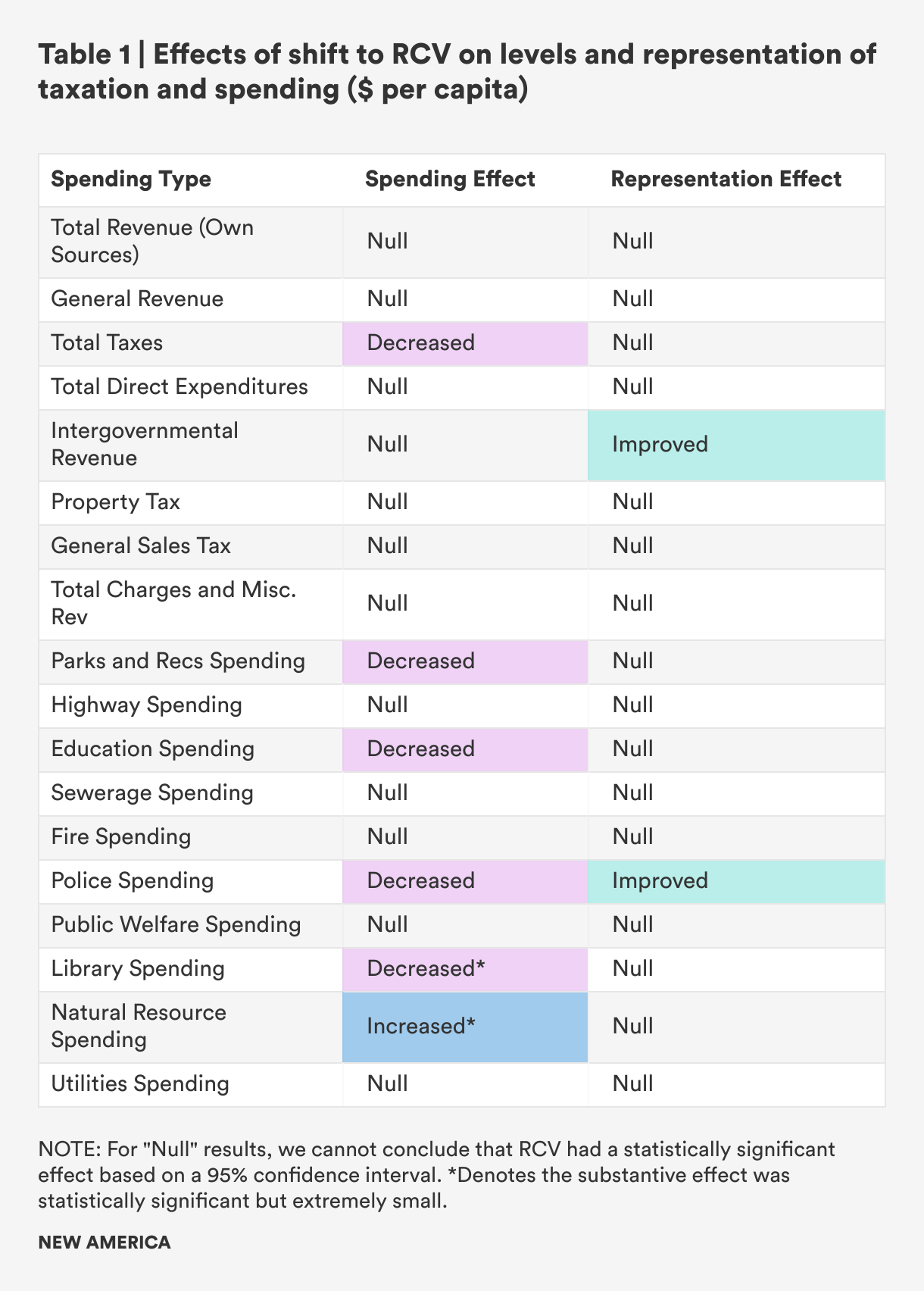
Beginning with changes in fiscal policy, it does not appear that total revenue, general revenue, total expenditure, or intergovernmental revenue levels change following adoption of RCV. Total taxes appear to have gone down following implementation of RCV; however, for the two most visible and important categories of local taxes鈥攑roperty and sales taxes鈥攍evels either stayed the same or increased. In the cities that adopted RCV in the sample studied, property and sales taxes account for 75 percent of total tax revenue from 2000 to 2017. Insofar as lower tax revenues come from changes in various less visible domains (e.g., motor fuel taxes, hunting and fishing licenses), it seems less plausible to attribute these changes to RCV. Regarding expenditure categories, the model suggests that spending decreased in parks and recreation, education, and police. Or, in other words, there was a smaller increase in spending than we project would have happened without RCV. (There were also statistically significant but substantively small effects on library and natural resource spending.)
Then, I look at changes in representation. This metric is calculated as the absolute difference between observed spending levels and predicted levels conditional on the city's mass liberalism. These predicted values represent the preferred level of spending for a city given its ideology. Thus, it looks at the spending in cities with similar ideological leanings to predict what the citizens of the city being studied want. As a result, higher values on this metric signify declines in the quality of representation (since the distance between policy and citizens' views has increased). It appears that effects are null for total revenue, general revenue, and total direct expenditures, and, unlike at the policy level, it does not appear that there was an improvement on policy representation for total taxes. This suggests that the relative decline in taxes in some RCV cities corresponded to an increase in representation in some cities but a decline in representation in others. Although it appears that representation on intergovernmental revenue improved, it is unlikely that voters have strong preferences over that category.
Turning to tax and expenditure categories, we see that the increase in general sales tax revenues also lines up with a decline in representation. Compared to the fiscal policy analysis, an even greater share of the representation coefficients are not statistically significant; the only one that achieves significance is police spending (an improvement in representation). In sum, while some categories saw increases or decreases in spending, the picture painted as a whole does not lend itself to any clear interpretation wherein RCV changed municipal policy or altered substantive representation.
Next, I look at the effects of RCV implementation on the ideology of city councils using the Catalist Ideology field and the CFscore. The Catalist Ideology field takes on values from 0 to 100, where higher values are more conservative. The CFscores are not bounded but mostly take on values from -2 to 2, where, again, higher values are more conservative.13 I run two separate models; the first tracks changes in the ideological composition following RCV, and the second explores changes in the distance between the mayor or council and mass opinion (where higher values indicate worse levels of representation). Once again, I use generalized synthetic controls to estimate the average treatment effect of RCV. RCV induces a slight shift rightward on both metrics, but neither of the changes achieves statistical significance. Similarly, we see a slight increase in the caliber of representation on these city councils, but, once again, the change does not reach statistically significant levels.
Finally, I employ roll call data from San Francisco and Oakland city councils collected by Peter Bucchianeri.14 In addition to verifying my findings from other sources, I estimate dynamic ideal points for the two cities. I find here that the same legislators did not have an ideological shift following the adoption of RCV. I also employ estimates of city district-level ideology in San Francisco from Bucchianeri to evaluate whether the caliber of responsiveness within the city changed, and I again find no effects. Further detail of this analysis is available in the full paper.
Conclusion
Most debates about ranked-choice voting come down to questions of representation. Thus, the key question is whether switching from FPTP to RCV improves the correspondence between the ideologies of elected officials or the policies they adopt and the views of the citizenry.
This project provides the first direct analysis of whether RCV affects substantive representation. Formal theories of candidate and voter behavior do not necessarily predict a decline or improvement in representation, and my empirical findings suggest that there is no significant effect of the reform. While it appears RCV produces limited change in the municipalities that have adopted it, my findings do not resolve several of the outstanding debates between supporters and detractors. For example, enabling voters to cast a sincere ballot may be a normative good in and of itself. Similarly, it may be a normative ill if certain groups are less likely to cast a completed RCV ballot. Finally, my findings are limited to the set of fairly progressive cities that have adopted the reform. As additional jurisdictions adopt the reform鈥攅specially at the state level鈥攎ore research should be done to explore whether this relationship persists. However, my empirical findings suggest that at the end of the day, the net effect of this reform on municipal policy and representation is at best limited.
Acknowledgments: Sophia Lee, Mirnes Kukic, and Shelly Tsirulik provided excellent research assistance. I am grateful to 国产视频 and Arnold Ventures for funding the research. Chris Warshaw and Peter Bucchianeri graciously shared much of the data in the analyses with me. Tyler Simko, Jim Snyder, and participants in the Electoral Reform Research Group gave helpful comments and advice on the paper. I am especially indebted to Jon Rogowski for detailed comments and advice on the paper.
Evaluating the Effects of Ranked-Choice Voting
- Introduction (Lee Drutman and Maresa Strano)
- Support for Ranked-Choice Voting across Race and Partisanship (Joseph Anthony, David C. Kimball, Jack Santucci, and Jamil Scott)
- Ranked-Choice Voting is an Acquired Taste (Joseph Anthony and David C. Kimball)
- Does Ranked-Choice Voting Reduce Racial Polarization? (Yuki Atsusaka and Theodore Landsman)
- Ranked-Choice Voting is No Refuge for Extreme Candidates (Melissa Baker)
- The Future is Proportional: Improving Minority Representation through New Electoral Systems (Gerdus Benad猫, Ruth Buck, Moon Duchin, Dara Gold, and Thomas Weighill)
- Choosing to "Vote As Usual" (Andr茅 Blais, Carolina Plescia, and Semra Sevi)
- Ranked-Choice Voting and Political Expression: Voter Guides Narrow the Gap between Informed and Uninformed Citizens (Cheryl Boudreau, Jonathan Colner, and Scott MacKenzie)
- Ranked-Choice Voting, Runoff, and Democracy: Insights from Maine and Other U.S. States (Joseph Cerrone and Cynthia McClintock)
- RCV is Neither Panacea nor Catastrophe for Minority Representation (Melody Crowder-Meyer, Shana Kushner Gadarian, and Jessica Trounstine)
- Electoral Systems Affect Legitimacy Gaps and Affective Polarization (Sean Fischer, Amber Hye-Yon Lee, and Yphtach Lelkes)
- Multi-seat Districts and Larger Assemblies Produce More Diverse Racial Representation (Michael Latner, Jack Santucci, and Matthew S. Shugart)
- Ranked-Choice Voting Delivers Representation and Consensus in Presidential Primaries (Baodong Liu, Nadia Mahallati, and Charles M. Turner)
- More Expression, Less Error: Alternative Ballots Outperform Status Quo (Jason Maloy)
- Does Ranked-Choice Voting Affect Attitudes Toward Running for Office? (Jamil Scott and Jack Santucci)
- The Missing Link: RCV and Substantive Representation in Local Politics (Arjun Vishwanath)
Citations
- Sarah John, Haley Smith, and Elizabeth Zack, 鈥淭he Alternative Vote: Do Changes in Single-Member Voting Systems Affect Descriptive Representation of Women and Minorities?,鈥� Electoral Studies 54 (2018): 90鈥�102, .
- Chris Tausanovitch and Christopher Warshaw, 鈥淩epresentation in Municipal Government,鈥� The American Political Science Review 108, no. 3 (2014): 605鈥�41, .
- Justin de Benedictis-Kessner and Christopher Warshaw, 鈥淢ayoral Partisanship and Municipal Fiscal Policy,鈥� The Journal of Politics 78, no. 4 (2016): 1124鈥�38, .
- The Editorial Board, 鈥淭he Primaries Are Just Dumb,鈥� The New York Times, February 26, 2020; The Editorial Board, 鈥淣ew Yorkers Have a Chance to Remake How They Vote,鈥� The New York Times, October 15, 2020.
- Robert Richie, 鈥淚nstant Runoff Voting: What Mexico (and Others) Could Learn,鈥� Election Law Journal 3, no. 3 (2004): 501鈥�12, .
- Todd Donovan, Caroline Tolbert, and Kellen Gracey, 鈥淐ampaign Civility under Preferential and Plurality Voting,鈥� Electoral Studies 42 (2016): 157鈥�63, .
- E.g., de Benedictis-Kessner and Warshaw, 鈥淢ayoral Partisanship and Municipal Fiscal Policy鈥�
- I cannot use data from San Francisco, Burlington, Cary, and Portland for the analysis of city council ideology. See the paper for more details.
- Kawika Pierson, Michael L. Hand, and Fred Thompson, 鈥淭he Government Finance Database: A Common Resource for Quantitative Research in Public Financial Analysis鈥� (PLoS ONE, 2015), .
- Chris Tausanovitch and Christopher Warshaw, 鈥淩epresentation in Municipal Government,鈥� The American Political Science Review 108, no. 3 (2014): 605鈥�41, .
- Adam Bonica, 鈥淢apping the Ideological Marketplace,鈥� American Journal of Political Science 58, no. 2 (2014): 367鈥�86; I do not have sufficient ideology data for the city councils of San Francisco (prior to treatment) or Burlington, Cary, and Portland (after treatment).
- Yiqing Xu, 鈥淕eneralized Synthetic Control Method: Causal Inference with Interactive Fixed Effects Models,鈥� Political Analysis 25, no. 1 (2017): 57鈥�76, .
- For example, Bernie Sanders scores at -1.72 and Rand Paul scores at 1.26.
- Peter Bucchianeri, 鈥淭here鈥檚 More than One Way to Party: Progressive Politics and Representation in Nonpartisan San Francisco,鈥� 2018.