A Chapter of: More Parties, Better Parties
2. The Case for Political Parties: Why Modern Mass Democracy Needs Political Parties and Can鈥檛 Operate without Them
This section will cover the essential roles that political parties play in a democratic system.1 Some political parties perform these roles more responsibly and effectively than others do. However, given the scale and scope of modern representative democracy, it is impossible to conceive of the system working without political parties. As one classic political science text on political parties argues, 鈥渢o talk, today, about democracy, is to talk about a system of competitive political parties. Unless one chooses to reject the representative model that has been the staple of the theory and practice of democracy since the French Revolution, one must come to terms with political parties.鈥�2
By understanding the roles that political parties should play, we can set out an ideal to work toward. As we will see, a highly polarized, highly nationalized two-party system creates significant obstacles for political parties to perform these roles effectively. But these failures should not mean giving up on parties. They must push us into thinking about how political parties can work better.
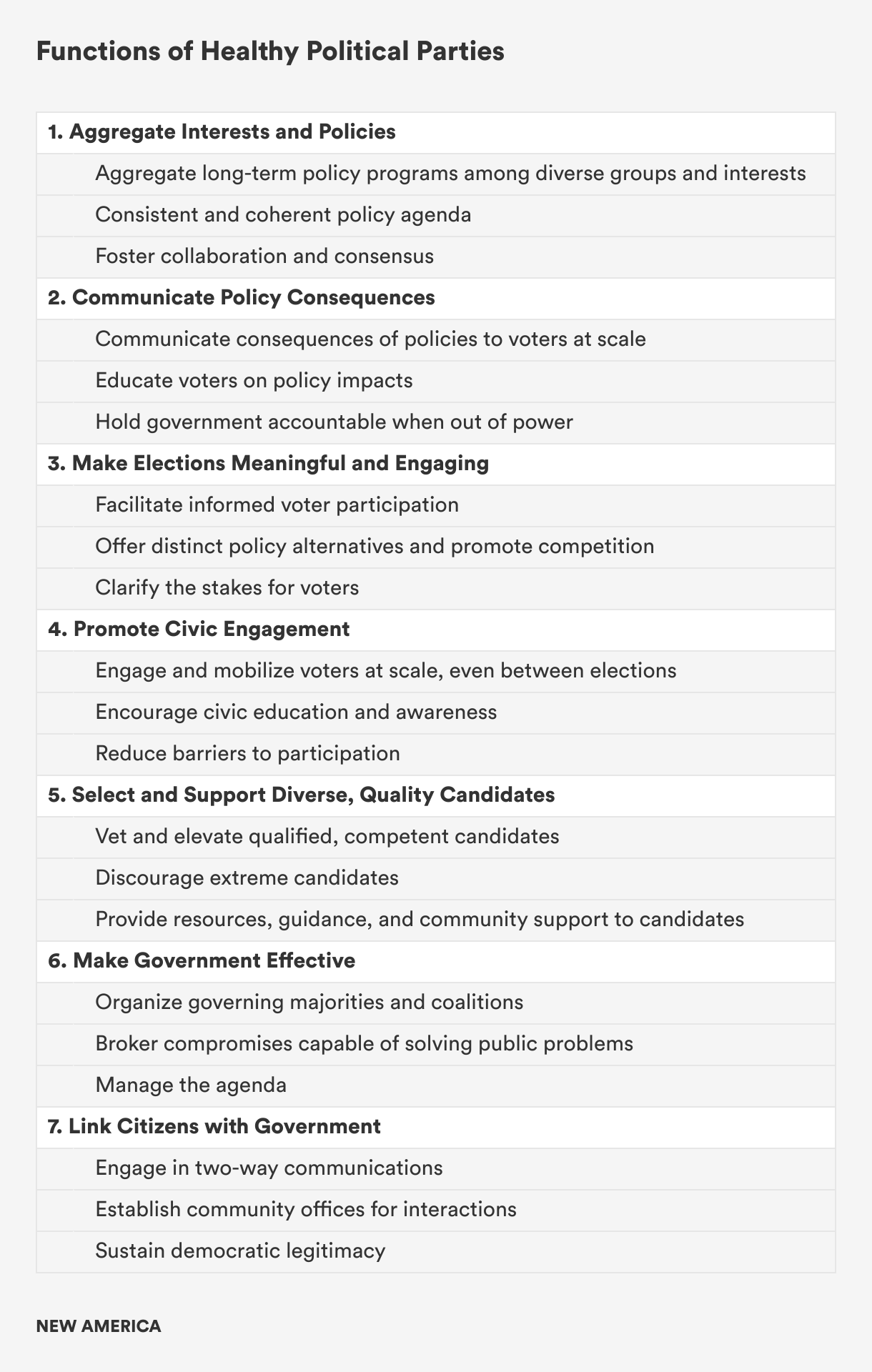
Healthy Parties Aggregate Long-Term Policy Programs That Broker among Groups and Interests
Political parties are coalitions of ambitious politicians, political operatives, organized interest groups, donors, activists, and more diffuse supporters.3 These actors would have a difficult time agreeing if they operated independently. But because they have to agree at least somewhat in order to have a chance at winning shared representation, they must find common ground.
Thus, political parties aggregate citizen and group preferences, and fuse those interests into a consistent long-term program. Without this partisan brokering function, independent actors would float around the political space chaotically. Voters would have little understanding of how their vote choices might translate into public policy. Voters would not know whom to hold accountable for public policy failures or to reward for public policy successes, all of which depend on collective coordination across many actors.
Healthy Parties Make Elections Meaningful and Engaging for Voters
Parties give voters clear electoral choices by developing policy programs and group alignments that are somewhat consistent over time. Because parties campaign on policy programs (or, at the very least, values and priorities), elections emphasize policy and value conflicts. To win elections, parties differentiate themselves from each other and strategically elevate competing issues. Conflict and competition, over policies, values, and priorities, are what make elections meaningful. Conflict engages voters and clarifies the stakes. Competitive elections are the most powerful force for citizen engagement and voter turnout.4
Without the adversarial nature of electoral democracy, one party could rule indefinitely, without challenge. New ideas enter politics and innovative policy solutions emerge through partisan competition and conflict, not in spite of it.5 Without partisan challengers, incumbents and one-party systems drift into corruption.6
Healthy Parties Engage and Mobilize Voters at Large Scale and Over Time
Much as we might idealize citizen participation as an individual choice and responsibility, real politics is fundamentally a social and group activity. Most people engage in politics because others engage them. Marginalized citizens particularly depend on others to engage them in politics by investing in their participation.7
Because political parties are trying to win elections, they organize to mobilize and engage voters. While individual candidates also have the same motivations and can also build organizations to mobilize and engage voters, candidates compete in only single races. They come and go. Only political parties can engage and mobilize voters consistently at scale and across time. Ideally, this gives political parties a longer-term view that must go beyond the personality or charisma of any single leader (though, obviously, party leaders are important).
When parties are institutionally weak, individual candidates take on outsized roles. Candidates cannot rely on parties. They must develop their own organizations, especially if they compete in primaries.8 For example, presidents and presidential candidates now increasingly build their own campaign operations distinct from the parties. Barack Obama built his own operation, Organizing for America, rather than building up the Democratic Party. Donald Trump has his distinct organization. Indeed, because parties do not control presidential or candidate nominations, individual candidates have a strong reason to build up their own independent organizations鈥攆urther undermining the ability of parties to do the important work of long-term mobilization. Candidates come and go. Parties last.
Moreover, because parties are somewhat consistent across elections in their policies, values, and priorities, even voters who are not overly engaged in politics can still make informed choices without having to do extensive personal research. Knowing what the parties stand for enables voters to choose the party that best aligns with their values. This reduces participation barriers for citizens who lack the time or resources to evaluate policies or candidates independently.
Certainly, many other civic and political organizations play crucial roles in mobilizing collective citizen power. A robust pluralism of associations of varying scale is essential for a healthy democracy. However, political parties are unique in both their electoral role and their level of aggregation. A democracy of only civic associations would be too fragmented to function. Many civic associations come and go. Scale and structure matter for consistency and equality of representation.
Healthy Parties Vet Candidates for Office
Who is qualified to hold public office? Who knows? Who decides? Healthy political parties vet and elevate candidates who have the qualifications and temperament for public office. When this is done responsibly, political parties perform a crucial quality-control function in electoral democracy.9
Voters cannot conduct full background checks on candidates. They cannot elevate the candidates directly. They don鈥檛 know whose public extroversion is also private psychotic narcissism, and whose public awkwardness is quiet competence. Voters rely on a kind of 鈥減eer review鈥� within party leadership that can push aside those who are most likely to abuse their power.
鈥�Weak and unhealthy political parties can easily become fiefdoms of autocratic rulers. Indeed, the failure of political parties to play this key gatekeeping role is a common warning sign of oncoming democratic decline.鈥�
When parties do not perform these roles responsibly, demagogues can come to power. Weak and unhealthy political parties can easily become fiefdoms of autocratic rulers. Indeed, the failure of political parties to play this key gatekeeping role is a common warning sign of oncoming democratic decline.10
Parties are also solving a collective action problem of would-be candidates by helping them coordinate their campaigns and providing shared branding, technology, and funding. This can lower the barriers to entry for candidates. A hollow party leads to mostly candidates with high personal wealth or dedicated partisan zeal running for office. These qualities best prepare candidates to conquer the costly nomination climb.11
Healthy Parties Make Governance Possible and (Somewhat) Accountable by Organizing Governing Majorities
Parties and candidates can make many promises when they campaign. But whether they can turn those promises into public policy depends on their ability to secure legislative majorities for these proposals. Without political parties, every legislative vote would require its own distinct process of coalition-building and renegotiation. Anybody who has ever tried to negotiate an agreement among a large and diverse group will appreciate the limits of open-ended individualistic deliberation.
The first U.S. political parties emerged in the First Congress to solve the chaos problem. The Federalist Party assembled to pass Alexander Hamilton鈥檚 banking proposal. Thomas Jefferson and James Madison formed the Democratic-Republican Party to organize the opposition. Though the Framers had fretted about political parties in writing the Constitution, they quickly changed their minds when they set to governing, having realized that without the ability to organize a long-term coalition, governing would be impossible.12
Without a team approach to politics, the task of passing legislation devolves into a chaotic free-for-all that is far less likely to yield any resolution, much less a negotiated consensus resolution. More precisely, when each lawmaker is a free agent, many demand side payments for support. This is why weak parties and highly fragmented politics almost always correspond to rampant corruption.
Governing is a team sport. Political parties make governance possible by organizing teams around specific policy promises and the value of a shared 鈥渂rand鈥� that all candidates can benefit from across multiple elections.
Individual candidates, by contrast, cannot make meaningful policy promises because a single lawmaker is largely powerless without a party. They cannot promise to 鈥渄eliver results鈥� beyond narrow parochial concerns, since only organized political parties have any chance of delivering anything policy-related. As a result, only parties can be held accountable for how hard they worked toward that policy outcome.
Political parties cohere policy alternatives and manufacture majority coalitions in support of them.13 Without political parties, it would be impossible to form governing majorities of any scale in legislatures.14 Without parties, governance would devolve into endless bargaining. Every individual lawmaker would attempt to extract something in exchange for their support. This is why extensive corruption is commonly found alongside personalized weak parties and highly fragmented party systems.15
Healthy Parties Contribute to Democratic Legitimacy by Linking Citizens with Government and Making Voters Feel Represented
By connecting citizens to government, political parties play a crucial 鈥渓inkage鈥� role in sustaining democratic legitimacy. Across democracies, citizens report being most satisfied with democracy when they support political parties who they feel represent them well, especially when those parties hold power (including within a governing coalition). Because political parties have clear incentives to mobilize and engage voters, well-resourced political parties contribute to democratic legitimacy. When voters see parties and candidates within those parties who are trying to earn their vote, they are more satisfied with democracy. When citizens don鈥檛 see candidates showing up in their communities, listening to them, and reflecting their concerns, they are understandably less satisfied with democracy.16
Individual elected officials, to be sure, can also help connect citizens to government, separate from parties, through their constituency service. However, because individual elected officials can accomplish little independently, the linkage is limited to simple constituency service. This is one reason many individual representatives run against Congress: it allows them to blame their failures on the system. This, in turn, contributes to further distrust and dissatisfaction with Congress, which further undermines democratic legitimacy.
Healthy parties, however, can engage in a thicker, more long-term way than individual candidates. Parties can set up community offices to enable essential two-way communications, so that party representatives not only campaign but also listen. Parties with a permanent organizational presence can direct party volunteers and employees to hear citizens鈥� diverse concerns and share them with party leaders and candidates. Parties can invite local civic associations to contribute to a party鈥檚 agenda. Ultimately, parties should engage in this kind of 鈥渁ssociational party building鈥�17 because building thick ties with community organizations ultimately gets out more votes.
Of course, this is only if the parties need wider community support to win seats. Not all parties need such support. Parties that operate in places where they are guaranteed either victory or defeat have no reason to build anything.
Parties can also contribute to democratic legitimacy by accepting elections as legitimate. Indeed, one minimal definition of democracy is a system in which parties lose elections.18 Parties perform crucial leadership roles in helping citizens accept electoral losses and understand that they will have opportunities to win in the future. Without this leadership, democratic legitimacy is difficult to maintain. Obviously, political parties can also undermine democratic legitimacy. Irresponsible and unhealthy parties are marked by activities that undermine democratic legitimacy, in particular by attacking their political opponents as illegitimate and by advocating for and passing policies that alter the rules of electoral competition to their advantage. Organized power can be abused. Hence, many reformers remain skeptical of organized power. But, again, the solution to antidemocratic or illiberal parties is not to undermine parties altogether鈥攊t is to create better and alternative parties that can build up democratic legitimacy.
What Is the Alternative?
Those who dislike political parties might imagine a better alternative. But there is a good reason why every stable modern democracy has strong, functioning, long-lasting political parties. The alternative to political parties is chaos. Countries with weak or nonexistent political parties fall into authoritarianism and corruption.
Just as a stable government is necessary to provide some basic law and order (the alternative to government is not freedom, it is complete disorder), so political parties are necessary to provide stable representative government. It is easy to romanticize a truly equal society in which everybody decides independently and rationally. Indeed, we seem to be hard-wired for this kind of romanticism, since it seems to pop up repeatedly in various utopian visions. But we seem equally hard-wired never to achieve this vision.
鈥淲ithout parties,鈥� writes the political scientist Nancy Rosenblum, 鈥渄eliberation is disorganized and impossible within legislatures, much less on a public national scale… Parties not only organize debate within government; they can organize debate among activist citizens and can force those into argument who would rather evade it.鈥�19
A politics without parties lacks any coherent or even semi-stable structure. It is a politics of chaos and anarchy, not reasoned deliberation and compromise.
Indeed, a core warning sign of a degrading democracy is weakening political parties. As democracy expert Kim Lane Scheppele has observed, 鈥淐ollapsing democracies follow on collapsing political parties.鈥�20 As Scheppele explains: 鈥淚f one traces the failing and failed democracies, one will generally find that traditional parties in that country had first fallen victim to insidious infighting, ideological drift, or credibility collapse in a way that disrupted the ability of those mainstream parties to screen out toxic choices put to voters. And the voters, not realizing that the safety checks had disappeared when they were offered up seriously bad options, picked one of the options they were given鈥攚hich in turn sent their countries down 鈥榯he rabbit hole of autocracy.鈥欌��
Scheppele offers case studies of Venezuela and Hungary to illustrate. Both countries were once widely described as stable and thriving multiparty democracies. But then, 鈥渕ultiple parties collapsed into a two-party system and a punishing-vote practice emerged in which the electorate threw out the government at every opportunity save one鈥� The paths that led to Ch谩vez and Orb谩n involved progressively narrowing party choices, ending eventually in an election in which the budding autocrat was the only reasonable-looking option among the available limited choices. In short, party collapse preceded democratic collapse.鈥�21
Similarly, developing democracies with weak, incoherent, and transient political parties are most likely to slide back into autocracy. Authoritarian leaders thrive amid the chaos of such gossamer parties. When parties cannot organize politics, charismatic dictators have an opening.
Certainly, core functions like candidate recruitment and agenda-setting can occur without parties. However, broad interest aggregation and reconciliation uniquely depend on parties. Without parties, narrowly organized groups will instead shape candidate recruitment and issue agenda-setting. Without parties at the center, the alternatives are all less transparent, less accountable, and less representative than political parties.
Governing without parties is more difficult. Governing institutions require some mechanism to decide what comes up for a vote, which usually means selecting some leaders. Ambitious politicians will lead and assemble coalitions to pass their preferred policies. These coalitions will behave like parties.
Whatever their flaws, political parties are much better at organizing democratic contestation and representation than any of the alternatives at present.
Building healthy political parties does not mean that we have to go back to a bygone era of 鈥渟moke-filled rooms鈥� where political 鈥渂osses鈥� trade favors with donors and make decisions insulated from public input. We can instead envision a twenty-first-century version of political parties that combines leadership and representativeness and builds upon new organizational forms. A new generation of scholars and organizers is thinking through new innovative approaches to party organizing in the United States.22 Abroad, new parties are exploring new organizing models on the ground.23 But abroad, new parties can emerge because more permissive electoral rules allow space for new parties to enter.24 Long-standing parties typically have little interest in innovating until their dominance is threatened. Under U.S. voting rules, existing parties face no threat. Both parties have a monopoly on opposition.
To reiterate: Stronger, healthier political parties enhance the quality of representative government. Better political parties are not the goal for their own sake. They are the institutions that make stable, healthy governance possible in the twenty-first century.
The Problem of Just Two Parties
Parties are important. But both the sheer size of U.S. political parties (two parties for a diverse nation of 330 million people) and the binary nature of partisan competition (which creates a monopoly on opposition for both parties) makes it difficult for the Democratic and Republican parties to carry out the responsibilities of healthy political parties.
Having discussed the essential democratic roles of political parties above, I will now turn to the ways in which two polarized nationalized parties face significant obstacles to performing those roles.
Let鈥檚 start with aggregation. Again, parties perform a crucial policy aggregation role. However, there is a trade-off between size and effectiveness. Parties that are too big must suppress too many potential internal conflicts, thus keeping many issues off the agenda.
A big tent may be necessary to win elections, but a big tent can be stretched so big that it becomes difficult for voters to know exactly what they are voting for because the party they support aims to represent so many perspectives. Indeed, this was the long-standing critique many threw at the U.S. party system for much of the twentieth century鈥攖hat the parties were too indistinguishable and, as a result, voters lacked meaningful choices, particularly on the crucial issue of civil rights.
However, because twentieth-century American politics centered more on state and local politics than national politics, the national parties operated more like loose labels鈥攎ore like dispositional than programmatic parties. In practice, this yielded a kind of hidden multi-party system within the two-party system. Organized factions played a significant role. Both parties came in many regional varieties.
Moreover, because many voters had some sympathies with both parties, a vibrant competition of policy innovation could emerge, as party leaders sought new policy aggregations capable of winning over the many groups of voters willing to consider either side. This is how party competition should work. A substantial group of voters should be open to multiple parties. Parties should innovate new policies to attract new voters.
However, as American politics nationalized and sorted, parties simplified and flattened into two distinct coalitions, with much less overlap. Winning over 鈥渟wing voters鈥� has diminishing returns. Few remain, and those who do are unpredictable, heterogenous, and mostly disengaged and disgusted by politics. Though factions continue to exist within the two parties, they are no longer overlapping. In the twenty-first century, American partisan conflict has collapsed into an all-or-nothing binary. This means party leaders can suppress internal conflict by emphasizing their common enemy.
Only in a binary conflict is the enemy of my enemy my friend. This kind of zero-sum conflict makes partisan competition so totalizing that the potentially innovative benefits of party aggregation disappear into the black hole of us-versus-them group psychology. Politics has now become calcified.25 With few voters up for grabs, the potential for flexible policy innovation and aggregation declines to zero. As COVID-19 demonstrated, even a public health crisis could become a very partisan issue in only a few short months.
Indeed, while parties do make elections meaningful and engaging for voters, binary adversarial competition can make elections too meaningful. In 2020, for example, the United States had its highest-turnout election in more than 100 years. Nothing drives turnout like a crisis.
Limiting choices to only two simplifies elections, which is one supposed benefit of the two-party system. However, limiting choices to just two can also oversimplify elections, which is one of the drawbacks of the two-party system. Elections can become a recursive and reductive us-versus-them conflict, with the same us and same them over and over, particularly when parties turn to negative, lesser-of-two-evils campaigning鈥攁 strategy that a two-party system encourages.
A two-party system also leaves dissatisfied voters only one 鈥渃hange鈥� option. This can lead to a constant cycle of 鈥渢hrow the bums out鈥� based on small shifts. If every election becomes a change election, constant policy whiplash undermines effective governing. And if one of two major parties turns illiberal (which is common in a polarized two-party system because having only one opposition alternative breeds oppositional extremism), a vote to 鈥渢hrow the bums out鈥� can become an unwitting vote to install authoritarian leadership. Because the costs of losing seem so high, parties in power often change the rules to avoid losing.26
Turning to parties鈥� role in engaging voters in elections, it is notable that turnout is consistently lower in countries with first-past-the-post elections, like the United States. This is not surprising. In a system with single-member districts, many districts are not two-party competitive. When districts are not competitive, parties have little incentive to mobilize voters. The dominant party has good reasons not to mobilize voters (since it is already in power). The opposing party sees no chance of winning; why waste precious resources?
By contrast, in multiparty systems with proportional representation, every voter counts the same, regardless of geography. And with more parties competing everywhere, more parties are out mobilizing and engaging voters. More parties also mean more options for voters, and thus more likelihood voters will feel excited about supporting a party.
Turning to parties鈥� role in vetting candidates, the United States is unique in so fully turning candidate selection over to the public. As a result of the direct primary鈥攁 Progressive Era reform鈥攙oters (not party leaders) choose party nominees. In all other advanced democracies, political parties have their own internal processes for selecting candidates, though some parties have moved toward more open elections among party members.
However, though U.S. parties do leave nominations open to the public, party networks and factions do work behind the scenes, supporting particular candidates with their money and public endorsements.27 Parties also rely on outside groups with narrow agendas to recruit and support candidates.28 These fuzzy lines of responsibility blur the meaning of political parties in the United States and make money even more important, contributing to unrepresentative candidate recruitment patterns.
They also contribute to a vague and ever-present distrust. When it鈥檚 not clear who is actually making decisions, conspiracy thinking thrives. This fuels more antisystem sentiment. For example, in 2016, many Bernie Sanders supporters believed that the Democratic presidential nomination process was somehow rigged.29 Was it? The rules were not always clear to voters, and party leaders almost certainly intervened to clear the field for Hillary Clinton. No process is entirely neutral.
As for governance, political parties make governing possible because political parties broker coalitions and compromises to pass legislation. A long-standing argument for a two-party system is that having two cohesive, responsible parties allows voters to choose one, assess its performance, and evaluate the results in subsequent elections. This is the so-called Responsible Party Government theory.30
Nonetheless, this theory seems ill-suited for the American government. Separated powers and bicameralism frequently generate divided government and blur responsibility. Biennial congressional elections leave little time to evaluate policy results. The American system of government was designed intentionally to frustrate narrow majoritarian governing with overlapping and ever-changing authority. In modern American politics, divided government has been the dominant situation in Washington.31 Unified government is rare, and it is even rarer for one party to hold a filibuster-proof majority in the Senate.32 And even here, the Supreme Court offers a potential veto, since the United States is unique in having widespread judicial review.
In two-party polarized politics, divided government means legislative gridlock. And legislative gridlock means that the executive branch is left to improvise within existing legal authority. This creates more instability. The Obama presidency marked a major reversal from the Bush presidency on a range of administrative policies. The Trump presidency marked an even bigger reversal on even more policies. The Biden presidency has intensified the executive branch whiplash. The next Republican administration will accelerate the instability even further. This policy whiplash leads to high executive branch turnover, which contributes to poorer and more inefficient governing. It also undermines American global leadership and industry, given the extent to which the rest of the world cannot count on American promises from one administration to the next.
Meanwhile, a polarized Congress becomes helpless to take back any of its power. Under unified government, one-party rule fuses congressional powers with the presidency. Under divided government, the congressional opposition is left to either pass bills that will be vetoed, or just to engage in oppositional oversight. Compromise is not rational for either party. Blurring the differences by cooperating undermines a clear electoral message: The other side is dangerous.
In the current era of pendulum politics, both parties get two years of unified government every 12 years or so, and a chance to pass some big, important policies. (Democrats managed to do that during their recent hold on unified government. Republicans did much less during theirs.) But a government that is only able to assemble governing majorities to pass big policies less than a third of the time can hardly be considered effective or efficient.
It is true that in multiparty systems, coalitions sometimes take a few months to come together after an election, and sometimes coalitions fall apart and change (in parliamentary systems, this sometimes involves a new election). But compared to the U.S. two-party system, which spends most of its time mired in gridlock in which little can happen, multiparty systems are much more effective in solving public problems on an ongoing basis, in large part because coalitions have more flexibility to change over time.
When it comes to democratic legitimacy and the importance of partisan 鈥渓inkage鈥� in maintaining that legitimacy, a polarized two-party system presents a problem.
First, on the problem of 鈥渓inkage:鈥� Because two major parties are inevitably big, broad coalitions (even if they are polarized), it is difficult for a big party to connect meaningfully with a wide range of voters, especially in a large and diverse country. Smaller parties can speak more directly to different communities and represent their concerns more effectively. Of course, parties must also act as aggregators, so parties that are too small would not perform this crucial democracy-enhancing function. A middle ground exists between too small and too large.
Additionally, because the single-member districts that maintain two-party competition inevitably result in large numbers of districts that are uncompetitive (even in the most competitive times), two geographically polarized parties have mostly safe districts and safe states, where they do not need to worry about any competition. This lack of competition means that both Democrats and Republicans need not invest in meaningful 鈥渓inkage鈥� activities in large parts of the country.
Yet both parties still need some way to motivate and unify voters. A geographically polarized two-party system provides the obvious answer: the threat of the other party winning. Nothing unites like a common enemy. Not only does a fearsome common enemy absolve parties of having to listen to concerns of many of their voters, it also allows鈥攁nd perhaps even encourages鈥攑arty leaders to refuse to concede elections.
鈥淟osers鈥� consent鈥� (the political science term for partisan losers accepting outcomes) is a crucial foundation for modern democracy, since without legitimate elections, the whole system of representative self-government degrades into authoritarianism.
However, as multiple studies have shown, in two-party systems, especially polarized two-party systems, political losers experience a sharper sting from losing. This makes losers less likely to trust the government, and more skeptical of democracy generally when they are out of power. In proportional multiparty systems, the sting of losing is less severe, since power is much more broadly shared and fluid, and the differences between the opposition coalition and the governing coalition are usually smaller.33 Thus, in proportional, multiparty systems, losers鈥� consent is much higher, and voters are more satisfied with democracy and more trusting in the government even when the party they supported isn鈥檛 in power.
鈥�Newer parties can find new ways of organizing, can highlight new solutions and new concerns, and can find new ways of linking citizens with governing.鈥�
To be sure, political parties in multiparty systems are not always healthy and effective either. Established political parties in European multiparty systems tend to rise and fall in a somewhat cyclical and even dialectical manner. As parties centralize internally and govern predictably, they often make hard compromises that leave many supporters cold. In response to a crisis of legitimacy, voters鈥攑articularly younger voters鈥攃an migrate to newer parties. Newer parties are not bogged down by old structures and old leadership. Newer parties can find new ways of organizing, can highlight new solutions and new concerns, and can find new ways of linking citizens with governing.34
This process of 鈥渃reative destruction鈥� makes political systems resilient. In many ways, the recent party volatility in European multiparty democracies is a clear and ultimately healthy sign of this. Political parties throughout history have innovated in how they organize and connect citizens to the government. The European story of party development, by contrast, is a story of change through the rise and fall of particular parties, with innovation coming from new parties rather than from attempting to retrofit old parties.35
But in a two-party system, innovation must come from within major parties, where it is slowest, messiest, and least likely. This means factions challenging each other internally, undermining the ability of parties to perform their essential roles with consistency and coherence. Indeed, American party development is essentially a series of internal party reform episodes鈥攐utsiders busting open existing power structures, and then struggling to build something new out of a busted-open institution.36
The American story of party reform is anti-party. This is partially because the American political tradition holds major skepticism toward any organized power. It is also because Americans have repeatedly tried to refashion the existing parties, trying to make them into something they cannot be鈥攖ruly open and porously participatory鈥攁nd yet still be effective in carrying out the basic roles of political parties in modern democracy. The end result has been a worst-of-both-worlds compromise: not effective enough to be legitimate and capable, and not participatory enough to satisfy small-d democratic demands. Stuck with just two options, many Americans get little out of party democracy. But they can鈥檛 govern themselves collectively without party democracy.
More Parties, Better Parties
- Executive Summary
- Introduction: The Case for More and Better Parties
- 1. Defining the Problem(s)
- 2. The Case for Political Parties: Why Modern Mass Democracy Needs Political Parties and Can鈥檛 Operate without Them
- 3. Learning from History: The Flawed American Tradition of 鈥淭earing Open鈥� without 鈥淏uilding Up鈥�
- 4. The Contemporary Choice: Will We Repeat the Mistakes of the Past or Build Something Better for the Future?
- 5. Pro-Parties Reform: Building More and Better Parties
- 6. Conclusion: Imagining a Better Future, with More and Better Parties
Citations
- For an even more extended discussion of the essential role of political parties in modern democracy, see Nancy L. Rosenblum, On the Side of the Angels: An Appreciation of Parties and Partisanship (Princeton, NJ: Princeton University Press, 2008); Russell Muirhead, The Promise of Party in a Polarized Age (Cambridge, MA: Harvard University Press, 2014); Russell Muirhead and Nancy L. Rosenblum, 鈥淭he Political Theory of Parties and Partisanship: Catching Up,鈥� Annual Review of Political Science 23 (May 11, 2020): 95鈥�110; Russell Muirhead, 鈥淎 Defense of Party Spirit,鈥� Perspectives on Politics 4, no. 4 (2006): 713鈥�27; Frances Rosenbluth and Ian Shapiro, Responsible Parties: Saving Democracy from Itself (New Haven, CT: Yale University Press, 2018). The following discussion draws on insights from these works, especially the writings of Nancy Rosenbaum.
- David Bruce Robertson, A Theory of Party Competition (Hoboken, NJ: John Wiley & Sons, 1976), 1.
- Some theories of parties suggest that politicians form parties for their own advancement in winning office and passing policies. See, e.g., John H. Aldrich, Why Parties? The Origin and Transformation of Political Parties in America (Chicago: University of Chicago Press, 1995); Joseph A. Schlesinger, Political Parties and the Winning of Office (Ann Arbor: University of Michigan Press, 1991). Other theories of parties see them as coalitions of interest groups and donors. From a comparative perspective, there are many types of parties, which differ in how they organize internally and the types of constituencies they represent. See, e.g., Susan E. Scarrow, Paul D. Webb, and Thomas Poguntke, eds., 鈥淐onclusion: The Study of Party Organization,鈥� in Organizing Political Parties: Representation, Participation, and Power (Oxford: Oxford University Press, 2017), 307-320; Richard Gunther and Larry Diamond, 鈥淪pecies of Political Parties: A New Typology,鈥� Party Politics 9 (March 2003): 167鈥�99, . Over time, political parties have changed considerably, and they come in many different varieties. Richard S. Katz, and Peter Mair, 鈥淭he Evolution of Party Organizations in Europe: The Three Faces of Party Organization,鈥� American Review of Politics 14 (January 1994): 593鈥�617, . Yet what all political parties have in common is that they put forward candidates for public office on an official ballot line. See, generally: Giovanni Sartori, Parties and Party Systems: A Framework for Analysis (Colchester, UK: ECPR Press, 1976).
- Consistent across all studies is that competitive elections drive higher turnout: Andr茅 Blais, 鈥淲hat Affects Voter Turnout?鈥� Annual Review of Political Science 9 (June 2006): 111鈥�25, ; Jo茫o Cancela and Benny Geys, 鈥淓xplaining Voter Turnout: A Meta-Analysis of National and Subnational Elections,鈥� Electoral Studies 42 (June 2016): 264鈥�75, ; Gary W. Cox, 鈥淓lectoral Rules, Mobilization, and Turnout,鈥� Annual Review of Political Science 18 (May 2015): 49鈥�68, ; Benny Geys, 鈥淓xplaining Voter Turnout: A Review of Aggregate-Level Research,鈥� Electoral Studies 25 (December 2006): 637鈥�63, .
- Nelson W. Polsby, Political Innovation in America: The Politics of Policy Initiation (New Haven, CT: Yale University Press, 1985).
- Research consistently finds a relationship between low levels of partisan competition and high levels of political corruption, both across U.S. states and across countries worldwide. See, e.g., Kim Quaile Hill, 鈥淒emocratization and Corruption: Systematic Evidence from the American States,鈥� American Politics Research 31 (November 2003): 613鈥�31, ; Thomas Schlesinger and Kenneth J. Meier, 鈥淰ariations in Corruption among the American States,鈥� in Political Corruption, ed. Michael Johnston (New York: Routledge, 2002), chap. 33; Daniel Treisman, 鈥淭he Causes of Corruption: A Cross-National Study,鈥� Journal of Public Economics 76 (June 2000): 399鈥�457, ; Petra Schleiter and Alisa M Voznaya,鈥淧arty System Competitiveness and Corruption,鈥� Party Politics 20 (September 2014): 675鈥�86, .
- Few 鈥渘ormal鈥� people participate in politics because of a spontaneous passion or interest; they participate because somebody asks them. Political聽parties are the institutions that have historically done most of the asking. When political parties do not subsidize mobilization, it is the poor and least engaged who tend to drop out of politics. See, e.g., Sidney Verba, Kay Lehman Schlozman, and Henry E. Brady, Voice and Equality: Civic Voluntarism in American Politics (Cambridge, MA.: Harvard University Press, 1995); Steven J. Rosenstone and John Mark Hansen, Mobilization, Participation, and Democracy in America, (New York, Munich: Pearson, 2002); Kim Quaile Hill and Jan E. Leighley, 鈥淧olitical Parties and Class Mobilization in Contemporary United States Elections,鈥� American Journal of Political Science 40 (August 1996): 787, ; Robert Huckfeldt and John Sprague, 鈥淧olitical Parties and Electoral Mobilization: Political Structure, Social Structure, and the Party Canvass,鈥� American Political Science Review 86 (March 1992): 70鈥�86, ; Joe Soss and Lawrence R. Jacobs, 鈥淭he Place of Inequality: Non-Participation in the American Polity,鈥� Political Science Quarterly 124, no. 1 (2009): 95鈥�125, .
- John M. Carey and Matthew Shugart, 鈥淚ncentives to Cultivate a Personal Vote: A Rank Ordering of Electoral Formulas,鈥� Electoral Studies 14 (December 1, 1995): 417鈥�39, ; Audrey Andr茅, Sam Depauw, and Matthew S. Shugart, 鈥淭he Effect of Electoral Institutions on Legislative Behaviour,鈥� in The Oxford Handbook of Legislative Studies, ed. Shane Martin, Thomas Saalfeld, and Kaare W. Str酶m (Oxford: Oxford University Press, 2014), 231鈥�249.
- Reuven Y. Hazan and Gideon Rahat, Democracy within Parties: Candidate Selection Methods and Their Political Consequences (Oxford:鈥疧xford University Press, 2010).
- Levitsky and Ziblatt, How Democracies Die; Kim Lane Scheppele, 鈥淭he Party鈥檚 Over,鈥� in Constitutional Democracy in Crisis? ed. Mark A. Graber, Sanford Levinson, Mark Tushnet (Oxford: Oxford University Press, 2018), .
- Andrew B. Hall, Who Wants to Run? How the Devaluing of Political Office Drives Polarization (Chicago: University of Chicago Press, 2019).
- See John H. Aldrich, Why Parties? The Origin and Transformation of Political Parties in America (Chicago: University of Chicago Press, 1995); John H. Aldrich and Ruth W. Grant, 鈥淭he Antifederalists, the First Congress, and the First Parties,鈥� The Journal of Politics 55, no. 2 (1993): 295鈥�326.
- Rosenblum, On the Side of the Angels: An Appreciation of Parties and Partisanship, 58: 鈥淣o majority exists spontaneously, ready to be contested for. It is identified in the course of drawing lines of division. That is what political activity generally and party activity is specifically about.鈥�
- Seymour Martin Lipset, 鈥淭he Indispensability of Political Parties,鈥� Journal of Democracy 11, no. 1 (2000): 48鈥�55, ; Elmer Eric Schattschneider, Party Government (New York: Farrar & Rinehart, Inc., 1942).
- See, e.g., Michael Johnston, Corruption, Contention and Reform: The Power of Deep Democratization (Cambridge: Cambridge University Press, 2014); Susan Rose-Ackerman and Bonnie J. Palifka, Corruption and Government: Causes, Consequences, and Reform (New York: Cambridge University Press, 2016).
- Hannah M. Ridge, 鈥淛ust Like the Others: Party Differences, Perception, and Satisfaction with Democracy,鈥� Party Politics 28, no. 3 (May 2022): 419鈥�30, : 鈥淐itizens who view their system as including a broad array of parties are more likely to be satisfied with their democracy鈥檚 performance.鈥� See also: Paul Webb, Susan Scarrow, and Thomas Poguntke, 鈥淧arty Organization and Satisfaction with Democracy: Inside the Blackbox of Linkage,鈥� Journal of Elections, Public Opinion and Parties 32, no. 1 (January 2, 2022): 151鈥�72, .
- Tabatha Abu El-Haj, 鈥淣etworking the Party: First Amendment Rights and the Pursuit of Responsive Party Government,鈥� Columbia Law Review 118, no. 4 (2018): 1225鈥�1302; Tabatha Abu El-Haj, and Didi Kuo, 鈥淎ssociational Party-Building: A Path to Rebuilding Democracy,鈥� Columbia Law Review 122 (2022): 50.
- Adam Przeworski, Democracy and the Market (Cambridge, : Cambridge University Press, 1991).
- Rosenblum, On the Side of the Angels, 160.
- Scheppele, 鈥淭he Party鈥檚 Over.鈥�
- Scheppele, 鈥淭he Party鈥檚 Over,鈥� 8.
- Lara Putnam, Daniel Schlozman, Tabatha Abu El-Haj, Joseph Anthony, Jacob M. Grumbach, Alexander Hertel-Fernandez, Adam Seth Levine, and Caroline Tervo, 鈥淟ocal Political Parties as Networks: A Guide to Self-Assessment,鈥� Scholars Strategy Network (May 19, 2020), ; El-Haj and Kuo, 鈥淎ssociational Party-Building: A Path to Rebuilding Democracy.鈥�
- Piero Ignazi, 鈥淭he Failure of Mainstream Parties and the Impact of New Challenger Parties in France, Italy and Spain,鈥� Italian Political Science Review/Rivista Italiana Di Scienza Politica 51, no. 1 (March 2021): 100鈥�116, .
- Margit Tavits, 鈥淧arty System Change: Testing a Model of New Party Entry,鈥� Party Politics 12 (January 2006): 99鈥�119, .
- John Sides, Chris Tausanovitch, and Lynn Vavreck, The Bitter End: The 2020 Presidential Campaign and the Challenge to American Democracy (Princeton, NJ: Princeton University Press, 2022).
- Scheppele, 鈥淭he Party鈥檚 Over.鈥�
- Marty Cohen, David Karol, Hans Noel, and John Zaller, The Party Decides: Presidential Nominations Before and After Reform (Chicago: University of Chicago Press, 2008); Marty Cohen, David Karol, Hans Noel, and John Zaller, 鈥淧arty Versus Faction in the Reformed Presidential Nominating System,鈥� PS: Political Science & Politics 49, no. 04 (October 2016): 701鈥�8, ; Hans J. G. Hassell, The Party鈥檚 Primary: Control of Congressional Nominations (Cambridge: Cambridge University Press, 2017); Hans J. G. Hassell, 鈥淧arty Elite Engagement and Coordination in House Primary Elections: A Test of Theories of Parties,鈥� American Journal of Political Science 67, no. 2 (2023): 307鈥�23, .
- See Theda Skocpol and Alexander Hertel-Fernandez, 鈥淭he Koch Network and Republican Party Extremism,鈥� Perspectives on Politics 14, no. 3 (September 2016): 681鈥�99, .
- See Ezra Klein, 鈥淲as the Democratic Primary Rigged?鈥� Vox, November 14, 2017, .
- For a useful history of the idea of responsible party government and its development in U.S. politics, see Sam Rosenfeld, The Polarizers: Postwar Architects of Our Partisan Era (Chicago: University of Chicago Press, 2017).
- Since 1994, Republicans have enjoyed six years of unified government (four under Bush, two under Trump), and Democrats have enjoyed four years of unified government (two under Obama, two under Biden). That means two-thirds of the time, control of the presidency, Senate, and the House was split between the two parties.
- This happened in 2009. Before that, it last happened in 1977-1978.
- Shaun Bowler, Todd Donovan, Ola Listhaug, Christopher J. Anderson, and Andr茅 Blais, Losers鈥� Consent: Elections and Democratic Legitimacy (Oxford: Oxford University Press, 2007); Matthew Germer, Restoring Losers鈥� Consent: A Necessary Step to Stabilizing Our Democracy (Washington, DC: R Street Institute, September 2021), ; Richard Nadeau and Andre Blais, 鈥淎ccepting the Election Outcome: The Effect of Participation on Losers鈥� Consent,鈥� British Journal of Political Science 23, no. 4 (1993): 553鈥�63.
- Piero Ignazi, 鈥淭he Failure of Mainstream Parties and the Impact of New Challenger Parties in France, Italy and Spain,鈥� Italian Political Science Review/Rivista Italiana Di Scienza Politica 51 (March 2021): 100鈥�116, . Ignazi notes how challenger parties are innovating in response to the failures of the old mainstream parties.
- Luciano Bardi, Stefano Bartolini, and Alexander Trechsel, 鈥淧arty Adaptation and Change and the Crisis of Democracy,鈥� Party Politics 20, no. 2 (March 1, 2014): 151鈥�59, .
- Austin Ranney, Curing the Mischiefs of Faction: Party Reform in America (Berkeley: University of California Press, 1975); Byron E. Shafer and Regina L. Wagner, The Long War over Party Structure: Democratic Representation and Policy Responsiveness in American Politics (Cambridge: Cambridge University Press, 2019), .