
Mothering the Bay
The BART engine screamed as if it had been wounded, and the brakes engaged with an awful, ear-splitting screech.
Future Tense Fiction is partnering with ¹ú²úÊÓƵ’s Technology and Democracy programs on “Digital Futures Reimagined,” a series of policy dinners around the country. This story was partly inspired and informed by “Democracy and Digital Empowerment in the Age of Deepfakes,” a dinner attended by the author and co-hosted by ¹ú²úÊÓƵ and the University of California, Berkeley’s College of Computing, Data Science, and Society. The dinner was held on the UC Berkeley campus in October 2024.
This story was in . Subscribe to the Issues to make sure you never miss a story.
Be sure to read the response essay to this story by education technology expert Babe Liberman.
I.
Thirty minutes before the train crash, mother and daughter took the long, twisting escalator down to the BART platform under the Civic Center. The downward escalator curved around an identical escalator that rose up, forming a double helix to commemorate the proud history of San Francisco’s biotech industry. As the escalator descended smoothly, they passed displays celebrating the discovery of DNA, the founding of Genentech, the development of CRISPR, and the once-proud history of fighting the pandemics that surged through the first 30 years of the twenty-first century.
“Why did she ask if we had a witness, mom?” Simone asked, holding her mother’s hand.
“It’s something she has to ask everyone,” Luisa replied.
“Is that why she asked you two times?”
“P°ù´Dzú²¹²ú±ô²â.”
“And then she asked me all by myself?”
“It’s her job to make sure everything is safe for you.”
The escalator passed through the smiling face of Dr. Jennifer Doudna nodding like a benevolent grandmother. Luisa was oddly moved by the simple narrative structure on the escalator: First humanity discovered DNA, then we founded successful biotech companies, then we learned how to manipulate DNA, and today we are better off. There was no mention of failed experiments, no balance sheets from bankrupted biotech startups, no fierce rivalries between multinational drug conglomerates. Clean and neat.
“Simone, you don’t have to call me mom if you don’t want to.”
Simone looked at her. “But that’s why we went there. You’re my mom now.”
“Yes,” Luisa said carefully. “I am your guardian and I’m going to protect you. But I would never force you to call me something that doesn’t feel right to you.”
Simone narrowed her eyes. “Are you saying you don’t want me to call you mom?”
Too sharp! Luisa thought. Simone’s intuition had been extraordinary since the day they’d first met. Truth was, she wanted nothing more in the world than to be called mom by this beautiful, gifted child. But she wanted to earn it. She wanted the word to be meant.
“I want it to feel right to you, Simone,” she replied evenly.
“For both of us,” the girl agreed.
Down on the platform, a display indicated the BART train on the red line would be arriving in four minutes. Luisa observed the waiting passengers, trying to discern whether any of them had had any work done. She liked to silently sculpt their faces, imagining a nip here or a tuck there, adjusting their bone structure. It had become a habit.
“I’m going to call you mom until I don’t want to,” Simone decided.
“I’m not sure that’s what I meant.”
“Then what did you mean?”
“I meant that we will make this what we want to make it. Together.”
Simone did not look convinced. Luisa had tried to create a simple rule for her to follow—call her mom when she meant it—but it had come out more complicated than she had intended.
Oh well, Luisa thought. Welcome to the world of motherhood. And daughterhood.
Many of the subway riders wore translucent visors that covered their entire faces, enabling them to interact with their agents, which were personalized AI assistants catered to their needs—whatever those were. The visors responded to eye tracking, voice recognition, gesture recognition, and touchscreen keyboards. Luisa prided herself that she only needed a few basic agents. At work, she used a scheduling agent to organize her calendar and make appointments with patients. At home, she used a manager agent to pay her bills, accept package deliveries, and handle maintenance calls for repairmen. She did not allow her agents to talk to each other because she valued her privacy, unlike people who used total agents that could access all the data in their lives. Except for her sunvisor—a necessity after her eye surgery—she trusted her own eyes and ears. She wasn’t a Luddite, but working in cosmetic surgery made her distrust technological enhancements that claimed to make life better.
Like other children in foster care, Simone had been fitted with a tracker visor that she dangled around her neck with a neoprene strap. Luisa was not allowed to remove the tracker for six months after the formalized adoption so that the foster service could ensure that Simone was being well-treated. The visor held an archaic agent that Simone could use to ask simple questions to navigate the foster system, mostly related to check-ins, cognitive tests, and medical appointments. She also wore a biometric ring around her index finger that was linked to her visor. The foster service could access her tracker directly, including, in an emergency, the cameras—although that supposedly didn’t happen often.
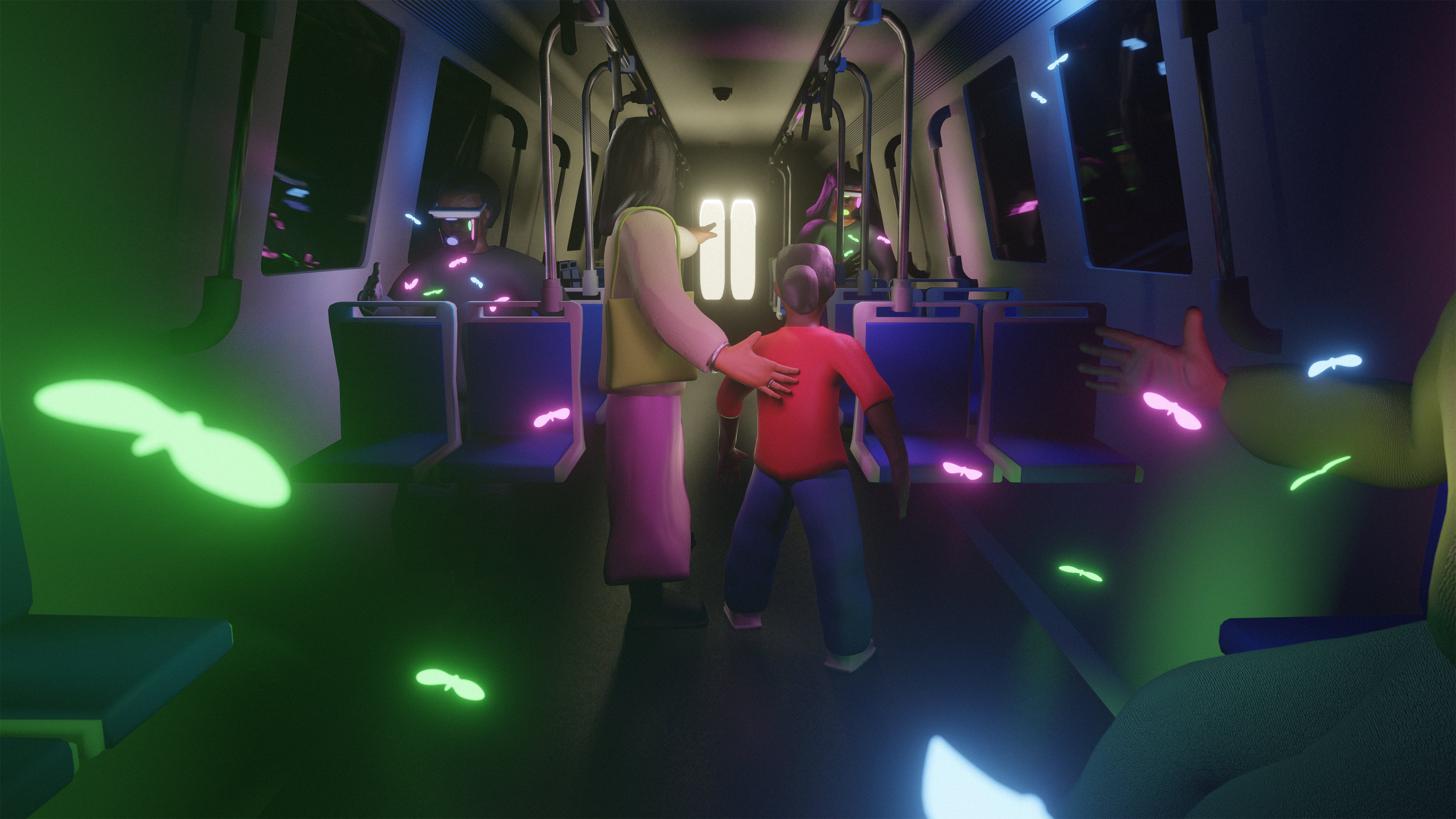
The subway tracks began to crackle into the station, growing into a buzz like a mosquito lamp, and erupting into a roar. The six-car train stopped after a long deceleration and the car doors slid open to the platform. A flurry of moths fluttered out from the car in front of them.
“Moths!” Simone said gleefully. “Omari told me about these. Come on, mom!”
Luisa heard the word mom first, even though her daughter had uttered it last. Maybe she did want to be called mom even if it wasn’t meant. Distracted by that thought, Luisa had been pulled into the last subway car before she could refuse. Simone didn’t understand the subtle game of commuters, that you studied the cars as they pulled in and then picked the one that you hoped would provide you the most comfort.
Too late! She steered Simone toward two open seats as the moths flitted about everywhere, iridescent, electric blues, pale saffron, scintillating gold, green, and night-black, with wings traced by quicksilver. People called them moths because technically their manufactured parts mimicked that of moths, but they had the soft lilting flight of butterflies.
“They’re amazing!” Simone said. “Omari said they can do anything.” She was already putting on her tracker visor.
“Don’t look at them with your visor,” Luisa warned.
“Why not? Everyone else is looking at them.”
“Their agents have filters—”
“This one is so beautiful, like a raindrop.”
“It’s not a raindrop.”
Too late! Simone’s eyes widened as she looked at the moth. “Mom …” she trailed off.
Luisa was tempted to snatch the visor from Simone’s face, but resisted her impulse, feeling that Simone needed to learn on her own. Instead, she put on her own sunvisor to look at the moth herself.
Instantly, a full-size human—not a moth—appeared in the seat next to Luisa, and he was breathtakingly handsome, with a prominent nose, strong jaw line, and caramel skin. He was wearing a soft cashmere sweater that looked like it would wrap her in comfort and safety forever. His gentle eyes beckoned to her as he scooted closer, causing her to swallow. He was subtly muscular with a comforting paunch and large hands. This was a family man.
There is someone waiting for you, Luisa, he said in a baritone voice that dripped with honey. If you just take the time to look.
The ad beckoned her to sign up for a dating service with an iris scan.
Dazed, Luisa took off her sunvisor. It had been years since she had last accessed a moth, and she had forgotten how personalized the ads were. If she could have designed a boyfriend from scratch, he would have looked a lot like that man. She felt a yearning for that virtual man so intense that her stomach knotted.
“Can you make it stop, mom?” Simone was pleading.
Simone’s gaze was transfixed on the moth, her hand frozen in mid-air. “Please, mom, make it stop!”
Luisa gently removed the glasses from Simone’s brow. Her daughter was shaking. She cradled her in her arms.
“What did you see, Simone?”
“There was a girl standing next to me. She had these perfect braids that were neat and clean. It was her real hair, too. Her natural hair. She said your hair doesn’t need to be kinky to look as good as hers does. And there was purple in it, too, a pretty purple, like the moth wings. She kept telling me my hair could be better. More natural, more beautiful.”
In some ways, Luisa was relieved. It could have been much worse—pornography, low earth orbit cage-fighting, alcohol, vapes.
“You have beautiful hair, Simone,” she soothed.
“But it could be better. Really better like hers.”
“She’s not real. She was created by AI to look like someone you would like.”
“She said she grew up in Salinas, too!”
Even if the model was real, Luisa tried to explain, the model’s face would certainly have been altered and her blemishes removed.
Her words only seemed to make Simone feel worse. Simone had seen so much in her life already—and yet she had been protected by the foster system from AI as if it were a virus. The system should have prepared her for AI, not quarantined her against it. She should have been taught to think for herself to understand how agents worked—the data sets, the policies, the algorithms—or at least she should have been taught to understand what kind of agent could enrich her life. That was the best defense. Like brushing your teeth, the work was never done, but agent hygiene was good for you.
“That’s what you do at work, right, mom?” Simone asked, still wrestling with the ad she had seen. “You make people look better.”
“Sometimes,” Luisa admitted. “If I do my job right.”
“You’re bringing out their true self.”
“Well, I try to be honest with them. I was a patient once, too. I don’t know who is true and who is not, Simone. It doesn’t take much to change how people look. It’s skin, muscle, and cartilage. Bone, too. That’s not the person. The person is how they behave. How they act. That’s who they really are.”
“That’s their truth.”
“You could say that. That’s where real beauty comes from.”
Even as Luisa said these words, though, she knew that none of her patients actually believed them—they felt that real beauty came from looking younger, sexier, or more voluptuous. And she worried she was an accomplice in affirming their belief.
Her daughter watched the passengers disembark and board the train at Powell Street, deep in thought. Luisa had always put her cards on the table with Simone—she never hid that she worked as a nursing assistant for a cosmetic surgeon, or that she lived alone, or that she ate dinner every Sunday in Alameda with her parents, who only ever talked to each other when she was in the room, yet somehow remained married.
“What are the moths for if they just make you feel bad?” Simone blurted, gently brushing aside a liver-colored moth with pale green antennae.
“You looked at an ad moth, Simone. That’s how ads work—they make you want something that you don’t already have.” Luisa told Simone how the moths had been released a couple years ago as part of a prank in San Francisco—an agent that someone combined with a little drone. How the moths took on a life of their own. How some moths were independent agents that were evolving. “It’s hard to know what a moth does without connecting to it—that’s why some people like them. They like the mystery.”
“You mean it’s like gambling?”
“Kind of, but you don’t usually win anything. The trains used to be full of poetry.”
Simone smiled as if she had uncovered a secret. “Omari would trip out if he heard about this!”
“I’m sure he would.”
Luisa had never met Omari, a foster brother of Simone’s who had been transferred away somewhere. He was mentioned in her file a few times—the separation had been traumatic for Simone. The agency warned Luisa not to try to find him, but wouldn’t release any clarifying information. Had he gotten into trouble? Was he safe? Was he alive? Luisa had no idea and feared that there might be a reckoning one day when Simone learned the facts.
The BART train stopped at Montgomery Street and then the Embarcadero, where baseball fans in Giants jerseys exited the train for a game. A stunning woman with shoulder-length black hair stepped into the car wearing bright red pumps. She sported an orange-tinted visor and flicked her locks about dramatically, like a celebrity.
Simone nudged her. “You see her hair?”
“Yep,” Luisa admitted. “She was a patient of mine.”
“That lady had laser surgery?”
Luisa nodded.
“She’s hot. You couldn’t even tell.”
“I’m good at my job.”
The patient would be back again soon, Luisa knew, because she had been to the clinic three times already. Of course, Luisa wouldn’t say anything to the woman because confidentiality was a mark of the profession. And technically, as a nursing assistant Luisa herself hadn’t performed the laser surgery—that had been controlled by Dr. Chaudhari, who mapped the patient’s face and monitored the surgical robot.
The real artistry in cosmetic surgery, Luisa understood, was in outpatient recovery. That’s where she excelled—checking on patients after they left the clinic, ensuring they applied the right serums at the right time, reminding them to avoid the sun and get some sleep. The body needed time to heal. The secret was that vaseline perfectly healed most laser surgery, but Dr. Chaudhari charged a hundred times more than a jar of vaseline by mixing in a little turmeric and calling it Sun Serum.
Above all, Luisa listened to her patients, hoping to nudge them closer to finding whatever was missing in their lives.
Just as the doors were closing, a disheveled man wedged his foot between the doors and wriggled inside. He reeked of stale urine. He grabbed a subway strap, his head jerking about to look at the different moths. He was carrying a weathered ukulele with only one string remaining, and swatted at the moths with the instrument.
“H¾±²õ²õ!” he said, each time he swung the ukulele.
“H¾±²õ²õ!”
“H¾±²õ²õ!”
He swatted at about 20 different moths and didn’t hit a single one. Homelessness had been eradicated in San Francisco after Prop 23 passed, which guaranteed a bed for all unhoused people. The red tag on his wrist showed he was someone who had refused a bed. His jawline, Luisa noticed, once held promise, but the hard living had ruined it, pockmarking his skin with scars.
The other passengers instinctively moved away from the man, but Simone was captivated by him. She giggled to herself, nudging Luisa with her finger.
“H¾±²õ²õ!”
Too late!
Noticing that he had found an audience, the man sidled over to Simone to strum on his ukulele. The single string was clearly out of tune, but it didn’t stop him from singing in a high-pitched tenor:
The rocks will be melting.
The sea will be boiling
The moths will be a-fluttering.
Downpressor, girl!
Downpressor, girl!
Paraphrasing the apocalyptic lyrics by Peter Tosh, he sang cheerfully with a smile, revealing several missing teeth. If he was being ironic, he didn’t seem aware of it, making his sallow, insistent face even more confounding.
“Oh, my god,” Simone whispered to Luisa, snickering. “I just. Can’t.”
The moths will be a-fluttering.
The roof will be falling.
The air will be burning.
Down oppressor, girl!
Down oppressor, girl!
Simone burst out laughing, a huge and colorful sound filled with real mirth. Luisa couldn’t help laughing herself. She didn’t like to mock the distressed, but she couldn’t help it.
The ukulele player was as startled by Simone’s laughter as she was by his passionate singing, and he tipped an imaginary hat, grateful for her attention.
“The lioness and her cub,” he bowed.
He ambled further into the subway car, pleased to have provoked a reaction other than disgust, as people parted around him.
“That guy,” Simone whispered, still jolted by giggles.
Luisa smiled, squeezing her daughter’s hand. “I know.”
The BART roared as they entered the tunnel to begin their five-minute crossing of the Bay. Once they crossed the deep waters, Luisa decided, they would officially be a family. Mother and daughter. Laughter and melancholy.
Across the aisle, a drab gray moth settled onto the visor of a young woman with purple bangs who was clutching a skateboard. Luisa noted the smallest hint of a smile on her face as the moth fluttered its wings, as if it was suckling from a night-blooming cereus.
“What do you think that one is, mom?” Simone asked curiously.
“Could be anything. I like to pretend it’s something good.”
“Like she’s talking to a friend?”
“Or listening to a song.”
“But it could be bad, too,” Simone guessed.
“Yes,” Luisa sighed. “It could be.”
No sense hiding the bad from a child born into badness. Fentanyl, morphine, meth, cocaine—all of it had been detected in Simone’s blood when she had become a ward of the state as an infant. She would legally be entitled to learn that fact when she turned 18, which gave Luisa eight years to prepare her for that harsh truth.
II.
There was no warning. One moment the passengers were calmly riding the subway on their typical daily commute across the Bay, unaware of the secret bond forming between a new mother and her 10-year-old daughter.
The next instant a thunderclap tore through the subway car. The BART engine screamed as if it had been wounded, and the brakes engaged with an awful, ear-splitting screech. Simone crashed into Luisa’s ribs. The ukulele player pawed at a subway strap, grasping it just as his legs went flying into the air, until he couldn’t hold on and he went skidding down the aisle. Two teens, not much older than Simone, tumbled along the floor, one cracking his arm on a metal pole with a horrifying snap. A carton of milk escaped a grocery bag and exploded in a gush of white at the far end of the tram.
Then there was silence. The lights flickered in the subway car as the acrid smoke of burnt steel stung their nostrils. Several moths had crashed to the floor and were flexing their wings helplessly.
“Are you okay, mom?” Simone asked, disentangling herself from Luisa’s arms.
Luisa felt a sharp pain in her ribs. “I think so,” she said, hopefully, but the pain blinded her for a moment. “Ouch.”
“Get off me!” someone was shouting. It was Luisa’s former patient, berating the ukulele player on the ground. “Get your filthy hands off me!” She was wrestling with his soiled coat as if it were a poisonous snake.
“I’m trying, lady,” the man was saying. The spilled milk from the exploded carton was leaking toward them on the floor, and it only infuriated the woman further.
“Get off me!”
“Stop hitting me!”
Simone suddenly whispered to Luisa: “What’s her name?”
“W³ó´Ç?”
“Your patient.”
“It’s Carvel. Joan Carvel.”
Simone got up.
“Simone!” Luisa hissed. “Come back here!”
Too late! Simone was walking over to the woman, who was now swinging her handbag at the man on the floor.
“Stop!” he said. “Stop hitting me!”
“Then get off me!”
“Please, Ms. Carvel,” Simone said calmly, “let me help you up.”
The woman’s eyes were daggers. “How do you know my name?”
“It’s Joan, right? Here, take my hand.”
“How do you know my name? Are you a hacker? Did you steal my data?”
“No, Ms. Carvel,” Simone said calmly. “I’m 10 years old. We met before. Let me help you up.”
“I’ve got his piss all over me.”
“Take my hand.”
“Don’t talk about my coat like that, lady! This coat saw action in Ukraine.”
Simone helped the woman up as the ukulele player started naming different battles from the prolonged conflict that had started in Ukraine.
“I was in Dnipro! Mariupol! Kiev!”
“If your coat is so damn precious to you,” Ms. Carvel snapped, “wash it!”
“I’ll never wash away the blood of my comrades!”
Simone carefully escorted Ms. Carvel to the far end of the subway car. After Ms. Carvel had calmed down—taking great pains to brush off the filth she thought had infected her—Simone fished under a seat and returned the ukulele to the man. He accepted it, lost in his own thoughts, brushing the solitary string with a thumbnail. “Toretsk, Donetsk …”
Luisa squeezed Simone’s hand as she returned to her seat, marveling over her daughter’s courage. She had told a white lie to calm down Ms. Carvel. Simone hadn’t told Ms. Carvel how she knew her name, but she had used her name all the same. Simone’s courage made Luisa proud and also frightened her—because Luisa herself would never have done that.
Now that Simone had bravely defused the situation, the other passengers started discussing what had happened to the train. Everyone listened intently for an announcement from BART, but none came. The overhead lights flickered and the ventilation fan slowed, quieting the car in stillness, before powering on again.
Luisa checked her agent but couldn’t find a connection to the network—the Wi-Fi was down on the subway and she couldn’t get a signal.
“Anyone have a signal?” someone asked.
“I’ve got one,” a dressy young man carrying a briefcase said, concentrating on his visor. “I’ve got the platinum package.”
This was the priciest and most premium data package on the market after the mobile carriers consolidated. The platinum pass was the envy of all data engineers, giving subscribers first rights over any available bandwidth.
“What does it say?” someone asked enviously.
“I’m not getting much. It’s really slow. The network may be congested.”
The passengers watched the man attentively, but he just shook his head in frustration. “I can’t believe I pay five thousand bucks a month for this …”
“The only thing worse than no internet,” someone complained, “is slow internet.”
No one responded.
“Anyone know what happened?” someone asked.
“Did we hit something?”
A passenger at the front of the car looked out the windows into the darkness, shining a light from their phone. “I can’t see anything on the tracks.”
“It was a bomb,” a young woman announced from behind her visor, startling everyone.
“How do you know that?” Luisa challenged. “If you don’t have a signal?”
“I’m running my agent locally. She said the sudden stop proves it was a bomb.”
“Goddamn Russians!” the ukulele player hissed from somewhere.
“She says it was probably a pipe bomb.”
The train stood still. There was no announcement.
“If it was a bomb,” one passenger asked, responding to the girl, “you think the tunnel could have sprung a leak?”
“Oh, forget about it,” a man in an Oakland Raiders visor sniped. “It wasn’t a bomb. Y’all need to stay calm.”
“My agent says there is a 30% chance of a leak in the tunnel,” another passenger said, “if it was a bomb.”
“Your agent don’t know shit! It don’t know anything more than ours does, girl! No one has a signal. We don’t want to hear about it. Y’all just hallucinating!”
The girl fell silent. Luisa found herself thinking about the amount of air contained in the subway car. And she tried to banish the thought of thousands of tons of water pressing down above her, waiting to gush into the tunnel.
“Mom,” Simone asked quietly, responding to the rising panic. “Are we going to be okay?”
“We’ll be okay,” Luisa said. She moved, painfully, to an emergency panel next to the central doors. She pressed the red call button and waited for a response on the other end. Nothing happened. No indicator light, no microphone or response. Nothing. Yet there was somehow electricity in the car.
“Is the switch broken?” Simone asked.
“I don’t know,” Luisa said.
“Could have been a tactical strike,” a man in a blue hoodie volunteered. “A small missile that hit the subway lines.”
“Or an EMP,” another suggested. “A pulse would have taken out the mobile towers.”
“My agent says there are four possibilities,” a woman in a pink blouse chimed in, speaking through her visor. “First is a mechanical problem with the car. The second is an obstruction on the tracks. A third is an attack. A fourth is an earthquake.”
“Maybe a mechanical problem,” another passenger reasoned, “caused the emergency brakes to trip.”
“My agent agrees that’s possible.”
“Oh come on, man,” the man in the Raiders visor complained. “Don’t nobody want to hear about your goddamn agents! Let me make my picks in peace.”
As the man angrily made his fantasy football picks with his agent, the passengers waited for some announcement. There wasn’t one.
“My agent says that if there’s a leak, the best thing is to exit the train,” a portly man in sweatpants declared with conviction. “We need to get out of the tunnel.”
“How the hell do we do that?” someone asked. “We’re under the bay!”
“We were in the tunnel for about two minutes. That means the best egress point is back at Embarcadero,” he pointed with his fingers like an airline attendant to the back of the car. “We’ve traveled about one mile. We can walk out of the tunnel in 20 minutes.”
“We should stay in the train,” Luisa warned.
“You want to stay in the train if there’s a leak? We’ll all drown.”
“You don’t know there’s a leak,” Luisa countered. “You’re just guessing.”
The man bristled. People kept checking for a connection, but didn’t find one, and instead continued to spout different theories. Twenty minutes passed as the man grew increasingly agitated, tapping his feet, lifting his visor on and off his brow.
Finally, he stood up with a swish of his sweatpants. “This is ridiculous. No one knows anything, and there is no sign that anyone is coming. I’m getting out of here.”
“Don’t be stupid!” Luisa blurted.
“Staying here and drowning is stupid!”
The passenger elbowed his way to the end of the subway car and opened the exit door that would have led to the next car if they hadn’t been at the end of the train. With a sense of mounting dread, Luisa watched him slide down onto the tracks.
Luisa squeezed Simone’s arm tightly to reassure her. But Luisa hadn’t counted on a man fleeing the train, and didn’t know what to say. She only hoped that no one else would follow him, because if nothing else, the trains obviously couldn’t run again until everyone was safely off the tracks.
A moment later she heard an ear-piercing shriek. Another passenger opened the door to the car and peered into the darkness.
“What happened?” someone yelled.
“I don’t know! He’s having some kind of seizure!”
Other passengers crowded towards the door.
“He’s being electrocuted! He’s touching the third rail!”
“Pull him off!”
“You’ll get shocked too! It powers the train!”
All the while, a sickly smell of burnt flesh wafted into the train. The man in the Raiders visor had hopped off and managed to wrap his leather bomber jacket around his hands to haul the passenger off the track and back onto the car.
“Help him up!” he shouted.
A group of passengers carried the man over to one of the bench seats, where they lay him on his back. His eyes were still open, and his salt and pepper hair spiked out unnaturally. His face was ashen and withdrawn.
“Damn! His skin is hot!” the Raiders fan said, shaking out his hands.
“Give me your ring,” Luisa instructed Simone, taking her biometric ring and placing it on the man’s finger.
“Can you see his pulse in your visor, Simone?”
“Yes,” Simone nodded. “It’s 42.”
“That’s low,” Luisa said. “He needs medical attention. We need to prop up his feet.”
Once they placed a backpack under the passenger’s feet, his eyes miraculously closed, offering a small hope that he might survive. The smell lingered in Luisa’s nostrils like a caustic chemical agent. She tried to mask the tears running down her face to show some inner strength to her daughter, but she couldn’t help but whimper to herself quietly. Luisa took small comfort in correctly predicting bad things, especially things she hadn’t prevented.
The rest of the passengers kept gloomily to themselves. The snappy dresser checked his Platinum-powered visor, perked up for a second, and then shook his head.“We should try the moths,” someone suggested. “They might have learned something.”
Those who had removed their visors placed them back on, and various moths fluttered over to them as their visors allowed them access. Simone fingered her own tracker visor, but Luisa restrained her from putting them on.
“Don’t look, Simone,” she said. “They won’t help.”
One woman tore off her mask instantly, brushing a gray-black moth away. “Augh, disgusting!”
“This one says it could have been the Chinese. The start of a broader attack on the West Coast.”
“Giants were up one-nothing when we went into the tunnel.”
“Doesn’t anyone know the truth?” a passenger moaned, growing exasperated.
No one reported anything useful. The train still hadn’t moved.
Luisa gently pulled Simone by the arm. “Let’s try the next car,” she whispered.
People barely noticed the pair were leaving because they were too busy searching their agents for answers. Thankfully, the door at the end of the car slid open. On the small platform connecting the cars, the air was filled with dust. The next car was even more crowded, with several people nursing injuries. Sticky coffee coated the floor, and a half-eaten churro floated in the middle of the mess.
“Keep going,” Luisa urged.
“Where are we going?” Simone whispered.
“The quiet car,” Luisa said. “Hold my hand.”
They passed through three more cars that were very much the same—people immersed in their agents, minor injuries, pretzels and napkins and tortilla chips strewn about the floor. A passenger using a meditation agent was doing ritualized breathing exercises and pressing her palms together. One man had summoned all the moths in the car to his visor, checking the multiple agents to see if they had any more information. Luisa did not wait to find out if he had learned anything.
Finally, they reached the quiet car, the first car on the train that was designed to be a talk-free and agent-free zone, with a strictly limited amount of spectrum. There were only two people inside, a small woman with olive skin, who Luisa guessed was Vietnamese, and a silver-haired man in a checkered flat-cap calmly reading a book, who looked like her uncle Pete. Luisa assumed they were married.
“Any news?” the man asked casually.
“Someone tried to leave the train and stepped on the third rail.”
“Will they make it?” the man frowned
Luisa shook her head. “I don’t know.”
“Then we wait,” he concluded, returning to his book.
“How awful,” his wife said.
After a moment of respectful silence, Luisa asked: “What did the two of you see up here?”
“We’re in a tunnel,” the man replied. “There’s nothing to see. I heard the brakes go on. And then a loud bang.”
“That’s not what I heard, Henry,” his wife corrected. “First there was a noise and then the brakes went on.”
“I just said that,” Henry said. “A bang and the brakes.”
“No, you said that you heard the brakes and then the bang—”
“—that’s what I heard, too,” Luisa confirmed. “The noise and then the brakes going on.”
“Me too,” Simone chimed in.
“My name is Rose,” the small woman smiled with some effort. “What’s yours, young lady?”
“I’m Simone.”
“Did you smell any smoke in the other car, Simone?” Rose asked.
“Not in our car—it didn’t smell like anything was on fire. There was some dust in the air when we walked between the cars.”
“That’s good,” Rose said.
Simone pressed the call button on the emergency panel.
“We tried it already,” Rose explained. “And it didn’t work. There should be redundancy in each car—that’s a hard line, not a mobile line. I used to work for the city. We developed a lot of protocols for emergencies like this.”
“The panels didn’t work in the other cars either,” Simone said.
“This is the problem with technology,” Henry shrugged. “You used to be able to ask a conductor what was going on.”
“That means the emergency responder is probably down,” Rose went on, ignoring him. “I don’t think the line in every car would be severed. The mobile networks have backup batteries, but they seem to be down too. Did you see anything on the tracks? Something we hit?”
“Not that I know of.”
“If we had hit something, probably only one or two cars would break their hard line. Not all of them.”
“What does that mean?” Luisa asked. “Do you know what happened?”
“No,” Rose concluded with a sigh.
Realizing they weren’t learning anything new, Luisa sat heavily, cradling her ribs, as Simone placed her head in her mother’s lap. Luisa stroked her hair, feeling the thick curls with her fingertips. The curls felt like perfection, nothing that could be improved by a cosmetic surgeon like Dr. Chaudhari. Maybe that was motherhood too, accepting what could not be changed. What should not be changed. And knowing the difference.
They waited an hour in silence. At least there weren’t any moths.
After some time, the exit door slid open, and the ukulele player stepped in from the first car.
“I owe a song to the young cub,” he announced to Simone, “for saving my uke.”
“You can’t sing in here,” Henry intervened, wrinkling his nose at the stench. “This is the quiet car.”
“I owe her a song!”
“Look at the sign,” Henry pointed. “It’s the quiet car!”
The ukulele player sat and smoldered, scratching his head.
Thirty more minutes passed.
Then Luisa suddenly felt nauseous, her stomach wrenching, and she was jolted sideways along her seat. The entire car shook for a few seconds. Something large crashed outside the car, a pipe or a truss. Something important.
“That wasn’t an explosion,” the ukulele player declared. “I know what a bomb feels like.”
“Sure you do,” Henry challenged.
“I was in Ukraine! I lived in a bomb shelter in Dnipro!”
“Fine, fine. We don’t need all the history. This is the quiet car.”
Luisa looked at the ukelele player as he slumped over his instrument. She knew from his face that he was not lying. He had lived in a bomb shelter, whether as a soldier or a civilian she could never know. It didn’t matter. That man knew what a bomb felt like. She believed him. It was the first thing he had uttered with conviction all day, the kind of conviction that came out of firsthand experience.
“If it wasn’t a bomb,” she asked, “then what was it?”
“That was probably an aftershock,” Rose declared. “It wasn’t as powerful as the first blast. It would explain why the emergency service was knocked out—because the earthquake would have hit the emergency responders too. You said it yourselves—the train stopped after there was a bang. That would have been the primary earthquake. You said there was nothing on the tracks, so we didn’t hit anything. You didn’t smell any smoke, right?”
“Nothing burning,” Luisa confirmed.
“Just dust. So that rules out an explosion.”
“Someone said that there could be a leak in the tunnel,” Simone chimed in.
“A leak? Did they see a leak?”
“N´Ç.”
“Then they’re guessing. Agents will say anything to make their hosts feel better. We’ll be fine, sweetie. BART is heavily reinforced. The engineers built it strong enough to survive a 7.5 quake—that’s more than a military bunker. They knew they were building it right on top of the San Andreas Fault. All we need to do is sit still and wait, my dear. Help will come.”
“Yeah, it’ll be fine, young lady,” Henry said, opening his book. “Nothing to worry about. Rose knows what she’s talking about.”
Simone looked to her mother.
“I think she’s right,” Luisa agreed. “We’ll be fine.”
“How do you know that?”
“I just do. They’ll be here soon.”
What Luisa really knew was that Rose and Henry and the uke player represented the world she wanted Simone to know—one where you observed and learned and decided for yourself. A world in which smoke and dust and yes, even pain, could help you wend your way to the truth. One in which you were your own agent. She wanted to believe they were right.
Maybe the agents in the other cars were telling their users that there was an earthquake, too, but no one would trust them. There would always be lingering doubt—without a connection to a network, the agents could be hazarding unverifiable guesses, or hallucinating answers based on an unknowable algorithm.
Luisa stroked Simone’s hair, slipping her locks between her fingers.
Already, Luisa could imagine the emergency responder in his hard hat prying open the exit door. He would be exhausted and covered with dust, beaming his flashlight along the tracks. He would choose their car first, hauling himself up on his comforting paunch.
We’re here for you, he’d say, in a rich, mellifluous voice. Everyone okay?
We’re fine, Luisa would respond.
This your girl, ma’am?
Yes, it is. Her name is Simone.
Let me help you down, Simone.
And what’s your name, ma’am?
It’s Luisa.
I got you, Luisa.
And he’d easily hoist her down to the tracks with his strong, large hands, and say: Mother and daughter, you can go now. Go toward the light. They’re waiting for you.
More ¹ú²úÊÓƵ the Authors
Issues
Related

Tech for the People, by the People: From Tracking Antarctic Seals to Wrangling America’s Water Data with EmmaLi Tsai

Take Back Tech—Understanding How Surveillance Culture Impacts Advocacy

