Emmy Liss
Independent Researcher and Policy Consultant


This blog continues our series of publications on the work of the Early Care and Education (ECE) Implementation Working Group. For more information on the group鈥檚 origin and activities, please see our first blog Implementation is Everything, and Early Care and Education is No Exception and a recent update Meet the Early Care and Education Implementation Working Group. For a deep dive into some of the findings from the initial working group cohort, see our briefs Family Outreach, Centralized Enrollment, Participatory Planning, and Local Governance.
In the year since to share learnings about the challenges early education program administrators face on the ground, there have been countless ups and downs, as local leaders continued to expand and strengthen their programs, while also reacting to changing federal politics.
Ahead of a new school year, we鈥檙e looking back at the lessons we鈥檝e captured with the Implementation Working Group, many of which remain as timely as ever. We continue to believe theses insights can meaningfully inform implementation improvement efforts in other cities and counties across the country to deliver better outcomes for families, providers, and policymakers.
Here are some highlights:
The ECE Implementation Working Group鈥檚 focus is fiercely local, but national politics inevitably became a topic of conversation over the last year. Elections are newsworthy in themselves, but the current administration鈥檚 policies have sent shockwaves through the ECE community. Immigration enforcement, the freezing and delay of federal funds, and shuttering offices providing technical assistance and program oversight have created uncertainty in the sector.
In our first meeting of 2025, members were looking for and sharing information on federal funding and the new administration鈥檚 posture towards early childhood programs. In sharing this information more broadly, our goal was to support other local leaders鈥� understanding of current events and strategic decisionmaking on behalf of the families they serve.
By February, group members were able to share practical advice about mindful, strategic data collection, providing reassurance and resources to providers, and leveraging existing communication channels or creating new ones to keep critical communities in the loop.
Cutting Head Start could have enormous ripple effects for Local Early Childhood Initiatives
With the fate of Head Start in danger earlier this year, we looked at what its elimination might mean for local programs with dedicated local funding sources. More often than not, multiple funding sources are used to create stronger programs to serve more children with less complexity, making Head Start a critical tool for ECE.
(You can also read our op-ed about the )
Despite the national attention, local politics are still incredibly important for ECE programs
While presidential elections consume enormous amounts of time, money, and attention, local early childhood leaders know that politics are happening all the time and in our own backyards鈥攁nd this has a big impact on kids and families. Understanding how to navigate changes in the local political environment鈥攁nd where there may be opportunities to influence how transitions happen鈥攊s critical.
Whatever happens in Washington, D.C. or capitols across the country, this group has a mission to sustain and expand high quality, equitable pre-K programs locally, and believes in the value of communicating hard-won lessons across contexts. Sharing the nuts and bolts of running programs was foundational to group members, giving them an opportunity to learn from each other and share lessons with others, and this will remain a key focus.
The perspectives from this working group begin to form the foundation of a playbook for how to design, build, scale, and sustain local early childhood programs.
Participatory Planning is essential to building successful early childhood education programs
Too often, programs aimed at supporting families are developed without their input, creating problems with delivery that result in even the best-intentioned efforts from reaching or being used by the people they should serve. Participatory planning processes can improve program design鈥攏ot only for the government leaders and administrators responsible for programs, but for the families that ultimately use them. (You can also read our longer brief on the subject).
Existing public pre-k models offer different benefits that can inform future program design
While many local programs have been built in isolation, by analyzing their common themes and practices, future ECE administrators and policymakers can gain valuable insight. In this first-of-its-kind report, we define early learning governance archetypes, map those archetypes to locations, and describe the operational strengths and challenges associated with each.
(See archetypes excerpted from our full report in "Figure 6" below).
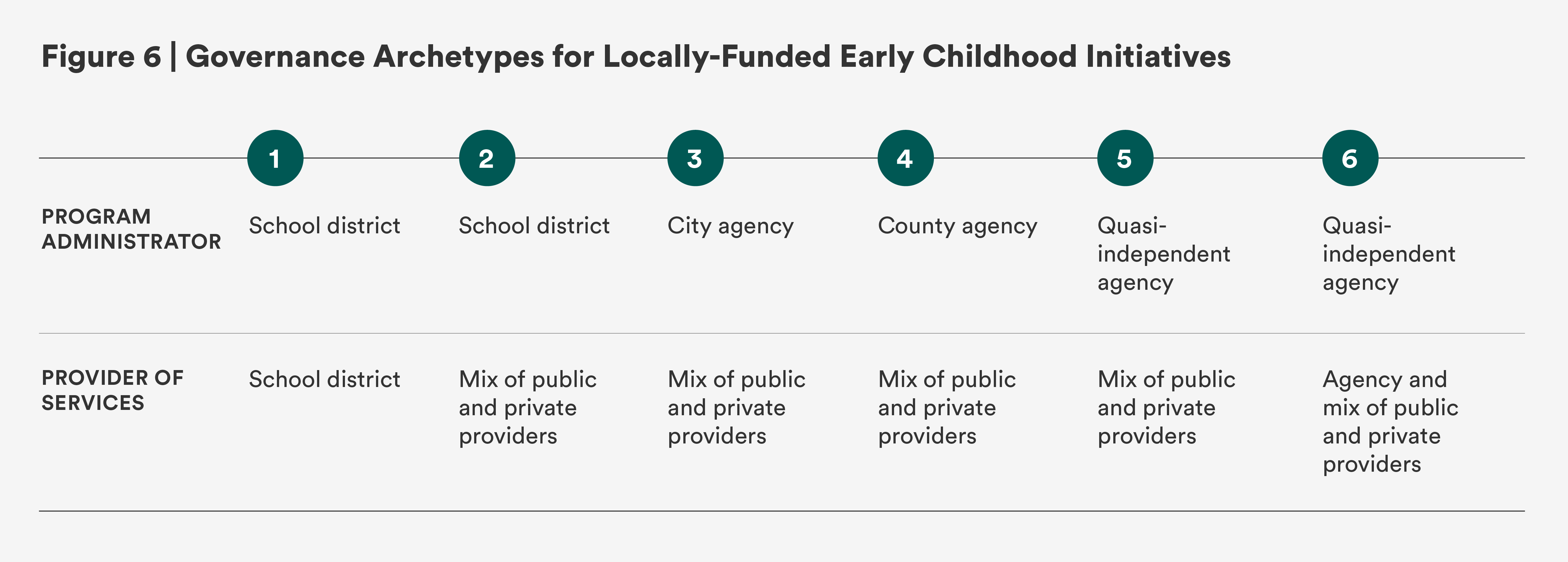
While many local programs have been built in isolation, by analyzing their common themes and practices, future ECE administrators and policymakers can gain valuable insight. In this first-of-its-kind report, we define early learning governance archetypes, map those archetypes to locations, and describe the operational strengths and challenges associated with each.
Communities have solutions to building a stronger ECE workforce
Workforce conversations can feel circular and intractable given the systemic nature of the challenge, and making wholesale changes to compensation and competencies at once can feel out of reach in current policy environments. Despite the scope of early childhood workforce issues, incremental strategies working in tandem can smooth the experience of both prospective and current early childhood educators.
Centralized enrollment portals can improve ECE access 鈥斅爄f you can get one built
Connecting and enrolling families in early learning programs is a complex process, and while centralized enrollment systems are effective, there are major administrative and political challenges to getting them built. The brief dives into the biggest hurdles communities face when developing portals, as well as tested strategies to overcome these technical and political challenges.
Home-based childcare providers need to be part of the ECE conversation
Home-based child care providers are an essential part of the early care and education landscape in the U.S., but despite their popularity, they are not always integrated into major early care and education programs. Whether explicit or inadvertent, the exclusion of home-based providers can have devastating consequences for providers, the families they serve, and the overall availability of care鈥揵ut there are ways to bring them into the sector. Thanks to a collaboration with Home Grown, two founders of the Implementation Working Group to support the integration of home based providers into public pre-K systems.
Getting support for ECE initiatives means building ECE coalitions
Coalition building is of perpetual interest to the ECE Implementation Working Group because it matters at every stage of a program, from ideation to launch to ongoing support and maintenance. It can be incredibly powerful to unite the early childhood sector toward a common aim, but that power is limited if the coalition does not include a broader group of leaders from business, labor, and the civic sector. A bigger tent of supporters will help ECE leaders land the point that 鈥渆very issue is a child care issue鈥� for their communities.
Local ECE leaders can 鈥渕anage-up鈥� to build more support from the state house
Local-state dynamics vary widely among early childhood initiatives but local leaders across the board frequently find themselves in the dual position of playing both policymaker and advocate. While there is no one-size-fits-all approach given the variation across state contexts, the lessons learned by local early childhood leaders trying to 鈥渕anage up鈥� can help administrators advocate for themselves and their families more effectively. This meeting included a 鈥�deep dive鈥� conversation between a state and local early childhood leader in Colorado, shedding much needed light on the way these dynamics play out on the ground.
The biggest lesson of the first year of the ECE IWG may simply be this:
Expanding public early care and education services is no exception.
For its members, the working group has helped to fill some of this gap by providing a peer community and a space to share lessons learned. Throughout the rest of 2025 鈥� and hopefully beyond 鈥� this group will continue meeting, and will stay focused on what matters most in challenging times: helping families and children access the kind of high quality early childhood services they want, need, and deserve. We will also continue using this platform to bring those lessons to other local leaders who are working on expanding, strengthening, or even just starting, an early childhood education program.

The ECE Implementation Working Group is a group of early childhood education leaders from cities and counties across the country. These leaders gather to share best practices from their experience working with families and local communities, and their work aligns with the New Practice Lab鈥檚 theory of change: that implementation lessons should inform policy design from the start. More information about the Working Group can be found here. You can reach out to us with questions about the group and its work at [email protected].
Independent Researcher and Policy Consultant
Senior Policy Manager, New Practice Lab