
Don’t Underestimate the Uncertainty Ahead for Georgia
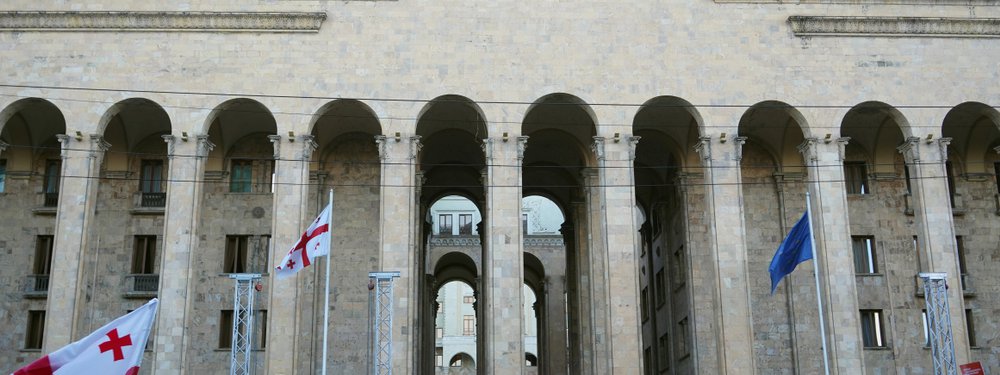
Georgians are entering the new year with good news鈥攕alted with bad news.
First, the good. Georgia had a historic election on Nov. 28 and, for the first time ever, elected a woman as president. Salome Zurabishvili was once the foreign minister of Georgia under former President Mikhail Saakashvili, who sacked her in 2005. Though she ran as an independent, she was supported by the billionaire Bidzina Ivanishvili鈥檚 relatively progressive Georgian Dream (GD) coalition, and prevailed over . She took office on Dec. 16.
And yet, just below the surface of this tremendous win for the GD lurks something more sobering for anyone concerned with the current state of democracy in the world. Beyond the obvious symbolic significance of Zurabishvili鈥檚 victory, Georgia鈥檚 political environment has been beleaguered by the GD鈥檚 inability to make meaningful progress on its democratic promises over the last several years鈥攑rogress that will continue to face key challenges even with Zurabishvili at the helm.
How did Georgia鈥攁nd the GD鈥攇et here?
Georgians have been waiting anxiously for the GD to right the wrongs of the previous government at least since 2012, when the party defeated Saakashvili鈥檚 United National Movement (UNM) in that year鈥檚 parliamentary elections. But in the intervening years, the coalition, led and originally stitched together by Ivanishvili, has fallen from grace.
Initially motivated by a concern for improving the plight of Georgians, the GD has increasingly been mired in alleged corruption and incompetence, often failing to deliver on its political promises. To top it all off, last October, shortly before the first round of elections, surfaced in the Georgian media that implicated the country鈥檚 political top brass鈥攊ncluding former Prime Minister Giorgi Kvirikashvili and Ivanishvili鈥攊n systemic corruption, patronage, and bribery.
Due largely to these failures, in late October, Ivanishvili and his ministers slammed into a setback: a runoff election, held on Nov. 28th. This was a devastating blow to Ivanishvili, and it shook the GD to its core. But the billionaire-turned-political puppeteer had mostly himself to blame; over the years, he has turned his electorate into a 鈥渘anny state,鈥� with Ivanishvili pulling the strings. Shrewdly using his inexhaustible financial resources to his advantage, he鈥檚 been personally bankrolling the salaries of members of the Georgian intelligencia, including famous actors, singers, composers, writers, and public intellectuals.
To an extent, that Ivanishvili and his coalition had to face a second round of presidential elections showed that people refused to accept his morally pious stance as a bulwark against evil. In the second round, many Georgians chose to hinge their votes on their with the country鈥檚 , not on a fear of Saakasvhili鈥檚 return, as the GD has claimed in the past. (In what seemed like a last-ditch appeal to voters, Ivanishvili publicly announced a massive , of over a billion lari, that would write off 鈥渂ad debts鈥� for 600,000 Georgians. The program, along with the elections, has been harshly criticized by the and other leading Western .) It has become abundantly clear that if the GD wants to regain the public鈥檚 trust, Ivanishvili will have to rethink his approach to politics.
Enter Zurabishvili.
After a 2005 dispute with Saakasvhili, Zurabishvili鈥檚 political career in Georgia . It wasn鈥檛 until after she began supporting the GD in 2012 that she became a member of the Georgian parliament, with the GD鈥檚 help. Along the way, GD politicians had kept a close eye on her, until she was ultimately tapped as a presidential candidate.
In many ways, Zurabishvili brings more to the table than people may think. In private and professional circles, she鈥檚 known for being a principled technocrat. On top of that, her lengthy career in Paris, where she worked for three decades as ambassador to Georgia, underscores how stepped she is in European diplomacy and foreign policy. For the pro-European GD, this is an asset that many of her predecessors lacked.
In other words, Zurabishvili is of a different political mold than her peers, and Ivanishvili was wise to try to harness this as he navigates Georgia鈥檚 tricky domestic politics.
Still, despite the promise of Zurabishvili鈥檚 victory, it doesn鈥檛 seem too likely that much will change. After the elections, Ivanishvili thanked Georgian voters for giving the GD a second mandate, saying that 鈥�.鈥� This was hardly a reassuring sentiment, given people鈥檚 exhaustion with the GD鈥檚 performance over the past six years.
In a similar vein, in the months ahead, Ivanishvili must be careful not to treat Zurabishvili with the same heavy-handed patronage that he鈥檚 long had a penchant for. Already, critics of the the new president have said that she only won because she ran on 鈥渢he dirtiest campaign鈥� in the country鈥檚 history. Natalia Antelava, a Georgian journalist, The Daily Beast that 鈥渢he powers that backed [Zurabishvili]鈥攆rom political parties to individuals鈥攁re among the most xenophobic and sexist on Georgia鈥檚 political spectrum.鈥�
Clearly, Zurabishvili has her work cut out for her, thanks in no small part to the fact that Ivanishvili鈥檚 transactional, money-buys-everything approach to governance has a tendency to cheapen the office of president, and erode trust in state institutions.
The GD has the potential to move Georgia and its people forward鈥攖o make the Georgian dream more than just a pipe dream鈥�if it can overcome its steepest obstacle: itself.
More 国产视频 the Authors
Related
State Education Budgets in Turbulent Times

Making the Case for Youth Apprenticeship: The Appeal to Gen Z

Nothing 国产视频 Us Without Us Can Actually Raise Us
