Danielle Sanderson Edwards
Assistant Professor of Educational Leadership and Workforce Development, Old Dominion University
Author's Note: Grow Your Own programs are rooted in the needs of local communities. Many of these programs are designed to create opportunities and strengthen education for those that need it most. We have endeavored to create a research agenda that can be used and applied in a variety of contexts that are operating under different policy conditions.
Grow Your Own (GYO) is a teacher recruitment and preparation strategy focused on developing and retaining teachers from the local community. GYO is often used to address teacher shortages and strengthen the teacher workforce; it relies on local community pathways and reciprocal relationships between institutions of higher education, community organizations, and local school districts.
Now more than ever, as federal priorities shift, states and local communities are being tasked with the responsibility of addressing teacher shortages and ensuring a high-quality teacher workforce that can sustain educational opportunities for all. We must understand the impacts of these programs to help strengthen teacher preparation, promote teacher retention and continue targeted investments in community teachers.
As of 2024, all 50 states and the District of Columbia had at least one GYO program.[2] The number of states that provide funding for GYO program development and implementation has doubled since 2020, from 18 to 35, plus DC. In 2022, at least 900 school districts were engaged in GYO.[3] Historically, the federal government has also played a role in supporting GYO programs through competitive and discretionary grants from the US Department of Education.[4]
Despite increasing interest and investment in GYO programs, little is known about the extent to which these programs achieve their purposes; the features, participants, and conditions that are needed for them to be effective; the cost and return on investment; and unintended consequences. We developed this research agenda to identify key questions and data sources that can be used to uncover how GYO programs shape education, influence teacher outcomes, affect school and district performance, improve student outcomes, and impact the larger community. We recognize that different policymakers, researchers, and program designers will approach these questions from their own vantage points and interests. In developing this agenda, we offer central research questions around which the field can direct its efforts.
GYO programs are partnerships that recruit and support community members to become educators. The programs target many different populations and offer a variety of programming to meet community needs. Certain features of GYO programs contribute to their effectiveness:
Teachers are the most important within-school factor for student success.[5] However, many students, especially those from rural areas, low-income families, multilingual students, and students of color, lack the same access to well-prepared and experienced teachers as their peers.[6] In response to this issue, districts, states, and EPPs have increasingly invested in GYO programs.
GYO programs recruit and support youth and adults, especially those who face financial and other barriers to earning a teaching degree, to become teachers in their own communities. These programs address teacher workforce challenges, and many seek to enhance the quality of teaching and learning, foster community engagement and empowerment, and promote equal educational opportunities.[7]
We outline four purposes of GYO programs below. It is critical to note that few of these purposes have a direct research base. In other words, most are assumptions based on anecdotal or inferred evidence.
The supply of teachers to work in U.S. public schools is threatened by lower levels of interest in education careers,[8] and high levels of teacher attrition within the first five years.[9] At the same time, the demographic composition of the teacher workforce is not keeping pace with demographic changes in the student population.[10] GYO programs are thought to:
To increase EPP enrollment, teacher retention, and overall interest in education as a career, programs must be relevant to the experiences of teachers and their students. The limited population of students in traditional EPPs reinforces their conceptual and geographic "distance" from communities with teacher shortages. GYO programs are thought to:
Our education system is plagued with inequalities that contribute to disparate outcomes among different student groups. Many students attend inadequately resourced schools and lack access to teachers who represent their local community.[18] GYO programs are thought to:
Early GYO efforts were characterized by the desire to promote educational advancement and spur community development by providing pathways into teaching for community members.[21] Many contemporary GYO programs share a focus on building a strong teacher workforce that is reflective of the community and a commitment to strengthening educational opportunities and outcomes for the benefit of the entire community. GYO programs are thought to:
Our questions below reflect the need to understand the direct effects and influences of these programs on teachers, students, and communities by examining the extent to which GYO programs increase the number and representation of teachers, improve their preparation, improve educational opportunity and student success, and support community development. We also believe that it is important to understand the extent to which, and how, GYO programs transform current educational systems.
At the same time, it is vital for us to expand the research literature by furthering our understanding of the experiences of program participants and partners.
Finally, we need to understand how and why impacts and experiences may vary from program to program. There is a great deal of variation in GYO programs: They focus on different groups (e.g., high school students, paraeducators, or parents); they provide different kinds of supports (e.g., scholarships, wraparound supports, or academic supports); and they have different structures and partnerships.[22] By examining different program types and their features, researchers can identify the conditions that make GYO initiatives successful. Understanding variation by student, teacher, and community characteristics can help GYO programs to meet the needs of all students.
To address these questions and understand the direct effects of GYO programs on teachers, students, and communities, we need reliable, identifiable, and longitudinal qualitative and quantitative data from a variety of sources. Prior research has been hampered by limited data sources, which typically reflect a brief window of time from individual participants in single GYO programs. To understand the influence and ability of GYO programs to transform educational systems, we need data which are:
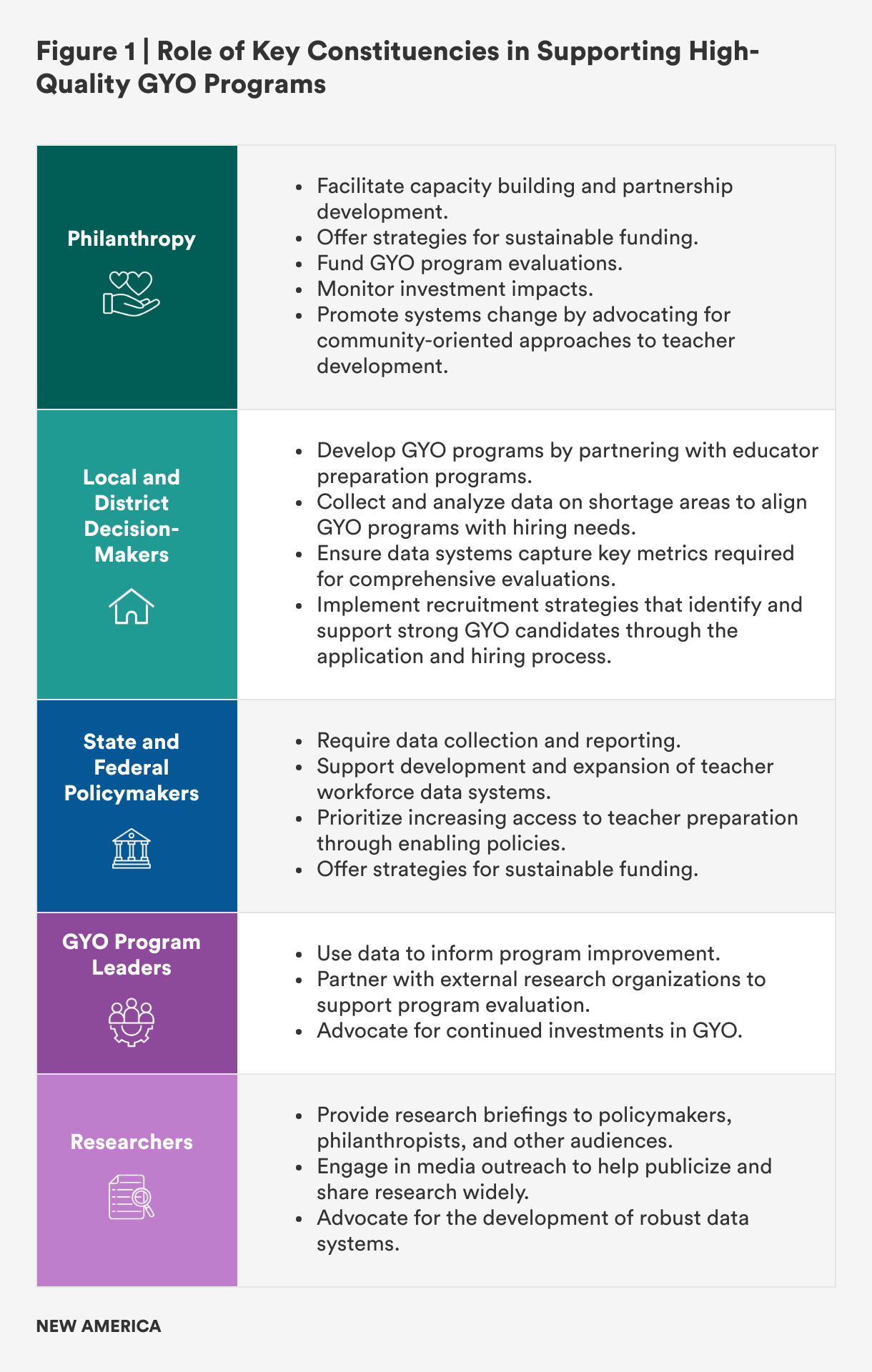
Enacting this research agenda will require a variety of key constituencies, all of which have a role to play in supporting the development and implementation of high-quality GYO programs (see Figure 1):
We believe in GYO as a strategy for strengthening and retaining a high-quality educator workforce. We need a strong evidence base to ensure that investments in GYO are sustained, to help guide program development and implementation, and to influence policy development. This research agenda can be used to better understand the impacts of GYO programs on students, teachers, and communities. For more detailed guidance on what we need to know and the data we need to answer these questions, please see the .
[1] Authors are listed alphabetically by first name. Suggested citation: Amaya Garcia, Bradley Carl, Conra D. Gist, Danielle Sanderson Edwards, Jason Greenberg Motamedi, Jennifer Seelig and Roey Ahram, Research Agenda: Grow Your Own Teachers (国产视频, 2025).
[2] For more on state-level GYO policies, see Amaya Garcia, Grow Your Own Teachers: A 50-State Scan of Policies and Programs (国产视频, 2024).
[3] For more about GYO program types and design, see Danielle Sanderson Edwards and Matthew A. Kraft, , EdWorkingPaper 24鈥�895 (Annenberg Institute at Brown University, 2024).
[4] For more examples of federal grant programs see: National Clearinghouse of Language Acquisition, 鈥�,鈥� and U.S. Department of Education, 鈥溾��.
[5] For more on the impact of teacher characteristics on teacher quality, see Jennifer K. Rice, (Economic Policy Institute, 2003).
[6] For more on student experiences, see Jessica Cardichon, Linda Darling-Hammond, Man Yang, Caitlin Scott, Patrick M. Shields, and Dion Burns, (Learning Policy Institute, 2020); Richard M. Ingersoll and Henry Tran, 鈥�,鈥� Educational Administration Quarterly 59, no. 2 (2023): 396鈥�431; Evan Rhinesmith, J. Cameron Anglum, Aaron Park, and Abigail Burrola, 鈥�,鈥� Peabody Journal of Education 98, no. 4 (2023): 347鈥�363; Christine Montecillo Leider, Michaela Colombo, and Erin Nerlino, 鈥�,鈥� Education Policy Analysis Archives 29, no. 100 (2021); and Lucrecia Santiba帽ez and Patricia G谩ndara, (UCLA Civil Rights Project, 2018).
[7] For more on the purposes of GYO, see Conra D. Gist, 鈥�,鈥� Teacher Education Quarterly 46, no. 1 (2019): 9鈥�22.
[8] For more on perceptions of the teaching profession, see Matthew A. Kraft and Melissa Arnold Lyon, , EdWorkingPaper 22-679 (Annenberg Institute at Brown University, 2024).
[9] For more on teacher attrition, see Richard M. Ingersoll, Elizabeth Merrill, Daniel Stuckey, and Gregory Collins, (Consortium for Policy Research in Education, October 2018).
[10] For more on the demographics of the K鈥�12 teacher workforce, see Katherine Schaeffer, 鈥�,鈥� Pew Research Center, December 10, 2021.
[11] For more on the barriers paraprofessionals face in entering teaching, see Kaylan Connally, Amaya Garcia, Shayna Cook, and Conor P. Williams, (国产视频, 2017).
[12] For more on teachers鈥� preferences on where they work, see Michelle Reininger, 鈥�,鈥� Educational Evaluation and Policy Analysis 34, no. 2 (2012): 127鈥�145.
[13] For more about the localized nature of teacher labor markets, see Mimi Engel and Marisa Cannata, 鈥�,鈥� Peabody Journal of Education 90, no. 1 (2015): 84鈥�92.
[14] For more about a GYO program that removes barriers, see Margarita Bianco, Nancy L. Leech, and Kara Mitchell, 鈥�,鈥澛�Journal of Negro Education 80, no. 3 (2011): 368鈥�383.
[15] For more on student teaching experiences, see Sheila W. Valencia, Susan D. Martin, Nancy A. Place, and Pam Grossman, 鈥�,鈥� Journal of Teacher Education 60, no. 3 (2009): 304鈥�322.
[16] For more on how GYO influences teacher development, see Conra D. Gist, 鈥�,鈥� Educational Researcher 51, no. 1 (2022): 51鈥�57.
[17] For more on community teacher development, see Conra D. Gist, 鈥�,鈥� Equity & Excellence in Education 55, no. 4 (2022): 342鈥�356.
[18] For more on the experiences of students in schools, see Lisa M. Yarnell and George W. Bohrnstedt, 鈥�,鈥� American Educational Research Journal 55, no. 2 (2018): 287鈥�324; and Kari Dalane and Dave E. Marcotte, , EdWorkingPaper: 20鈥�33 (Annenberg Institute at Brown University, 2020).
[19] For more on the impacts of teachers on student outcomes, see Seth Gershenson, Cassandra M.D. Hart, Joshua Hyman, Constance A. Lindsay and Nicholas W. Papageorge, 鈥�,鈥� American Economic Journal: Economic Policy 14, no. 4 (2022): 300鈥�342.
[20] For more on effective teaching, see Geneva Gay, 鈥�,鈥� Journal of Teacher Education 53, no. 2 (2002): 106鈥�116.
[21] For more on the early history of GYO programs, see Conra D. Gist, (National Education Policy Center, 2022).
[22] Sanderson Edwards and Kraft, ; and Garcia, Grow Your Own Teachers: A 50-State Scan.
Thank you to Lynne Gardner, Taylor McCabe-Juhnke, and Stephanie Sowl for their thoughtful feedback. Appreciation to Elena Silva, Sabrina Detlef, Katherine Portnoy and Natalya Brill for editorial and layout support. This work was generously supported by the W.K. Kellogg Foundation. The views expressed in this report are those of the authors and do not necessarily reflect the views of the foundation.
Assistant Professor of Educational Leadership and Workforce Development, Old Dominion University

Advisor, GYO National Network

Senior Research Scientist, Education and Child Development at NORC

Director of Strategy and Learning, Grow Your Own Illinois
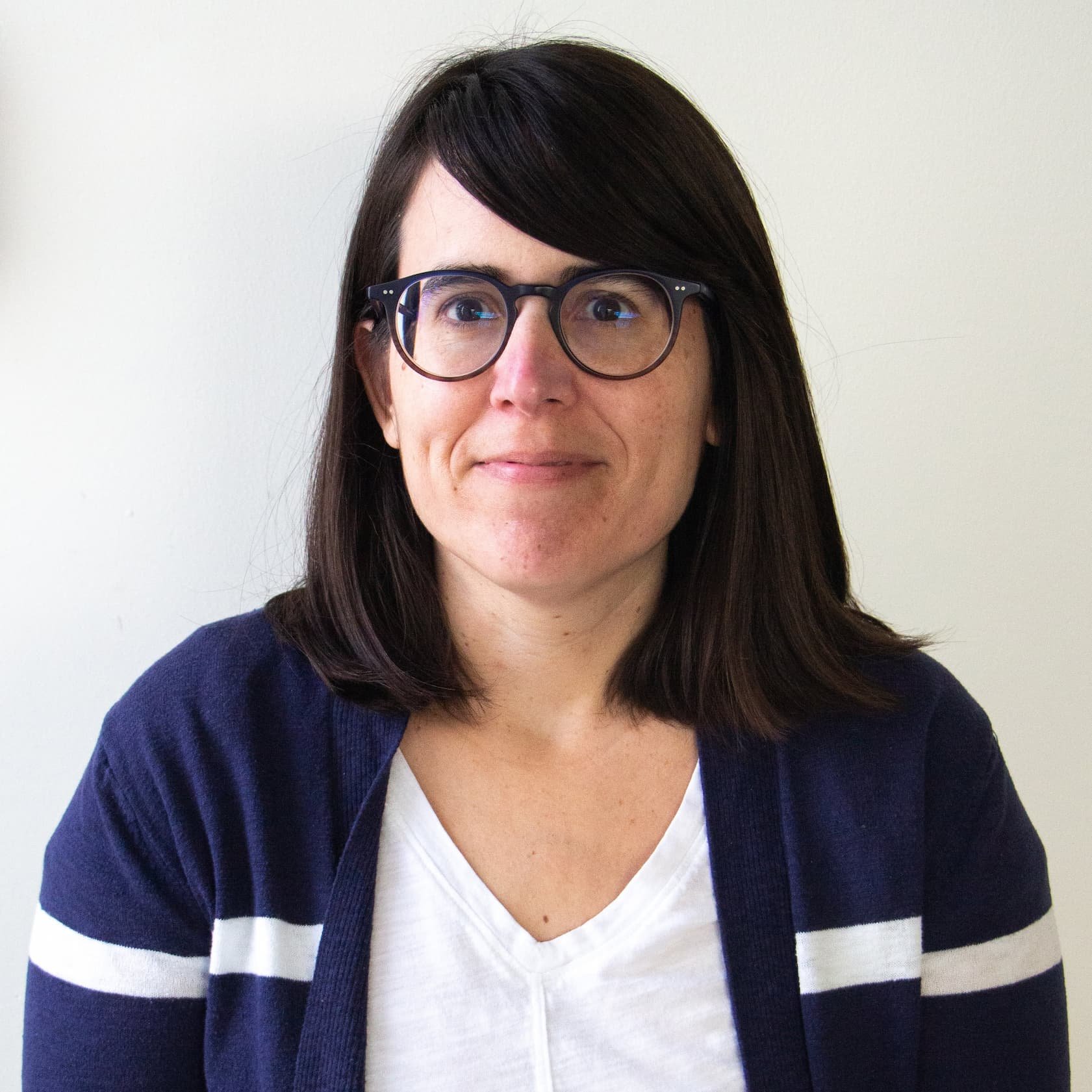
Director, PreK-12 Research and Practice

Scientist and Founding Co-Director, Wisconsin Evaluation Collaborative, Wisconsin Center for Education Research at UW-Madison

Professor in the College of Education, University of Houston