A Chapter of: From Revolution Muslim to Islamic State
ISIS Takes Up the Revolution Muslim Template
When Revolution Muslim disbanded in 2011, it looked to many like the terrorist threat in the West was winding down. Three weeks before Abdullah Muhammad’s May 26 arrest in Casablanca, Navy SEALs killed Osama bin Laden in Abbottabad, Pakistan. In September 2011, the influential al-Qaeda ideologue and operational leader Anwar al-Awlaki was killed in a drone strike in Yemen. Meanwhile, al-Shabaab’s governance in Somalia dwindled and the Arab Spring raised hopes that jihadism would be left behind as an organizing principle for political action.1
However, Revolution Muslim’s emergence out of a broader tradition of Islamist organizing with its own history of splits, groups collapsing and new groups rising should have warned against focusing too much upon the fate of any one group. Revolution Muslim, despite its disbandment, had built a template for jihadist organizing online and proven its power. That template remained for other groups to adopt and use.
By 2014, the hopefulness receded as a new jihadist group, ISIS, seized global headlines by taking Mosul, Iraq’s second-largest city, declaring the establishment of an Islamic State, or caliphate, and recruiting thousands of foreign fighters from Western countries. ISIS’ strength was supported by its sophisticated use of the internet to recruit and spread its message. ISIS effectively integrated interactive social media, English-language propaganda magazines and direct communication platforms into its effort. Yet each of these strands of ISIS’ propaganda was foreshadowed by and built upon the Revolution Muslim template and network.
Interactive Social Media
ISIS’ use of interactive social media to recruit and spread its message is extensive and well known. From September through December 2014, ISIS supporters utilized between 46,000 and 70,000 Twitter accounts.2 Social media companies have removed hundreds of thousands of pro-ISIS accounts since, but ISIS’ online supporters continue to stress the importance of retaining influence over social media.3
Charlie Winter, a researcher at the International Centre for the Study of Radicalisation (ICSR), and Jade Parker, at the Terror Asymmetrics Project (TAPSTRI), have specialized in analyzing ISIS’ online activities. In their 2018 piece “Virtual Caliphate Rebooted: The Islamic State’s Evolving Online Strategy,” they note that one aspect of ISIS’ virtual caliphate is “ideological incubation. This manifests in social media and messaging platforms, on which members swap views about everything related to the Islamic State.”4 Winter and Parker further note:
“… supporters of the Islamic State have also tried to surreptitiously mainstream certain aspects of its ideology. One example of this is the invite-only mentoring circles and social media group pages for which normal indicators of Islamic State involvement are entirely obscured. These virtual seminaries operate at the scholarly end of the jihadist spectrum, disseminating religious texts and encouraging discussion and understanding, while also offering an opportunity for intensive peer-to-peer mentoring in the Islamic State’s creed.”5
Though it is ISIS’ use of such tactics in the news recently, Revolution Muslim’s own use of social media foreshadowed ISIS’ efforts. It was Revolution Muslim that first pioneered the shift to online discussion circles from the reliance on in-person meetings that predominated in the Islamic Thinkers Society.
Even with social media in a nascent state (Facebook would open to the public in September 2006, only a year before Revolution Muslim’s founding), Revolution Muslim realized its power. At its inception, RM started its own online forum connected to the organization’s core website. After attaining 500 followers and incorporating those most active and qualified on it into the organization more formally, the cofounders started to experiment with social media. Khattab and Abdullah Muhammad also kept in contact with Samir Khan, then running another popular U.S.-based jihadi blog, Inshallahshaheed, via Skype or Windows Instant Messenger. Khan connected Revolution Muslim to another key hub in the online jihadi network, the Ansar al-Mujahideen online forum (ansar1.info), a pro-al-Qaeda outlet affiliated with the Global Islamic Media Front (GIMF).6 The Ansar forum hosted Khan’s blog Inshallahshaheed on its server. Khan chose revolution.ansar.net for the name of his new domain. The Ansar forum also utilized free uploading sites to host and protect jihadist content from removal. Samir Khan and Revolution Muslim would then cross-post the content and tailor it for their American audience. The same process allows ISIS propaganda today to avoid deletion.
Revolution Muslim also utilized video uploading sites such as YouTube. Shortly before RevolutionMuslim.com launched in December 2007, Abdullah Faisal sent a DVD to the Revolution Muslim cofounders, according to Abdullah Muhammad.7 It was a copy of a nationally televised debate on a show in Jamaica called “Religious Hard Talk.” In it, Faisal attempted to embarrass a Catholic bishop by explaining that “Jesus, he preached Jihad.” Faisal pointed to a quote from a biblical parable. RM’s leadership created a simplistic video and uploaded the segment to YouTube. The video included on-screen titles that announced Faisal’s return to the public and requested that viewers purchase the full debate DVD through the website.8
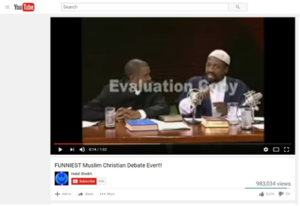
YouTube
The video immediately drew attention. In the comments section, some Muslims celebrated Faisal’s return, and American youth who had no knowledge of his previous presence in Britain were exposed to his confrontational style. Moderate Muslims and Christians opposed the content and went into back-and-forth dialogue in their comments. Subscribers to RM’s YouTube channel started rising. To this day, Faisal’s video remains a radicalizing element. It’s been uploaded innumerable times to different accounts. One version has been viewed over 1 million times.9 It has been translated into Arabic, and requests to purchase a DVD of the debate continue to flow into the old Revolution Muslim Gmail account.10
The comments section on YouTube became a key means of interaction, recruitment and facilitating migration to more secure communication mechanisms. Revolution Muslim started making videos of all its activity and uploading them to YouTube. These activities included Q & A sessions with “Sheikh” Faisal, old lectures from Faisal’s time in the U.K., current events analysis and regular street dawah presentations outside New York City mosques, along with other public demonstrations. Revolution Muslim also experimented with Facebook, Twitter, Blip.tv and other relatively nascent social media platforms.11
While Revolution Muslim ceased to exist in 2011, its impact on the use of social media to promote jihadism continued. For example, the progression from these early efforts by Revolution Muslim on social media platforms were later adopted and adapted by ISIS. According to one analysis, from January through March 2014, three of seven English-language organizational Twitter accounts found to be deeply embedded in foreign fighter Twitter feeds were affiliated with ALM (and by extension Revolution Muslim). Anjem Choudary was by far the most followed. The list also included SalafiMediaUK, an organization run by Abu Waleed, a student of Omar Bakri and Abdullah Faisal who collaborated with RM,12 demonstrating Revolution Muslim’s lasting influence upon the larger ALM network. The third, a Twitter account called Millatu Ibrahim, was led by Mohamed Mahmoud, an Austrian who moderated the Ansar al-Mujahideen forum and who had once run the Global Islamic Media Front, which had collaborated with Revolution Muslim.13
English-Language Magazines
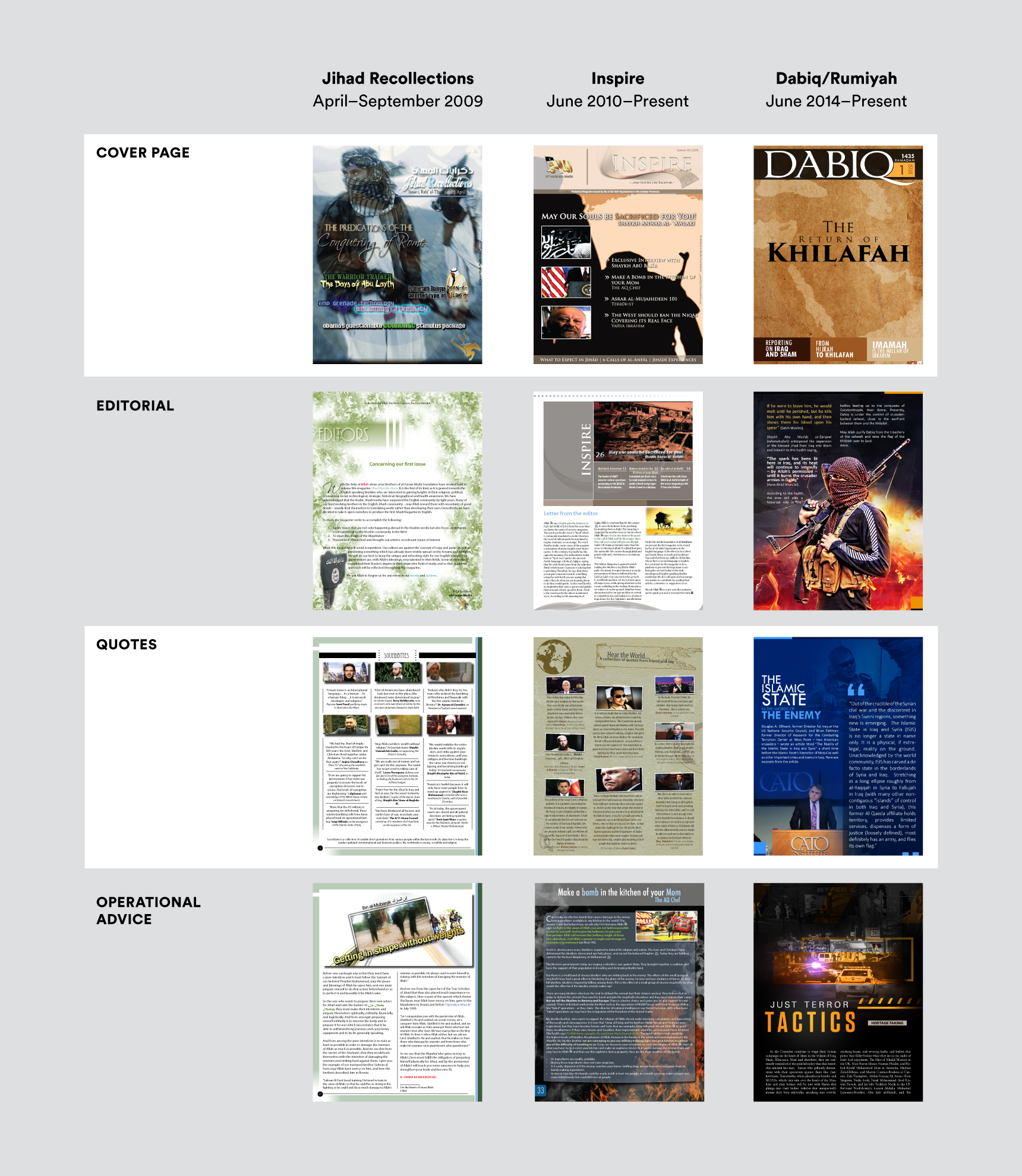
ISIS combined its social media savvy with well-produced English-language propaganda magazines, as well as similar magazines in languages including French, German, Russian, Indonesian and Uyghur.14 Yet the concept, structure and form of ISIS’ flagship English-language magazine Dabiq (now titled Rumiyah) had been developed and tested years earlier with Inspire by Samir Khan, a young American who joined Anwar al-Awlaki and Al-Qaeda in the Arabian Peninsula. Despite living in North Carolina, as a member of Revolution Muslim, Khan closely collaborated (remotely) with key figures within the organization before departing for Yemen in October 2009.
On February 12, 2009, Khan sent an email entitled “A Call to become a writer/helper for a new English Salafi-Jihadi Magazine.” It was addressed to two people, Arif al-Islam at ITS and Abdullah Muhammad at Revolution Muslim. The email read in part, “After discussing with a few brothers, I’ve decided to start an English Salafi-Jihadi Magazine.” Arif al-Islam declined to participate15—a sign of ITS’ reluctance to embrace explicit promotion of Salafi-jihadist terrorism—but Abdullah Muhammad agreed to pen the lead article for what would become Jihad Recollections.16
While English-language, jihadist-oriented magazines existed in the past, including during the recruitment drive for the Afghan-Soviet war in the 1980s, Jihad Recollections represented the most advanced jihadist magazine in the English language at the time.
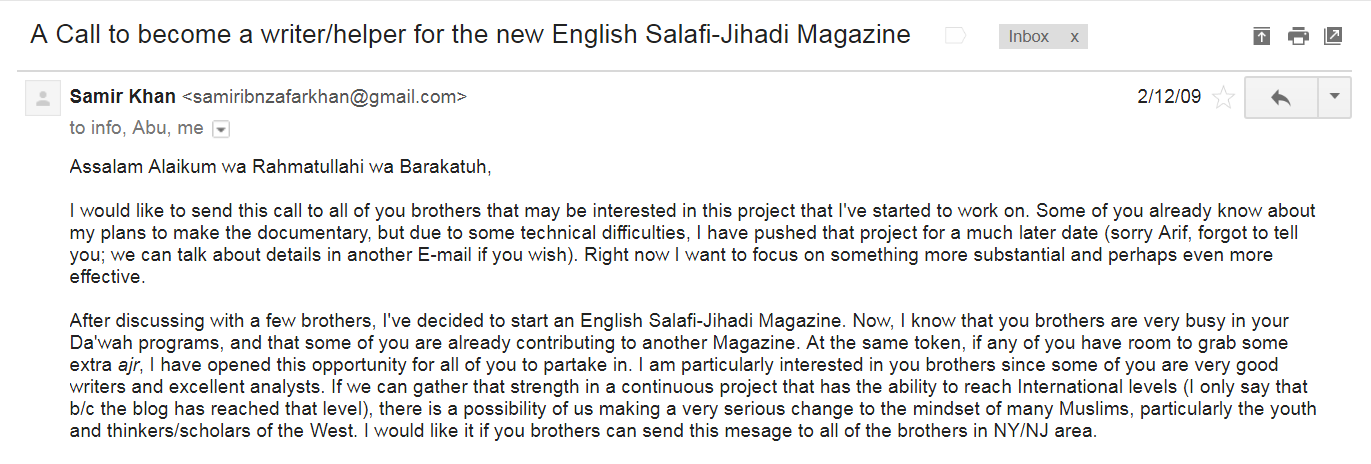
The development and publication of the new magazine was collaborative. Members of al-Fursan Media and the Global Islamic Media Front advised Khan and Abdullah Muhammad.17 The most prominent online jihadi forum in English, Ansar al-Mujahideen, disseminated it throughout the online jihadist network.18
Samir Khan released the first edition of Jihad Recollections in April 2009, and its cover story was the piece by Abdullah Muhammad entitled “Predications of the Conquering of Rome.” In it, Abdullah Muhammad outlined a foreign policy grievance consistent with the narrative of al-Qaeda, arguing that terrorism against Americans was necessary and that jihadists needed to embed themselves in populist protests against Middle Eastern governments. The magazine included articles from a variety of people who would go on to commit or attempt to commit terrorism-related crimes. Asia Siddiqui, who wrote poetry for Jihad Recollections, was arrested with an accomplice for planning attacks in New York City in 2015.19 Mohamed Osman Mohamud, who was later convicted of plotting to attack a Christmas tree lighting ceremony in Portland, Oregon, also wrote articles for the magazine, including one on training without weights.20 Zachary Chesser also wrote for Jihad Recollections during his time as a Revolution Muslim propagandist.21
While over time the relevance of Jihad Recollections would become clear, its launch generated limited concern from counterterrorism experts at the time. For example, Thomas Hegghammer explained, “Jihadi Recollections sets a new standard for jihadi propaganda in English … but generally I think the importance of English-language propaganda tends to be overestimated by western analysts.”22 He mocked Mohamud’s article in particular: “I guess one indication would be if European jihadis suddenly start getting slender, flexible bodies.”23
Jihad Recollections operated for a mere six months, from April to September 2009, and published four issues. Yet its publication run was only the beginning of the collaboration between Samir Khan and Revolution Muslim with regard to the role of English-language propaganda magazines. Khan’s next magazine, Inspire, would be produced not by jihadist sympathizers in the United States, but by Al-Qaeda in the Arabian Peninsula (AQAP). Khan’s path from publishing Jihad Recollections to publishing Inspire from Yemen was in part enabled by Revolution Muslim, which would also play a major role in distributing Inspire once it launched.
In October 2009, Khan met with members of ITS and RM in New York City just before departing from JFK International Airport en route to Yemen. Khan informed his collaborators that he intended to continue the magazine project. He claimed that Anwar al-Awlaki had approved of Jihad Recollections. The initiative was to continue once he was safe and embedded with AQAP. According to Abdullah Muhammad, who was at the meeting, Khan said that once he arrived he’d be able to turn up the narrative.24
For the first several months that Khan spent in Yemen, he kept a low profile, preparing the groundwork for his next publication. Meanwhile, Revolution Muslim continued its efforts in the United States.
By the time Revolution Muslim recruited Zachary Chesser to join the group and issued the South Park threat on April 16, 2010, it was a well-known entity. However, the South Park threat thrust Revolution Muslim further into the limelight. The incident prompted responses from many, including Molly Norris, an artist from Seattle who started a Facebook page titled “Everybody Draw Mohammed Day.” She explained:
In light of the recent “veiled” (ha!) threats aimed at the creators of the television show South Park … by bloggers on Revolution Muslim’s website, we hereby deem May 20, 2010 as the first annual “Everybody Draw Mohammed Day!” Do your part to both water down the pool of targets and, oh yeah, defend a little something our country is famous for (but maybe not for long? Comedy Central cooperated with terrorists and pulled the episode) the first amendment.25
Meanwhile, by the summer of 2010, Samir Khan, working with Anwar al-Awlaki, launched Inspire magazine. The magazine was almost an exact replica of Jihad Recollections in form and content.
Khan and al-Awlaki utilized the controversy created by Revolution Muslim’s South Park threats to help launch the magazine and frame its effort. Inspire’s “Hear the World” section—consisting of quotes from “Friends and Foes” of al-Qaeda—included Revolution Muslim’s Yousef al-Khattab saying on CNN, “I love Usamah bin Laden, I … Walahi … I love him … pfft … like I can’t begin to tell you,” as well as Mitch Silber, NYPD director of intelligence analysis and coauthor of this paper, who called the Islamic Thinkers Society “bug lights for aspiring jihadists.”26
The issue also announced a new terrorist campaign targeting cartoonists who drew the Prophet Muhammad, entitled “The Dust Will Never Settle Down.” The announcement included a timeline of key events related to cartoons of Muhammad, a hit list of targets and a fatwa from Anwar al-Awlaki justifying the effort. Each of these sections of the campaign drew upon the work done by Revolution Muslim in making the South Park threats.
Revolution Muslim not only advised Khan on his efforts in developing the magazine but also played a central role in its distribution to aspiring jihadists in the West. Abdullah Muhammad posted the first edition on July 11, 2010, to the Revolution Muslim website a few days after its release over the Ansar forum.27 The prosecutor in his case would later state at the sentencing hearing that sharing the first edition of Inspire was “likely to cost innocent people their lives somewhere and someday.”28
Indeed, the first issue of Inspire included an article entitled, “Make a bomb in the kitchen of your Mom.” By including this article, Inspire took a step into explicit support for terrorist violence that its earlier incarnation in Jihad Recollections had avoided.
Abdullah Muhammad now explains that, while he didn’t think the prosecutor’s statement would prove prescient, “I remember watching CNN when it was revealed that the Tsarnaevs used the recipe at the Boston Marathon bombings and realizing the long-term consequences of Revolution Muslim-related propaganda.”29 Ahmad Khan Rahami, who cited the influence of ISIS in a journal, also utilized the same recipe to build the bombs that injured 31 people in New York and New Jersey in September 2016.30 More recently, Akayed Ullah, a 27-year-old Bangladeshi living in Queens, New York, utilized the recipe from Inspire to build a pipe bomb that he strapped to his chest and detonated at the Port Authority in Manhattan in December 2017.31
ISIS’ English-language magazine Dabiq and its successor, Rumiyah, are the latest versions of the template developed by Samir Khan in collaboration with Revolution Muslim. Absent some quality improvements, an issue of Dabiq or Rumiyah is almost identical to an issue of Jihad Recollections. Unsurprisingly, ISIS’ magazines have an editorial lineage that traces back to the network surrounding Revolution Muslim. ISIS claims that Ahmad Abousamra, an IT expert and Syrian-American in exile from America, played a key role in Al-Hayat—ISIS’ primary media arm—and was a key contributor to its English-language magazines.32 In 2004, Abousamra traveled with Tarek Mehanna,33 an American jihadist from Boston who was convicted in 2011 for providing material support to al-Qaeda, to seek out training camps in Yemen.34 Mehanna was connected to Khattab and members of the Islamic Thinkers Society.35
ISIS mastered the utility of English-language magazines. However, the true power of such magazines lies in their connection to a broader propaganda strategy that will likely survive ISIS’ fall. As Samir Khan put it in the Fall 2011 edition of Inspire, just before he was killed alongside Anwar al-Awlaki, “[I]t goes without saying that we have thrown something at America and her allies which they will forever be stuck with.”36
Direct Communication Platforms
In its recruitment and propaganda efforts, ISIS has made extensive use of direct communication platforms. Increasing numbers of Muslims have carried out attacks in the West in the name of ISIS following private communication with what the counterterrorism community now calls “virtual planners,” who are “members [of ISIS] who operate in the dark spaces of the Internet—to inspire and coordinate attacks abroad.”37 In the United States alone, at least 19 individuals have received encouragement or facilitation from an individual embedded with ISIS overseas.38
Yet, this threat is not altogether new. While ISIS took the use of direct messaging to a new level by providing explicit operational advice and support, Revolution Muslim introduced the tools and made initial use of direct communication to sanction and encourage terrorism—though not operationally support it—years before ISIS burst onto the global scene.
Revolution Muslim’s website encouraged sympathizers and supporters to contact the organization directly by phone, email and even Windows Live Messenger. Revolution Muslim used these platforms to collaborate with ALM members overseas, to field inquiries for regular Q & A sessions with Abdullah Faisal and to organize participation in protests and other activities. However, it became apparent that the reach of these platforms was limited. Revolution Muslim needed a platform that could amplify the message and facilitate direct communication simultaneously.
Revolution Muslim found its answer in a free, downloadable program called Paltalk, which allows users to communicate by video, chat and voice. RM organized regular lectures using the platform, which Omar Bakri had utilized extensively in the past. In 2005, Bakri started giving daily talks in an al-Muhajiroun chat room, where he expressed views more radical than those he expressed in public.39 For example, in public Bakri claimed that ALM adhered to the notion of a “covenant of security,” whereby acts of homegrown terrorism were forbidden by Islam.40 However, an investigation into the content of lectures on Paltalk revealed that the cleric preached that such a covenant had been “violated” by the U.K. government’s anti-terrorism legislation.41
Revolution Muslim expanded the use of Paltalk and integrated it within its public-facing, online propaganda approach—vastly extending the tool’s reach. Revolution Muslim created its own Paltalk room, “Masjid Syed Qutb,” early into its existence, using it sporadically until July 2010, when RM announced the creation of a new website, “Authentic Tauheed.” The outlet centered on Sheikh Faisal, but provided access to live 24/7 Paltalk discussions with contributors from the Revolution Muslim website, along with interactive lectures from a variety of radical clerics.42 The Paltalk chat room was embedded on the Revolution Muslim homepage so that anyone viewing the website could click on an audio button and listen in live. Lectures were promoted over RM social media platforms; photoshop posters grew more urbane and lectures were promoted with times in New York, London and Sydney. Faisal started giving lectures three times a day.43 The effort became an immediate draw and attracted additional attention and interactivity with those interested in the jihadist narrative.
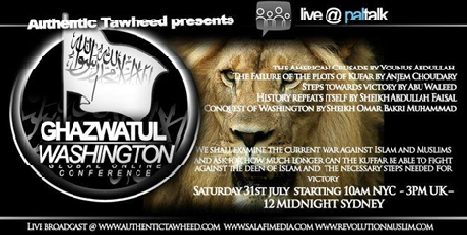
Revolution Muslim also organized conferences over its Paltalk platform. Conferences drew a larger audience because they were formatted to include several preachers commenting on a specific topic or issue.
On July 31, 2010, for example, Authentic Tauheed coordinated a conference entitled “Ghazwatul Washington.”44 The event included Abdullah Muhammad, then residing in Morocco; Anjem Choudary; Abu Waleed, a Revolution Muslim collaborator and organizer of SalafiMedia in the U.K.; Omar Bakri; and Abdullah Faisal. Listeners could post freely during the lectures over a public chat service. Room administrators kept conversations focused, typed notes, bounced unwanted room members and directed some participants to the instant messaging service for more intimate discourse.
Unlike the programs ISIS uses today, Paltalk was not encrypted, but instant messaging provided at least a (perceived) layer of security as the RM leadership set up tiers of hierarchy. Administrators were recruited to monitor the room and to identify and log frequent onscreen nicknames. For intimate communication, room participants had to request an administrator to direct them to the member of the leadership they wanted to speak with. Administrators screened the types of questions the participants wanted to ask and were instructed to chat with them until the administrators verified their understanding of the ideology and felt confident they were not informants. Screened requests were then passed on. Once the lecturer or leader accepted the request, they could initiate an online text chat or communicate over audio.
Unlike ISIS, Revolution Muslim did not provide direct orders to carry out attacks or give operational information. However, RM did provide individualized sanctioning of terrorist activities through direct communication facilitated by Paltalk. For example, Rezwan Ferdaus, who was arrested for plotting to attack the U.S. Capitol and the Pentagon with a remote-controlled aircraft in September 2011, was a frequent participant in the Authentic Tauheed chat room and viewed Revolution Muslim’s website regularly. When he asked Abdullah Muhammad over the Revolution Muslim Gmail account on February 2, 2010, whether martyrdom operations were permissible, Abdullah Muhammad advised that they had some positive and negative ramifications but, “That is all I have time to say now, but if you log onto our site and join our Paltalk discussion on Thursday’s you can ask the questions and we will go into greater detail inshallah. Stay tuned to the homepage to find out what time.”45 During the investigation, Ferdaus told undercover informants that “viewing jihadi websites and videos” made him realize “‘how evil’ America is,” according to the complaint in the case.46
Rezwan Ferdaus was not a lone case of individuals plotting terrorist attacks after individualized sanctioning by Revolution Muslim leaders. Around Christmas 2010, several members of Call2Islam, then ALM-UK’s most influential offshoot, were arrested (and eventually convicted) for plotting to bomb the London Stock Exchange.47 Members of the plot were active in the Authentic Tauheed Paltalk room, and Mohammed Chowdhury, the alleged “linchpin” of the group, had even been approached by Abdullah Muhammad to help administer the Revolution Muslim website when he moved to Morocco.48 Before the plot was launched, Abdullah Muhammad had given a lecture on the Authentic Tauheed platform about the evils of financial institutions and specifically referenced conspiratorial claims about the City of London.49 Court records revealed that the London conspiratorswould meet on the street at Call2Islam dawah stalls and then continue their conversations on Paltalk at night.50 Abdullah Muhammad did not instruct them to conduct the attack, but sanctioned “terrorism” in private discourse over Paltalk’s instant messaging service.51
Today, ISIS utilizes Telegram, another instant messaging service, in a manner very similar to Revolution Muslim’s earlier efforts. To instruct adherents, it holds virtual “durus” (lessons) over public channels. Durus function as a means of formal education and further radicalization. These classes are taught by a “sheikh,” who opens text chat in the room for a question and answer session afterward. The chat session is followed by a brief quiz. Topics replicate those Revolution Muslim covered over Paltalk, teaching doctrinal differences with opposing interpretative schools, building social interaction and group cohesion and, where appropriate, facilitating one-on-one communication.52 From the broader conversations occurring on Telegram, ISIS then recruits individuals for more private discussions regarding potential attacks.53 ISIS’ innovation upon what Revolution Muslim had already done was expanding the method of personalized interaction and recruitment to provide operational assistance and using its ability to benefit from more available encryption.
Beyond Adopting the Template: ISIS’ Adoption of the ALM/RM Network
Revolution Muslim’s contribution to jihadist organizing was not merely its development of a template for utilizing the internet to great effect in recruitment and propaganda, but its stitching together of a large transnational jihadist network. From the time of Revolution Muslim’s disbandment in May 2011 until June 2014, when ISIS pronounced its caliphate, jihadist networks were sustained by Revolution Muslim progeny like Abdullah Faisal’s Authentic Tauheed platform and ALM propagandists in Britain who had been influenced by RM’s methods in the United States.54 As ISIS began to grow, it drew upon these networks that Revolution Muslim had nurtured, and called many to emigrate to join the caliphate or conduct attacks in the West.
One of the first criminal cases involving ISIS in the United States involved three young American siblings attempting to travel to join the group in Syria. The ringleader, 19-year-old Mohammed Hamzah Khan, had communicated with a pro-ISIS recruiter online. Khan asked the jihadist advocate whether he had to travel to Syria or could remain in the U.S. He was told that it was not obligatory but was advised that a single day under a caliph was better than to “to live and die in [ignorance].”55 Khan subsequently attempted to depart for Syria from Chicago with his younger sister and brother. The individual who advised Khan to travel to Syria was Abu Baraa (aka Mizanur Rahman), a leader of ALM in Britain, Anjem Choudary’s right-hand man and an acolyte groomed by Omar Bakri Muhammad to continue ALM into the next generation.56
ISIS’ adoption of the larger network built by ALM and its offshoots like Revolution Muslim was manifested not only in the flow of foreign fighters to Syria, but also in attacks in the West. On June 3, 2017, three perpetrators wearing fake explosive vests ran over pedestrians on London Bridge, then fled to stab others before they were all shot dead by police. The attack killed eight people and injured dozens.
The cell had deep ties to the ALM network, including to Revolution Muslim.The apparent ringleader of the cell was Khuram Butt, 27, of east London. Butt had been filmed in a 2015 documentary, The Jihadis Next Door, praying behind key members of ALM.57 Among those ALM leaders were Siddhartha Darr (aka Abu Rumaysa), who eventually emigrated to join ISIS and became one of the most senior commanders among foreign fighters in Mosul,58 and Mohammed Shamsuddin, Anjem Chouwdry’s one-time deputy,59who had connected with Abdullah Muhammad on Paltalk. Abdullah Muhammad, while working as an informant and analyst with the U.S. government, reported that Butt helped administer Revolution Muslim’s Paltalk platform in 2010 and that Butt was on the FBI’s radar as well.60
Butt had other ties to the ALM network. He was a regular at the Ummah Fitness Centre in Ilford, where cameras recorded him hugging the two other London attackers outside a few weeks before the attack.61 At the gym, he taught alongside Sajeel Shahid, a UK citizen who had visited New York before 9/11 on an ALM recruiting trip and who led ALM in Pakistan in 2001.62 According to Mohammed Babar, the New Yorker who had radicalized within ALM-NY, Shahid was present with him at a training camp in Pakistan.63 That camp was the location where Omar Khyam, the future leader of the 2004 London fertilizer bomb plot, and Mohammad Siddique Khan, the future leader of the London 7/7 bombings, trained.
A day after the London Bridge attack, ISIS’ news agency, Amaq, posted a message over Telegram in English: “A detachment of Islamic State fighters carried out the London attacks yesterday.”64 Soon thereafter, ISIS released a new issue of Rumiyah, the English-language magazine successor to Dabiq, built upon the template developed by Samir Khan in collaboration with Revolution Muslim. The magazine exclaimed that
“a unit of Islamic State soldiers, Abu Sadiq al-Britani, Abu Mujahid al-Britani, and Abu Yusuf al-Britani, carried out an operation striking two locations in London, the first being London Bridge where they ran over a number of Crusaders, and the second being a pub where they stabbed several others before attaining shahadah.”65
The attack demonstrated ALM’s resilience, despite the imprisonment of ALM leader Anjem Choudary in September 2016 and the jailing of other key leaders.66 More than 16 years after 9/11, the Islamist challenge that al-Muhajiroun and Revolution Muslim present in the West has not receded.

Citations
- Alexander Meleagrou-Hitchens and Hussein Solomon, “Factors Responsible for Al-Shabab’s Losses in Somalia,” CTC Sentinel, September 26, 2012.
- J.M. Berger and Jonathon Morgan, “The ISIS Twitter Census: Defining and describing the population of ISIS supporters on Twitter,” Brookings, March 2015.
- Audrey Alexander, “Digital Decay? Tracing Change Over Time Among English-Language Islamic State Sympathizers on Twitter,” George Washington University Program on Extremism, October 2017.
- Charlie Winter and Jade Parker, “Virtual Caliphate Rebooted: The Islamic State’s Evolving Online Strategy,” Lawfare, January 7, 2018.
- Ibid.
- Regarding Samir Khan’s ties to the Ansar forum and GIMF and his role in connecting them with Revolution Muslim, see personal experience of the authors; Jason Leopold, “An Exclusive Look Inside the FBI’s Files on the US Citizen Who Edited Al Qaeda’s Official Magazine,” Vice, September 22, 2014. ; Jihad Recollections, Issue 3, August 2009, p. 7; and email correspondence, November 7, 2010 [email protected]
- Personal experience of the authors; See also Jesse Morton, “My Former ‘Sheikh’ Abdullah Faisal: Arrested at Last by Jesse Morton,” Parallel Networks, August 29, 2017.
- “Sheik Faisal Returns – Refuting Christianity– Is Jesus God?” YouTube video, posted by “SheikFaisal,” November 18, 2007,
- “Funniest Muslim Christian Debate Ever,” YouTube video, posted by “Halal Sheikh,” August 9, 2011.
- “Debate between Sheikh Abdullah Al-Faisal and Bishop Joseph Adgol6.flv.” YouTube video, 5:07, posted by “mhmdzbayde,” December 9, 2010. ; personal experience of the authors.
- United States vs. Jesse Curtis Morton, “Statement of Facts,” 1:12cr35 (Alexandria Division, 2012)
- “Benefit grabbing extremist who hates Britain: Preacher wants non-Muslims to shave their heads and wear red belts around their necks,” Daily Mail, June 29, 2014.
- Jytte Klausen, “Tweeting the Jihad: Social Media Networks of Western Foreign Fighters in Syria and Iraq,” Studies in Conflict and Terrorism 38:1, 2015.
- Bethan McKernan, “Isis’ new magazine Rumiyah shows the terror group is ‘struggling to adjust to losses,’” Independent, September 6, 2016.
- Interview with Jesse Morton, New York City, September 9, 2017.
- Samir Khan, “A Call to become a writer/helper for the new English Salafi-Jihadi Magazine,” February 12, 2009, email.
- Steven Stalinsky and R. Sosnow, “The Life and Legacy of American Al-Qaeda Online Jihad Pioneer Samir Khan – Editor of Al-Qaeda Magazine ‘Inspire’ and A Driving Force Behind Al-Qaeda’s Push for ‘Lone Wolf’ Terror Attacks in the West,” Middle East Media Research Institute, Inquiry & Analysis Series, Report No. 886, September 28, 2012.
- “Al-Fursan Media: First English Jihad Magazine – Jihad Recollections no. 1.” Ansar al-Mujahideen Forum. April 7, 2009. Originally posted at . Screenshot retrieved on November 18, 2017, . Also see Jihad Recollections, Issue 3, August 2009, p. 7.
- United States of America Against Noelle Velentzas and Asia Siddiqui, “Complaint and Affidavit in Support of Arrest Warrants,” (15M303) April 1, 2015.
- United States of America vs. Mohamed Osman Mohamud (No. 14-30217) (United States Court of Appeals for the Ninth District, 2016)
- Personal experience of the authors; Paul Cruickshank and Tim Lister, “Alleged American Jihadists – Connecting the Dots,” CNN, August 2, 2010.
- Thomas Hegghammer, “Jihad Recollections,” Jihadica, April 7, 2009.
- Ibid.
- Personal experience of the authors.
- Jimmy Orr, “Creators of ‘Everybody Draw Muhammad Day’ drop gag after everybody gets angry,” Los Angeles Times, April 26, 2010.
- Inspire magazine, Issue 1, Summer 2010.
- United States vs. Jesse Curtis Morton, “Statement of Facts,” 1:12cr35 (Alexandria Division, 2012)
- United States vs. Jesse Curtis Morton, “Position of the United States with Respect to Sentencing Factors,” 1:12cr35 (Alexandria Division, 2012)
- Interview with Jesse Morton, New York City, September 9, 2017.
- Marc Santora and Adam Goldman, “Ahmad Khan Rahami Was Inspired by Bin Laden, Chargers Say,” New York Times, September 20, 2016.
- Zolan Kanno-Youngs and Scott Calvert, “After New York Attack, Investigators Ask: Should ISIS Material Be Online?” Wall Street Journal, December 15, 2017.
- Paul Cruickshank, “ISIS Lifts veil on American at the heart of its propaganda machine,” CNN, April 7, 2017.
- Milton J. Valencia, “Mass. Man May Be Supporting Militants in Syria,” Boston Globe, September 4, 2014.
- Milton J. Valencia, “Tarek Mehanna Guilty of Terror Charges,” Boston Globe, December 20, 2011.
- Personal experience of the authors; Paul Cruickshank and Tim Lister, “Arrested Man Attended Protests Organized by Islamic Radical Group,” CNN, June 12, 2010.
- Samir Khan, “The Media Conflict,” Inspire, Issue 7, Fall 2011.
- Bridget Moreng, “ISIS’ Virtual Puppeteers: How They Recruit and Train ‘Lone Wolves,’” Foreign Affairs, September 21, 2016.
- Alexander Meleagrou-Hitchens and Seamus Hughes, “The Threat to the United States from the Islamic State’s Virtual Entrepreneurs,” CTC Sentinel, March 9, 2017.
- Gary R. Bunt, iMuslims: Rewiring the House of Islam, University of North Carolina Press: 2009.
- John Horgan, Walking Away from Terrorism: Accounts of Disengagement from Radical and Extremist Movements, Routledge: 2009.
- Sean O’Neill and Yaakov Lappin, “Britain’s online imam declares war as he calls young to jihad,” The Times, January 17, 2005.
- H. Perez, “Attempted VBIED Attack at a Military Recruiting Center [Baltimore, Maryland],” CFIX Open Source Assessment, December 19, 2010.
- Interview with Jesse Morton, New York City, September 9, 2017; “¹ú²úÊÓƵ,” AuthenticTauheed.
- “Paltalk July 31st: Global Islamic Conference, Plotting World Domination,” Logan’s Warning, July 27, 2010.
- United States vs. Jesse Curtis Morton, “Statement of Facts,” 1:12cr35 (Alexandria Division, 2012)
- United States vs. Rezwan Ferdaus, “Affidavit of Special Agent Gary S. Cacace,” 11-mj-4270-TSH (Boston Division, 2011).
- “Terrorism gang jailed for plotting to blow up London Stock Exchange,” Telegraph, February 9, 2012.
- Paul Cruickshank, “Suspect in ‘South Park’ threats pleads guilty,” CNN, February 9, 2012.
- Dominic Casciani, “Anjem Choudary’s American Follower,” BBC, September 6, 2016.
- Raffaello Pantucci, We Love Death as You Love Life: Britain’s Suburban Terrorists, Hurst: 2015, p.169.
- Interview with Jesse Morton, New York City, September 9, 2017.
- Andre Gagne and Marc-Andre Argentino, “How the Islamic State uses ‘virtual lessons’ to build loyalty,” The Conversation, November 5, 2017.
- Joby Warrick, “The ‘app of choice’ for jihadists: ISIS seizes on Internet tool to promote terror,” Washington Post, December 23, 2016.
- Jytte Klausen et al., “The YouTube Jihadists: A Social Network Analysis of the Al-Muhajiroun Propaganda Campaign,” Perspectives on Terrorism, 2012.
- Janet Reitman, “The Children of ISIS,” Rolling Stone, March 25, 2015.
- Kevin Sullivan, “Police call him an ISIS recruiter. He says he’s just an outspoken preacher,” Washington Post, November 23, 2015.
- Jon Sharman, “Khuram Shazad Butt: Footage Emerges of London Attacker in TV Documentary ‘The Jihadis Next Door,’” Independent, June 5, 2017.
- Adam Withnall, “Isis sex slave kidnapped by British ‘new Jihadi John’ suspect Siddhartha Dhar,” Independent, May 1, 2016. ; David Casciani, “Who is Siddhartha Dhar?” BBC, January 4, 2016. ; William Booth and Rick Noack, “Man featured in a documentary called ‘The Jihadis Next Door’ was one of London attackers,” Washington Post, June 5, 2017.
- Counter Extremism Project. “Mohammad Shamsuddin.”,
- Matt Zapotosky, “The Feds billed him as a threat to American freedom. Now they’re paying him for help,” Washington Post, February 5, 2016. ; A.J. Chavar, Camilla Schick and Rukmini Callimachi, “Meet The Former Extremist Who Flagged a London Attacker in 2015,” New York Times, June 7, 2017.
- Fiona Simpson, “Terrorist Khuram Butt was inspired by YouTube Videos and met accomplices at Ilford gym, relatives say,” Evening Standard, June 8, 2017. ; Lizzie Deardon and May Bulman, “London attack: CCTV video shows terrorists laughing while planning atrocity at Ilford gym,” Independent, June 8, 2017.
- Peter Campbell et al., “Focus turns to east London gym with links to terror attacks.” Financial Times, June 8, 2017. ; “Re: United States v. Mohammed Junaid Babar,” 04-CR-528 (Southern District of New York, 2010).
- Richard Watson, “Has al-Muhajiroun Been Underestimated?” BBC, June 27, 2017.
- Brian Ross et al., “ISIS claims responsibility for London Bridge attack,” ABC News, June 4, 2016.
- Rumiyah, Issue 10, June 2017.
- Alexander Meleagrou-Hitchens, “The Toxic Movement that Brought Terror to London Bridge,” War on the Rocks, June 19, 2017.