Introduction
Cyberspace鈥攖he newest domain of conflict鈥攊s among the most prominent forums of conflict in the twenty-first century. Increasingly nation-states utilize cyber and information capability in pursuit of foreign policy and national security objectives. This report focuses on two nation-states that are leading the charge in this respect: China and Russia.
While Russia seeks to destabilize the global system for its own advantage, China鈥檚 goal is to maintain the current system and replace the United States as the global hegemon. To that end, China and Russia are pursuing robust cyber capabilities to advance their respective geopolitical, economic, and security interests. Moreover, Chinese and Russian state-run enterprises use tools ranging from cyber espionage to weaponizing information in an effort to undermine the efficacy of democracy and, in general, western interests around the world.
Figure 1: U.S. Military Approach to Information1
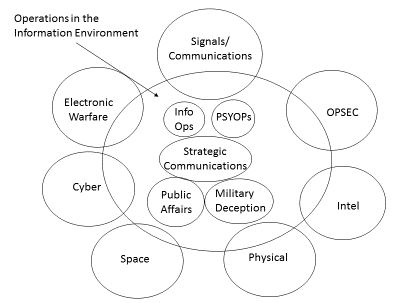
In this report, we offer an overview of Chinese and Russian cyber capabilities. We interpret these broadly to include both computer network, or cyber, capabilities and internet-enabled information and influence capabilities. Their view of the use of information to influence or 鈥渙perations in the information environment鈥� are different from the point of view of the United States, in particular the U.S. military. Although the U.S. Department of Defense seeks a more unified theory of how to influence other actors, the reality is that each community involved could be called a 鈥渃ylinder of excellence.鈥� Each group is very good at what they do, but the efforts are not integrated in the planning or execution stages of the operations. Figure 1 shows the relationship of the various actors who operate in the information environment.
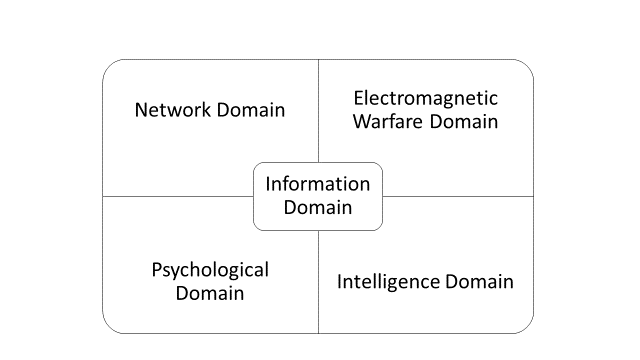
By contrast, Russia and China both have a more integrated view of the use of information. Russia鈥檚 approach is called 鈥渋nformation confrontation鈥�2 while the Chinese approach is one of 鈥渋nformation dominance鈥�3 Figure 2 illustrates the Russian integration of all elements of information while Figure 3 shows a Chinese military theorist鈥檚 conceptualization of the information domain.
Figure 2: The Russian Perspective on Information Competition4
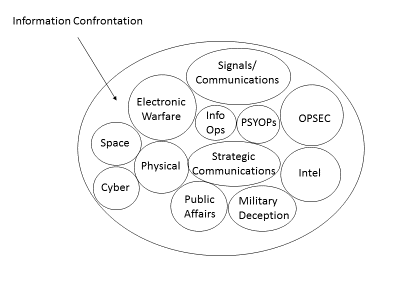
Figure 3: Chinese Military Theorist鈥檚 Conception of the Information Domain5
This report flows as follows: We start with an overview of Chinese and Russian cyber capabilities. Contained within each of these sections is an overview of key state and non-state actors, as well as overviews of known operations and capabilities. We then provide an analysis of how these capabilities are or could be used in the future in Latin America and the Caribbean. While the focus of the analysis is on applications in Latin America and the Caribbean, the information about Chinese and Russian capabilities is also applicable to operations that they may undertake in other regions.

Citations
- Chart is the original work of G. Alexander Crowther, Ph.D.
- 鈥淚nformation Confrontation over Ukraine,鈥� Cybernautika, February 27, 2014.
- Dean Cheng, 鈥淐yber Dragon: Inside China鈥檚 Information Warfare and Cyber Operations,鈥�(Keynote address, Heritage Foundation, Washington, D.C., March 20,2017).
- Chart is the original work of G. Alexander Crowther, Ph.D.
- Figure 3. 鈥淐hina and Cybersecurity鈥� (Figure 8.2 in Chapter 8), Oxford University Press (Oxford, UK, April 2015)