A Chapter of: Terrorism in America 18 Years After 9/11
The War on ISIS and Other Extremist Groups
The United States has demonstrated its ability to deal substantial military defeats to jihadist1 groups that take territory. In March 2019, the United States Central Command (CENTCOM) congratulated the Syrian Democratic Forces (SDF) on the 鈥渆limination of Daesh鈥檚 self-proclaimed territorial caliphate.鈥�2 The territorial defeat of ISIS3 illustrates the stark limitations to jihadist efforts to establish long-term safe havens. However, instability and social conditions in the Middle East, North Africa, and parts of South Asia combined with the connecting power of social media ensure that jihadist militancy鈥攊ncluding but not limited to its expression in the form of ISIS and al Qaeda鈥攚ill remain a resilient regional and local threat.
These conditions suggest the need for a foundational evaluation of U.S. goals in its counterterrorism wars, and what is achievable at what cost. Under the Trump administration, the United States has escalated many of these wars and continues to backtrack on the already limited transparency surrounding these wars, making the ability to assess the true impact of the Trump administration鈥檚 policy changes difficult in this environment.
The Territorial Defeat of ISIS in Syria and Iraq
Over the past year, the United States and its partners have successfully eliminated all of ISIS鈥� territory in Iraq and Syria. In March, the U.S.-backed SDF liberated ISIS鈥� last piece of territory in Syria in Baghuz. However, in effect, ISIS鈥� territorial caliphate in Iraq and Syria had already collapsed. The group lost Raqqa, the capital of its self-proclaimed caliphate almost two years ago in October 2017 when the SDF took the city.4 A month later, ISIS lost its last populated territory in Iraq.5 In early 2018, the United Nations (UN) Security Council Committee鈥檚 Analytical Support and Sanctions Monitoring Team reported that ISIS 鈥渓ost control over all remaining urban areas [in Iraq and Syria].鈥�6 By March 2019, all that remained was the 1.5 square mile of ISIS territory in Baghuz liberated by the SDF that month.7
The loss of its territory in Iraq and Syria dramatically undercuts ISIS鈥� claim that it is the caliphate, because the caliphate has historically been a substantial geographic entity, such as the Ottoman Empire, as well as a theological construct.8 Not only did it hold vast territory and theological significance, but the so-called caliphate allowed the organization to have a constant influx of money through its vast crop and oil holdings, in addition to its income from antiquities sales, ransoms, and taxation.9
As ISIS鈥� territorial caliphate collapsed, there has been a noticeable decline in its propaganda capability. Key propaganda outputs including ISIS鈥� English-language magazine Rumiyah appear to have ceased publication.10 According to Europol鈥檚 2019 report, ISIS鈥� losses 鈥渉ad a significant impact on its digital capabilities,鈥� leaving its weekly Arabic Al-Naba newsletter as its only regular output.11 Likewise, the UN Analytical Support and Sanctions Monitoring Team鈥檚 January 2019 report assessed that ISIS鈥� 鈥渕edia production fell during the course of 2018 as did the quality of its output and the reliability of its claims for responsibility for attacks.鈥�12 In addition to an increased number of false claims of attacks, there has been confused messaging on ISIS鈥� part regarding the structure of its provincial and affiliate network.13 The Sanctions Monitoring Team鈥檚 January 2019 assessment mirrors its February 2018 assessment that 鈥渢he propaganda machinery of the ISIL core is further decentralizing, and the quality of its material continues to decline.鈥�14
Limits to ISIS鈥� Defeat in Syria and Iraq
While ISIS鈥� territorial collapse represents a major success for the counter-ISIS coalition, this is not the first time that ISIS has been dealt substantial tactical defeats. The group remains capable of exploiting current and potential future instability in Iraq and Syria to improve its position.
The UN Sanctions Monitoring Committee in February 2019 assessed that in Iraq, the group鈥檚 transition 鈥渋nto a covert network is well advanced鈥� and that ISIS poses a 鈥渕ajor threat鈥� in the form of assassinations of officials and 鈥渇requent attacks鈥� on civilians.15 Indeed, ISIS has previously demonstrated its ability to continue operations in areas where it has lost territory during the so-called 鈥渟urge鈥� that began in 2007 and in areas previously liberated during the current counter-ISIS campaign.16
In Syria, security conditions in Raqqa remain poor. According to 国产视频 fellows David Kilcullen and Nate Rosenblatt, Raqqa and its surroundings鈥攔ather than having been stabilized鈥攊s 鈥減ower-locked鈥� with American power suppressing large-scale challenges to the SDF. But an American withdrawal or other shift in conditions could reignite broader conflicts and allow ISIS to reapply the strategy it used to take Raqqa in the first place.17
Some analysts conclude that ISIS, even with its territorial defeat, is in a far stronger position with regards to a number of capabilities than it was in the aftermath of the surge when it managed to turn post-Arab Spring instability and other factors into the fuel for its burst onto the global stage.18
However, there are other factors that may limit the group鈥檚 ability to achieve a resurgence in the near-term. Iraq has exited the ISIS crisis in far better shape than conventional wisdom expected at the outset of the counter-ISIS campaign, providing a stronger basis for preventing an ISIS resurgence having faced it once already.19 In addition, the presence of U.S. forces as well as the U.S.-backed SDF and the Iraqi Counter Terrorism Service鈥攁ll of whom are well aware of the danger posed by ISIS鈥攎akes an ISIS resurgence less likely. In addition, ISIS鈥� surge in strength was in part the result of the revolutionary environment of the Arab Spring鈥檚 immediate aftermath and substantial foreign fighter flows from around the world.20 It is unclear whether such conditions will reemerge in the near-term or if ISIS can generate anywhere near the strength it did in 2014 in the absence of such conditions.
What is clear, however, is that the territorial defeat of ISIS in Syria and Iraq does not mean the defeat of the organization as a whole, let alone the larger jihadist movement in the two countries.
ISIS Beyond Syria and Iraq
ISIS continues to pose a threat beyond Iraq and Syria through its networks of affiliates and provinces as well as its use of social media to promote and support terrorism. Through these groups and networks, ISIS will likely remain capable of at least claiming and amplifying attacks and smaller scale efforts at governance over a large area.
Viewing ISIS or even the group鈥檚 territorial structure as merely its presence in Iraq and Syria is dangerously myopic. On Easter Sunday, April 21, 2019, terrorists killed more than 250 people in coordinated bombings of three churches and three hotels in Sri Lanka.21 The two groups tied to the attacks are ISIS22 and National Thowheed Jamath (NTJ).23 ISIS claimed the attack two days after it took place, and later reporting indicated that multiple family networks coordinated the bombings. According to the UN Secretary General鈥檚 July 2019 report on the threat posed by ISIS, Abu Bakr al-Baghdadi, ISIS鈥� leader, was not aware of the attack before it happened.24 However, the attackers were sufficiently connected to ISIS鈥� network that ISIS was able to release video of the attack via its official platforms.25
The Sri Lanka attack illustrates ISIS鈥� ability to inspire attacks outside of Syria and Iraq. And it is not a stand-alone case. Since 2017, ISIS and its supporters have conducted attacks in more than 25 countries.26 Even so, there is reason for optimism. The UN Sanctions Monitoring Team reported a 鈥渟ubstantial reduction in global external attacks鈥� associated with ISIS in 2018.27
ISIS鈥� ability to conduct such attacks is bolstered by two overlapping sources of international strength. One is its online networks鈥攐r what some have termed a 鈥淰irtual Caliphate鈥濃�攚hich produce and spread propaganda but also provide advice for attacks while helping ISIS鈥� central organization claim ties to attacks carried out by people thousands of miles away.
The rise of social media has helped spread this network鈥檚 power. Since these networks depend on individual connections and local roots more than ISIS鈥� core organization, they might survive a more substantial collapse of the group. They also rely upon templates for activity that are easily adopted and scaled. As Mitch Silber, former New York Police Department director of intelligence analysis, and Jesse Morton, the former leader and cofounder of the American Salafi-jihadist group Revolution Muslim, which advanced much of the online propaganda techniques that would later be used by ISIS, noted in a report for 国产视频, 鈥淸a] key lesson of the effort against Revolution Muslim is that countering virtual jihadist recruitment will be an ongoing struggle, and law enforcement and intelligence agencies should not overemphasize the collapse of any particular group.鈥�28 Even if such activity doesn鈥檛 occur under the ISIS brand, such virtual networks will continue to pose a challenge for the future.
The second factor is ISIS鈥� more official structure of wilayat (provinces) and affiliates. In January 2019, the UN Sanctions Monitoring Team reported that a centralized ISIS leadership remains that 鈥渃ommunicates and provides resources to its affiliates, albeit at a reduced level."29 Al-Qaeda鈥檚 continued existence and maintenance of its own affiliate network after Osama Bin Laden鈥檚 death warns against dismissing the ability of the group to maintain a coherent albeit reduced network after territorial or leadership losses.
ISIS has shown some evidence of its ability to build or sustain its brand and affiliate structure in the wake of the territorial collapse in Syria and Iraq. In April 2019, it claimed its first attack in the Democratic Republic of Congo, announcing a Central African province.30
On the other hand, the strength of ISIS鈥� affiliates should not be overestimated. Giving ISIS too much credit for its control over affiliates with pre-existing constituencies or exaggerating its affiliates鈥� strength can aid ISIS鈥� media strategy of portraying itself as in control of a highly centralized, globalized Caliphate even in the wake of its territorial defeat in Iraq and Syria.31 Many of ISIS鈥� affiliates and provinces are either struggling or are under substantial military pressure.
In Libya, once viewed as a potential fallback for the group, ISIS lost its territorial hold in the city of Sirte in late 2016.32 Yet the group appears to continue to pose a resilient insurgent and terrorist threat.33
In other areas, where ISIS held less power, affiliates are facing even tougher environments. In January 2019, the UN Sanctions Monitoring Committee reported that 鈥淚SIL in Yemen now has only a few mobile training camps and a dwindling number of fighters;鈥� the group is not economically self-sufficient; it receives few foreign fighters; and its activities in Al-Bayda 鈥渘ow consist mainly of protecting the group鈥檚 leaders and their family members.鈥�34
Some affiliates have also seen the deaths of important leaders. For example, Abdulhakim Dhuqub, ISIS鈥� second in command in Somalia, was killed by a U.S. airstrike in April 2019 in Xiriiro, Somalia.35 Abu Sayed Orakzai, also known as Sad Arhab and the leader of ISIS in Afghanistan, was killed by an airstrike by Afghan and coalition forces in Afghanistan in August 2018.36
The fact that ISIS has been able to maintain substantial capabilities and loyalties in the wake of its territorial collapse in Iraq and Syria showcases the limitations of military action against particular groups when pursuing broader objectives than preventing the particular threats posed by that group鈥檚 safe haven. That said, the territorial collapse has had an impact on the broader networks and effectiveness of ISIS鈥� brand.
The Resiliency of al-Qaeda
Even as ISIS suffers repeated setbacks, al-Qaeda has shown resiliency in the face of the counterterrorism campaigns directed against it and the challenge from within the jihadist movement posed by the rise of ISIS. In August, al-Qaeda marked the 31st anniversary of its founding, making the group one of the longest-lasting terrorist groups in history.37
Eighteen years after 9/11, al-Qaeda continues to operate across North Africa and South Asia despite the heavy losses it has sustained, including the death of its founder, Osama bin Laden, and of dozens of other al-Qaeda leaders who have been killed in drone strikes in Pakistan and Yemen. Al-Qaeda in the Indian Subcontinent, Al-Qaeda in the Arabian Peninsula, and Al-Qaeda in the Islamic Maghreb all retain capacity for sustained local attacks.
In Syria, al-Qaeda鈥檚 fortunes are far from clear, though any accounting must acknowledge a substantial al-Qaeda presence in the country. Al-Qaeda in Syria has undergone changes to its naming and organizational design. Initially known as the Nusra Front or Jabhat al-Nusra, al-Qaeda in Syria adopted the name Jabhat Fateh al-Sham in July 2016 to distance itself from al-Qaeda core, though then-Director of National Intelligence James Clapper labeled it a 鈥淧R move … to create the image of being more moderate.鈥�38 In January 2017 another rebranding occurred, with the group taking the name Hayat Tahrir Al-Sham (HTS).39 In turn, Hurras al-Din, a group closely tied to al-Qaeda and its global vision, split off during the creation of HTS publicly announcing itself in February 2018.40 Regardless of the shifting monikers, the group and its various manifestations and splinters remain a potent force, as seen by its role in the takeover of Idlib, a prominent city and province in the country鈥檚 northwest corner, in July 2017.41 However, according to some analysts, the series of splits and rebrandings represents a meaningful loss of organizational control in Syria on the part of al-Qaeda and a major setback.42 Even so, al-Qaeda continues to count on the loyalty of thousands of fighters. The analysts Tore Hamming and Pieter Van Ostayen put the number at about 2,000 while others who give less credence to the meaningfulness of the splits put the number at up to 20,000.43 This demonstrates al-Qaeda鈥檚 resilience.
Despite its resilience, al-Qaeda has not demonstrated a capability to strike the West in more than a decade. The last deadly attack in the West directed by al-Qaeda was the July 7, 2005 bombing of London鈥檚 transportation system, which killed 52 commuters.44 Despite this poor record of successfully attacking the West, al-Qaeda cannot be dismissed as a threat.
It is also possible that al-Qaeda could feed off of ISIS鈥� setbacks to regain leadership of the global jihadist movement.45 The UN Sanctions Monitoring Team notes that al-Qaeda remains stronger than ISIS in some regions, and that its leader Aymen al-Zawahiri released more statements than ISIS鈥� leader in 2018.46 On the other hand, al-Qaeda has its own troubles with the reported death of Hamza bin Laden, who was widely believed to have been being groomed for leadership, and al-Zawahiri鈥檚 reported health issues.47
The possibility of parts of ISIS and al-Qaeda merging also cannot be ruled out. At the very least, al-Qaeda鈥檚 ability to remain resilient after decades of counterterrorism efforts suggests that ISIS remnants may similarly be able to continue on long after losing its hold on Syria and Iraq.
Underlying Instability and the Resiliency of Jihadism
Beyond the fates of particular organizations, whether al-Qaeda or ISIS, the jihadist movement has proven resilient in the Middle East, parts of the Sahel, North Africa and the Horn of Africa, as well as South Asia. This is in large part because it serves as a response to underlying stressors and continuing instability across these regions, as well as a continuous exporting of radical religious education that focuses on sectarian narratives.48
These underlying stressors include the Sunni-Shia sectarian conflict that overlaps with the Saudi-Iran regional proxy war playing out in Syria, Yemen, and elsewhere; state collapse across the Middle East and North Africa, most extensively in Iraq, Libya, Syria, and Yemen; high unemployment and economic strain in much of the region; and an ongoing youth bulge.49
This combination of factors, along with trends that reduce the barriers to entry to jihadist organizing including the sustained use of social media, make it likely that instability will continue in the Middle East and North Africa and that this instability will enable jihadist activity for the foreseeable future.
Today there could be as many as 230,000 jihadists worldwide, quadruple the number from 18 years ago.50 However, some analysts have noted that this large count includes groups and a large number of people who don鈥檛 quite fit the jihadist label as well as many whose focus is local and not global.51
Policymakers should remain attentive to the potential for surges of new revolutionary activity and how they might affect the extent of the jihadist threat in the aftermath of the Arab Spring. However, one region-shaping political dynamic is worthy of particular attention for its potential to fundamentally reshape the future of jihadist activity.
That dynamic is the substantial escalation in Saudi-Iranian and U.S.-Iranian tensions and proxy war over the past year, and the potential for these conflicts to escalate to more direct conflict. This escalation was largely predictable in the wake of the Trump administration鈥檚 unilateral reneging on the Iran Nuclear Deal and adoption of a strategy of 鈥渕aximum pressure.鈥�52 In June 2019, Iran shot down an American drone in the Strait of Hormuz.53 The Trump administration reportedly pulled back at the last moment after approving retaliatory strikes against Iranian targets.54
Aside from the fallout of the incident with the drone being shot down, there have been other steps by both parties that illustrate an escalation in tensions. The United States, for its part, has ramped up sanctions on Iran. Iran has begun to show signs of moving away from the Iran Deal itself (having seen the United States already renege on the deal). Iran surpassed its agreed upon low-enriched uranium level of 3.67 percent enrichment, reaching 4.5 percent, although even that rate is well below the 90 percent rate required for a weapon.55 A number of Iranian-supported forces in the Middle East have appeared to increase the aggressiveness of their activity and Iran has been blamed for targeting tankers in the Gulf as well.
The consequences of a major escalation for the United States, Saudi Arabia, and Iran have so far prevented a larger direct confrontation, and for now the conflict has remained mostly in the realm of proxies. The countries have incentives to pull back when there are more direct clashes, as demonstrated with the drone shoot-down in June 2019.
However, the risk of a major escalation to a broader conflict should not be dismissed for several reasons. First of all, the conflicts at the root of these tensions are not confined to the balance of threats and deterrence made by two rival states.56 Instead there are a number of local conflicts as well as a broader regional Sunni-Shia conflict layered atop the U.S.-Iran and Saudi-Iran tensions. Approaching the situation primarily through the lens of affecting Iranian decision-making regarding its use of proxies risks escalating these conflicts. 国产视频 fellows Douglas Ollivant and Erica Gaston, for example, warn that a focus on Iran could generate a security dilemma where actions aimed at providing security vis-脿-vis Iran appear threatening and escalate local underlying tensions in Iraq.57
Second, it is not clear what the envisioned exit from the current tensions is. The United States walked away from an existing deal and Iran is unlikely to accept surrendering to pressure. It is not clear what the U.S. objective is, aside from that expressed in the past by some administration officials; for example, now-former National Security Advisor John Bolton has been an outspoken proponent of regime change.58 In this environment, repetition of crisis moments is likely increasing the potential for one moment to escalate in the absence of major policy changes on the part of one or more of the involved states.
Third, the risk that certain parties within the administration are seeking escalation towards war should not be dismissed. John Bolton still thinks the decision to invade Iraq was correct and has sought military options against Iran, in addition to repeatedly voicing support for regime change in the country.59 His departure from the administration may change this dynamic but it remains to be seen what it will mean for the administration's Iran policy. It is far from clear whether any of these factors will drive the United States and Iran towards war, but the two countries are closer to war than at any point in the past decade.
Further escalations in either the U.S.-Iran or the Saudi-Iran conflicts could provide fresh fuel for jihadists. A major escalation or war would likely fuel apocalypticism in the region and do so in a way that aligns with the jihadist ideology that has framed Iran and Shia Muslims as enemies; the consequences could be similar to the regional catastrophe triggered by the 2003 U.S. invasion of Iraq.60 In addition, escalated interstate conflict could provide new opportunities for al-Qaeda to benefit, potentially by integrating its efforts within the proxy force structures developed by competing states or by taking advantage of the broader rise in conflict even without more direct links to states.61
In last year鈥檚 assessment we identified a second potential region-shaping dynamic: the reform efforts of Saudi Crown Prince Mohammed bin Salman. The potential for positive region-shaping outcomes from that effort has been largely lost. The Trump administration squandered the opportunities to press the Saudi government on issues of importance, instead providing unquestioning support.62 The murder of Jamal Khashoggi, credibly alleged63 to have been authorized and directed by the Saudi government on October 2, 2018, has resulted in Western skittishness regarding being involved in or tied to the Saudi government鈥檚 policies and an unravelling of the Saudi government鈥檚 ability to pursue its reforms.64
Already the Saudi government鈥檚 reform effort was running into issues due to its being tied to bin Salman鈥檚 moves to consolidate personal power, which resulted in the arrest of hundreds of prominent Saudis, their detention, and alleged physical abuse, purportedly as part of an anti-corruption drive.65 Bin Salman also authorized a series of covert missions that targeted Saudis for rendition and Saudi women鈥檚 rights activists (members of the team were also reportedly involved in Khashoggi鈥檚 murder).66
U.S. Targeted-Killing Program and the Evolution of Counterterrorism Policy Under President Trump
In countering the resilient threat posed by ISIS, al-Qaeda, and other jihadists, air and drone strikes as well as occasional counterterrorism raids remain a major tool. In 2019, the United States conducted counterterrorism strikes in at least six countries.67 Though these operations have yielded important successes in degrading terrorist capabilities, it is difficult to assess whether or not they are achieving strategic objectives and the costs to civilians and other American interests imposed by their use. This is partly the result of the complex conflicts in which the United States finds itself using force, but also a result of policy decisions by the Trump administration.
The Trump administration reshaped U.S. policies regarding counterterrorism strikes, particularly regarding transparency over reporting civilian casualties and what qualifies as a militant target. The Trump administration walked back the Obama-era standard of annual reporting of civilian casualties from covert counterterrorism strikes,68 as well as the Obama-era Presidential Policy Guidance rules on targeting militants in conflict zones.69 While the administration has replaced the Presidential Policy Guidance, it has not publicly released its new guidance on counterterrorism strikes.
The extent and nature of the Trump administration鈥檚 changes remains unclear, and there has been little governmental transparency regarding counterterrorism operations under Trump, and what little is known often comes from the news media. U.S. Africa Command has regularly released press releases on strikes it claims in Somalia.70 However, there are significant questions regarding its assessments of civilian casualties, particularly in the aftermath of its April 2019 admission when it failed to report known civilian casualties due to what it said was a recording error.71 CENTCOM has given individual reports of the date and location of strikes when requested, but has not put such individualized information consistently on its site and continues to not report casualty assessments for each strike.72
Despite the lack of transparency and clarity regarding American policy, the Trump administration has escalated some counterterrorism campaigns seemingly in the hopes of countering resilient terrorist insurgencies. On the other hand, the administration has de-escalated or not escalated other counterterrorism campaigns and has proposed withdrawals from Afghanistan and Syria.
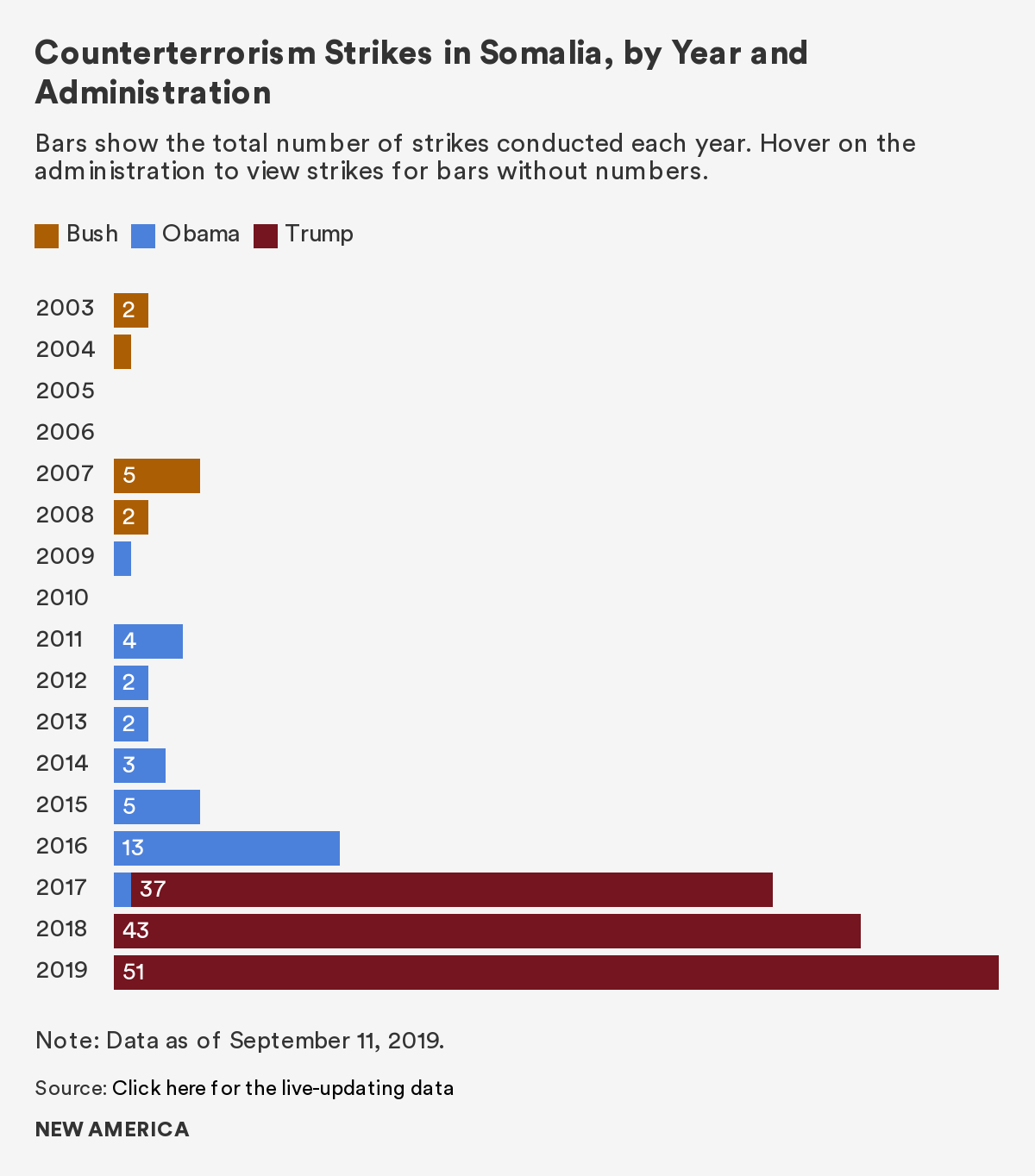
This year in Somalia, the Trump administration has further escalated strikes, continuing what was an already unprecedented escalation last year. In 2018, The United States carried out 43 strikes鈥攅ither air strikes or ground raids鈥攁nd through September 11, 2019, there have been at least 51 strikes, surpassing any other year recorded by 国产视频. The United States is on track to have more casualties from these strikes than any other year recorded. In 2018, the United States killed between 350 and 40873 people according to 国产视频鈥檚 database, the highest number recorded since the U.S. air campaign in Somalia began. So far in 2019, the United States has reportedly killed between 326 and 357 people. Between three and four of these deaths involved people whose combatant status is unknown or disputed.
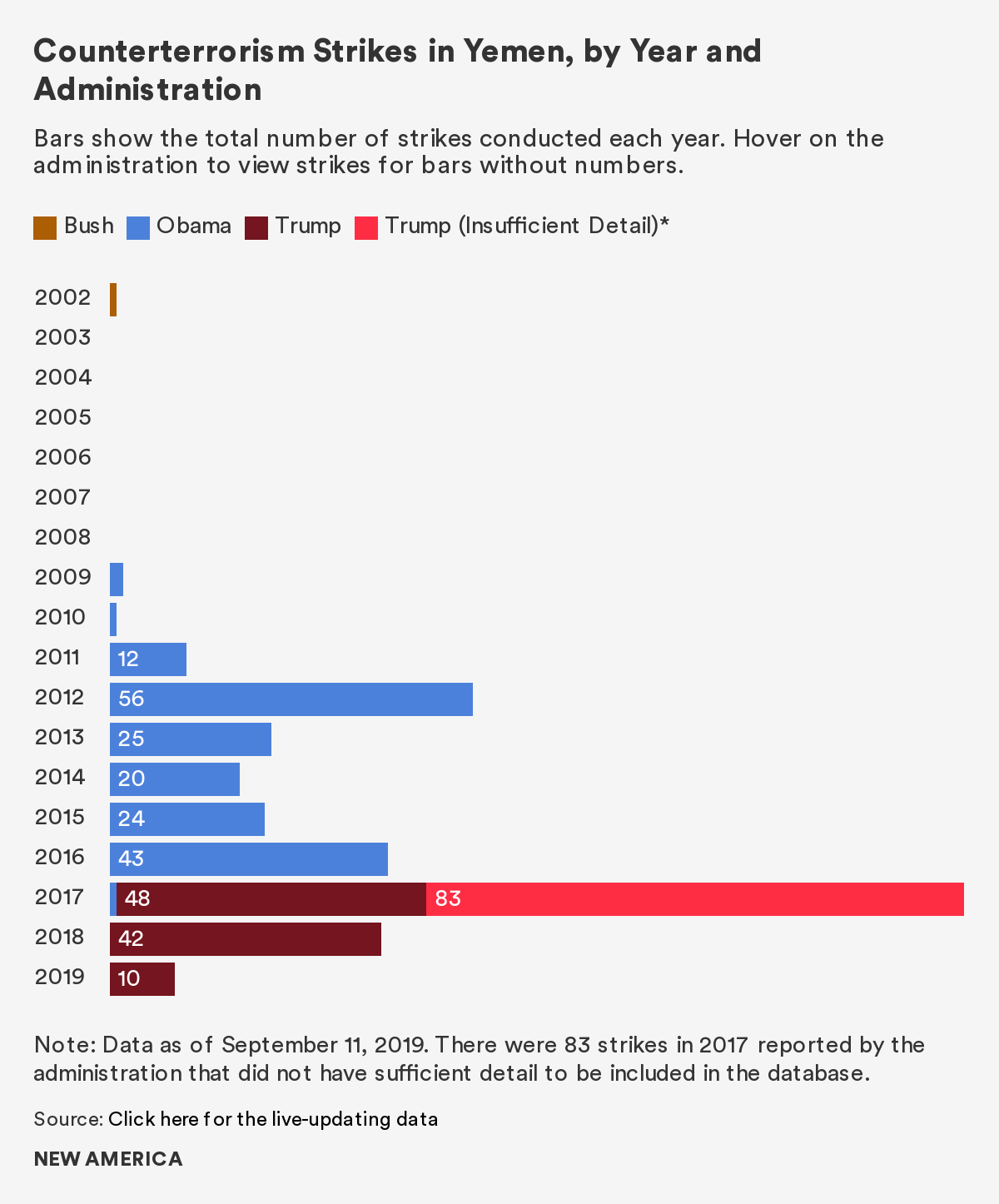
In its first year in office, the Trump administration also escalated the counterterrorism war in Yemen. However, in the past two years, the pace of strikes has substantially fallen from that peak. As of September 11, 2019, the United States has conducted ten strikes in Yemen, according to 国产视频. The United States had conducted 40 strikes by September 11, 2018 (and 42 in the entire year), according to 国产视频. In 2017, CENTCOM stated it conducted at least 131 strikes in Yemen.74 One caution regarding the apparent decline is it is possible the United States is conducting covert strikes in Yemen or relying upon Saudi Arabia, the United Arab Emirates, or other partner nations to conduct counterterrorism strikes. There have been multiple strikes attributed to the United States in recent years that CENTCOM does not acknowledge carrying out.75
Despite the substantial changes and escalation under Trump in Somalia, there should be caution in attributing the escalating strikes to 国产视频 decision style. The campaigns in Yemen and Somalia had begun escalating鈥攁lthough to lesser extents鈥攗nder the Obama administration.76
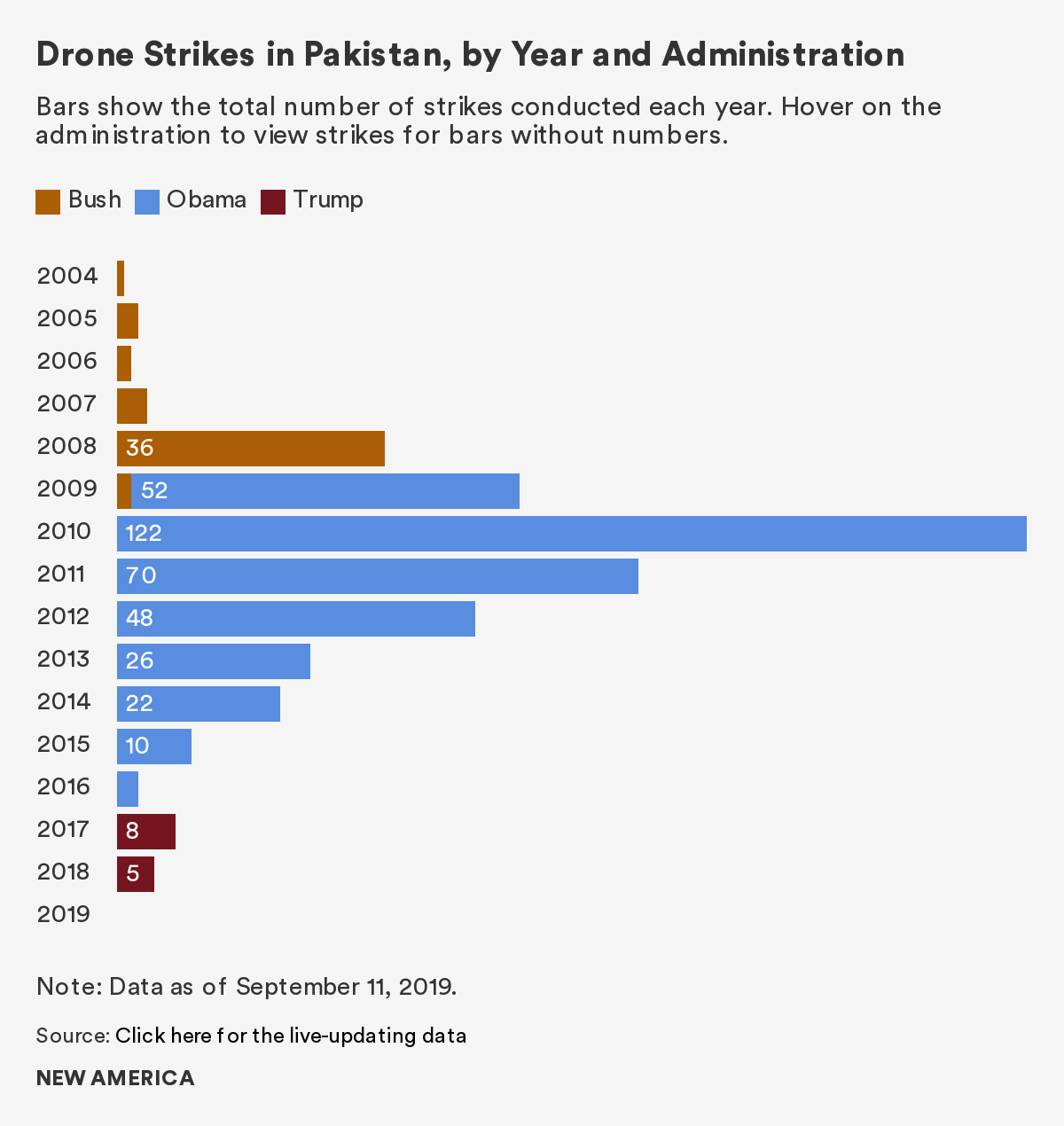
Moreover, the Trump administration has not substantially escalated the drone war in Pakistan.77 Instead, under Trump, the war in Pakistan has seen its longest halt since the campaign began, with Pakistan marking a full year without a drone strike on July 4, 2019.78 In 2018, the Trump administration conducted a total of five strikes, compared to the total of eight strikes in 2017. Over its entire term so far, the Trump administration has conducted far fewer than the 122 strikes the Obama administration conducted in a single year at the peak of the drone campaign in Pakistan in 2010.
There are many possible reasons for the decline in strikes in Pakistan. One likely key factor is that the United States now has far fewer troops in Afghanistan than it did in 2010 and thus less need to carry out strikes to protect its forces. Another likely key factor is that Pakistan carried out a major military operation in its northwest tribal regions in 2015 that drove many militants into Afghanistan and killed others, reducing the number of militant targets in Pakistan. Both of these factors illustrate the importance of matters beyond the Trump administration鈥檚 policy changes in the conduct of the drone war.
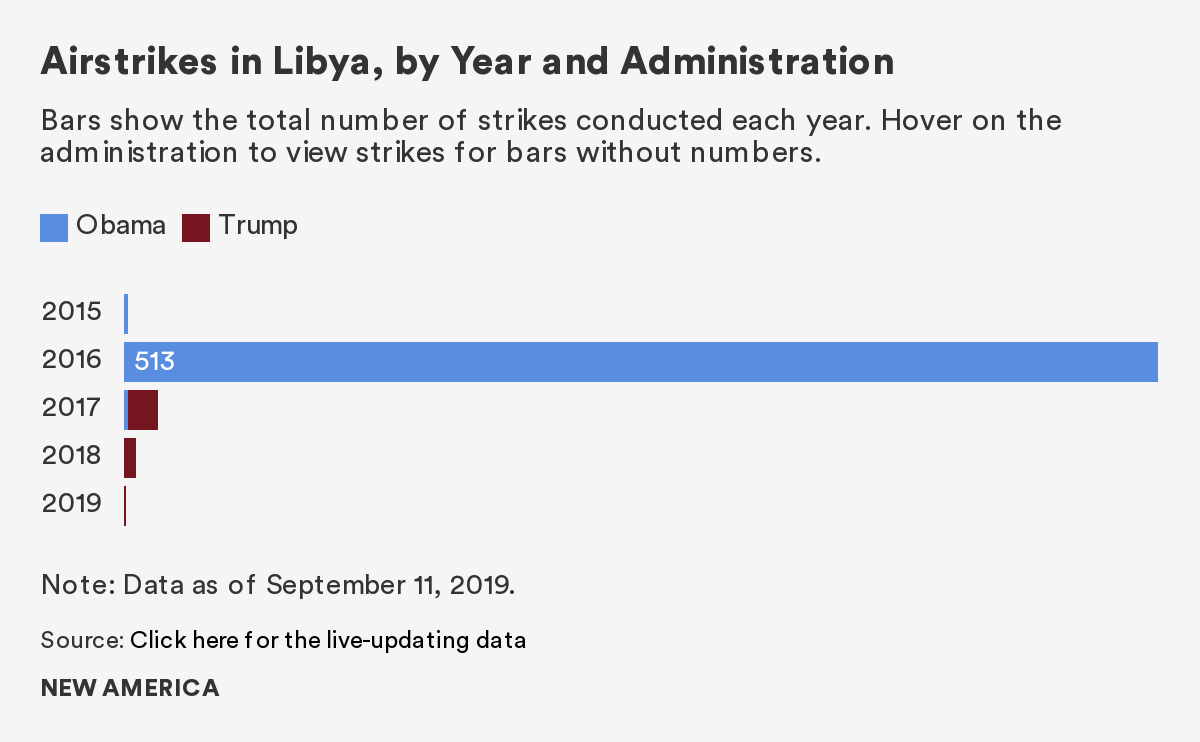
In Libya, the Obama administration carried out a major escalation of airstrikes in 2016, conducting 513 strikes, up from only two in 2015, according to research by 国产视频 and Airwars.79 This major escalation was the result of a decision in the second half of 2016 to authorize strikes against ISIS in and around Sirte, Libya.80 In contrast, under Trump, the number of strikes in Libya fell in 2018 to only six strikes, and one strike in 2019 as of September 11, according to 国产视频 and Airwars research.81

Citations
- We define jihadist to include those who are motivated by or directly support those motivated by versions of Osama bin Laden鈥檚 global ideology. We do not include Hamas, Hezbollah, or similar groups that do not follow bin Laden鈥檚 ideology.
- U.S. Central Command, 鈥淐oalition, Partner Forces Liberate Last Territory Held by Daesh,鈥� press release no. 20190323-01, March 23, 2019,
- The Islamic State of Iraq and Syria is referred to by several names in the literature, including ISIL, Daesh, IS, or the Islamic State. Throughout this paper we use ISIS except when a quoted passage utilizes a different term.
- Anne Barnard and Hwaida Saad, 鈥淩aqqa, ISIS 鈥楥apital,鈥� Is Captured, U.S.-Backed Forces Say,鈥� The New York Times, October 17, 2017,
- Mustafa Salim and Tamer El-Ghobashy, 鈥淚raqi Forces Retake Last Town under Islamic State Control,鈥� Washington Post, November 17, 2017,
- 鈥淭wenty-First Report of the Analytical Support and Sanctions Monitoring Team Submitted Pursuant to Resolution 2368 (2017) Concerning ISIL (Da鈥檈sh), Al-Qaida and Associated Individuals and Entities鈥� (United Nations Analytical Support and Sanctions Monitoring Team, January 17, 2018),
- Rukmini Callimachi, 鈥淚SIS Caliphate Crumbles as Last Village in Syria Falls,鈥� The New York Times, March 23, 2019,
- Peter Bergen, 鈥淚s the Fall of Mosul the Fall of ISIS?,鈥� CNN, July 11, 2017,
- Callimachi, 鈥淚SIS Caliphate Crumbles as Last Village in Syria Falls.鈥�
- 鈥淭wenty-First Report of the Analytical Support and Sanctions Monitoring Team.鈥�
- 鈥淭errorism Situation and Trend Report 2019 (TE-SAT)鈥� (EUROPOL, 2019),
- 鈥淭wenty-Third Report of the Analytical Support and Sanctions Monitoring Team Submitted Pursuant to Resolution 2368 (2017) Concerning ISIL (Da鈥檈sh), Al-Qaida and Associated Individuals and Entities鈥� (United Nations Analytical Support and Sanctions Monitoring Team, January 15, 2019),
- 鈥淭errorism Situation and Trend Report 2019 (TE-SAT)鈥�; 鈥淭wenty-First Report of the Analytical Support and Sanctions Monitoring Team.鈥�
- 鈥淭wenty-First Report of the Analytical Support and Sanctions Monitoring Team.鈥�
- 鈥淭wenty-Third Report of the Analytical Support and Sanctions Monitoring Team.鈥�
- Daniel Milton and Muhammad al-鈥橴baydi, 鈥淭he Fight Goes On: The Islamic State鈥檚 Continuing Military Efforts in Liberated Cities鈥� (West Point: Combating Terrorism Center, June 2017), ; Brian Fishman, 鈥淩edefining the Islamic State鈥� (国产视频, August 18, 2011), source
- Nate Rosenblatt and David Kilcullen, 鈥淗ow Raqqa Became the Capital of ISIS: A Proxy Warfare Case Study鈥� (国产视频, July 25, 2019), source
- Jennifer Cafarella, Brandon Wallace, and Jason Zhou, 鈥淚SIS鈥� Second Comeback: Assessing the Next ISIS Insurgency鈥� (Institute for the Study of War, July 23, 2019),
- Douglas Ollivant and Bartle Bull, 鈥淚raq After ISIS: What To Do Now鈥� (国产视频, April 24, 2018), source; After ISIS: What Is next in the Middle East (Future of War Conference: 国产视频, 2018),
- David Sterman and Nate Rosenblatt, 鈥淎ll Jihad Is Local: Volume II ISIS in North Africa and the Arabian Peninsula鈥� (国产视频, April 5, 2018), source
- Roshni Kapur, 鈥淪ri Lanka鈥檚 Easter Sunday Bombings: Moving Forward,鈥� Middle East Institute (blog), May 7, 2019, ; Amarnath Amarasingam, 鈥淭errorism on the Teardrop Island: Understanding the Easter 2019 Attacks in Sri Lanka,鈥� CTC Sentinel 12, no. 5 (June 2019),
- Jeffrey Gettleman, Dharisha Bastians, and Mujib Mashal, 鈥淚SIS Claims Sri Lanka Attacks, and President Vows Shakeup,鈥� The New York Times, April 23, 2019,
- Ethirajan, Anbarasan. "Sri Lanka Attacks: The Family Networks behind the Bombings." BBC News, May 11, 2019.
- 鈥淣inth Report of the Secretary-General on the Threat Posed by ISIL (Da鈥檈sh) to International Peace and Security and the Range of United Nations Efforts in Support of Member States in Countering the Threat鈥� (United Nations Security Council, July 31, 2019),
- Amarasingam, 鈥淭errorism on the Teardrop Island: Understanding the Easter 2019 Attacks in Sri Lanka.鈥�
- Jin Wu, Derej Watkins, and Rukmini Callimachi, 鈥淚SIS Lost Its Last Territory in Syria. But the Attacks Continue,鈥� New York Times, March 23, 2019,
- 鈥淭wenty-Third Report of the Analytical Support and Sanctions Monitoring Team.鈥�
- Jesse Morton and Mitchell Silber, 鈥淔rom Revolution Muslim to Islamic State: An Inside Look at the American Roots of ISIS鈥� Virtual Caliphate鈥� (国产视频, June 4, 2018), source
- 鈥淭wenty-Third Report of the Analytical Support and Sanctions Monitoring Team.鈥�
- Steve Wembi and Joseph Goldstein, 鈥淚SIS Claims First Attack in the Democratic Republic of Congo,鈥� New York Times, April 19, 2019, ; Rukmini Callimachi, 鈥淚SIS, After Laying Groundwork, Gains Toehold in Congo,鈥� New York Times, April 20, 2019,
- For a discussion of these risks see, for example: Daveed Gartenstein-Ross and Nathaniel Barr, 鈥淣either Remaining Nor Expanding: The Islamic State鈥檚 Global Expansion Struggles,鈥� War on the Rocks, February 23, 2016,
- Lachlan Wilson and Jason Pack, 鈥淭he Islamic State鈥檚 Revitalization in Libya and Its Post-2016 War of Attrition,鈥� CTC Sentinel 12, no. 3 (March 2019),
- Wilson and Pack; 鈥淭wenty-Third Report of the Analytical Support and Sanctions Monitoring Team.鈥�
- 鈥淭wenty-Third Report of the Analytical Support and Sanctions Monitoring Team.鈥�
- Kyle Rempfer, 鈥淯S Killed No. 2 Leader of ISIS-Somalia, Officials Say,鈥� Air Force Times, April 15, 2019,
- Ehsan Popalzai, Ryan Browne, and Eric Levenson, 鈥淚SIS Leader in Afghanistan Killed in Airstrike, US Says,鈥� CNN, August 26, 2018,
- For one discussion of terrorist group longevity, see: Jodi Vittori, 鈥淎ll Struggles Must End: The Longevity of Terrorist Groups,鈥� Contemporary Security Policy 30, no. 3 (December 2009): 444鈥�66,
- Bryony Jones, Clarissa Ward, and Salma Abdelaziz, 鈥淎l-Nusra Rebranding: New Name, Same Aim? What You Need to Know,鈥� CNN, August 7, 2016,
- 鈥淭ahrir Al-Sham: Al-Qaeda鈥檚 Latest Incarnation in Syria,鈥� BBC, February 28, 2017,
- 鈥淭he Best of Bad Options for Syria鈥檚 Idlib,鈥� Middle East Report (International Crisis Group, March 14, 2019), ; Tore Refslund Hamming and Pieter Van Ostaeyen, 鈥淭he True Story of Al-Qaeda鈥檚 Demise and Resurgence in Syria,鈥� Lawfare, April 8, 2018,
- Suleiman Al-Khalidi, 鈥淯.S. Says 鈥楪rave鈥� Consequences If Syria鈥檚 Al Qaeda Dominates Idlib Province,鈥� Reuters, August 2, 2017,
- See, for example: Charles Lister, 鈥淗ow Al-Qa`ida Lost Control of Its Syrian Affiliate: The Inside Story,鈥� CTC Sentinel, February 2018, ; Seth Jones, Charles Vallee, and Maxwell B. Markusen, 鈥淎l Qaeda鈥檚 Struggling Campaign in Syria鈥� (CSIS, April 2018), ; Hamming and Ostaeyen, 鈥淭he True Story of Al-Qaeda鈥檚 Demise and Resurgence in Syria.鈥�
- Hamming and Ostaeyen, 鈥淭he True Story of Al-Qaeda鈥檚 Demise and Resurgence in Syria.鈥�
- Al-Qaeda in the Arabian Peninsula, or AQAP, trained two brothers in Yemen in 2011 who, more than three years later, attacked the Paris offices of Charlie Hebdo, a satirical magazine. It is far from clear if AQAP had any real role in directing this attack beyond providing training years before the attack took place. For more on this attack see: Maria Abi-Habib, Margaret Coker, and Hakim AlMasmari, 鈥淎l Qaeda in Yemen Claims Responsibility for Charlie Hebdo Attack,鈥� Wall Street Journal, January 14, 2015, .
- Bruce Hoffman, 鈥淭he Coming ISIS鈥揳l Qaeda Merger,鈥� Foreign Affairs, March 29, 2016,
- 鈥淭wenty-Third Report of the Analytical Support and Sanctions Monitoring Team.鈥�
- 鈥淭wenty-Fourth Report of the Analytical Support and Sanctions Monitoring Team Submitted Pursuant to Resolution 2368 (2017) Concerning ISIL (Da鈥檈sh), Al-Qaida and Associated Individuals and Entities鈥� (United Nations Analytical Support and Sanctions Monitoring Team, July 15, 2019), ; Julian E. Barnes, Adam Goldman, and Eric Schmitt, 鈥淪on of Qaeda Founder Is Dead,鈥� New York Times, July 31, 2019,
- Examining the Global Terrorism Landscape, Subcommittee on Middle East, North Africa and International Terrorism (Committee on Foreign Affairs) Cong., 1-12 (2019) (testimony of Ali Soufan).
- This draws on: Peter Bergen, 鈥淣ormandy, Istanbul, Dhaka, Nice, Baghdad, Orlando: WHY?鈥� CNN, July 26, 2016,
- Seth G. Jones et al., 鈥淭he Evolution of the Salafi-Jihadist Threat鈥� (CSIS, November 2018),
- Sam Heller, 鈥淩ightsizing the Transnational Jihadist Threat,鈥� Intenational Crisis Group (blog), December 12, 2018,
- Peter Bergen, 鈥湽悠� Smart Call on Iran,鈥� CNN, June 22, 2019, ; Peter Bergen, 鈥淗ow Donald Trump Created One Hell of a Mess with Iran,鈥� CNN, June 21, 2019,
- Joshua Berlinger et al., 鈥淚ran Shoots down US Drone Aircraft, Raising Tensions Further in Strait of Hormuz,鈥� CNN, June 20, 2019,
- Michael D. Shear et al., 鈥淪trikes on Iran Approved by Trump, Then Abruptly Pulled Back,鈥� The New York Times, June 20, 2019,
- Jon Gambrell and Amir Vahdat, 鈥淚ran Breaches Uranium Stockpile Limit Set by Nuclear Deal,鈥� AP, July 1, 2019, ; Erin Cunningham, 鈥淚ran Surpasses Uranium Enrichment Limit in Its First Major Breach of Nuclear Deal,鈥� Washington Post, July 8, 2019,
- Candace Rondeaux and David Sterman, 鈥淭wenty-First Century Proxy Warfare: Confronting Strategic Innovation in a Multipolar World鈥� (国产视频, February 20, 2019), source
- Douglas Ollivant and Erica Gaston, 鈥淭he Problem with the Narrative of 鈥楶roxy War鈥� in Iraq,鈥� War on the Rocks, May 31, 2019,
- Bergen, 鈥淗ow Donald Trump Created One Hell of a Mess with Iran.鈥�
- Peter Bergen, 鈥淛ohn Bolton Is Donald 国产视频 War Whisperer,鈥� CNN, May 16, 2019,
- Jesse Morton and Amarnath Amarasingam, 鈥淗ow Jihadist Groups See Western Aggression Toward Iran,鈥� Just Security, April 16, 2018,
- Daveed Gartenstein-Ross and Varsha Koduvayur, 鈥淗ow to Win Friends and Wage Jihad,鈥� Foreign Affairs, July 1, 2019,
- Peter Bergen, 鈥湽悠� Art of the Giveaway,鈥� CNN, November 25, 2018,
- 鈥淎nnex to the Report of the Special Rapporteur on Extrajudicial, Summary or Arbitrary Executions: Investigation into the Unlawful Death of Mr. Jamal Khashoggi鈥� (United Nations Special Rapporteur on Extrajudicial, Summary, or Arbitrary Executions, June 19, 2019),
- Peter Bergen, 鈥淭he Global Fallout from the Khashoggi Murder Is Bad News for the Saudis,鈥� CNN, November 1, 2018,
- Ben Hubbard, David D. Kirkpatrick, Kate Kelly, and Mark Mazzetti, 鈥淪audis Said to Use Coercion and Abuse to Seize Billions,鈥� The New York Times, March 11, 2018,
- Mark Mazzetti and Ben Hubbard, 鈥淚t wasn鈥檛 Just Khashoggi: A Saudi Prince鈥檚 Brutal Drive to Crush Dissent,鈥� The New York Times, March 17, 2019,
- Those countries are Afghanistan, Iraq, Syria, Yemen, Libya, and Somalia.
- Exec. Order. No. 13,862, 84 C.F.R.8789, March 6, 2019,
- Charlie Savage, "Trump Revokes Obama-Era Rule on Disclosing Civilian Casualties From U.S. Airstrikes Outside War Zones," The New York Times, March 06, 2019,
- United States Africa Command, June 26, 2019, accessed July 01, 2019,
- John Vandiver, 鈥淐ivilian Deaths in Somalia Airstrike Weren鈥檛 Reported Properly, AFRICOM Says,鈥� Stars and Stripes, April 5, 2019,
- David Sterman, 鈥淐ENTCOM Improves Transparency of Yemen War Civilian Casualties, But Gaps Remain,鈥� Just Security, January 28, 2019, ; David Sterman, 鈥淔our Policies Candidates Can Embrace Today on America鈥檚 Counterterrorism Wars,鈥� 国产视频 (blog), June 25, 2019, source
- 国产视频鈥檚 data includes a range of casualties reported for militants, civilians, and unknown. Of the 350-408 people killed in 2018, the combatant status of nine was unknown or disputed, and between two and six were civilians.
- Courtney Kube, Robert Windrem, and William M. Arkin, 鈥淯.S. Airstrikes in Yemen Have Increased Sixfold under Trump,鈥� NBC, February 1, 2018,
- Sterman, 鈥淐ENTCOM Improves Transparency of Yemen War Civilian Casualties, But Gaps Remain.鈥�
- This section draws upon: David Sterman, 鈥淐an the Next Presdient Dismantle an Inherited Drone War,鈥� Fellow Travelers (blog), April 4, 2019,
- This section draws upon David Sterman, 鈥淭he Drones in Pakistan Are Silent,鈥� 国产视频, June 13, 2018, source and Melissa Salyk-Virk, 鈥淯.S. Drone Strike Hits Pakistan鈥檚 FATA Region After Nearly Five Months,鈥� 国产视频, July 6, 2018, source
- David Sterman, 鈥淧akistan Set to Mark One Year with No U.S. Drone Strikes: Is the War Over?,鈥� 国产视频 (blog), July 3, 2019, source
- Peter Bergen et al., 鈥淎irstrikes and Civilian Casualties: Libya,鈥� 国产视频, source
- Peter Bergen and Alyssa Sims, 鈥淎irstrikes and Civilian Casualties in Libya,鈥� New America, June 20, 2018. source
- "Airstrikes and Civilian Casualties: Libya," America鈥檚 Counterterrorism Wars, accessed September 11, 2019, source