Lisa Guernsey
Senior Director, Birth to 12th Grade Policy; Co-Founder and Director, Learning Sciences Exchange
Part 2: The Context Behind the Woodson Collaborative

Note: This is the second of a two-part series. Part 1 can be found here.
Teaching any subject has its challenges, but getting students to care about history is a special case. In an age of live-streamed news and celebrity tweets, the events and uprisings of the past are, by definition, old news. Scores from the National Assessment of Educational Progress show that American students aren鈥檛 absorbing much from their history classes, with only 15 percent of eighth graders testing at or above proficient in U.S. history, a drop from four years prior.[1] To help their students do better, effective teachers know they have to make history worth their while.
Research shows that students retain more when the materials in their lessons are relevant to their lives and inclusive of their diverse cultures and backgrounds.[2] Yet the textbooks and lesson plans of a decade ago can seem out-of-date, especially as many Americans have recently gained a greater awareness of whose stories were left out of the history classes of their youth. In the summer of 2020, after George Floyd鈥檚 killing, for example, many of them became primed to better recognize racial injustice in the United States. Soon after, the story of the 100-year anniversary of the 1921 Tulsa Race Massacre started to make headlines, and the questions followed: How is it that these events were not part of the national narrative? How could this have been hidden from history?
Many educators have wondered the same. Some are now on a quest to find information that captures historical events and figures in ways that resonate with their students. Where can they find educational materials that bring a fuller picture of America鈥檚 story, including more diverse heroes, to their classrooms? What materials should they use?
Textbooks and lesson plans of a decade ago can seem out-of-date, especially as many Americans have recently gained a greater awareness of whose stories were left out of the history classes of their youth.
In addition, the COVID-19 pandemic made clear that teachers need online materials and cannot rely solely on printed textbooks. So not only are teachers seeking more accurate resources that explain our country鈥檚 history, and not only are they seeking to include the perspectives of people overcoming injustice, but they also need these materials to exist in digital form. They need them to be easily accessible and shareable with students, not to mention parents who want to better understand what is being taught.[3]
In 2021, an online hub opened for teachers across the state of Virginia: The Dr. Carter G. Woodson Collaborative. It was developed during the pandemic by educators, historians, and social studies specialists to include resources from 29 museums and other education organizations from nearly all corners of Virginia. It is rooted in findings from a landmark state commission on how to improve the teaching of African American history. It offers openly licensed educational resources about African American history. And it is free to educators, families, and interested individuals around the world.
The Woodson Collaborative and its attributes are described in Part 1 of this series of briefs. Part 1 was written to show what can be learned from the Woodson Collaborative model, helping education leaders across the country see new ways to address problems related to the teaching of complex subjects and the need for high-quality curricular materials.
Part 2 sets the Woodson Collaborative inside a much larger story, one that has been unfolding in Virginia over more than 100 years, but also in other states and localities, as educators and education leaders work to ensure that students are taught a more comprehensive and accurate history of the U.S. It explains not only how the Collaborative came to be, but also why its existence matters. This part of the report shows that it is possible to create and curate materials that can help teachers鈥攏ot to mention parents, family members, and whole communities鈥攆ind materials for learning about, discussing, and exploring our past to help us understand our future.
The roots of the Woodson Collaborative go back decades, as educators across the Commonwealth of Virginia have been trying to improve the textbooks that, in the days before the internet, served as the gateway for students to learn history. Those textbooks have been the subject of serious scholarship for Virginia teachers and historians who see the importance of telling a fuller and more factual history of what has transpired over the past 400 years.
Virginia is known for its poor track record in providing students with accurate textbooks about what happened before, during, and after the Civil War. The myth of the Lost Cause (a romanticized interpretation of the war told from the Confederate point of view) has a lingering hold in the state. Its capital, Richmond, was the capital of the Confederacy, and Robert E. Lee, the general on the Confederate side, was a Virginian. In the 1890s and early 1900s, as Confederate ancestry groups erected statues of Confederate soldiers throughout the South, groups like the United Daughters of the Confederacy developed educational materials to ensure their children and their children鈥檚 children would learn about the bravery of Confederate soldiers and be 鈥渓iving monuments鈥� of the Lost Cause.[4]
James McPherson, author of the Pulitzer-winning Battle Cry of Freedom and many other books about the Civil War, labels these efforts the beginning of the 鈥淪outhern Textbook Crusade.鈥� One textbook he cites is A School History of the United States, written by Susan Pendleton Lee, a Virginian. He quotes Lee as writing that Southern people knew that 鈥渢he evils connected with [slavery] were less than any other menial class of labor鈥� and that 鈥渢he kindest relations existed between slaves and their owners.鈥漑5]
Words like this, McPherson says, were written to counter the 鈥淵ankee lies鈥� being told in textbooks published in the North.[6] Throughout the early 1900s, Virginia students were not supposed to see those Northern-published textbooks. In fact, when students at Roanoke College in Salem, VA came across a history book by a Northern writer who had labeled the war 鈥渢he slaveholder鈥檚 rebellion,鈥� they held a protest. As McPherson recounts, 鈥�The Roanoke Times thundered: 鈥榃e would like to see a fire kindled on the campus and every copy of the book formally and carefully committed to the flames.鈥欌�� The newspaper declared it was 鈥減oison鈥� to have students taught that 鈥渢he soldiers of the Confederacy fought to maintain human slavery.鈥漑7] Even through the mid-1950s, elected officials in Virginia were still trying to ensure that students were taught Confederate interpretations of history, imbued with stories that might help students understand why Black and White students were required to attend segregated schools.
Carol Sheriff, a historian at the College of William & Mary, and a parent, has documented how the Virginia Department of Education in the 1950s commissioned textbooks that evoked the 鈥淰irginia spirit鈥� and emphasized 鈥渉ow antebellum slavery supposedly created bonds of affection and dependence between owner and slave.鈥漑8] The intent, Sheriff writes, was to shape young minds in the midst of Virginia鈥檚 massive resistance to desegregation. As she puts it, 鈥渢he textbooks imply that segregation, too, had its benefits for both races a century later.鈥漑9]
These textbooks did have an effect. Ty Seidule, a retired U.S. Army brigadier general and the first professor emeritus of history at West Point, provides a detailed account of how these textbooks affected him. In his book Robert E. Lee & Me: A Southerner鈥檚 Reckoning with the Myth of the Lost Cause, Seidule describes growing up in Alexandria, VA, in the 1960s and 鈥�70s, reading these books, with 鈥渞esplendent鈥� pictures of Robert E. Lee and little reckoning with the horrors of slavery. Years later, while researching his book, he reviewed the textbooks he grew up with.
I read through the Virginia history textbook with disbelief, followed by profound anger. I checked the publishing data: first edition 1957; second edition and the one I read 1964. All the lies of the Lost Cause myth in one convenient package to inculcate Virginia children, like me, with the same racist ideology: states鈥� rights and tariffs as the cause of the Civil War; the evils of Reconstruction; the heroism of the Confederate soldier; the righteousness of the cause; the godliness of the Virginia way of life; and of course, Lee as god.[10]
By the late 1960s, textbooks titled the Virginia Histories were being lambasted for bias, and according to Sheriff, 鈥渁 public protest emerged over the state鈥檚 unabashedly pro-Confederate textbooks.鈥漑11] By 1972 they were 鈥渄ecommissioned鈥� and by the late 1970s most were no longer used in the public schools.
Yet that was not the end of Virginia鈥檚 textbook saga. One reason Sheriff was digging into the history of Virginia鈥檚 textbooks is because, in 2010, her daughter came home with one used for fourth grade Virginia Studies classes across the Commonwealth. As she opened up Our Virginia, published by Five Ponds Press, Sheriff says she found 鈥渁mple reason to worry that [it] would misinform and confuse children about the Civil War.鈥� She describes one of the biggest mistakes she discovered:
Under a subheading of 鈥淭he Virginia Confederates,鈥� the book tells children: 鈥淭housands of Southern blacks fought in the Confederate ranks, including two black battalions under the command of Stonewall Jackson.鈥� To my knowledge, not a single piece of peer-reviewed scholarship contends that blacks served in such large numbers as soldiers (rather than laborers) in the Confederate army or that Stonewall Jackson commanded black soldiers (rather than black laborers).[12]
When they learned about the inclusion of this false claim about Stonewall Jackson in Our Virginia, McPherson and other historians denounced it. McPherson warned that its inclusion in the textbook is another example of Confederate heritage groups trying to purge their association with slavery.[13]
When the Virginia Department of Education approved Our Virginia for fourth graders, Sheriff writes, it appears that no historians reviewed the book. The author was not a historian either.[14] Sheriff wrote about the misinformation in an op-ed for The Washington Post that turned into a front-page news story and captured the attention of national media outlets.[15] State education officials instructed districts to avoid that passage or use different materials. But starting over again and finding new textbooks was not easy. 鈥淢ost districts,鈥� Sheriff wrote, 鈥渉aving just bought new textbooks in 2010, can no longer afford to purchase alternative texts from a different publisher.鈥漑16] Eventually the department approved a revised version of the textbook, but historians complained that errors still existed in that and other books from Five Ponds Press and asked why the department continued to contract with that publisher.[17]
In reflecting a few years later on how to prevent misinformation seeping into textbooks, Sheriff wrote:
At first, the remedy seemed clear: Historians must be directly involved in the process of creating children鈥檚 textbooks, and the state must commission content experts to review all textbooks that it approves. But once I began looking into Virginia鈥檚 history of embattled textbooks, I began wavering in my convictions.[18]
What gave her pause was what she had uncovered about Virginia's textbook commissions of the 1950s, with state officials choosing Southern historians who exhibited the 鈥淰irginia spirit鈥� over non-Southern historians who had a broader, and not always flattering, perspective on the state鈥檚 role in history. Simply bringing in state-level experts, she realized, may not lead to accurate educational materials if those experts have their own biases; it would be naive to assume that all the government officials approving the textbooks are devoid of a political agenda.
By 2019, nine years after the discovery of the problem in the Virginia Studies textbooks, more and more people in Virginia had come to realize there had to be a smarter way to develop history materials for K鈥�12 students.[19] The governor of Virginia at the time, Ralph Northam, was among them, spurred in part by a scandal in which photos emerged that apparently showed him in blackface in an old medical school yearbook. [20] As part of his attempt to atone for that behavior and learn more about African American history, the governor set up the Virginia Commission on African American History Education in the Commonwealth.[21] This commission鈥攚hich included teachers, historians, museum educators, curriculum specialists, school administrators, community members, and parents representing a variety of racial and ethnic identities鈥攚as charged with coming up with recommendations for the state's education system. The aim was to tell a more accurate version of African American history and ensure that the lessons taught in classrooms recognized the contributions of Black Virginians over hundreds of years.
鈥淭he full history of Virginia is complex, contradictory, and often untold,鈥� Northam said in 2019, 鈥渁nd we must do a better job of making sure that every Virginia graduate enters adult life with an accurate and thorough understanding of our past, and the pivotal role that African Americans have played in building and perfecting our Commonwealth.鈥漑22]
The commission held meetings in cities and towns across Virginia. More than 300 people, including parents and students, had attended these sessions in 2020, before the COVID-19 pandemic started. During the early days of the pandemic, online meetings resumed the conversation, and surveys were distributed to collect comments. Meetings were open to the public. Additional written comments were collected digitally and put in a public Dropbox folder. By August of that year, the commission published a 78-page report with a series of recommendations on how to improve the teaching of history and social studies in Virginia鈥檚 schools, from kindergarten through high school.[23]
The Virginia African American History Education Commission released its final report and recommendations on August 31, 2020, 10 months after it was established by Governor Northam as part of the commemoration of the 400th anniversary of the arrival of enslaved Africans. The final report stated: 鈥淏lack people in Virginia endured not only decades of enslavement but also Jim Crow terror and discrimination, Massive Resistance, and modern-day iterations and remnants of government sanctioned Black oppression. Virginia has failed to fully represent African Americans in its history, contributing to a legacy of racism that has seeped into systems that impact every individual and every aspect of American life, including our classrooms.鈥�
Three high-level recommendations emerged from the commission鈥檚 work:
Other outcomes from the commission include the creation of a high school elective course in African American history[24] and the enactment of legislation requiring teachers to gain professional development in cultural competency.[25]
One of the report鈥檚 recommendations was to update Virginia鈥檚 academic standards, known as the Standards of Learning, or SOLs. These standards, which are written for subjects in each grade level, lay out what students should learn to be considered knowledgeable about a particular subject area. One objective of these standards is to ensure all students get an equal and rigorous dose of American history; they lay out for teachers the full breadth and depth of content that students need to know. The state standards set the foundation for curriculum frameworks, which are documents aligned with the standards to provide specifics on which facts, figures, and concepts teachers should bring into their courses. The standards and frameworks also suggest which topics will appear on state standardized tests.
The social studies standards for K鈥�12 students in Virginia were last approved and published in 2015. Since state law says standards must be reviewed on a seven-year cycle, the commissioners knew when they met in 2020 that they had an opportunity to fix omissions in the social studies standards related to African American history in time for the fuller process that was expected in 2022. A subcommittee took on that work, looking at each standard, grade by grade and line by line. A work group focused on the curriculum frameworks and suggested technical edits. It was led by Edward L. Ayers, president emeritus of the University of Richmond and a humanities professor who won a Humanities Medal of Freedom for his work to make history accessible.
On October 15, 2020, those technical edits were approved by the Virginia Board of Education in a unanimous roll-call vote.[26]
What was edited, exactly? In one example, sections on slavery include a deeper recognition of the role of Virginia in establishing slavery across all of the colonies, starting in the early 1600s. For example, this statement is added as information that high school students taking U.S. history should know: 鈥淓ach of the colonial governments used Virginia's Slave Codes as a model for restricting the rights of free blacks and for the treatment of enslaved people.鈥漑27]
The edits also refer to more African Americans from Virginia as significant figures who pushed for more equality. In the early grades, this includes figures such as Douglas L. Wilder, the first African American governor of Virginia and first African American to be elected governor in any state, as well as John Mercer Langston, the first Black congressman from Virginia. Other notable additions are more details about the accomplishments of figures from outside Virginia: Harriet Tubman, Ida B. Wells, and the Tuskegee Airmen.
No matter how comprehensive standards and curriculum frameworks might become, they are not enough to improve teaching鈥攊n fact, they are just the starting point. Teachers will need new instructional materials as well as professional training on any new concepts embedded in the standards. Even before the board approved the technical edits in October of 2020, this reality was on the mind of many social studies educators. One of those was Ma'asehyahu Isra-Ul, then an instructional specialist with the Richmond Public Schools and the current president of the Virginia Social Studies Leaders Consortium. In an interview with 国产视频, Isra-Ul said he didn鈥檛 want teachers 鈥渨alking into this brand new, without assistance or resources.鈥漑28] The technical edits would be a waste, he said, if teachers didn鈥檛 have anything to work with.
So Isra-Ul and a group of educators around Virginia teamed up to create an online library of curated and vetted materials that teachers could access easily and use at no cost. They joined forces with Jean Weller, then the technology integration specialist at the state鈥檚 department of education, who had already been developing an initiative called #GoOpenVA to help teachers find and use openly licensed educational resources (OER).[29] Another key leader for the hub was Beau Dickenson, a social studies supervisor in Rockingham County Public Schools. He was Isra-Ul鈥檚 predecessor at the Virginia Social Studies Leaders Consortium and served on the history-education commission. The Virginia Association of Museums was also a partner.
Throughout the fall of 2020, the Woodson Collaborative brought together social studies specialists from 11 different public-school districts and curators from 29 museums and educational organizations to seek and vet materials.
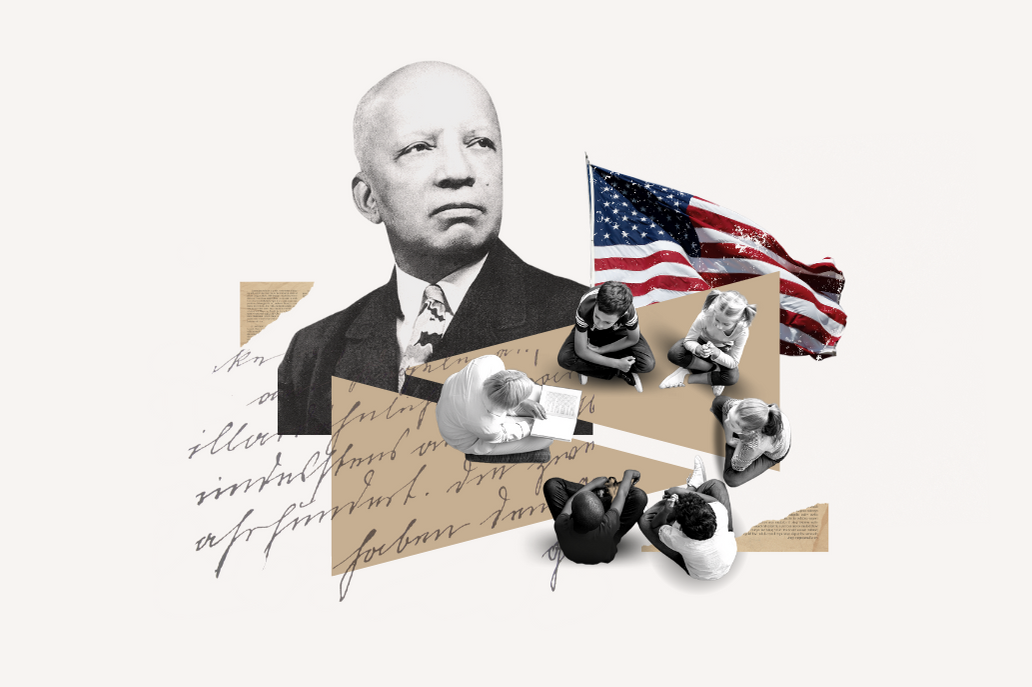
The group decided to call its effort the Dr. Carter G. Woodson Collaborative, after the Virginia scholar who started Black History Week in 1926, which evolved into the Black History Month that most Americans know well today.
The #GoOpenVA initiative gave the Woodson Collaborative a running start. During the height of the COVID-19 pandemic, the #GoOpenVA site became a critical resource for teachers seeking quality digital content they could deliver to their students online. It also helped, Weller said, that the state of Virginia had, for over a decade, required every school district to have at least one information technology resource teacher working with subject-area teachers to integrate tech into their lessons.[30] 鈥淭hat meant that many teachers were more ready for the use of digital tools and materials and knew more about OER,鈥� Weller said.[31]
Throughout the fall of 2020, the Woodson Collaborative brought together social studies specialists from 11 different public-school districts and curators from 29 museums and educational organizations to seek and vet materials. They collected and sorted documents written for teachers about how to engage students in the content鈥攕uch as writing prompts and ideas for student projects鈥攁s well as pieces of content itself, such as photographs and videos digitized by the Smithsonian and local museums, and footage from public television programs.
鈥淲e started crowdsourcing everything we had,鈥� said Anne M. Evans, co-coordinator of the Virginia Geographic Alliance and director of education and outreach for , which features learning resources for K鈥�12 teachers. 鈥淲e said, 鈥榟ere鈥檚 what we have that will help fill that content.鈥� And where there were holes, we got groups of us together to make new content, so that the day that the technical edits went live, no one could say there鈥檚 nothing to use to teach it.鈥漑32]
Dickenson says that since the pandemic called for working virtually, over Zoom and in Google Docs, across counties and cities, synchronously and asynchronously, people who ordinarily wouldn鈥檛 have been able to meet were able to collaborate. This included staff at local museums and educators with tight schedules. 鈥淲e were meeting over Zoom because we had to,鈥� Dickenson said, 鈥渂ut if we tried to do this in person, I鈥檓 not sure it would be possible and not nearly as efficient.鈥漑33]
Participants also worked with Department of Education experts to create wholly new lesson plans and instructional materials. Many Zoom meetings led to in-depth conversations over those four months about what kinds of resources teachers needed to support high-quality instruction and stimulate more student engagement. As Dickenson said, 鈥渢here are nuances in teaching hard history鈥攏ot all of it is hard history, but some of it is鈥攁nd you want to make sure that is done in a culturally responsive way that enables student voice and is responsive to what they have experienced.鈥�
By April 2021, the hub included 48 resources curated by members of the Collaborative, including the Department of Education鈥檚 history and social science department. It also included information on how to include more details about the humanity of enslaved peoples, incorporate more African American historical figures into lessons, and start to recognize the omissions in the previous standards. There is no mandate to use the hub, of course. Teachers can choose to adapt or expand the content in the hub, depending on how many weeks they might spend on a topic or how the topic connects to a local museum or event.
In November 2021, Virginia held elections for its statewide leaders. Governors in Virginia are only allowed to hold one consecutive term. The Democratic candidate to replace Governor Northam, Terry McAuliffe, lost to Republican Glenn Youngkin. As soon as he was inaugurated in January 2022, Governor Youngkin signed an executive order to ban any 鈥渄ivisive concepts鈥� being taught in schools.[34] In addition, his staff cut out any resources focused on equity from the Department of Education training manuals and teaching materials.[35] This was widely seen as a response to groups that had become alarmed about what they thought was being taught in schools. But Youngkin鈥檚 executive order also contained these words:
We must equip our teachers to teach our students the entirety of our history鈥攂oth good and bad. From the horrors of American slavery and segregation, and our country鈥檚 treatment of Native Americans, to the triumph of America鈥檚 Greatest Generation against the Nazi Empire, the heroic efforts of Americans in the Civil Rights Movement, and our country鈥檚 defeat of the Soviet Union and the ills of Communism, we must provide our students with the facts and context necessary to understand these important events.
As of this writing (March 2023), the full complement of social studies standards that were supposed to be approved by the State Board of Education in 2022 have gone through many revisions and are still not set. Although Virginia law requires academic standards to be reviewed every seven years, the process this time has been marked by multiple delays and an array of competing documents. The composition of the board changed in the summer of 2022, with five new members appointed by Governor Youngkin.
In its first meeting with new members, the board decided not to move forward with a version, made public in August, that the Department of Education had started under the previous administration. That August version had incorporated almost a year of public input, from at least seven committees, some of which included parents and students. It had already drawn more than 6,000 public comments and it was developed as a 400-page document that also included a curriculum framework. Several board members, grappling with the complexities of these standards for the first time, asked for a more manageable document.
The Youngkin administration presented a new version in November; it was 53 pages long, introduced by a six-page statement of 鈥済uiding principles,鈥� and developed through a different process that involved an outside consultant.[6] It omitted key historical figures and concepts that had been in the state standards since 2015, though some figures, such as Martin Luther King Jr., who apparently was mistakenly dropped from some pages, were added back into the document before the board meeting. The omissions in the November document led to a public outcry, with more than 75 people squeezing into the board room and dozens of speakers asking what happened to the previous version.[37]
The board asked the Virginia Department of Education to re-do the standards and send them a new version based on the November document but also incorporating the August version. Three groups outside the department decided to help. In December, the Virginia Social Studies Leaders Consortium, the Virginia Association for Supervision and Curriculum Development, and the American Historical Association worked together to weave the August and November versions into what was called a 鈥渃ollaborative鈥� document the department could use and consult.[38]
Teachers still need new instructional materials on African American history, including lesson plans, photographs, videos, primary sources, discussion prompts, and writing activities.
On January 6, 2023, the department put forward its own new version. It did not make any reference to the collaborative one.[39] In its February 2023 meeting, a divided State Board of Education, voting 5 to 3, moved the department鈥檚 version forward over the objections of nearly 50 people who came to Richmond to speak on behalf of the version developed by the three professional groups. The department, in showcasing its version at the meeting, focused on enhancements to the teaching of civil rights history. Some of the key differences between the two documents include the wording of the front matter, changes to sequencing of grade-level content, and the addition of dozens of new facts and names.
The next step is a series of six meetings (underway at the time of this report鈥檚 publication) in which members of the public are invited to provide comments on the department鈥檚 version of the standards, with the board expected to take a final vote in April after taking stock of these comments. Once that final version is approved, the department says it will develop a curriculum framework to accompany the new standards, a process that may take months.
In short, the future of Virginia鈥檚 social studies standards is still in flux. But teachers around the commonwealth are, of course, still teaching classes on social studies and American history. The 2020 technical edits to the frameworks still represent the official guidance from the department of education. That means that teachers still need new instructional materials on African American history, including lesson plans, photographs, videos, primary sources, discussion prompts and writing activities. This is what the Woodson Collaborative was designed to address. In fact, teachers everywhere, not just in Virginia, are seeking materials to update their history lessons and spark the interest of their students. As a resource built for the 21st century鈥攄erived from the input of dozens of education experts from all areas of the state, open to the public, and designed to take in feedback to help it improve and grow鈥攖he Collaborative is a robust website for helping teachers and students learn the complicated, thought-provoking, and inspiring stories of American history.
Thank you to my 国产视频 colleagues who provided invaluable guidance and reviewed various versions of these briefs, including Elena Silva, An-Me Chung, Ted Johnson, Amanda LaTasha Armstrong, Jimmeka Anderson, and Jazmyne Owens. A big thank you to Sabrina Detlef for expert editing and Mandy Dean and Fabio Murgia for their communications support. I am grateful to Laurel Sneed, executive director of the Crafting Freedom Institute, who introduced me to teachers who spoke with me about the importance of multimedia resources, on-site learning, and other forms of professional development. I also appreciate the many education leaders, teachers, and parents in Virginia and in other states who spent time with me to provide background and context for this report, as well as the many educators involved in the Woodson Collaborative who were willing to be interviewed. I also thank Joceyln Pickford and Kate Poteet of CurriculumHQ and HCM Strategists, Anne M. Evans of the Virginia Geographic Alliance and 国产视频n History, and Janna Chan of EdReports for reviewing various sections of this work for accuracy. This work would not have been possible without the generous support of the William & Flora Hewlett Foundation.
Senior Director, Birth to 12th Grade Policy; Co-Founder and Director, Learning Sciences Exchange