What Is the Role of Materials in Culturally Responsive Education?
Historically, educational spaces in the United States have privileged certain norms and ways of teaching and learning that emerged from predominantly Western European or White cultures. As a result, many educational practices that acknowledge and support communities with non-White or non-Western backgrounds have been omitted and/or erased. That has progressively changed, as teachers have integrated more inclusive practices and materials, and researchers have published more studies about these practices and materials. But while there has been progress, over the past year multicultural approaches to education, such as culturally responsive education, have been affected by misinformed references to critical race theory.1 New policies either passed, introduced, or emerging are restricting inclusive teaching practices or causing some educators to avoid materials that make references to race or ethnicity in classrooms.2
Culturally responsive education, when done well, is designed to make all students feel they are a part of the educational community. As Geneva Gay of the University of Washington explains in her 2018 book, culturally responsive teaching is an asset-based approach that uses 鈥渢he cultural knowledge, prior experiences, frames of reference, and performance styles of ethnically diverse students to make learning encounters more relevant to and effective for them.鈥�3 Culturally responsive education also builds students鈥� accurate knowledge of diverse people and their awareness of different perspectives, and uses their existing knowledge and experiences as bridges to new content. While some critics suggest culturally responsive education practices only support students who are a part of groups that are systematically marginalized, such as those based on race and ethnicity, this approach can support all students to become engaged learners in content, including White, European American students.4 With this approach to teaching and learning, educators make meaningful connections between the curriculum and home experiences, validate and incorporate students鈥� culture in the learning environment, and build on students鈥� preexisting knowledge and skills.
Rudine Sims Bishop, a professor emeritus at Ohio State University widely recognized for highlighting the value of diverse representation in children鈥檚 literature, established the concept of mirrors, windows, and sliding doors in a 1990 essay to describe the types of experiences literature offers young readers.5 She referred to materials that make connections with students鈥� daily experiences as 鈥渕irrors鈥� and materials that expose students to other contexts and cultures鈥攁nd help them acknowledge and appreciate diverse cultures鈥攁s 鈥渨indows.鈥�6 Educators, librarians, and scholars within multicultural education, like culturally responsive education and culturally sustaining pedagogy, have documented the importance of integrating materials that reflect students鈥� lives as well as expose them to new environments and experiences to support student learning.7 Scholars of educational and instructional materials have used these concepts to investigate the frequency with which social groups are presented and the portrayal of varying social groups.
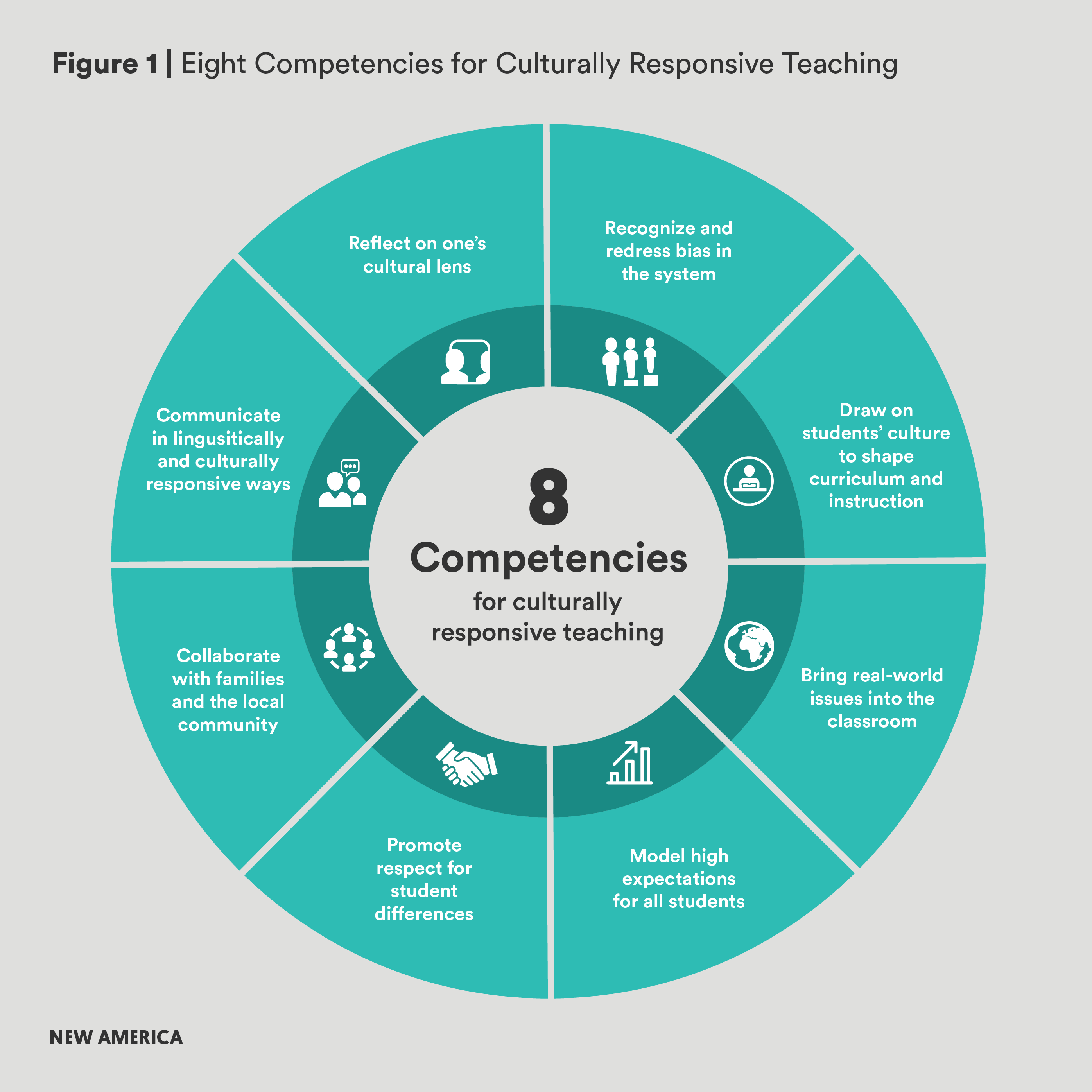
国产视频鈥檚 2020 guide to culturally responsive education identifies eight competencies that educators should acquire to become adept at this type of teaching. The third competency鈥斺�淒raw on Students鈥� Culture to Shape Curriculum and Instruction鈥濃�攊ncludes the evaluation of educational and instructional materials. It pushes educators to scan these materials for stereotypes and to seek out resources reflecting students鈥� cultures as well as those that depict his(her)(their)stories,8 traditions, and experiences of different cultural groups.9 国产视频鈥檚 report on LGBTQ-inclusive teaching presents recommendations for practice that include critically examining the messages classroom materials send to students.10
Culturally Responsive Education Materials Support Learning
Rather than seeing cultural responsiveness and academic goals as separate agendas, educators can combine them to support student learning.11 Incorporating culturally responsive materials enhances students鈥� engagement with classroom content, makes them more active learners, and can improve academic achievement over the school year, particularly when teachers initiate a lesson with materials that are mirrors and then progress to materials that are windows.12 A 2012 study by Beverly Faircloth, at the University of North Carolina at Greensboro, explored the connection between learning identity in two qualitative studies with a racial and ethnically diverse group of ninth-graders in English classes designed for remedial, restart, and struggling students.One result showed that when the educator broadened the literature to include characters that mirrored the students demographically, culturally, and experientially, students were more positively engaged learners, asking questions about the content and completing their assignments. There was a positive connection between students relating to the characters and characters鈥� experiences and engagement in their learning.13
Students are also encouraged to learn when teachers show they prioritize relating to students through the selection of materials. For instance, while at Otterbein College, E. B. Smith conducted research in 1995 showing that when lessons and activities became meaningful for students, they were more thorough and attentive in their work and participatory in classroom discussions.14 And studies on children鈥檚 picture books show that integration of culturally responsive educational materials can also support written and oral language development and reading comprehension.15
In the 2015 book More Mirrors in the Classroom, the authors use research and practice to demonstrate how culturally responsive education texts that are mirrors allow students to use their existing cultural knowledge to understand texts, which includes language, social contexts, and individuals鈥� responses in certain situations.16 This in turn reduces students鈥� cognitive load in terms of working memory as they are learning information.17 As a result, students can use more cognitive processes to focus on meaning-making, which improves reading comprehension.
Characters Influence Content Learning and Understanding of Social Identities
From Doc McStuffins and Dora the Explorer to Pippi Longstocking, characters can impact students鈥� learning more than educators may realize. Characters can be important for engaging students in materials and content, particularly if they are familiar or students relate to them. Some research from Sandra Calvert, Bonnie Strong, Eliza Jacobs, and Emily Conger of Georgetown University suggests that identification with characters may positively influence children鈥檚 learning more than for those who do not identify with the characters.18 Studies with students of older grade levels show that they may identify with characters based on familiar circumstances and life experiences, similar personalities, a common heritage and set of cultural nuances, and/or the same cultural affiliation.19 Similarities to characters based on social identity groups, such as race, ethnicity, and gender, and shared hobbies and interests can build connection to characters; this can enhance student content learning and curiosity about specific career fields.20
Characters and Content Learning
Research shows that when teachers contextualize lessons and activities based on students鈥� experiences, interests, identities, and cultures, those who previously resisted academic content may respond more positively to that content. These students may also form personal connections to the content area, value these connections, and invest more time and attention in producing higher quality assignments.21 Teachers can use materials where students identify with characters and circumstances as bridges to traditional and canonical materials and texts included in the curriculum.22 Culturally responsive education materials also expose students to new ideas and different perspectives, help develop their confidence as learners, and enable them to discover relevance to characters and experiences that may not be reflective of their daily circumstances.23 In 2018, results from a student survey published in the Texas Journal of Literacy Education indicated that while high school students value having their culture and experiences reflected in the characters and stories of materials, they also want to learn about people who have different circumstances, perspectives, and cultures.24
Characters and Social Groups/Self
In addition to helping students learn the content required by subject-area standards, educational materials鈥攁nd in fact, media of all kinds, whether labeled educational or not鈥攊ndirectly teach students about language, attitudes, beliefs, behaviors, and cross-cultural knowledge.25 These materials also inform students about what society expects of them and others based on social identity markers, and how society values them based on these markers.26 Scholars have defined this aspect of media as 鈥渟ocietal curriculum,鈥� which includes learning about various cultural groups that range from positive to negative.27 Media characters can influence children鈥檚 development of their own racial-ethnic and gender group identity as well as their understanding of different races, ethnicities, and genders.28
Through the content and portrayal of characters, the media influences children鈥檚 understanding of themselves and others, career expectations, and behaviors.29 For instance, consider a 2006 study in the Journal of Career Development. It asked high school students about their favorite media characters on television, finding that they often selected characters that reflect a similar social group affiliation (i.e., race, gender, etc.) as themselves鈥攁nd that these characters can influence their own career aspirations.30 One study with middle school students showed that students of varying gender, racial, and ethnic groups benefited from being exposed to diverse people engaged in STEM careers, which in some cases countered the stereotypes that certain people were neither interested in STEM disciplines nor contributed to the field.31 All students should have opportunities to experience characters that reflect their social identity engaged in a variety of activities and professional pursuits.
However, while research shows the benefits of culturally responsive education materials as tools for engaging students and exposing them to different perspectives and experiences, some studies indicate there is an imbalance in portrayal. Studies of literature curricula, including research on a large national sample from the Early Childhood Longitudinal Study, Kindergarten Class of 1998鈥�1999 (ECLS-K), found that more books depict White, male American characters and traditions, meaning White students and male students see more mirrors than windows. Individuals not of that racial and gender group have more windows than mirrors.32
Citations
- Critical race theory is a legal framework not typically taught in K鈥�12 settings but which has nevertheless been invoked in debates over what should be discussed in K鈥�12 schools. For more information, see Jazmyne Owens鈥� blog post, 鈥淐ritical Race Theory and Schools: What is Really Going On?鈥� EdCentral, July 29, 2021, source
- Education Week has been tracking the states in which legislators have developed specific bills to 鈥渁ttempt to regulate how teachers can discuss racism, sexism, and issues of equality and justice in the classroom鈥� on its frequently updated page, 鈥淲here Critical Race Theory is Under Attack.鈥� Last updated November 9, 2021, the page can be found at
- Culturally Responsive Teaching: Theory, Research, and Practice, 3rd ed. (New York: Teachers College, 2018).
- Beverly S. Faircloth, 鈥溾�榃earing a Mask鈥� vs. Connecting Identity with Learning,鈥� Contemporary Educational Psychology 37, no. 3 (July 2012): 186鈥�194, ; and Geneva Gay, Culturally Responsive Teaching. Gay鈥檚 book refers to several studies that demonstrate that culturally responsive teaching enhances academic achievement in different disciplines and with students of diverse backgrounds.
- Rudine Sims Bishop, 鈥淢irrors, Windows, and Sliding Glass Doors,鈥� Perspectives: Choosing and Using Books for the Classroom 6, no. 3 (Summer 1990),
- Natalie K. Conrad, Yi Gong, Lillie Sipp, and Lillian Wright, 鈥淯sing Text Talk as a Gateway to Culturally Responsive Teaching,鈥� Early Childhood Education Journal 31, no. 3 (March 2004): 187鈥�192, ; Gay, Culturally Responsive Teaching; and Ted Kesler, 鈥淭eachers鈥� Texts in Culturally Responsive Teaching,鈥� Language Arts 88, no. 6 (July 2011): 419鈥�429,
- See Jamie Campbell Naidoo, The Importance of Diversity in Library Programs and Material Collections for Children, a white paper written for the Association for Library Service to Children (ALSC) and adopted by the ASLC Board on April 5, 2014, 鈥嬧�嬧�嬧�媋vailable in Spanish and English at . See also Gay, Culturally Responsive Teaching; Django Paris, 鈥淐ulturally Sustaining Pedagogy: A Needed Change in Stance, Terminology, and Practice,鈥� Educational Researcher 41, no. 3 (2012): 93鈥�97, ; Gloria Ladson-Billings, 鈥淐ulturally Relevant Pedagogy 2.0: A.K.A. The Remix,鈥� Harvard Educational Review 84, no. 1 (March 2014): 74鈥�84, ; and Django Paris and H. Samy Alim, Culturally Sustaining Pedagogies: Teaching and Learning for Justice in a Changing World (New York: Teachers College Press, 2017).
- The term 鈥渉is(her)(their)stories鈥� in lieu of 鈥渉istory,鈥� acknowledges the role and perspectives of multiple gender groups in past events, narratives, and stories.
- Jenny Mu帽iz, Culturally Responsive Teaching: A Reflection Guide (Washington, DC: 国产视频, 2020), source
- Sabia Prescott, Supporting LGBTQ-Inclusive Teaching (Washington, DC: 国产视频, 2019), source
- See 鈥淪electing Culturally Responsive Texts,鈥� one of several strategies for early literacy developed by Digital Promise鈥檚 Learner Variability Project, based on research from 17 studies (including many also noted in this report), . Also see Sabine Siekmann, Joan Parker Webster, Sally Angass鈥檃q Samson, and Catherine Keggutalinguq Moses, 鈥淭eaching Our Way of Life through Our Language: Materials Development for Indigenous Immersion Education,鈥� Cogent Education 4, no. 1 (September 2017): 1鈥�13,
- Shontoria Walker and Laveria Hutchison, 鈥淯sing Culturally Relevant Pedagogy to Influence Literacy Achievement for Middle School Black Male Students,鈥� Journal of Adolescent & Adult Literacy 64, no. 4 (January/February 2021): 421鈥�429, ; and Gayla Lohfink and Juana Loya, 鈥淭he Nature of Mexican American Third Graders' Engagement with Culturally Relevant Picture Books,鈥� Bilingual Research Journal 3, no. 3 (December 2010): 346鈥�363,
- Faircloth, 鈥溾�榃earing a Mask.鈥欌��
- Elizabeth Bridges Smith, 鈥淎nchored in our Literature: Students Responding to African American Literature,鈥� Language Arts 72, no. 8 (December 1995): 571鈥�574,
- Studies related to children鈥檚 literature supporting language development include Gayla Lohfink and Juana Loya, 鈥淭he Nature of Mexican American Third Graders' Engagement with Culturally Relevant Picture Books,鈥� Bilingual Research Journal 3, no. 3 (December 2010): 346鈥�363, ; and Wanda Brooks and Susan Browne, 鈥淭owards a Culturally Situated Reader Response Theory,鈥� Children鈥檚 Literature in Education 43, no. 1 (March 2012): 74鈥�85,
- Jane Fleming, Susan Catapano, Candace M. Thompson, and Sandy Ruvalcaba Carrillo, More Mirrors in the Classroom: Using Urban Children鈥檚 Literature to Increase Literacy (Lanham: Rowman & Littlefield, 2015).
- For information on cognitive load and background knowledge, see Fleming, Catapano, Thompson, and Ruvalcaba Carrillo, More Mirrors in the Classroom; Zaretta Hammond, Culturally Responsive Teaching and the Brain: Promoting Authentic Engagement and Rigor Among Culturally and Linguistically Diverse Students (Thousand Oaks, CA: Corwin, 2015); Ruanda Garth McCullough, 鈥淭he Relationship Between Reader Response and Prior Knowledge on African American Students鈥� Reading Comprehension Performance Using Multicultural Literature,鈥� Reading Psychology 34, no. 5 (August 2013): 397鈥�435, ; and Ruanda Garth-McCullough, 鈥淯ntapped Cultural Support: The Influence of Culturally Bound Prior Knowledge on Comprehension Performance,鈥� Reading Horizons: A Journal of Literacy and Language Arts 49, no. 1 (October/November 2008): 1鈥�30,
- Sandra L. Calvert, Bonnie L. Strong, Eliza L. Jacobs, and Emily E. Conger, 鈥淚nteraction and Participation for Young Hispanic and Caucasian Girls鈥� and Boys鈥� Learning of Media Content,鈥� Media Psychology 9, no. 2 (December 2017): 431鈥�335,
- Smith, 鈥淎nchored in our Literature.鈥�
- Sandra L. Calvert, Melissa N. Richards, and Courtney C. Kent, 鈥淧ersonalized Interactive Characters for Toddlers鈥� Learning of Seriation from a Video Presentation,鈥� Journal of Applied Developmental Psychology 35, no. 3 (May鈥揓une 2014): 148鈥�155, ; Jocelyn Steinke, Brooks Applegate, Jay R. Penny, and Sean Merlino, 鈥淓ffects of Diverse STEM Role Model Videos in Promoting Adolescents鈥� Identification,鈥� International Journal of Science and Mathematics Education (February 2021),
- Faircloth, 鈥溾�榃earing a Mask.鈥欌��
- Chantal Francois, 鈥淩eading Is 国产视频 Relating: Urban Youths Give Voice to the Possibilities for School Literacy,鈥� Journal of Adolescent & Adult Literacy 57, no. 2 (October 2013): 141鈥�149,
- Katie Sciurba, 鈥淭ext as Mirrors, Texts as Windows: Black Adolescent Boys and the Complexities of Textual Relevance,鈥� Journal of Adolescent & Adult Literacy 58, no. 4 (December 2014/ January 2015): 308鈥�316, ; and Francois, 鈥淩eading Is 国产视频 Relating.鈥�
- Mary Amanda Stewart, Katie Walker, and Carol Revelle, 鈥淟earning from Students: What, Why, and How Adolescent English Learners Want to Read and Write,鈥� Texas Journal of Literacy Education 6, no. 1 (Summer 2018): 23鈥�40,
- Carlos E. 颁辞谤迟别虂蝉, The Children Are Watching: How the Media Teach about Diversity, Multicultural education series (New York: Teachers College Press, 2000).
- Robin J. S. Sloan, Virtual Character Design for Games and Interactive Media (Boca Raton: CRC Press, Taylor & Francis Group, 2015); and Ronda Scantlin, 鈥淢edia Use Across Childhood: Access, Time, and Content,鈥� in The Handbook of Children, Media, and Development, ed. Sandra L. Calvert and Barbara J. Wilson (Malden, Blackwell Publishing, 2008): 51鈥�73.
- 颁辞谤迟别虂蝉, The Children Are Watching.
- Onnie Rogers, Dana Mastro, Michael B. Robb, and Alanna Peebles, The Inclusion Imperative: Why Media Representation Matters for Kids' Ethnic-Racial Development (San Francisco, CA: Common Sense, 2021), ; and L. Monique Ward and Jennifer Stevens Aubrey, Watching Gender: How Stereotypes in Movies and on TV Impact Kids鈥� Development (San Francisco, CA: Common Sense, 2017).
- Terry Frueh and Paul E. McGhee, 鈥淭raditional Sex Role Development and Amount of Time Spent Watching Television,鈥� Developmental Psychology 11, no. 1 (January 1975): 109, ; Paul E. McGhee and Terry Frueh, 鈥淭elevision Viewing and the Learning of Sex-Role Stereotypes,鈥� Sex Roles 6, no. 2 (April 1980): 179鈥�188, ; and Gordon L. Berry and Joy Keiko Asamen, eds., Children & Television: Images in a Changing Sociocultural World (Newbury Park, Sage Publications, 1993).
- Cynthia A. Hoffner, Kenneth J. Levine, Quintin E. Sullivan, Dennis Crowell, Laura Pedrick, and Patricia Berndt, 鈥淭V Characters at Work: Television鈥檚 Role in the Occupational Aspirations of Economically Disadvantaged Youths,鈥� Journal of Career Development 33, no. 1 (September 2006): 3鈥�18,
- Jocelyn Steinke, Brooks Applegate, Jay R. Penny, and Sean Merlino, 鈥淓ffects of Diverse STEM Role Model Videos in Promoting Adolescents鈥� Identification,鈥� International Journal of Science and Mathematics Education, (February 2021),
- Laura Northrop, Carlin Borsheim-Black, and Sean Kelly, 鈥淢atching Students to Books: The Cultural Content of Eighth-Grade Literature Assignments,鈥� The Elementary School Journal 120, no. 2 (December 2019): 243鈥�271, ; Anjali Adukia, Alex Eble, Emileigh Harrison, Hakizumwami Birali Runesha, and Teodora Szasz, What We Teach about Race and Gender: Representation in Images and Text of Children鈥檚 Books, (Chicago: Becker Friedman Institute at the University of Chicago, 2021),