Hollie Russon Gilman
Senior Fellow, Political Reform Program
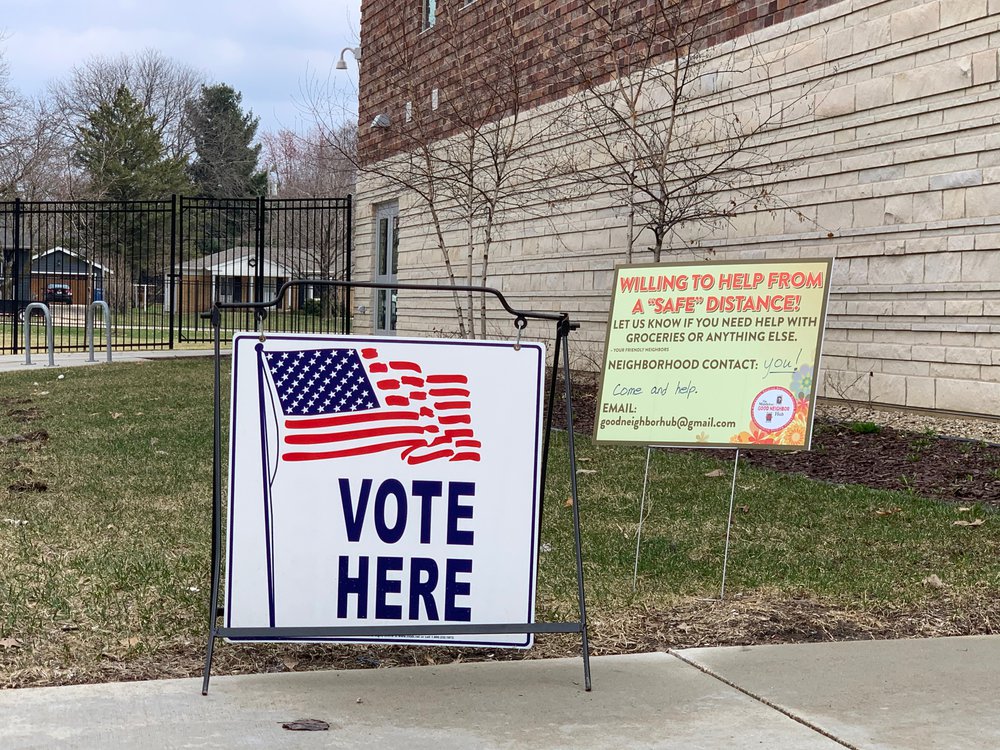
As a test for democracy, Wisconsin鈥檚 recent pandemic-time primary election failed. Within 24 chaotic hours before polls opened, Governor Tony Evers the election, the Wisconsin Supreme Court his decision, and the U.S. Supreme Court to grant an extension for mail-in ballots. Poll workers dropped out, and poll locations closed down over concerns about COVID-19.
Consequently, the election itself was, to say the least, messy. Voters waited in line for hours, some in rain and hail, putting themselves at risk for contracting COVID-19. Thousands of others stayed home and never received their absentee ballots.
These problems were particularly apparent in Milwaukee, where only five of 180 polling sites were open on election day. Milwaukee is also the site of half the state鈥檚 cases鈥攁nd, as it so happens, are Black.
As Wisconsin demonstrated, COVID-19, like all crises, disproportionately affects communities that have long been marginalized in America. And in this way, it鈥檚 a reminder that our democracy鈥檚 political inequalities mirror, derive from, and exacerbate other societal inequalities.
As the federal government continues to fumble its response to the pandemic, community leaders, mayors, and governors have become ever-more important political actors. And their work to address COVID-19 could be the first step toward building a more inclusive, participatory democracy.
First, at the state level, leaders are expanding democratic access during the pandemic by allowing vote-by-mail. States like , , and are implementing new voting measures to prevent the kind of public health threats and participation challenges seen in Wisconsin. In the long run, these electoral reforms may expand access to voters who face obstacles participating in traditional, in-person elections.
Of course, such a dramatic procedural change comes with its own challenges, especially when implemented on an expedited timeline. Advocacy groups and experts cite concerns about voter education, outreach, and logistical challenges that could prevent citizens from voting or result in discarded ballots: Kristen Clarke, president and executive director of the Lawyer鈥檚 Committee for Civil Rights Under Law, that Black voters鈥� absentee ballots are more likely to be rejected than white voters鈥�, who vote absentee at higher rates. Filling out ballots at home also means voters can鈥檛 be assisted by poll workers if they鈥檙e confused or have questions. States now expanding vote-by-mail during the pandemic must ensure their efforts actually improve democratic access, rather than inadvertently accomplishing the opposite.
Second, local public officials are experimenting with technology to facilitate civic participation in the midst of social distancing. In March, held its first virtual commission meeting and introduced three new methods of public participation via online platforms. Similar efforts took place this month in and the , among others. Flint, Michigan has identifying community resources available to residents during the pandemic, and the Bloomberg Harvard City Leadership Initiative and Bloomberg Philanthropies鈥� Coronavirus Local Response Initiative are holding with local leaders to help them navigate COVID-19 challenges. Such efforts are crucial during a crisis, and they could also succeed in finally making online engagement an integral part of civic life, promoting access for residents excluded from in-person engagement.
However, as digital life continues to move online, we鈥檒l also need a public reckoning around digital access, accessibility, and literacy. suggests that "162.8 million people are not using the internet at broadband speeds,鈥� and , 鈥渞acial minorities, older adults, rural residents, and those with lower levels of education and income are less likely to have broadband service at home.鈥� As officials shift public engagement online, they risk deepening these divides. Thus, it鈥檚 critical that digital engagement augment rather than replace in-person engagement.
Finally, new community leaders and groups are springing up in cities around the country. Organizations are for healthcare workers, connecting individuals to , and raising funds to cover essential bills and other costs for lower-income residents or residents who have lost their jobs as a result of the pandemic. Similarly, frontline workers are pushing back against the corporations putting their lives at risk. From , , and to , workers are striking for hazard pay, better health protections, and sick leave and benefits for part-time workers. Workers in other sectors are also organizing for better conditions: A group of have reportedly bargained for hazard pay, and , a platform for organizing non-union workers, is scaling up dramatically as workers across the globe .
In neighborhoods and workplaces, these efforts have reinforced existing community networks and, in many cases, established new civic infrastructures鈥攐nes that include Americans who are underrepresented in traditional democratic processes. The , for instance, is organizing a and providing and webinars to domestic workers鈥攎ost of whom are women of color and/or immigrants, and lack . Maintaining this civic infrastructure even after the pandemic slows could be a powerful tool for future civic organizing and democratic engagement.
COVID-19 has made raw and visible injustices that have existed in our country for decades, and there鈥檚 no silver bullet. Building a more resilient, equitable democracy will require us to open policy domains to the public鈥攅specially the most marginalized, at-risk members of society鈥攁nd find sustainable solutions to long-standing challenges and inequalities. This requires a thorough examination of how we got here, and collaboration across government, civil society, and philanthropy to imagine a different type of society: one that protects and empowers the most vulnerable among us.
Senior Fellow, Political Reform Program