A Chapter of: When Micro Goes Macro: A Nationwide Review of States鈥� Educator Micro-Credential Policies
Introduction
In the 2022鈥�2023 school year, one in eight of all vacant teaching positions in U.S. public schools went unfilled or were filled by individuals who were not fully certified to teach the grade(s) and/or subject(s) they were assigned to.1 Without talented educators鈥攖he most important in-school factor in students鈥� academic and long-term success2鈥攐ur students will continue to struggle to reach their full potential.3
One way states are attempting to address school workforce issues and improve students鈥� educational experiences and outcomes is by integrating micro-credential offerings into their policies to attract, credential, develop, and retain educators.
Why micro-credentials? First, many of the tools traditionally used to vet educators鈥� qualifications to enter, remain, or advance in the profession (e.g., tests of general knowledge4 and credits/degrees earned,5 etc.) can be expensive and burdensome despite weak evidence that they benefit educators鈥� daily work. This approach ultimately restricts the quantity, quality, and diversity of the educator workforce. High-quality micro-credentials, on the other hand, offer a low-cost way for educators to concretely demonstrate that they possess the competencies required to enter the profession, and to retain or enhance their professional credentials and roles.6 For example, high-quality micro-credentials offer educators a more accessible and evidence-driven option for obtaining professional recognition and rewards, such as higher-paid teacher leader roles, than doling out money for master鈥檚 degrees.
Additionally, the process required to earn a high-quality micro-credential can simultaneously improve educators鈥� job effectiveness as well as their satisfaction with their professional development opportunities, further boosting the quantity and quality of the workforce. In a national survey, nearly two-thirds of teachers reported being only somewhat satisfied or not satisfied with the professional development (PD) opportunities they were offered,7 which鈥攄espite federal efforts to get schools to shift to more evidence-based approaches鈥攕till often come as one-size-fits-all, short-term passive trainings, without opportunities to test drive the new information or skill, follow-up to see if or how they are applying the new concept in their classrooms, or assistance to help them do so successfully. These traditional types of PD opportunities often reward time spent rather than demonstrated professional learning and growth.8
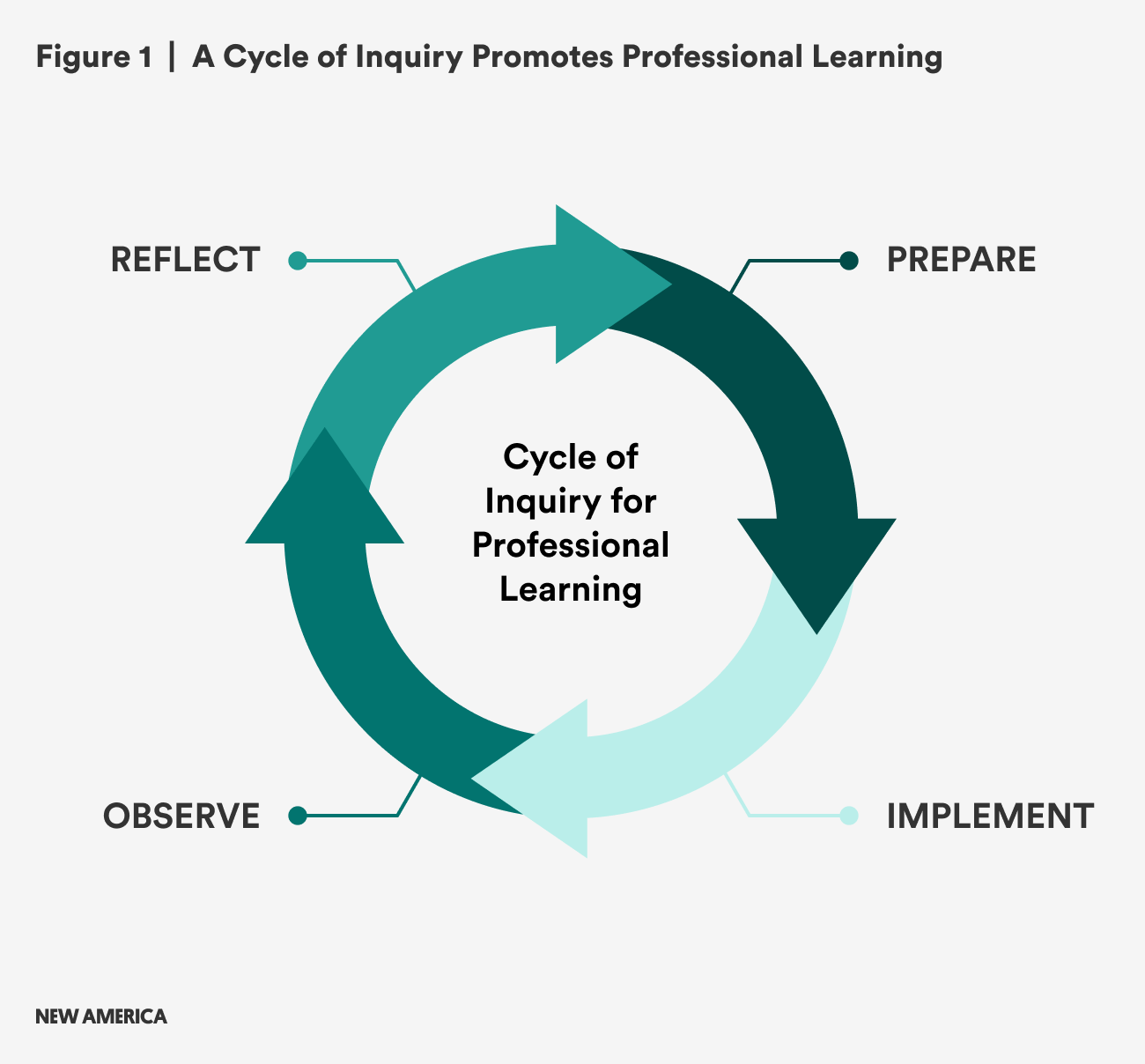
Conversely, the cycle of inquiry process baked into earning a high-quality micro-credential requires and rewards actively applying knowledge and skills in the educator鈥檚 specific school context and reflecting on the implementation and outcomes. Simplistically, such a cycle of inquiry includes four basic steps9:
- Reflect on instructional practice, including by reviewing student data, and identify the intended goal of changes to practice.
- Prepare ideas for how to modify practice, informed by research and evidence of what is most likely to achieve the goal.
- Implement and test out changes in practice in the classroom.
- Observe what resulted from the change in practice, including by reviewing data.
Then the process starts over, with educators reflecting on what they learned from implementing the change in practice, why it did or did not meet the intended goal, and how they might modify their practice further to improve outcomes (see Figure 1). For more details on the process for earning a high-quality micro-credential, and the entities playing roles within the micro-credentialing ecosystem, see Appendix A.
Allison Ball, a teacher in Kingsport City Schools who completed a micro-credential through the Digital Promise platform and responded to its 2018 survey about the experience, said: 鈥淚 would do a micro-credential again because it has helped me to not only reflect better and be more intentional and thoughtful, but it's actually given me practical choice in what I get to do and pursue.鈥�10
Not only do educators experience this type of learning-by-doing as more relevant, but research shows this active learning approach to be most likely to translate into improvements in instructional practice and advance student learning.11 And because of their 鈥渕icro鈥� nature, micro-credentials can help educators break down ambitious goals into manageable chunks, and provide a sense of accomplishment when each milestone is reached. For example, Rachel Heaton, a teacher in Kingsport City Schools who completed Digital Promise鈥檚 educator micro-credential survey, said: 鈥淲hile we were working on this micro-credential in my classroom, I was learning and my students were learning as well. We had multiple opportunities to achieve the skill in the micro-credential together. Then, as I worked through that, I was able to see evidence of their growth and then use that as the evidence [toward earning] my micro-credential.鈥�12
For a definition of the characteristics of a high-quality micro-credential, see the box below.
What Is a Micro-Credential, and What Makes a Micro-Credential High-Quality?
A micro-credential is a relatively new term in education, and it has been used to label a wide array of online activities and tools. Micro-credentials are like other types of credentials鈥攕uch as degrees or diplomas鈥攊n that they are a way for individuals to signal to current or potential employers that they possess relevant competencies, and individuals often engage in learning activities in order to earn them. Like other credentials, micro-credentials can be designed to reflect differing levels of expertise on a specific topic, but individuals must demonstrate relevant knowledge in order to earn them.
However, micro-credentials differ from credentials like degrees and diplomas in a few ways:13
- They recognize a small, discrete competency rather than a broad set of skills.
- They may not offer candidates instruction on how to develop the stated competency.14
- They may be agnostic as to when or how the candidate developed the competency.
- They are typically awarded in the form of a digital badge.15
A high-quality micro-credential offering encourages an inquiry-based learning process16 (see Figure 1) and meets five conditions:
- The measured competency is right-sized, precisely named, demonstrable, and evidence-driven.
- All accompanying resources are relevant, research-backed, and practicable.
- Candidates are required to submit robust evidence of applying the competency to a set of required practical tasks.
- Well-trained assessors review candidates鈥� submitted evidence of the competency via a transparent, reliable, and valid process.
- The final earning decision and associated feedback is communicated in a clear, timely manner.
While educator micro-credentials have been available for a decade, very little research has been done on how to maximize their potential. In 2021, 国产视频 published the most comprehensive report available on the topic, Harnessing Micro-Credentials for Teacher Growth: A National Review of Early Best Practices,17 and the companion Model State Policy Guide18 to inform education leaders鈥� understanding of this emerging tool. In addition to potential benefits of this new tool, we found there to be significant challenges to developing and implementing high-quality educator micro-credential offerings. For example, while the number of offerings labeled as 鈥渕icro-credentials鈥� was growing rapidly, no common mechanism existed for vetting quality, and many did not reflect the characteristics of high-quality educator micro-credentials outlined above.
The report highlighted how state and local policies influence educators鈥� willingness to attempt to earn micro-credentials, as well as their level of earning success. The report also provided a tally of states that included micro-credentials within different categories of educator policies. We found that 26 states explicitly referenced or encouraged the use of micro-credentials in at least one category of educator policy.
This report builds upon our earlier research and policy recommendations by examining how state policy on educator micro-credentials has changed over the past four years and providing recommendations for further state action.

When Micro Goes Macro: A Nationwide Review of States鈥� Educator Micro-Credential Policies
- Executive Summary
- Introduction
- State Policy Scan Methodology
- Overall Findings
- Detailed Policy Category Findings
- Comparison to 2020 Findings
- Discussion
- Conclusions and Recommendations
- Appendix A: Understanding the High-Quality Micro-Credentialing Process and Ecosystem
- Appendix B: Interviews Conducted by Authors, Chronologically
- Appendix C: Definitions and Examples for Six Educator Policy Areas
- Appendix D: Policy Categorization Methodology Differences from 2020 to 2025
- Appendix E: Summary of State Educator Micro-Credential Policies, by Category
- Appendix F: Additional Insights on Individual State Educator Micro-Credential Policies
Citations
- According to an analysis from the Learning Policy Institute, approximately 360,000 employed teachers across the nation are not fully certified for their teaching assignments. Further, when including vacancies, the authors estimated that over 400,000 teaching positions were either unfilled or filled by teachers not fully certified for their assignments, a total that represents approximately 1 in 8 teaching positions nationally. For more details see: Tiffany S. Tan, Ivett Arellano, and Susan Kemper Patrick, State Teacher Shortages 2024 Update: Teaching Positions Left Vacant or Filled by Teachers Without Full Certification (Learning Policy Institute, August 2024), . Interest in becoming, and remaining, an educator has been declining for multiple reasons, including lack of on-the-job support, dissatisfaction with pay, and a dearth of career advancement opportunities. More than 200,000 teachers exit the profession each year, with one in four saying they did so to pursue other career opportunities. For more details see: Anne Podolsky, Tara Kini, Joseph Bishop, and Linda Darling-Hammond, Solving the Teacher Shortage: How to Attract and Retain Excellent Educators (Learning Policy Institute, September 2016), .
- See results from Raj Chetty, John N. Friedman, and Jonah E. Rockoff, 鈥淢easuring the Impacts of Teachers II: Teacher Value-Added and Student Outcomes in Adulthood,鈥� American Economic Review 104, no. 9, (May 2014): 2633鈥�2679, .
- Student achievement on the annual National Assessment of Educational Progress (NAEP) has declined post-COVID-19. For more details, see National Assessment Governing Board, 鈥�10 Takeaways from the Newly Released 2024 NAEP Results,鈥� .
- Lisa Bardach and Robert M. Klassen, 鈥淪mart Teachers, Successful Students? A Systematic Review of the Literature on Teachers鈥� Cognitive Abilities and Teacher Effectiveness,鈥� Educational Research Review 30 (June 2020), .
- With the exception of in-area graduate degrees (for example, a master鈥檚 degree in mathematics) for middle and high school math teachers, master鈥檚 degrees have little to no effect on teacher effectiveness. In fact, some research finds that 鈥渙ut-of-area鈥� graduate degrees (school administration, counseling, curriculum specialist, etc.) are actually correlated with lower teacher effectiveness. See Kevin C. Bastian, 鈥淎 Degree Above? The Value-Added Estimates and Evaluation Ratings of Teachers with a Graduate Degree,鈥� Education Finance and Policy 14 (2019): 652鈥�678, ; and Matthew M. Chingos and Paul E. Peterson, 鈥淚t's Easier to Pick a Good Teacher than to Train One: Familiar and New Results on the Correlates of Teacher Effectiveness,鈥� Economics of Education Review 30, no. 3 (2011): 449鈥�465.
- For more details, see the Findings section in Melissa Tooley and Joseph Hood, Harnessing Micro-Credentials for Teacher Growth: A National Review of Early Best Practices (国产视频, January 2021), source.
- See question 鈥淛OBSATIS2 h鈥� on p. 4 in Pew Research Center鈥檚 2023 Survey of Teachers, April 2024, .
- Melissa Tooley and Kaylan Connally, No Panacea: Diagnosing What Ails Teacher Professional Development Before Reaching for Remedies (国产视频, June 2016), source.
- An example of a more detailed cycle of inquiry process can be found in the Regional Educational Laboratory West鈥檚 infographic, Using Inquiry Cycles in PLCs to Improve Instruction, February 2019, .
- Digital Promise, 鈥淢icro-Credentials for Me: Personal Stories from Real Teachers,鈥� .
- Melissa Tooley, 鈥淲hat Does High-Quality Research Say about Developing Teacher Practice?鈥� EdCentral (blog), 国产视频, March 16, 2017, source.
- Digital Promise, 鈥淢icro-Credentials for Me,鈥� ; Stephen Sawchuk, 鈥淐an 鈥楳icro-Credentialing鈥� Salvage Teacher PD?鈥� Ed Week, March 29, 2016, ; and Micro-credentials: Spurring Educator Engagement (Digital Promise, 2016), .
- For more details, see Q4 of Melissa Tooley, 鈥淓verything You Wanted to Know 国产视频 Educator Micro-Credentials: Fundamentals,鈥� EdCentral (blog), 国产视频, January 20, 2022, source.
- A common misconception about educator micro-credentials is that they are a type of direct teacher training rather than a credential. However, micro-credential offerings may be paired with resources for developing the specific competency they intend to measure, and high-quality micro-credential offerings always include relevant and evidence-based resources.
- Earners of micro-credentials are awarded a digital badge as proof of their accomplishment, but not all digital badges are obtained by earning micro-credentials. Digital badges can be awarded for something as simple as attending a conference training or completing a multiple-choice assessment, while earning high-quality micro-credentials requires successful application of the given competency. A 2015 survey of teachers by Digital Promise found that, of 19 distinct micro-credential benefits highlighted, teachers were least interested in displaying digital badges or sharing them on social media. See 鈥淔indings,鈥� Tooley and Hood, Harnessing Micro-credentials for Teacher Growth: A National Review of Early Best Practices, source. For more details on digital badges, see Brittany Gooding, 鈥淢icrocredentials vs. Open Badges: Navigating the Landscape of Digital Learning Recognition,鈥� The Instructure Study Hall (blog), Instructure.com, August 16, 2023, .
- Melissa Tooley and Joseph Hood, 鈥淭he Process to Earn a Micro-Credential鈥� (figure), Harnessing Micro-Credentials for Teacher Growth (国产视频, 2021), source.
- Tooley and Hood, Harnessing Micro-Credentials for Teacher Growth: A National Review of Early Best Practices, source.
- Melissa Tooley and Joseph Hood, Harnessing Micro-Credentials for Teacher Growth: A Model State Policy Guide, (国产视频, January 2021), source.