A Chapter of: America’s Endless Counterterrorism War in Yemen
3. Evaluating the Threat from AQAP
When the United States re-initiated direct U.S. strikes in Yemen in December 2009, AQAP posed a low-to-medium level of threat to the United States. It proved capable of conducting a major attack inside the United States and there’s a case that it would have successfully mounted a campaign of repeated attacks in the absence of the U.S. war.
Yet, even in 2009, AQAP never threatened to destroy the United States or seize its territory. Nor has AQAP ever proven capable of denying the U.S. military access to the battlefield. Thus, the stage was set for the war to take on an endless character if the United States did not carefully define and limit its objectives.
Today, in 2022, the threat from AQAP has been substantially diminished, yet the U.S. war continues. Whatever justifications for war might have existed in 2009 are increasingly being replaced by preventive war logic. Continuing the war under these conditions raises substantial moral and strategic issues.
AQAP’s Inability to Militarily Defeat the United States
AQAP is incapable of destroying the United States or denying it access to the battlefield. As Helen Lackner emphasizes, “While AQAP is widely described as a major threat to civilization as we know it, however awful, occasional terrorist incidents do not constitute an existential threat.”1 Located some 8,000 miles away from the United States, al-Qaeda in Yemen has carried out or coordinated two attacks in the United States over the span of almost two decades, only one of which was deadly—the attack in Pensacola that killed three people. AQAP has never managed to send more than a single individual at a time to conduct an attack inside the United States. AQAP has even struggled to exert territorial control within Yemen itself, let alone extend such power thousands of miles across oceans.
The United States conducted strikes in Yemen every year between 2009 and 2020, killing more than 1,300 people.2 While it is possible that it conducted no strikes in 2021, that should not be interpreted as a sign the United States could not conduct a strike if it chose to.
When AQAP succeeded in taking territory, rather than enhancing its ability to deny the United States access to the battlefield, it opened itself up to deadly strikes that ripped holes in its leadership.3 AQAP eventually withdrew from its territorial gains in Yemen.4 The Islamic State in Yemen had even less success in establishing a strong presence in Yemen.5
AQAP’s violence may be able to raise the cost of U.S. warfare with the aim of coercing the United States to exit the war. However, such an outcome does not constitute a decisive military defeat. Moreover, the United States’ adoption of drone warfare limits AQAP’s coercive power by removing the Americans who it could target from the battlefield.
AQAP’s Low-to-Medium Level of Threat at the War’s Initiation
AQAP did prove itself capable of conducting occasional attacks inside the United States in 2009. It therefore posed at least a low-level threat and arguably could have posed a medium-level threat capable of maintaining a campaign of repeated attacks inside the United States in the absence of military action.
On Christmas Day 2009, Umar Farouk Abdulmuttalab detonated a bomb he was carrying aboard a flight over Detroit; luckily the bomb did not explode properly, so the attack did not kill anyone. If it had succeeded, it would have killed more than 200 people. Abdulmuttalab had been radicalized in Nigeria and Britain but had spent time in Yemen in 2004 and 2005. In late 2009, he again traveled to Yemen where he sought out Anwar Awlaki, a Yemeni-American cleric who had returned to Yemen and joined with AQAP. Awlaki helped prepare him to conduct the attack and connected him to others in AQAP’s external attack apparatus.6
In the wake of the Christmas Day attack, AQAP mounted two similar attempts to attack the United States. In October 2010, AQAP placed bombs hidden in printer cartridges on flights with the packages addressed to locations in Chicago.7 Saudi intelligence reportedly learned of the plot as it went into motion and provided the tracking numbers of the packages to the United States a day after they shipped, leading to a scramble to locate and retrieve the bombs.
The administration perceived the plot as a close call.8 On October 29, 2010, the day after the Saudi tip, Obama gave a press briefing in which he provided an update on what he called “a credible terrorist threat against our country,” a phrasing that Obama, Trump, and Biden have not used to describe ISIS plotting against the United States.9 Obama’s counterterrorism adviser John Brennan wrote that the Saudis described the October intelligence as “100 percent reliable about an imminent attack against America.”10
In 2012, AQAP plotted to replicate the Christmas Day bombing, but the selected bomber was a Saudi informant.11
U.S. government assessments suggest that AQAP posed a direct, imminent threat to the U.S. homeland in a way that ISIS did not. For example, as the counter-ISIS war began in August 2014, then-Chairman of the Joint Chiefs of Staff General Martin E. Dempsey, stated that there had not yet been evidence that ISIS was engaged in “active plotting against the homeland, so it’s different than that which we see in Yemen.”12 The U.S. government repeatedly asserted it had no specific evidence of credible ISIS plots against the U.S. homeland.13
In contrast, in a September 2010 statement on U.S. strategy in Yemen, Aaron W. Jost, director for Arabian Peninsula Affairs for the National Security Council, stated, “There is no doubt AQAP is a serious threat to Yemen, the United States, and our allies. This was vividly demonstrated by the attempted bombing of Northwest Airlines Flight 253 on December 25, 2009,” adding that the group “continues to plot additional attacks against the United States.”14 In October 2010, Obama gave his briefing on the “credible” October 2010 plot.15 In 2011, then-FBI Director Robert Mueller stated, “AQAP has proven its capability to direct attacks into the United States, and a strike against its leadership, even a significant one, does not eliminate the potential for retaliation or other action by AQAP.”16 Also in 2011, John Brennan, Obama’s counterterrorism adviser, stated, “AQAP remains the most operationally active affiliate in the network and poses a direct threat to the United States.”17
The intelligence community’s Worldwide Threat Assessment testimony reveals the extent to which the United States perceived AQAP to be a major threat, particularly in the 2009-2012 period (See Appendix 1) and shows that the above remarks are not comparable to the occasional overheated remark in media interviews by administration figures about the threat posed by ISIS. Already in early 2009 before the Christmas Day attack, the intelligence community assessed that “Yemen is reemerging as a jihadist battleground and potential base of operations for al Qa’ida to plan internal and external attacks.”18 In 2010, the assessment called AQAP the “foremost concern,” discussed the need to “monitor the group’s capabilities, intentions, and recruitment of Westerners or other individuals with access to the US homeland.”19 In 2011, the assessment discussed AQAP as “energized,” “increasingly devoted to directing and inspiring attacks on the US homeland,” and likely to grow in strength without disruption while also mentioning specific past attack plots.20
The United States also perceived a direct threat from al-Qaeda in South Asia that heightened the concern regarding AQAP. In 2009, the intelligence community assessed that “al-Qa’ida continues to pursue plans for homeland attacks.”21 In 2010, it stated, “al-Qa’ida also retains the capability to recruit, train, and deploy operatives to mount some kind of an attack against the Homeland.”22
In a December 2009 speech, Obama called Afghanistan and Pakistan, “the epicenter of violent extremism practiced by al-Qaeda,” adding, “new attacks are being plotted as I speak. This is no idle danger; no hypothetical threat. In the last few months alone, we have apprehended extremists within our borders who were sent here from the border region of Afghanistan and Pakistan to commit new acts of terror.”23
In addition to the known attack plots for which there is no ISIS equivalent, a letter addressed to al-Qaeda figures in Yemen and recovered during the raid that killed Bin Laden suggests al-Qaeda core was in communication with AQAP about further developing direct plots against the U.S. homeland. The letter notes, “If the government does not agree on a truce, concentrate on the Yemeni emigrants who come back to visit Yemen and have American visas or citizenship and would be able to conduct operations inside America as long as they have not given their promises not to harm America. We need to extend and develop our operations in America and not keep it limited to blowing up airplanes.”24
Court cases suggest that AQAP was working on developing such a capability. Lawal Babafemi, a 35-year-old Nigerian, was sentenced to 22 years in prison in August 2015 after pleading guilty to providing material support to AQAP.25 According to the court records, between January 2010 and August 2011, Babafemi made two trips to Yemen, during which he trained with AQAP and worked with its English language media operatives, including Samir Khan, an American citizen, and received money and directions from Awlaki to recruit more English-speaking Nigerians.26 The government’s sentencing letter contended:
It is difficult to imagine that Awlaki saw Babafemi as nothing other than a useful recruiter for the group, since the last Nigerian citizen committed to jihad who had traveled to Yemen and joined AQAP had successfully—per Awlaki’s direction—obtained a visa to travel to the United States and boarded an airliner bound for Detroit with a bomb sewn into his underwear. Awlaki was well aware of the fact that Nigerian citizens have more connections in, and readier access to, the United States than non-English speaking citizens of various Middle Eastern countries.27
The letter notes that Babafemi met Minh Quang Pham, a British citizen who had joined AQAP, in Yemen in 2010.28 Pham was arrested after returning to the United Kingdom, in part, as a result of informants in AQAP’s networks.29 Pham pled guilty in January 2016 to providing material support to AQAP.30 The Department of Justice press release on the plea states that “Aulaqi personally taught Pham how to create a lethal explosive device using household chemicals and directed Pham to detonate such an explosive device at the arrivals area of London’s Heathrow International Airport following Pham’s return to the United Kingdom in 2011.”31 During the sentencing process, Pham contested parts of these claims, and his plea was vacated on constitutional grounds. His trial is ongoing as of this writing.32
The January 2015 attack on the offices of the satirical newspaper Charlie Hebdo in France provides another warning against viewing Abdulmuttalab’s attack as a rare exception. Chérif Kouachi, one of the perpetrators of the attack, reportedly traveled to Yemen in the summer of 2011, and received training and money from AQAP.33 During the attack, ChérifÌýKouachi told a news station, “I was sent, me, Cherif Kouachi, by Al Qaeda of Yemen. I went over there and it was Anwar al Awlaki who financed me.”34 AQAP claimed the attack, saying it financed and directed it and cited Awlaki as having a role in its preparation.35
According to Pro-Publica reporter Sebastian Rotella, French and U.S. intelligence sources believe that Kouachi met with Peter Cherif, another French militant active in AQAP, whom the Kouachis were previously connected to through a larger French jihadist network.36 They contend that Peter Cherif provided Kouachi with funding from AQAP, general instructions to carry out attacks in France focused on retaliating for the alleged desecration of the Prophet, and arranged for him to receive “brief” training from AQAP.37 While Peter Cherif was later captured and extradited to face terrorism charges in France, he was not charged in relation to the Charlie Hebdo attack.38
An examination of U.S. terrorism cases also confirms the government’s assessment that al-Qaeda core posed a direct threat. On September 9, 2009, Najibullah Zazi, an American citizen, who received training from al-Qaeda in Pakistan alongside two others, began a drive from Colorado to New York where he planned to bomb the New York subway; luckily, Zazi’s communications with his al-Qaeda handlers were intercepted, leading to his arrest.39
Why the Distinction Between Threat Levels Matters
Whether AQAP demonstrated a sustainable capability to plot and attempt major attacks inside the United States is a key question. As a Congressional Research Service report put it in January 2010, less than a month after the Christmas Day bombing, “Many analysts suggest that policymakers focus on whether or not terrorist groups in Yemen, such as Al Qaeda in the Arabian Peninsula (AQAP), have a sustainable ability to directly threaten U.S. homeland security. Such a determination, some argue, should dictate the extent of U.S. resources committed to counterterrorism and stabilization efforts there.”40
Pursuing war as a response to low- or very low-level threats is likely to lead to the adoption of preventive war logic in which war is motivated by a desire to keep a rival from growing its capabilities. In the case of a very low threat level, where the enemy lacks the capability to conduct attacks in the United States, preventive war logic is already present. Where a group can conduct occasional attacks but lacks the capability to mount a sustained campaign, military action is likely to quickly lead to a situation with a lack of targets posing imminent threats and then devolve into preventive war logic.
It is difficult to establish clear limits and markers of when a preventively framed objective might be achieved.41 In addition, rationales for military action that are preventive or only loosely tied to imminent threats generate security dilemmas regarding powers other than those initially targeted by suggesting that the United States may have aggressive motives beyond self-defense. This “preventive war paradox” tends to increase threats, missing the forest of the broader socio-political environment that it undermines for the trees of specific capabilities that might be eliminated or reduced.42
On the other hand, downplaying the importance of threats that are short of existential brings its own risks for those who wish to end endless war. If AQAP’s external attack capability was sustainable, representing not just a failure of U.S. protective measures but an adaptable enemy with the capability to repeatedly exploit and create vulnerabilities in the U.S. defense system, failing to disrupt the capability would eventually result in successful, deadly attacks on the homeland. Analysts and advocates should be wary of presuming that stated commitments to end endless war would survive a campaign of attacks.43
Waging war when the threat level is low or very low also raises moral issues. The United States’ current way of warfare—waged primarily by drones and proxy forces—has radically insulated the U.S. military from danger (at least from non-state groups like AQAP).44 The death of Chief Petty Officer William Ryan Owens in the botched January 2017 ground raid in the Yakla area of Yemen’s centrally located al Bayda governorate is the exception that proves the rule regarding the isolation of American forces from battlefield risk.45
The asymmetry on the battlefield combines with the asymmetry that arises when the United States can choose the location of the battlefield because its enemies are unable to project power into the United States on more than an occasional basis. American use of military force in such a context begins to look like one-sided forms of violence rather than war. This does not mean U.S. strikes are necessarily unjustifiable, but it raises moral concerns regarding the permissibility of targeting even those who belong to an enemy force.46
Had the Christmas Day attack succeeded, it would have killed hundreds of people and there is a case it was part of a larger set of attack plots that were disrupted through the use of military force. However, the presence of occasional attacks does not eliminate the moral problem. As Neil Renic argues, “one of the most important tasks of the Just War Tradition is the creation and maintenance of a stark demarcation between the zone of war and zone of peace.”47 Equating a low level of violence of the sort that AQAP or the al-Qaeda network as a whole has managed to carry out in the United States in recent years with the level of violence that is traditionally seen in war undermines that separation.48 Given that U.S. counterterrorism is partially a response to groups that seek to eliminate that demarcation, this is a strategic as well as moral problem.
Military action may have been justifiable in 2009. But in 2022, the counterterrorism war in Yemen—insofar as it is pursued based on American homeland security—looks ever more like the application of one-sided violence grounded in preventive war logic. The roots of that moral problem lie not merely with today’s decisions regarding how to wage the war, but also with the failure to define and limit the objectives of military action at the initiation of the war in order to account for the level of threat and how it might decline in the future.
Is There a Sustainable AQAP Threat to the Homeland Today?
This report assesses that there was a reasonable case that AQAP posed a medium level threat to the U.S. homeland between 2009 and 2012. However, the further one moves from the 2009-2012 period, the weaker the case becomes, even when accounting for the deadly 2019 attack in Pensacola, Florida.
A full assessment of the extent of AQAP’s threat to the U.S. homeland requires more information regarding the group’s activities than is publicly available. The United States should make increasing transparency regarding its assessment of that threat and what it knows about AQAP external attack structures a priority.
The Pensacola Attack: Evidence for a Continued Threat?
AQAP’s actions and propaganda suggest it has not abandoned its desire to promote attacks on the United States and other Western states.49 On December 6, 2019, Mohammed al-Shamrani shot and killed three people at Naval Air Station Pensacola in Florida. The attack was coordinated and potentially directed by AQAP.50
Yet, there is no public evidence that AQAP provided any form of material assistance to the perpetrator or actually contributed to the plot beyond branding it as an AQAP attack by communicating with the plotter and providing evidence of that communication. In addition, the plot was not particularly sophisticated, despite the involvement of a foreign terrorist organization.51 The attack involved a single individual who infiltrated the United States, and that individual killed three people in an attack not dissimilar from the attacks that Americans inspired by jihadist ideology—or other ideologies—have conducted without foreign terrorist organization support.52
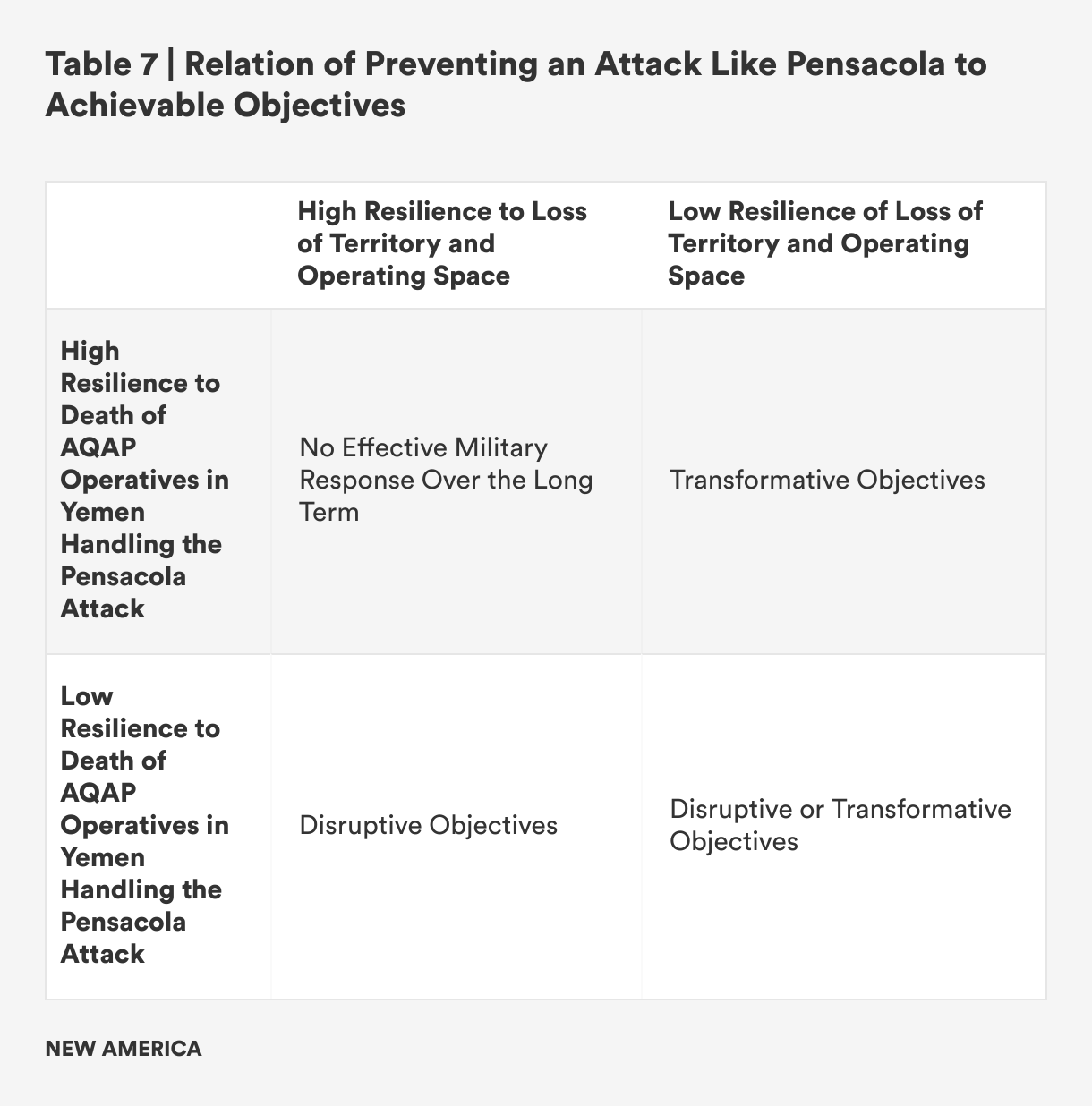
If the Pensacola attack does not represent evidence of a sustained AQAP external attack capability, and did not require a material contribution from AQAP, citing the prevention of such an attack as a military objective is a recipe for endless war. There is little reason to believe such an attack would not be resilient to AQAP’s loss of territory—it appears to have taken shape while AQAP was struggling to hold its own in Yemen’s complex civil war.53 Nor is it clear why the plot would not be resilient to the killing of specific operational figures in AQAP. The attacker could have connected with another operative inside Yemen or even outside Yemen. Moreover, it is difficult to see how a vision that justifies war against a group as a response to an enabled attack that killed three people can meaningfully separate conditions of peace from conditions of war given a death toll that was similar to any number of criminal acts of violence.54
This would mean that, in the absence of the total and complete defeat of not just AQAP but the jihadist movement it emerges from in Yemen and outside of it, which is an implausible objective, preventing similar attacks over the long term is not an achievable objective (see Table 7). If the plot is shown to not be resilient to these factors, achievable limited objectives might be available.
The three deaths in Pensacola are a tragedy and the role of AQAP in the attack requires close study. However, the attack should not overshadow the evidence that the AQAP threat to the homeland has declined since 2009.
Drone Strikes and Skilled Operative Losses as Evidence of a Reduced Threat
That evidence includes how U.S. strikes have killed many of the skilled operatives that staffed the external attack apparatus, suggesting the threat has declined. U.S. drone strikes have killed tens of AQAP commanders over the course of the campaign, including twice killing the group’s overall leader: first in 2015 when the United States killed Nasir al-Wuhayshi, and then in 2020 when the United States killed Qasim al-Raymi.55 In September 2011, the United States killed Anwar Awlaki, the subject of a long manhunt that defined much of the early phases of the U.S. counterterrorism war.56
Gregory Johnsen writes that AQAP’s external attack capability has, as a result, “atrophied.”57 Elisabeth Kendall writes, “It is unlikely that AQAP is currently in a position to exercise direct command and control over attacks in the West. But it can certainly still inspire, and possibly even provide some direction,” and notes the rapidity with which operatives tied to the attack in Pensacola were killed.58
The killing of AQAP’s leaders and operatives has not defeated the organization. Awlaki’s inspirational role arguably grew after his death.59 Some analysts conclude that the drone campaign has been counterproductive overall, helping to drive Yemeni support for AQAP and encouraging the group to view its role in more global terms.60
However, policymakers should not conflate the question of whether drones helped or harmed American objectives of destroying AQAP with the question of whether strikes disrupted specific plotting activity or degraded the capability to plot such attacks. A focus on the allegedly counterproductive impact of drone strikes on the conflict as a whole can—if not carefully applied—end up replicating the myth that AQAP is defeatable, fueling the dangerous obsession with unlimited ends and its tendency to obscure tradeoffs between more achievable, limited objectives.
Thomas Hegghammer argued in 2010 that AQAP’s foreign operations efforts are not the same as the group as whole and deliberately kept small and isolated from the group’s larger force structure, adding “if protecting the homeland is a priority, then dismantling AQAP’s Foreign Operations Unit should be at the top of America’s counterterrorism agenda in Yemen. Chasing the rest of AQAP is important, but should come second on the list of priorities. Of course, a strong core organization helps the Foreign Operations Unit, but the terrorist threat to the West from Yemen is by no means directly proportional to the overall strength of AQAP.”61 In the case of Awlaki, the stated reason the United States targeted him for assassination was his role in organizing direct attacks on the United States not his propaganda role.62 The intelligence community assessed that the loss of Awlaki likely partially disrupted AQAP’s external operations.63
In 2018, Johnsen, who was a subject of Hegghammer’s critique, acknowledged the distinction between AQAP’s external and internal capabilities, writing, regarding Yemen’s civil war, “When the war started, many outside observers—myself included—believed that the longer the fighting lasted, the more recruits AQAP would gain and the greater a threat it would become. We were half-right. The fighting has increased AQAP’s numbers but hasn’t made the group more of a threat to the West.”64
U.S. and European Statements as Evidence of a Reduced Threat
Recent U.S. government assessments, in contrast to the 2009-2012 period, also suggest AQAP’s threat to the homeland has declined. The government has repeatedly assessed that it lacks evidence of specific foreign terrorist organization plots targeting the homeland.
In April 2011, the United States replaced its infamous color-coded terrorism warning system with the National Terrorism Advisory System (NTAS), which would send out an alert in the case of important information regarding threats to the United States, distinguishing between either an “elevated” threat with no specific information on timing or location or an “imminent” threat where such information did exist.65 NTAS provided its first bulletin in December 2015, reading, “We know of no intelligence that is both specific and credible at this time of a plot by terrorist organizations to attack the homeland.”66 Further bulletins in June and November 2016 made similar assessments.67
While NTAS ceased using that language in May 2017, it provided no alerts regarding credible foreign terrorist organization plots.68 While the change in language emphasized the danger of encrypted communication, which played a role in the Pensacola attack, they did not specifically note any growing threat from AQAP. In the wake of the Pensacola attack, NTAS released two bulletins, but these focused on Iran and its proxies in the context of the assassination of Soleimani and not Pensacola or AQAP.
Further bulletins in 2021 generally focused on the domestic violent-extremist threat and provide no evidence for an increased threat of directed attacks by AQAP or any other foreign terrorist organization. A November 2021 bulletin stated, “As of November 10, 2021, DHS is not aware of an imminent and credible threat to a specific location in the United States.”69
The intelligence community’s Worldwide Threat Assessments paint a more complicated picture, with repeated assessments that suggest a persistent AQAP threat, but over time the specificity and urgency of the assessment declined (See Appendix 1).70
By 2012, the intelligence community also assessed that it had effectively degraded al-Qaeda core’s threat to the homeland.71 In 2013, the intelligence community assessed that “the group is probably unable to carry out complex, large-scale attacks in the West.”72 In October 2021, Undersecretary of Defense for Policy Colin Kahl told the Senate Armed Services Committee, “I think the intelligence community assesses that the overall risk to the homeland across the world is at its lowest point since 9/11.”73
In 2014, the intelligence community began to portray homegrown violent extremists rather than foreign terrorist organizations as the primary threat to the United States (See Appendix 1). For example, in 2014 the intelligence community assessed: “US-based extremists will likely continue to pose the most frequent threat to the US Homeland.”74 The 2015 assessment emphasized the importance of shortened distance, implying that distance posed a major obstacle to foreign terrorist organizations: “Homegrown violent extremists… will probably remain the most likely Sunni violent extremist threat to the US homeland because of their immediate and direct access.”75 This emphasis on homegrown threats suggests that the U.S. intelligence community viewed the threat from AQAP and other foreign terrorist groups by 2014 to be of a different kind than it did in 2009-2012.
In 2019, EUROPOL’s Terrorism Situation and Trend Report stated, “Despite the high numbers of AQAP fighters, however, the group’s wing specialising in attacks on Western targets has reportedly been significantly reduced in recent years, probably as a result of both military action targeting its members and the competition with local IS affiliates. As a result, in 2018, the threat from AQAP to Western interests seemed diminished.”76
Expanded Strategic Distance as Evidence of a Reduced Threat
The directed attack plots of the 2009-2012 period reflected conditions in Yemen that no longer exist. These plots relied upon the ease of travel to and from Yemen during the 1990s and 2000s.77 Increasing connections between Yemen and the West helped al-Qaeda shrink the strategic distance between its operatives capable of organizing major attacks and their targets in the United States and Europe.78
The plots of 2009-2012 took advantage of these conditions. For example, Abdulmuttalab was a Nigerian who had been living in Britain, previously traveled to the United States and Yemen, and returned to Yemen in 2009, ostensibly to study but really to seek out Awlaki. He was then able to exit the country, easily connecting to the international flight system. Carlos Bledsoe, an African-American convert from Tennessee, who does not appear to have actually joined AQAP but cited them as an inspiration for his deadly 2009 attack on a military recruiting station in Arkansas, had traveled to Yemen to study.79 Minh Quang Pham similarly entered Yemen as a tourist, according to court documents.80
Today, attack plots that rely upon such travel patterns are extremely unlikely. The strategic distance between AQAP and the United States expanded in 2015 as the growing Houthi rebellion and civil war cratered Yemen’s tourism industry and the number of flights to and from the country.81 According to Adam Baron, a researcher who has traveled in Yemen since the civil war, “in Yemen’s recent history, it has never been more difficult for non-Yemenis to enter Yemen. The war has effectively eliminated things like tourism and Arabic study programs.”82
More than a million tourists entered Yemen every year from 2010 through 2014, in 2015 that fell to 398,000.83 Similarly, the number of passengers on international or domestic flights by air carriers registered in Yemen cratered from 1.6 million in 2014, to about 443,000 in 2015, then bottoming out at 132,571 in 2017.84 In 2016, the FAA restricted U.S. flights transiting Yemeni airspace, due to the security situation.85 In 2021, the State Department maintained a Level 4 Travel Advisory for Yemen, its highest level, writing, “Do not travel to Yemen due to COVID-19, terrorism, civil unrest, health risks, kidnapping, armed conflict, and landmines.”86 Over the years, such warnings have become more explicit.87 The pandemic has also expanded the strategic distance between Yemen and the United States.88
Even before the civil war, travel to and from Yemen saw increased surveillance as a result of the Christmas Day attack.89 According to Adam Baron, there was a “steady decline in ease that followed that was itself followed by a cratering after the flight of the internationally recognized government and the subsequent launch of Operation Decisive Storm.”90 Law enforcement and immigration officials also began to treat travel to Yemen as a potential indicator for terrorist activity.91
Policymakers should not assume that the decline in Yemen’s interactions with other countries will be permanent.92 Refugee flows also continue along age-old routes of Yemeni interaction with the world, although these routes are heavily policed, often dangerous, and unreliable.93 Moreover, to the extent that any counterterrorism strategy’s calculation of success relies on the constraints on travel imposed by the civil war, it raises moral questions about that strategy as well as practical ones. However, it is critical to recognize that it is now extremely difficult for people to enter Yemen, receive training, and then enter the United States to conduct an attack.
AQAP appears to have recognized the difficulty of conducting directed attacks and has emphasized inspiring lone-actor attacks in the West instead. In 2017, AQAP told a Norwegian paper that it had only recruited five foreigners in the past five years, and that foreigners were not welcome given the role they had played in ISIS and the security difficulties they bring.94
While the claim about the specific number of foreigners may not be credible, a look at AQAP’s English language propaganda suggests that AQAP is no longer encouraging people to travel to Yemen in the same way that it was in 2011.95 The 17th issue of AQAP’s English language magazine Inspire (published in 2017) carried an article attributed to Hamza Bin Laden that encouraged Westerners to carry out attacks where they were rather than traveling to participate in jihad. It stated: “Inflicting punishment on Jews and Crusaders where you are present is more vexing and severe for the enemy” and “don’t underestimate yourself, nor belittle your work, for how many professionally executed individual operations in the West outweighed numerous operations in the East.”96 The issue also included numerous articles promoting lone-actor attacks in the West and explicitly placing equal or greater value on it compared to foreign fighting.97 In contrast, none of the articles listed in the issue’s table of contents called for people to travel to Yemen. The 16th issue of the magazine (published in 2016) likewise promoted lone-actor jihad but made no call for and provided no advice on travel to Yemen.98
AQAP has long-promoted lone-actor attacks in the West without travel even as it prepared directed attacks from Yemen. However, the first issue of Inspire (published in 2011) included explicit calls and advice for people to travel to Yemen.99 The second issue of Inspire reprised a section that appeared in the first issue providing advice for people coming to Yemen, and though it emphasized the value of attacks in the West and said some jihadists might ask why Westerners do not carry out attacks at home, it added, “Nevertheless, they’ll be exceptionally happy to have you in their ranks.”100 In the more recent issues, this language does not appear, leaving only an emphasis on attacks in the West without travel.
Even if jihadist groups have not shifted their strategic approach, it is not clear they are capable of recruiting people who are able to travel to Yemen and then carry out attacks in the West. The Islamic State in Yemen failed to attract foreign fighters despite its propaganda suggesting that it sought Western recruits.101 Multiple reviews of American terrorism cases suggest that there is little interest or ability on the part of Americans to join jihadist groups in Yemen today.102
In 2010, assessments that Yemen, along with Somalia, might be “a preferred destination for non-Yemeni converts or foreign fighters” played an important role in the American decision to wage war.103 Regardless of whether or not such an assessment was valid then, it is not valid today.
Contrary Evidence Pointing to a Sustained Threat
Two data points suggest AQAP may retain a sustainable capability to directly strike the U.S. homeland. They are the January 2015 Charlie Hebdo attack and reports of a connection between AQAP and plots against aviation out of Syria.
The Charlie Hebdo attack does provide reason to be wary of AQAP’s threat given AQAP’s claim of responsibility and reporting that ChérifÌýKouachi received training and financing from the group in Yemen in 2011. While the attack occurred in 2015, it may be better understood as an expression of the dying gasp of the 2009-2012 era, when the threat was higher. Seven years later, AQAP has not demonstrated the capability to follow up with a sustained campaign of violence in Europe (11 years if you start the clock with Kouachi’s Yemen trip). This failure warns against viewing the attack as strong evidence of a sustained external attack capability today.
Moreover, it is unclear how substantial a role AQAP actually had in directing the attack.104 If AQAP’s role in the attack consisted of training and financing but not a more specific direction, it raises questions about the effectiveness of military counterterrorism as a response. Even if Kouachi received general instructions regarding the target in 2011, as U.S. and French officials appear to believe, it can still raise questions about how essential those aspects were to an attack embedded in a larger, French network that had previously been involved in terrorist activity.
Even if the attack is judged to demonstrate a sustained AQAP capability to direct attacks in Europe, analysts should still be wary of assuming that means a similar threat in the United States. Europe provides an easier context within which to organize large scale jihadist attacks than the United States does.105
Possible AQAP ties to plots originating in Syria against aviation targets provide another argument for assessing that AQAP maintains a sustained external attack capability. As the United States escalated its war against ISIS into Syria, the United States also targeted what it called the Khorasan Group with air strikes saying that the group of senior al-Qaeda figures posed an imminent threat in large part through the development of sophisticated explosives that could be smuggled past airport security.106 Reportedly behind this fear was intelligence that suggested AQAP’s master bomb-maker, Ibrahim al-Asiri, who built the Christmas Day attack bomb, was part of the group’s network. Further, the group’s reported leader, Mohsen al-Fadhli, allegedly tied to the attack on the oil tanker MV Limburg off of Yemen’s coast, was believed to be well placed to connect al-Qaeda’s networks, including AQAP, with its efforts in Syria.107
The possible AQAP ties to plotting by the Khorasan Group provide a weak justification for war in Yemen. Despite initial claims that the 2014 aviation threat was imminent, later reporting suggested that it was more of an aspirational threat.108 Asiri was killed in 2017, and while he likely passed along bomb-making knowledge to others, the diffusion of such knowledge raises serious questions about how war in Yemen would meaningfully respond to such a resilient threat, particularly if the fear was that the threat was now coming from an entirely different country.109
The AQAP Threat Beyond the U.S. Homeland
Threats to the U.S. homeland are not the only threats that can motivate American military action. Many Americans live, work, and have families in areas threatened by jihadist groups. The United States has historically taken military action to protect those Americans, to defend particular societal arrangements in the Middle East perceived as being in the U.S. interest, and to fulfill humanitarian objectives, for example stopping ISIS’s genocidal advance.
AQAP certainly posed threats beyond the U.S. homeland although these threats tended to be less significant than those posed by ISIS. As noted above, AQAP plotted attacks outside of the United States, and claimed the January 2015 attack on Charlie Hebdo. Yet the scale of AQAP’s European efforts pale in comparison with ISIS’ campaign of terror in Europe from Syria.110 AQAP took hostages, including Americans, and filled its coffers using the ransoms it obtained. However, hostage taking in Yemen rarely involved the murder of hostages and the propagandistic use of brutal violence that characterized the hostage crisis in Syria, although that may have been changing by 2014.111 AQAP has also targeted Americans within Yemen for sophisticated attacks as well as for kidnapping.112
AQAP seized territory and provided some level of governance amid the Arab Spring’s aftermath and the renewed civil war with the Houthis.113 The most significant of these gains occurred in 2011, when AQAP took the cities of Jaar and Zinjibar in Yemen’s Abyan governorate, and in 2015 when AQAP took the port city of Mukalla in Yemen’s Hadramawt governorate and retook control in parts of Abyan.
However, AQAP’s ability to hold territory has been inconsistent and it has struggled to maintain its strength.114 In 2020, ACLED researchers wrote that AQAP “currently operates in isolated pockets of territory along with a variety of anti-Houthi forces.”115 AQAP’s struggles—particularly on the territorial front—do not only come from competition with non-jihadist forces, but also from the way that holding territory increases tensions within the group over its stance regarding ISIS.116 Though the group has found a niche for itself in Yemen’s politics and proven at times adept (or at least sufficiently adept to ensure its survival) at navigating the complexities of Yemeni politics, it is a relatively minor player and should not be portrayed as a mass movement similar in scale to other political forces active in the country or as fundamentally intertwined with Yemen’s tribes.117 That said, the polarization generated by the civil war and Houthi advances and the ongoing fragmentation of Yemeni politics may reshape political conditions, and open space for AQAP to overcome constraints on its growth.
In 2011 when AQAP governed territory in Abyan, it committed human rights abuses.118 However, when AQAP seized Mukalla, it was somewhat tempered by its earlier experience and sought to avoid oppressive actions that might alienate the population.119 AQAP and al-Qaeda more generally have avoided the kind of systematic large-scale atrocities that characterized ISIS governance, although this may be the result of temporary tactical factors.120
Even if AQAP’s efforts to limit atrocities are purely a temporary tactical choice, it shapes the conditions of the war, and poses challenges for war rationales based on humanitarian grounds. Amid the enormous humanitarian crisis and the clash of far more powerful and entrenched factions of Yemeni politics, jihadists are far from the greatest or primary threat to the ability of Yemenis to live full and secure lives.121 Importantly, the United States’ partners in Yemen also do not have clean hands when it comes to human rights violations in Yemen.122 For some Yemenis, this can encourage acquiescence to AQAP governance, particularly if the U.S. war appears to pose a choice between a harsh stability and an unaccountable, chaotic, and foreign imposed governance justified via the rhetoric of human rights, or if the difference is sufficiently blurred to discourage risking action.123
AQAP also played an important role in the broader al-Qaeda network, the elimination of which may have been a core objective of a larger strategy of disaggregating al-Qaeda’s threat. The group held close ties to al-Qaeda’s core. Nasir al-Wuhayshi, AQAP’s top leader until his death in a 2015 drone strike, served as a close secretary to Bin Laden in Afghanistan for years and was named al-Qaeda’s second in command when Ayman al-Zawahiri took over the organization in the wake of Bin Laden’s death.124 At the same time, AQAP had ties to al-Qaeda-affiliated groups in North Africa, the Middle East, and Somalia, while al-Qaeda’s leadership in South Asia was somewhat cut off from its network’s activities in the region due to counterterrorism strikes and other pressure in Pakistan.125
AQAP’s effectiveness in this role should not be exaggerated. The documents that were recovered during the raid that killed Bin Laden showed that while bin Laden was in touch with AQAP’s leadership over key details of strategy, there were also tensions between al-Qaeda core and its Yemeni affiliate.126 More recently, while AQAP remained loyal to Zawahiri and al-Qaeda as ISIS challenged al-Qaeda’s claim to leadership of the jihadist movement, its stance was more equivocal than Zawahiri might have hoped, and internal rifts over how to respond to the rise of ISIS had a significant impact on the group’s lower-levels.127 Similarly, AQAP’s historical ties to al-Shabaab are clear.128 Yet cooperation between AQAP and al-Shabaab is constrained by local tribal opposition.129
Threats beyond the U.S. homeland may have provided important rationales for the U.S. war in Yemen. Yet, at the time of the war’s initiation, American and Yemeni decision-makers held views that warn against over-emphasizing the role of local threats. The Obama administration repeatedly expressed an intent to stay aloof from the localized business of waging a counterinsurgency campaign in Yemen.130 The Yemeni government in turn viewed AQAP as a lesser threat than the Houthi rebels.131 American concerns about its own homeland security played a central role in motivating the war. To the extent that regional security or humanitarian rationales played a role, they were rarely analyzed in isolation from the presumed threat to the homeland.
The constraints on AQAP’s local power—particularly in comparison to other more powerful factions in Yemen—should lead analysts to be wary of their use to justify the continuation of the U.S. war. Analysts should also be wary of the way that preventive homeland security rationales can hide tradeoffs and overshadow cost-benefit assessments regarding other rationales, functioning as an excuse to justify continued military action when the United States fails to achieve regional security objectives.
America’s Endless Counterterrorism War in Yemen
- Executive Summary
- 1. Introduction
- 2. A Theory of Endless War and its Applicability in Yemen
- 3. Evaluating the Threat from AQAP
- 4. Assessing the Clarity and Character of American Objectives
- 5. Assessing the Achievability of American Objectives
- 6. Assessing the Level of War Termination Planning
- 7. Conclusion: Towards A Path Out of Endlessness
- Appendix 1: U.S. Intelligence Community Threat Assessments
- Appendix 2: Presence of Unlimited Objectives in CENTCOM Press Releases Under the Trump Administration
Citations
- Lackner, Yemen in Crisis, 144.
- Bergen, Sterman, and Salyk-Virk, “America’s Counterterrorism Wars: The War in Yemen.”
- David Sterman, “A Death Trap for Al Qaeda Leaders?,” CNN, June 16, 2015, .
- AQAP’s withdrawal is generally viewed as having been a negotiated withdrawal. Therefore, while it does show AQAP’s inability to deny the U.S. access to the battlefield, it does not demonstrate that the group would be incapable of making any operation to retake territory in the absence of an al-Qaeda decision to withdraw from a bloody battle. “Yemen’s al-Qaeda: Expanding the Base,” 26.
- Elisabeth Kendall, “The Failing Islamic State Within the Failed State of Yemen,” Perspectives on Terrorism 13, no. 1 (February 2019), .
- Alexander Meleagrou-Hitchens, Incitement: Anwar al-Awlaki’s Western Jihad (Cambridge, Massachusetts: Harvard University Press, 2020), 165–88. Also see the FBI’s notes from their interviews of Abdulmutallab after his arrest available at: .
- Scott Shane, Objective Troy: A Terrorist, a President, and the Rise of the Drone, First Edition (New York: Tim Duggan Books, 2015), 256.
- Shane, 259.
- Jesse Lee, “President Obama: ‘A Credible Terrorist Threat Against Our Country, and the Actions That We’re Taking’” (The White House, October 29, 2010), .
- John O. Brennan, Undaunted: My Fight against America’s Enemies, at Home and Abroad, First edition (New York: Celadon Books, 2020), 205.
- Sudarsan Raghavan, Peter Finn, and Greg Miller, “In Foiled Bomb Plot, AQAP Took Bait Dangled by Saudi Informant,” Washington Post, May 9, 2012, .
- “Dempsey: We Will Act If Islamic Group Threatens U.S.,” AP, August 25, 2014, .
- Sterman, “Decision-Making in the Counter-ISIS War: Assessing the Role of Preventive War Logic.”
- Aaron W. Jost, “A Comprehensive Approach to Yemen,” The White House, September 24, 2010, .
- Lee, “President Obama: ‘A Credible Terrorist Threat Against Our Country, and the Actions That We’re Taking.’”
- Tabassum Zakaria, “U.S. Monitors Effect of Awlaki Death on Qaeda Branch,” Reuters, October 6, 2011, .
- John O. Brennan, “Remarks of John O. Brennan, Assistant to the President for Homeland Security and Counterterrorism, on Ensuring al-Qa’ida’s Demise — As Prepared for Delivery” (The White House Office of the Press Secretary, June 29, 2011), .
- Dennis C. Blair, “Annual Threat Assessment of the Intelligence Community for the Senate Select Committee on Intelligence,” February 2009, 7, .
- Dennis C. Blair, “Annual Threat Assessment of the US Intelligence Community for the Senate Select Committee on Intelligence,” February 2, 2010, 10, .
- James R. Clapper, “Statement for the Record on the Worldwide Threat Assessment of the U.S. Intelligence Community for the Senate Committee on Armed Services,” March 10, 2011, 2, .
- Blair, “Annual Threat Assessment of the Intelligence Community for the Senate Select Committee on Intelligence,” 6.
- Blair, “Annual Threat Assessment of the US Intelligence Community for the Senate Select Committee on Intelligence,” 8.
- “Remarks by the President in Address to the Nation on the Way Forward in Afghanistan and Pakistan” (White House, December 1, 2009), .
- “Letter to Nasir Al-Wuhayshi” (Combatting Terrorism Center, n.d.), SOCOM-2012-0000016, .
- “Terrorist Sentenced to 22 Years for Providing Material Support to Al-Qaeda in the Arabian Peninsula” (Department of Justice Office of Public Affairs, August 12, 2015), .
- “Terrorist Sentenced to 22 Years for Providing Material Support to Al-Qaeda in the Arabian Peninsula.”
- United States Attorney Eastern District of New York, “Re: United States v. Lawal Babafemi Criminal Docket No. 13-109 (JG),” April 24, 2015, 11, .
- United States Attorney Eastern District of New York, 3.
- “Member of Al Qaeda in the Arabian Peninsula Pleads Guilty to Terrorism Charges” (Department of Justice Office of Public Affairs, January 8, 2016), .
- “Member of Al Qaeda in the Arabian Peninsula Pleads Guilty to Terrorism Charges.”
- “Member of Al Qaeda in the Arabian Peninsula Pleads Guilty to Terrorism Charges.”
- Details on the docket and recent filings can be found here: . On the dispute over factual claims see for example: “SENTENCING SUBMISSION by Minh Quang Pham” (Law Offices of Bobbi C. Sternheim, May 9, 2016), Document 110, Case 1:12-cr-00423-AJN, ; “SENTENCING SUBMISSION by USA as to Minh Quang Pham” (United States Attorney Southern District of New York, May 11, 2016), Document 114, Case 1:12-cr-00423-AJN, ; “TRANSCRIPT of Proceedings as to Minh Quang Pham Re: Sentence Held on 5/16/16” (United States District Court Southern District of New York, June 3, 2016), Document 123, Case 1:12-cr-00423-AJN, .
- Initial reports suggested that Said Kouachi or both Kouachi brothers traveled to Yemen, but later reporting suggested that it was ChérifÌýKouachi traveling on his brother’s passport. Rukmini Callimachi and Jim Yardley, “From Amateur to Ruthless Jihadist in France,” New York Times, January 17, 2015, .
- “Charlie Hebdo Shooter Says Financed by Qaeda Preacher in Yemen,” Reuters, January 9, 2015, .
- Maria Abi-Habib, Margaret Coker, and Hakim AlMasmari, “Al Qaeda in Yemen Claims Responsibility for Charlie Hebdo Attack,” Wall Street Journal, January 14, 2015, ; Jeremy Scahill, “Al Qaeda Source: AQAP Directed Paris Attack,” Intercept, January 9, 2015, .
- Sebastian Rotella, “How France Let the Charlie Hebdo Killers Go Free,” Daily Beast, July 12, 2017, ; Sebastian Rotella, Dan Edge, and Ricardo Pollack, “Transcript: Terror in Europe,” Frontline, October 18, 2016, . On Peter Cherif see also: “Peter Cherif” (United Nations Security Council, September 29, 2015), ; “Charlie Hebdo Attack Suspect Arrested, French Officials Say,” AP, December 21, 2018, .
- Rotella, “How France Let the Charlie Hebdo Killers Go Free.”
- Willy Le Devin, “Peter Cherif, Superviseur Des Attaques de Janvier?,” Liberation, September 1, 2020, .
- Jonathan Dienst, “Man Who Plotted to Blow up NYC Subway May Soon Walk Free,” NBC, May 2, 2019, .
- Jeremy M. Sharp, “Yemen: Background and U.S. Relations” (Congressional Research Service, January 13, 2010), 3, .
- Scott A. Silverstone, From Hitler’s Germany to Saddam’s Iraq: The Enduring False Promise of Preventive War (Lanham, MD: Rowman & Littlefield, 2019), 269; Charles S. Maier, Among Empires: American Ascendancy and Its Predecessors (Cambridge, Mass.: Harvard Univ. Press, 2006), 61; Jack Snyder, “Imperial Temptations,” The National Interest, Spring 2003, .
- Silverstone, From Hitler’s Germany to Saddam’s Iraq, 77, 80–91.
- Ben Rhodes, “The 9/11 Era Is Over,” Atlantic, April 6, 2020, .
- Renic, Asymmetric Killing; Gopal, “America’s War on Syrian Civilians.”
- Dave Philipps, “Special Operations Troops Top Casualty List as U.S. Relies More on Elite Forces,” New York Times, February 4, 2017, ; Vera Bergengruen, “These US Troops Were Killed In Combat During ¹ú²úÊÓƵ First Year In Office,” BuzzFeed, December 28, 2017, .
- Renic, Asymmetric Killing.
- Renic, 185, 174.
- See Neil Renic’s discussion of this issue specifically mentioning the war in Yemen: Renic, 174fn24.
- Elisabeth Kendall, “Twenty Years After 9/11: The Jihadi Threat in the Arabian Peninsula,” CTC Sentinel 14, no. 7 (September 2021), .
- David Sterman, “We Need More Oversight on US Counterterrorism Policy in the Wake of AQAP’s Confirmed Involvement in the Pensacola Attack,” Responsible Statecraft, May 22, 2020, ; “Attorney General William P. Barr and FBI Director Christopher Wray Announce Significant Developments in the Investigation of the Naval Air Station Pensacola Shooting”; David Sterman, Peter Bergen, and Melissa Salyk-Virk, “Terrorism in America 19 Years After 9/11” (¹ú²úÊÓƵ, September 11, 2020), source.
- Kendall, “Twenty Years After 9/11: The Jihadi Threat in the Arabian Peninsula.”
- This lack of sophistication reflects the larger failure of virtually coached plotters to demonstrate a greater threat than those merely inspired by propaganda. John Mueller, “The Cybercoaching of Terrorists: Cause for Alarm?,” CTC Sentinel 10, no. 9 (October 2017), .
- “Letter Dated 15 January 2019 from the Chair of the Security Council Committee Pursuant to Resolutions 1267 (1999), 1989 (2011) and 2253 (2015) Concerning Islamic State in Iraq and the Levant (Da’esh), Al-Qaida and Associated Individuals, Groups, Undertakings and Entities Addressed to the President of the Security Council” (United Nations Security Council, January 15, 2019), 8–9, .
- Renic, Asymmetric Killing, 185.
- “Yemen Al-Qaeda Leader al-Raymi Killed by US Strike,” BBC, February 7, 2020, ; Sterman, “A Death Trap for Al Qaeda Leaders?”; Bergen, Sterman, and Salyk-Virk, “America’s Counterterrorism Wars: The War in Yemen.”
- Shane, Objective Troy.
- Gregory D. Johnsen, “Khalid Batarfi and the Future of AQAP,” Lawfare, March 22, 2020, ; Gregory D. Johnsen, “The End of AQAP as a Global Threat” (Sana’a Center for Strategic Studies, March 5, 2020), ; Gregory D. Johnsen, “The Two Faces of Al-Qaeda in the Arabian Peninsula,” War on the Rocks, October 11, 2018, .
- Kendall, “Twenty Years After 9/11: The Jihadi Threat in the Arabian Peninsula.”
- On Awlaki’s posthumous impact see: Meleagrou-Hitchens, Incitement, 236–74; Thomas Hegghammer, “The Last Jihadi Superstar,” War on the Rocks, October 30, 2020, ; Shane, Objective Troy, 302; Peter Bergen et al., “Terrorism in America After 9/11” (¹ú²úÊÓƵ), accessed August 1, 2019, source.
- Jillian Schwedler, “Is the U.S. Drone Program in Yemen Working?,” Lawfare, September 27, 2015, .
- Thomas Hegghammer, “The Case for Chasing Al-Awlaki,” Foreign Policy, November 24, 2010, .
- Eric. H. Holder Jr., Letter to Patrick J. Leahy, Chairman Committee on the Judiciary, United States Senate Regarding Americans Killed in Counterterrorism Operations, May 22, 2013, . This is not to suggest that these reasons were fully separable, well explained at the time, or that there are not real questions about the process behind the targeted killings. However, the foundation of the stated theory for why Awlaki could and should be targeted did not rest on his inspirational power but on allegations that he was plotting attacks. For discussion of ongoing questions regarding the killing of Awlaki and Samir Khan, another American killed in the same strike who worked on AQAP’s Inspire magazine and whom the government says was not targeted, see: Scahill, Dirty Wars; Jason Leopold, “The FBI Discussed an ‘End-Game’ for a US Citizen Killed in a Drone Strike,” Vice, June 8, 2015, . In his memoir, Leon Panetta, who had just moved from being Director of Central Intelligence to Secretary of Defense at the time of the strike that killed Awlaki, said that the U.S. did not even know Khan was present when it conducted the strike. Leon E Panetta and Jim Newton, Worthy Fights: A Memoir of Leadership in War and Peace, 2015, 386, .
- James R. Clapper, “Unclassified Statement for the Record on the Worldwide Threat Assessment of the US Intelligence Community for the Senate Select Committee on Intelligence” (Office of the Director of National Intelligence, January 31, 2012), 3, .
- Johnsen, “The Two Faces of Al-Qaeda in the Arabian Peninsula.”
- “Terror Alert Systems Fast Facts,” CNN, November 2, 2018, ; John Hudson, “Obama’s Terrorism Alert System Has Never Issued a Public Warning — Ever,” Foreign Policy, September 29, 2014, ; “National Terrorism Advisory System (NTAS),” Department of Homeland Security, accessed August 13, 2019, .
- “National Terrorism Advisory System Bulletin” (Department of Homeland Security, December 16, 2015), .
- “National Terrorism Advisory System Bulletin” (Department of Homeland Security, June 15, 2016), ; “National Terrorism Advisory System Bulletin” (Department of Homeland Security, November 15, 2016), .
- “National Terrorism Advisory System (NTAS).”
- “National Terrorism Advisory System (NTAS)”; “National Terrorism Advisory System Bulletin” (Department of Homeland Security, November 10, 2021), .
- Hartig, “Full Accounting Needed of US-UAE Counterterrorism Partnership in Yemen,” December 7, 2018.
- Clapper, “Unclassified Statement for the Record on the Worldwide Threat Assessment of the US Intelligence Community for the Senate Select Committee on Intelligence,” 2–3.
- James R. Clapper, “Statement for the Record Worldwide Threat Assessment of the US Intelligence Community” (Office of the Director of National Intelligence, March 12, 2013), 4, .
- “Stenographic Transcript of Hearing to Receive Testimony on Security in Afghanistan and in the Regions of South and Central Asia” (Senate Committee on Armed Services (Transcript by Alderson Court Reporting), October 26, 2021), 50, ; Jeff Seldin, “Timeline for Potential Attacks by Islamic State, Al-Qaida Getting Shorter,” Voice of America, October 26, 2021, .
- James R. Clapper, “Statement for the Record Worldwide Threat Assessment of the US Intelligence Community” (Office of the Director of National Intelligence, January 29, 2014), 4, .
- James R. Clapper, “Statement for the Record Worldwide Threat Assessment of the US Intelligence Community,” § Senate Armed Services Committee (2015), 5, .
- “Terrorism Situation and Trend Report 2019 (TE-SAT)” (EUROPOL, 2019), 47, . The report, however, does warn of the potential that AQAP could reconstitute such capabilities if pressure lessened.
- For a broad discussion of travel patterns and tourism in Yemen and its complex interactions with Islamist militancy see: Laurent Bonnefoy and Cynthia Schoch, Yemen and the World: Beyond Insecurity, Comparative Politics and International Studies Series (Oxford ; New York, NY: Oxford University Press, 2018), 135–48. For one account of foreign tourism and religious study in Yemen that helps illustrate the relative ease of travel between the West and Yemen in the mid-2000s compared to today see: Theo Padnos, Undercover Muslim: A Journey into Yemen (London: Bodley Head, 2011). Another account of the Salafi scene in Yemen as well as travel between the West and Yemen more generally from the 1990s through the mid-2000s and how it sometimes connected with al-Qaeda’s networks comes from Morten Storm, who according to his account turned double agent, infiltrating the AQAP circles around Awlaki. Storm also discusses his later travels to Yemen, though given his work for Western intelligence services, caution is required in interpreting that travel’s meaning for questions of strategic distance. Morten Storm, Paul Cruickshank, and Tim Lister, Agent Storm: My Life Inside Al Qaeda and the CIA (New York, NY: Atlantic Monthly Press, 2014), 33-45,48, 55, 90–91.
- On strategic distance see: Patrick Porter, The Global Village Myth: Distance, War and the Limits of Power (Washington, DC: Georgetown University Press, 2015). The argument presented here is not reliant on a claim that links Salafism in Yemen to radicalization. For criticism of representations of the Salafi scene in Yemen as radicalizing based on individual cases of connection between the scene and participants in al-Qaeda’s violence see: Laurent Bonnefoy, Salafism in Yemen: Transnationalism and Religious Identity (New York: Columbia University Press, 2011), 94–95.
- On Bledsoe generally and his travel, see: Daveed Gartenstein-Ross, “Lone Wolf Islamic Terrorism: Abdulhakim Mujahid Muhammad (Carlos Bledsoe) Case Study,” Terrorism and Political Violence 26, no. 1 (January 2014): 110–28, ; Dina Temple-Raston, “FBI Encountered Accused Ark. Shooter In Yemen,” NPR, June 8, 2009, .
- “Government’s Sentencing Memorandum (United States of America v.Minh Quang Pham)” (United States District Court Southern District of New York, May 10, 2016), 8, 22, .
- On the war’s impact on connections between Yemen and other countries – other than in the form of bombs and mercenaries see: Bonnefoy and Schoch, Yemen and the World, 139, 152–53.
- Author’s email correspondence with Adam Baron, November 15, 2021.
- This data can be found at: .
- This data can be found at: .
- “Extension of the Prohibition Against Certain Flights in Specified Areas of the Sanaa Flight Information Region (FIR) (OYSC)” (Federal Aviation Administration, December 11, 2019), .
- “Yemen Travel Advisory,” U.S. Department of State, June 28, 2021, .
- “Travel Warnings,” Expat Exchange, accessed October 17, 2021, .
- “COVID-19 Movement Restrictions: Yemen Mobility Restriction Dashboard #28” (International Organization for Migration Yemen, September 6, 2021), ; “Yemen Suspends All Flights for Two Weeks over Coronavirus,” Reuters, March 14, 2020, .
- In 2010 Yemen tightened its admission policies, preventing people from obtaining a visa at the airport. Bonnefoy and Schoch, Yemen and the World, 143.
- Author’s email correspondence with Adam Baron, November 2021 and January 2022.
- “DHS Announces Further Travel Restrictions for the Visa Waiver Program” (DHS Press Office, February 18, 2016), ; Mark Mazzetti, “Detained American Says He Was Beaten in Kuwait,” New York Times, January 5, 2011, .
- Bonnefoy and Schoch, Yemen and the World, 154.
- Bogumila Hall, “Yemeni Freedom and Mobility Dreams,” Middle East Research and Information Project, August 11, 2021, .
- Erlend Ofte Arntsen, “Yemen’s al-Qaida: Entered Agreement with Tribal Leaders Not to Attack the West,” Verdens Gang, April 16, 2017, . Even foreign fighters from Somalia have reportedly complicated AQAP’s tribal outreach. Michael Horton, “Fighting the Long War: The Evolution of al-Qaida in the Arabian Peninsula,” CTC Sentinel 10, no. 1 (2017).
- See Elisabeth Kendall’s discussion of her assessment of the claim’s validity in Arntsen, “Yemen’s al-Qaida: Entered Agreement with Tribal Leaders Not to Attack the West.”
- Hamza Usama Bin Laden, “Advice for Martyrdom Seekers in the West,” Inspire, Summer 2017, 14–16, .
- For example, in an interview supposedly with then-AQIM leader Abdelmalek Droukdel, Droukdel stated, “the reward and station of such an individual is no less than the reward of those who migrate to the theaters of Jihad.” “Inspire Interview – Sheikh Abu Mus’ab Abdul Wadood -,” Inspire, Summer 2017, 50, .
- Inspire Magazine, Issue 16, Autumn 2016, .
- Inspire Magazine, Issue 1, Summer 2010,
- “What to Expect in Jihad,” Inspire, Autumn 2010, 24, .
- Kendall, “The Failing Islamic State Within The Failed State of Yemen,” 78.
- For a sense of the number of attempts see: “Overview: Profiles of Individual Radicalization in the United States-Foreign Fighters (PIRUS-FF)” (National Consortium for the Study of Terrorism and Responses to Terrorism, October 19, 2016), ; Seamus Hughes, Emily Blackburn, and Andrew Mines, “The Other Travelers: American Jihadists Beyond Syria and Iraq” (George Washington University Program on Extremism, August 2019), .
- Alistair Harris, “Exploiting Grievances: Al-Qaeda in the Arabian Peninsula,” in Yemen on the Brink (Carnegie Endowment for International Peace, 2010), 39.
- Gregory D. Johnsen, “5 Questions ¹ú²úÊÓƵ Al-Qaeda’s Claim of Responsibility For The Paris Attack,” Buzzfeed, January 14, 2015, . For more discussion of AQAP’s role in the specific attack beyond reportedly training the attackers see: “Charlie Hebdo: 14 Suspects on Trial over Paris Massacre,” BBC, September 2, 2020, ; Thomas Joscelyn, “AQAP’s Inspire Magazine Contains ‘Military Analysis’ of Charlie Hebdo Massacre,” Long War Journal, September 11, 2015, ; Scahill, “Al Qaeda Source: AQAP Directed Paris Attack.”
- Peter Bergen and David Sterman, “Is the U.S. at Risk of a Paris-like Attack?,” CNN, January 16, 2015, ; Peter Bergen, Courtney Schuster, and David Sterman, “ISIS in the West” (¹ú²úÊÓƵ, November 2015), source.
- Zachary Roth and Jane C. Timm, “Admin: Strikes on Khorasan Group Aimed to Avert Imminent Threat,” MSNBC, September 23, 2014, ; Matt Spetalnick, “Shadowy al Qaeda Cell, Hit by U.S. in Syria, Seen as ‘Imminent’ Threat,” Reuters, September 23, 2014, .
- Matthew Levitt, “The Khorasan Group Should Scare Us,” Politico, September 24, 2014, .
- Spencer Ackerman, “US Officials Unclear on Threat Posed by Obscure Al-Qaida Cell in Syria,” Guardian, September 25, 2014, ; Glenn Greenwald and Murtaza Hussain, “The Fake Terror Threat Used to Justify Bombing Syria,” The Intercept, September 28, 2014, ; Shane Harris, John Hudson, and Justine Drennan, “‘We’re Not Sure Their Capabilities Match Their Desire,’” Foreign Policy, September 23, 2014, .
- Zachary Cohen and Allie Malloy, “Trump Confirms al Qaeda Underwear Bomb Maker Killed Two Years Ago,” CNN, October 10, 2019, .
- ISIS’ attacks in Paris in November 2015 and then in Brussels in 2016 involved a large cell with direct ties to ISIS, a demonstrated ability to strike more than once in a short time period, and came amid evidence of other ISIS-connected plotting. This stands in contrast to AQAP’s role in the Charlie Hebdo attack. Even so, the strength of ISIS’s campaign of directed attacks in Europe should not be exaggerated. On the limits of jihadist violence even in the European context see: Thomas Hegghammer, “Resistance Is Futile,” Foreign Affairs, October 2021, .
- Katherine Zimmerman, “AQAP Hostage Somers Is a Symptom of Yemen Model Problems,” AEIdeas, December 4, 2014, .
- James Gordon Meek and Rhonda Schwartz, “Al Qaeda Group Threatens American Hostage Luke Somers in New Video,” ABC, December 4, 2014, ; Shane Bauer, “U.S. Embassy Hit in Yemen, Raising Militancy Concerns,” Christian Science Monitor, September 18, 2008, .
- Joana Cook, “‘Their Fate Is Tied to Ours’ Assessing AQAP Governance and Implications for Security in Yemen” (ICSR, October 2019), ; “Yemen’s al-Qaeda: Expanding the Base”; Bridget Moreng and Daveed Gartenstein-Ross, “Al Qaeda Is Beating the Islamic State,” Politico, April 14, 2015, .
- Johnsen, “Khalid Batarfi and the Future of AQAP”; Adam Baron and Raiman Al-Hamdani, “The ‘Proxy War’ Prism on Yemen: View from the City of Taiz” (¹ú²úÊÓƵ, December 10, 2019), source; “Letter Dated 15 January 2019 from the Chair of the Security Council Committee Pursuant to Resolutions 1267 (1999), 1989 (2011) and 2253 (2015) Concerning Islamic State in Iraq and the Levant (Da’esh), Al-Qaida and Associated Individuals, Groups, Undertakings and Entities Addressed to the President of the Security Council.”
- Andrea Carboni and Matthias Sulz, “The Wartime Transformation of AQAP in Yemen,” ACLED, December 14, 2020, .
- Abdelrazzaq al-Jamal, “Al-Qaeda’s Decline in Yemen: An Abandonment of Ideology Amid a Crisis of Leadership” (Sana’a Center for Strategic Studies, September 29, 2021), .
- Nadwa Al-Dawsari, “Foe Not Friend: Yemeni Tribes and Al-Qaeda in the Arabian Peninsula” (Project on Middle East Democracy, February 2018), ; Sarah Phillips, “What Comes Next in Yemen?,” Middle East Program (Carnegie Endowment for International Peace, March 2010), .
- “Conflict in Yemen: Abyan’s Darkest Hour” (Amnesty International, 2012), .
- Tawfeek Al-Ganad, Gregory D. Johnsen, and Mohammed Al-Katheri, “387 Days of Power: How Al-Qaeda Seized, Held and Ultimately Surrendered a Yemeni City” (Sana’a Center for Strategic Studies, January 5, 2021), .
- Daveed Gartenstein-Ross et al., “Islamic State vs. Al Qaeda: Strategic Dimensions of a Patricidal Conflict” (¹ú²úÊÓƵ, December 2015), .
- Peter Salisbury, “Misunderstanding Yemen,” International Crisis Group, September 20, 2021, ; Lackner, Yemen in Crisis, 25–26, 135.
- Maggie Michael, “In Yemen’s Secret Prisons, UAE Tortures and US Interrogates,” AP, June 22, 2017, .
- Al-Ganad, Johnsen, and Al-Katheri, “387 Days of Power: How Al-Qaeda Seized, Held and Ultimately Surrendered a Yemeni City”; Al-Dawsari, “Foe Not Friend: Yemeni Tribes and Al-Qaeda in the Arabian Peninsula,” 32–34; Faisal Edroos and Saleh Al Batati, “After Al-Qaeda: No Signs of Recovery in Yemen’s Mukalla,” Al Jazeera, January 11, 2018, .
- “Obituary: Yemen al-Qaeda Leader Nasser al-Wuhayshi,” BBC, June 16, 2015, .
- Katherine Zimmerman, “A New Model for Defeating al Qaeda in Yemen” (AEI, September 2015), .
- For a detailed look at the communications between AQAP and the core as well as the tensions and disagreements revealed by those communications see: Nelly Lahoud et al., “Letters from Abbottabad: Bin Ladin Sidelined?” (Combating Terrorism Center Harmony Program, May 3, 2012), 29–35, .
- al-Jamal, “Al-Qaeda’s Decline in Yemen: An Abandonment of Ideology Amid a Crisis of Leadership.”
- See for examples of ties: Horton, “Fighting the Long War: The Evolution of al-Qaida in the Arabian Peninsula”; “Manhattan U.S. Attorney Announces Guilty Plea Of Ahmed Warsame, A Senior Terrorist Leader And Liaison Between Al Shabaab And Al Qaeda In The Arabian Peninsula For Providing Material Support To Both Terrorist Organizations” (U.S. Attorney’s Office Southern District of New York, March 25, 2013), .
- Horton, “Fighting the Long War: The Evolution of al-Qaida in the Arabian Peninsula.”
- Robert F. Worth and Eric Schmitt, “Qaeda Ally Says Yemen Bomb Was Payback for Attacks,” New York Times, May 22, 2012, ; Ken Dilanian and David S. Cloud, “U.S. Escalates Clandestine War in Yemen,” Los Angeles Times, May 16, 2012, .
- Tankel, With Us and Against Us, 203–37.