A Case of Predatory Inclusion at Baylor University
Abstract
In the first report in a three-part series on financial aid leveraging, Stephen Burd details how Baylor University used predatory inclusion practices in their financial aid policies by steering the families of low-income students to Parent PLUS loans to fill substantial financial aid gaps, potentially causing them significant financial distress.
In recent years, the university has admirably reversed course and made Baylor more affordable for low-income students and their families. However, Baylor’s past practices have left thousands of low-income families stuck in debt at a time when the Trump administration has resumed collections on college loans and vowed to vigorously pursue delinquent and defaulted borrowers.
Acknowledgments
We would like to thank the Joyce Foundation for its generous support of this work. The views expressed in this report are those of its author and do not necessarily represent the views of the Joyce Foundation or its officers or employees. The author would also like to thank Rachel Fishman and Sabrina Detlef for their keen editing skills. He would also thank Katherine Portnoy, Amanda Dean, and Natalya Brill for their communications, production, and data visualization support.
Downloads
Introduction
On October 13, 2021, Baylor University officials woke up to a public-relations nightmare: an exposé in The Wall Street Journal entitled “How Baylor Steered Lower-Income Parents to Debt They Couldn’t Afford.”1
The newspaper revealed that the world’s largest Baptist university had been pushing low- and lower-middle-income families to borrow substantial amounts of federal Parent PLUS loans “to cover rising tuition,” leaving them “with debt they can’t repay.” U.S. Department of Education data showed that after two years in repayment, “only about a quarter of [all] Baylor parents paid down any of what they originally borrowed.”2 The university was, in other words, knowingly putting these cash-strapped families in harm’s way.
Congress created the Parent PLUS loan program in 1980 to help middle- and upper-middle-income students and their families afford expensive colleges.3 For low-income families with few assets, taking out PLUS loans is an extremely risky proposition. Unlike federal student loans, which are strictly limited to $5,500 to $7,500 per year for most students under the age of 24, PLUS loans allow parents to borrow up to the full cost of attendance, which includes not only tuition and fees but living expenses as well, regardless of their income. To obtain the loan, a parent need only pass an adverse credit history check, which does not assess whether the borrower will be able to repay the debt. Parent PLUS debt, like federal student loans, generally cannot be discharged in bankruptcy, and the loans are subject to the government’s extraordinary debt collection powers, including wage garnishment and partial offsets of defaulted borrowers’ Social Security benefits and income tax refunds.
Failure to repay these loans could lead to financial disaster, particularly for older Americans with few resources.
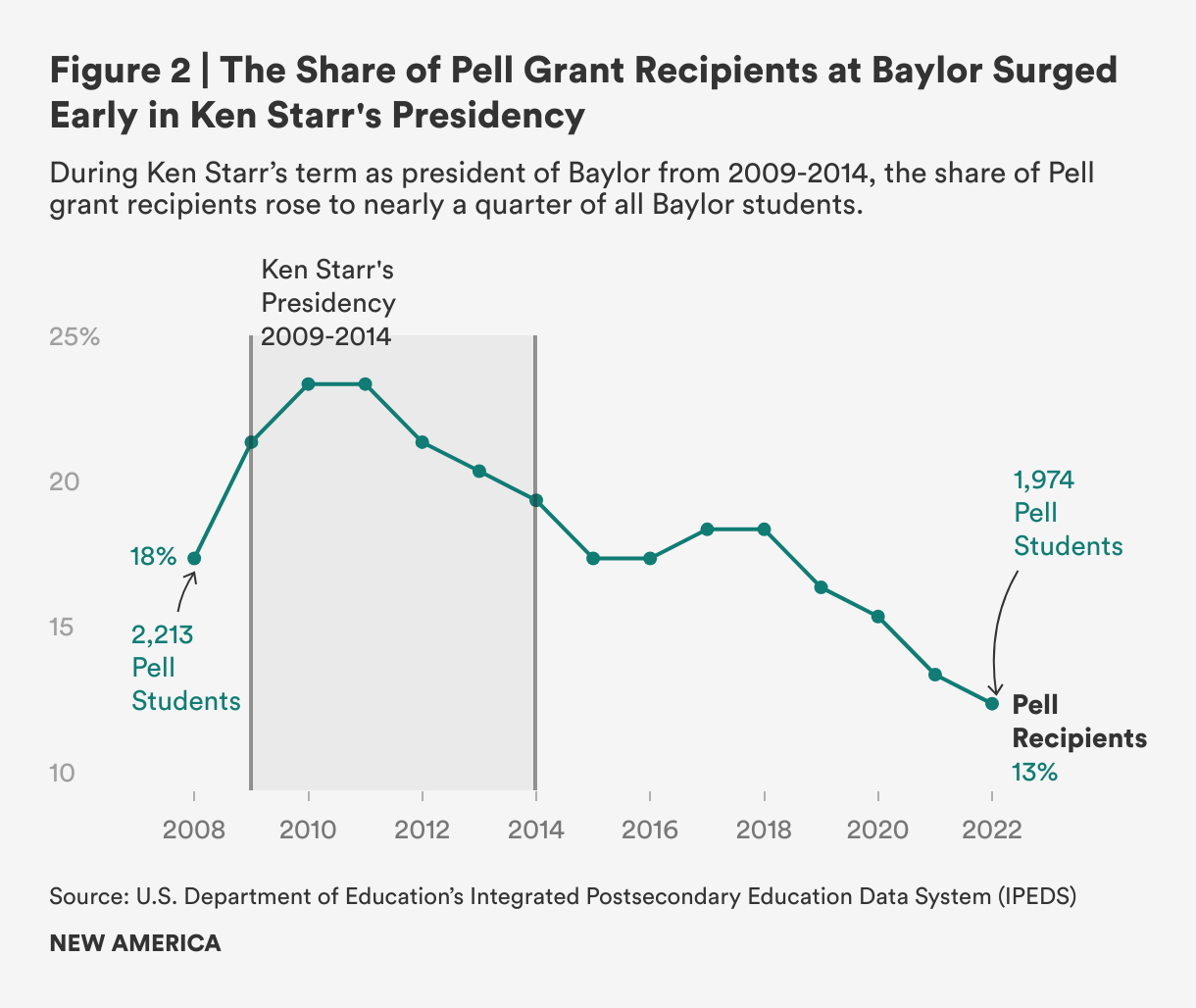
Baylor’s inability or unwillingness to adequately support low- and lower-middle-income students, however, did not discourage university officials from seeking them out. If anything, they recruited these students even more aggressively. Between 2010 and 2015, recipients of Pell Grants, the federal government’s primary source of funding for low-income students, grew to one-fifth or more of the student body annually.
Why would Baylor aggressively recruit low-income students if it could not adequately support them? And why would the university steer those students’ families to PLUS loans they most likely couldn’t repay? The answer to those questions came down to the outsize ambitions Baylor’s leaders had for the institution and the financial resources it would take to achieve them.
Founded in 1845 on the banks of the Brazos River in Waco, Texas, Baylor, for generations, offered a relatively affordable education to the offspring of middle-class Baptist families. But by the turn of the twenty-first century, Baylor officials set a lofty goal: to become the country’s top Protestant higher education institution, the Baptist version of the University of Notre Dame.4 To accomplish such an ambitious feat, the university needed lots of money.5 As a result, Baylor officials hiked up tuition—by as much as 40 percent per year. They also borrowed hundreds of millions in the bond market, allowing them to go on a building and faculty-hiring spree. And they hired the private enrollment management consulting firm Noel Levitz (which later merged with the enrollment and fundraising management company RuffaloCODY and became Ruffalo Noel Levitz) to help them develop admissions and financial aid strategies and algorithms to increase the university’s revenue and raise its U.S. News & World Report ranking.6 They knew that rising in the rankings would make the university more appealing to the upscale students and families they were hoping to attract.
At the enrollment management company’s urging, the university began engaging in an enrollment management practice known as financial aid leveraging or financial aid optimization, in which analysts determine the precise price points at which colleges can enroll different groups of students without spending a dollar more than is necessary.7 At selective colleges, both private and public, the largest discounts go to the students the institution want the most: typically, the highest-achieving applicants, who can help the institutions rise up the rankings and the wealthiest, who even with the tuition break, can boost the schools’ bottom line.8 While less affluent students will receive some aid, those dollars are unlikely to come anywhere close to meeting their financial need. As a result, low-income families have little choice but to borrow hefty Parent PLUS loans, which they are often unlikely to be able to repay, to cover those gaps.9
Many selective colleges use financial-aid leveraging strategies for only a subset of their students, and some may use a portion of the additional revenue they receive from recruiting affluent students to boost need-based aid at their institutions. However, the country’s largest enrollment management firms aggressively market financial aid leveraging or optimization products that are designed to help public and private colleges and universities to use all of their aid to pursue the most desirable prospective students and boost their bottom lines. As EAB, the giant enrollment management consulting company, states in its marketing materials, “Our Financial Aid Optimization program ensures that every dollar you commit to aid is used to further your enrollment and net tuition revenue goals.”10
Where colleges once used their institutional aid to meet students’ financial need, enrollment management industry officials now have a different view of what it should be used for. “The concept is to award financial aid in a way that results in the maximum total amount of net tuition revenue for the institution,” Nathan Mueller, the leader of EAB’s financial aid optimization team, told Higher Ed Dive in 2023.11
One way for a college to use financial aid to increase net revenue is to provide discounts to lure more wealthy students to its campus who, even with the discounts, will ultimately pay more than less advantaged students and have families who may be willing to make substantial donations to the institution. But another way is for the college to encourage a large number of low-income students to enroll and steer their families to Parent PLUS loans, as Baylor did. After all, for colleges, Parent PLUS loans are easy credit they can offer low-income families to cover their funding gaps.12 PLUS loans are readily available, so long as potential borrowers don’t have bad credit. And because colleges are not held accountable if borrowers go into default on this debt, administrators don’t have to worry about how hazardous these loans may be for students’ families. As a 2019 Urban Institute report stated, the PLUS loan program is “a no-strings-attached revenue source for colleges and universities, with the risk shared only by parents and the government,” which loses money if borrowers default.13
Confronted by The Wall Street Journal journalists, Linda Livingstone, Baylor’s president, acknowledged that her predecessors had acted irresponsibly by enrolling “students who really couldn’t afford Baylor.” She pledged to do better. “My heart goes out to families that are in that situation,” she told the newspaper. “We are working very, very hard to ensure that we don’t see that so much going forward.”14
While Livingstone’s sympathy provides cold comfort for the families who were encouraged to take on this debt, she has lived up to her promise to make Baylor more affordable for low-income students and their families. Under the new Baylor Benefit Scholarship Program, the university waives tuition and fees for students from families with annual incomes of $50,000 or less.15 The program is paying off, as the retention rate for low-income students at the university has shot up.16
There is a catch, though. In order to afford the tuition waivers, Baylor had to substantially pare back the share of Pell Grant recipients it enrolled, to about 13 percent of its students. The university, however, should never have been enrolling such a large share, Wesley Null, Baylor’s vice provost for undergraduate education and institutional effectiveness, said during a conference session he led last fall. “Baylor’s Pell percentage—you go back six or seven years ago—was crazy high,” Null stated. “¹ú²úÊÓƵ 25 or 26 percent of our undergraduate population were Pell eligible, and we were not serving those students well.”17
It would be tempting to take solace in what’s happening at Baylor. The Wall Street Journal article pushed the university to abandon a destructive policy that harmed low-income students and their families, and to embrace a new policy that made the institution more accessible and affordable for them. However, Baylor is hardly the only university steering low-income families to Parent PLUS loans. In fact, leaving low- and lower-middle-income students with substantial amounts of unmet financial need and encouraging their families to take out Parent PLUS loans is part and parcel of the financial aid leveraging strategies that the giant for-profit enrollment management firms, such as EAB, have been pushing colleges to use in awarding their institutional aid.18
The Wall Street Journal journalists recognized that these practices are widespread. The article led off by stating, “Some of the wealthiest U.S. colleges are steering parents into no-limit federal loans to cover rising tuition, leaving many poor and middle-class families with debt they can’t repay.”19 The article cited several other wealthy private universities “with relatively low Parent PLUS repayment rates and high numbers of borrowers from low-income backgrounds,” such as New York University, Syracuse University, Texas Christian University, and the University of Miami.20 But because the article focused almost entirely on Baylor, these other schools did not feel pressure to change their practices. Meanwhile, the private enrollment management firms that market financial aid leveraging products to colleges escaped scrutiny altogether.
By encouraging universities, both private and public, to increase their net revenue by reeling in low-income students and steering their families to Parent PLUS loans, the financial aid leveraging strategies that enrollment management firms like EAB and Ruffalo Noel Levitz market push their clients to engage in a process of predatory inclusion.
Predatory inclusion is when a marginalized group is given access to a service, good, or opportunity, but the conditions of access jeopardize the benefits. As the sociologists Louise Seamster and Raphaël Charron-Chénier wrote in 2017:
Processes of predatory inclusion are often presented as providing marginalized individuals with opportunities for social and economic progress. In the long term, however, predatory inclusion reproduces inequality and insecurity for some while allowing already dominant social actors to derive significant profits.21
Sociologists often point to subprime mortgage lending as a premier example of predatory inclusion. Banks long refused to provide mortgages to Black households. In recent decades, a subprime mortgage lending field emerged, offering the promise of homeownership. But the terms and conditions of the mortgages were so punitive that default and foreclosure were almost guaranteed.
In higher education, for-profit colleges, private student loan companies, and online program managers (OPMs)—for-profit companies that create and manage online courses and programs for public and private colleges and universities—have all been accused of engaging in predatory inclusion.22 Financial aid leveraging strategies and products that saddle low-income families with tens of thousands of dollars of debt they are unlikely to be able to repay need to be considered through the same lens. Yes, these universities are providing higher education access to these students, but at the potential cost of financial ruin for their families. That’s too high a price to pay, particularly given the wealth and power of these institutions.
This report is the first in a three-part series examining these policies and practices. It provides a history of Baylor’s pursuit of national prominence over the past several decades and shows how those ambitions led the university to embrace financial aid leveraging and put its most marginalized students’ families in jeopardy. It also takes a closer look at how Baylor has recently made the institution more affordable for low-income students and their families and suggests that other universities follow its lead.
The second report in the series will examine how widespread these hazardous practices are at both private and public universities. And the third part will offer solutions for reining in the enrollment management industry and making higher education more accessible and affordable for low- and lower-middle-income students and their families.
Baylor is now doing the right thing for its low-income students and families. Other colleges that have been steering these families to Parent PLUS loans should take notice. It shouldn’t take an exposé in a national newspaper to wake them up to the nightmare they are causing.
Citations
- Tawnell D. Hobbs and Andrea Fuller, “How Baylor Steered Lower-Income Parents to Debt They Couldn’t Afford,” The Wall Street Journal, October 13, 2021, .
- Hobbs and Fuller, “How Baylor Steered Lower-Income Parents,” .
- Rachel Fishman, The Wealth Gap PLUS Debt: How Federal Loans Exacerbate Inequality for Black Families (¹ú²úÊÓƵ, 2016), 6, source.
- Naomi Schaefer Riley, “At Baylor University, a Struggle Over Mind and Soul,” The New York Times, September 8, 2004, .
- Jessica Luther, “How Baylor Happened,” Deadspin, February 5, 2019, .
- Ben Gose, “Colleges Turn to Consultants to Shape the Freshman Class,” The Chronicle of Higher Education, May 7, 1999, .
- Gose, “Colleges Turn to Consultants,” .
- Matthew Quirk, “The Best Class Money Can Buy,” The Atlantic, November 2005, .
- Stephen J. Burd, “The Dangerous Game of Financial Aid Leveraging,” in Lifting the Veil on Enrollment Management: How a Powerful Industry Is Limiting Social Mobility in American Higher Education, ed. Stephen J. Burd (Harvard Education Press, 2024), 153–173.
- EAB, “Solutions: Financial Aid Optimization,” .
- Lilah Burke, “Why Colleges Are Using Algorithms to Determine Financial Aid Levels,” Higher Ed Dive, September 5, 2023, .
- Fishman, The Wealth Gap PLUS Debt, source.
- Sandy Baum, Kristin Blagg, and Rachel Fishman, Reshaping Parent PLUS Loans: Recommendations for Reforming the Parent PLUS Program (Urban Institute, April 2019), 4, .
- Hobbs and Fuller, “How Baylor Steered Lower-Income Parents,” .
- Baylor University, “Baylor Benefit Scholarship,” .
- Wesley Null (Baylor University vice provost for undergraduate education and institutional effectiveness), in discussions with the author, April 2025.
- Wesley Null and Lynn Wisely, “Baylor University: SEM Change Management, Year 2,” AACRAO’s Strategic Enrollment Management Conference, Boston, MA, November 5, 2024.
- Burd, “The Dangerous Game of Financial Aid Leveraging.”
- Hobbs and Fuller, “How Baylor Steered Lower-Income Parents,” .
- Hobbs and Fuller, “How Baylor Steered Lower-Income Parents,” .
- Louise Seamster and Raphaël Charron-Chénier, “Predatory Inclusion and Education Debt: Rethinking the Racial Wealth Gap,” Social Currents 4, no. 3 (2017): 200, doi: 10.1177/2329496516686620.
- Seamster and Charron-Chénier, “Predatory Inclusion and Education Debt,” Mapping Exploitation: Examining For-Profit Colleges as Financial Predators in Communities of Color (Student Borrower Protection Center, July 21, 2021), ; and Amber Villalobos, “Online College Programs Increasingly Put Black and Hispanic Students at Risk,” The Century Foundation, November 17, 2023, .
Becoming a “Modern University”
The idea that Baylor could rise to national prominence would have seemed far-fetched in 1990. For much of the higher education world, the university seemed to be stuck in the dark ages.
One of the oldest private universities in the country, Baylor is affiliated with the Baptist General Convention of Texas, which has tightened its grip over the institution at various times during its history. For example, in the 1980s, the convention’s fundamentalist wing required Baylor professors to sign a “statement of faith,” in which they pledged to adhere to fundamentalist beliefs on issues such as creationism and homosexuality in their teaching.1
At the time, Baylor was probably most widely known and mocked for prohibiting dancing on campus. In 1990, an effort to overturn the then-145-year-long ban failed, even though Baylor’s president and the university’s board chairman had both signaled their support for ending it.2 Baylor’s leaders said that they maintained the ban to honor the university’s “unique Christian atmosphere.” But behind the scenes, Baylor officials acknowledged that they were afraid that ending the prohibition would provoke the fundamentalist faction to try to wrest control of the institution by taking over the Baptist convention. “These guys are after power,” one Baylor trustee told The New York Times. “In time, they will outnumber us.”3
Baylor was now “a modern university,” as one student said, and it was going places.
University officials knew that if they wanted to move Baylor forward and improve its reputation, they would have to keep the fundamentalists at bay. Otherwise, they feared that Baylor would become “an Oral Roberts University, or a dying West Texas Bible School,” as one conservative Baptist preacher, who believed the university’s fears were unfounded, told The Chronicle of Higher Education.4
To avoid such a fate, Baylor’s leaders did an end run around the Baptist General Convention in the fall of 1990, secretly changing the university’s charter to create a largely independent governing board.5 When the news got out, the convention considered suing Baylor for acting unilaterally and defying its authority. However, the convention’s moderate majority ultimately approved the changes in 1991.6 Baylor officials saw this victory as a crucial first step to achieving higher ambitions. “We can now devote 100 percent of our efforts to making Baylor again the greatest Christian [higher education] institution on the face of the Earth,” declared Randall H. Fields, who was the president of the Baylor Alumni Association at the time.7
Five years later, Baylor lifted the much-reviled dancing ban. With this move, the university’s leaders hoped to send a message to the rest of the higher education world: Baylor was now “a modern university,” as one student said, and it was going places.8
Citations
- Schaefer Riley, “At Baylor University,” .
- “Campus Life: Baylor: A Ban on Dancing Survives Another Test,” The New York Times, August 12, 1990, .
- “Campus Life: Baylor,” .
- “Baylor U. Removes Itself from Baptist Control,” The Chronicle of Higher Education, October 31, 1990, .
- “Baylor U. Removes Itself from Baptist Control,” .
- Associated Press, “Fundamentalists Lose Bid to Control Baylor,” The Washington Post, November 11, 1991, .
- Schaefer Riley, “At Baylor University,” .
- Lucy Ruscitto, “Baylor’s 1996 Lift of the On-Campus Boogie Ban,” Baylor Lariat, October 5, 2020, .
Financial Aid Leveraging Comes to Baylor
Now that Baylor officials had vanquished the fundamentalist threat and overturned the dancing ban, they turned their attention to changing how the university recruited students. Like many colleges seeking to raise their stature by rising up the U.S. News rankings, Baylor in 1997 hired the private enrollment management consulting firm Noel Levitz to help bring the university’s student recruiting practices into the modern era.1
Up to this point, Baylor had not been particularly strategic in seeking prospective students. Students applied, and the admissions office picked out the best applicants. All applicants received a similar amount of attention from admissions officers. Stan Madden, who became the admissions director shortly before the university turned to Noel Levitz, told The Chronicle of Higher Education that previously the admissions office pretty much “just mail[ed] everything out and hope[d] for the best.”2
The consultants’ first task was to create a predictive analytics system that would help Baylor identify “red-hot” prospects: the best students who were likely to enroll, if pursued.3 The system would rank prospective students, using data that the university had collected about them. Top scores went to high-achieving students from affluent families who had exhibited interest in the school by visiting the campus more than once and who lived in communities that had sent a lot of students to Baylor. The university’s admissions staff would then focus predominantly on wooing these students.4
In the course of their work, the consultants concluded that Baylor was not using its institutional financial aid effectively to attract top prospects. The university already awarded some non-need-based aid to try to bring in better students. However, the biggest merit aid awards were going to students who appealed their aid packages and asked the university to match aid offers from other colleges. The result was that “Baylor ‘had given away the farm’ to some mediocre students who were adept at negotiating with the financial aid office, while stronger students ended up with less-generous offers and chose to attend college elsewhere,” The Chronicle reported.5
Instead, the consultants suggested that Baylor use financial aid leveraging to boost its net revenue and rankings.6 Enrollment managers use financial aid leveraging to determine the precise price points that it will take to enroll different groups of students without spending a dollar more than needed. At selective colleges, the largest discounts go to the students they want the most: typically, the best applicants, and those who otherwise can pay full freight and help boost the institutional bottom line.
In his book The Debt Trap, The Wall Street Journal’s Josh Mitchell explains the role that the enrollment management companies play in financial aid leveraging:
Firms like Ruffalo Noel Levitz helps schools determine how much to discount for each student to make as much money as possible overall. The firms use hundreds of variables—including race, home address, SAT scores, parental education level, and wealth, and even how many times the student visited campus during recruiting—to gauge each student’s “price sensitivity.” That phrase refers to how much his or her family might be willing and able to pay. The firms study the behavior of the past three years of freshman classes and then suggest, down to the dollar, what the school should charge students of different characteristics.7
Working with Noel Levitz, Baylor began to leverage its aid and was pleased with the initial results. Enrollments were up, incoming students’ SAT scores were on the rise, and so was net revenue. The amount of aid that Baylor was offering “may not be as much as students want,” Madden, Baylor’s then-admissions director, told The Chronicle. “But it’s often enough to get them here.”8
In adopting financial aid leveraging, Baylor increased the amount of non-need-based aid it was awarding. In 2000, the university gave out about $13 million to non-needy students, the thirty-first highest among selective colleges that year in terms of merit aid. ¹ú²úÊÓƵ one-third of first-year students received an average non-need-based aid award of $5,500 each.9
Citations
- Gose, “Colleges Turn to Consultants,” .
- Gose, “Colleges Turn to Consultants,” .
- Gose, “Colleges Turn to Consultants,” .
- Gose, “Colleges Turn to Consultants,” .
- Gose, “Colleges Turn to Consultants,” .
- Gose, “Colleges Turn to Consultants,” .
- Josh Mitchell, The Debt Trap: How Student Loans Became a National Catastrophe (Simon & Schuster, 2021), 179.
- Gose, “Colleges Turn to Consultants,” .
- Data on Baylor’s yearly spending on non-need-based aid and on the share of freshmen receiving these awards comes from an annual survey that the college guidebook publisher Peterson’s conducts of colleges and universities. ¹ú²úÊÓƵ licensed data from Peterson’s “Undergraduate Financial Aid and Undergraduate Databases,” 2024.
Baylor on the Rise?
When Baylor officials started engaging in enrollment management and financial aid leveraging, they signaled that they wanted to improve the university’s reputation and standing. But just how high were their ambitions? The answer arrived in 2002, and it was “the sky’s the limit.”
That year, Baylor’s president, Robert B. Sloan, introduced a ten-year plan, named “Baylor 2012,” that aimed to “put Baylor in the upper echelon of American universities, while reaffirming and strengthening our Christian mission.”1 According to The New York Times, Baylor’s goal was “to remake itself into a national Christian university on the model of Notre Dame.”2
To carry out its plan, Baylor hiked up its tuition—by 44 percent the first year and by 30 percent or more annually in the following years—to catch up with what top-tier colleges were charging.3 The university also issued nearly $250 million in bonds and went on a building spree to upgrade facilities and add top-shelf amenities that the affluent students and families they hoped to attract have come to expect, including more-upscale dorms.4 The scale of construction and renovation sent the message that Baylor was a campus on the rise. “The 158-year-old university looks like it just came out of the catalog,” Texas Monthly reported in 2003. “Baylor, the pride of Waco, is changing.”5
Baylor officials not only wanted to change the look of the campus but to enhance the academic profile of its students.
Baylor officials not only wanted to change the look of the campus but to enhance the academic profile of its students. At the heart of “Baylor 2012” was the aspiration to “attract and support a top-tier student body.” The university “will recruit a student body of high academic merit, Christian character, commitment to service and potential for leadership,” the plan stated. “We will seek students from a range of backgrounds to enrich our community and, through scholarships and other forms of support, will further enhance Baylor’s student profile,” it said.6
To attract these high-achieving students, the university established an honors college where the best and brightest could thrive. And during Sloan’s presidency, the university nearly doubled the amount it spent on non-need-based aid to attract these students, from about $16 million (the twenty-second highest among private selective colleges) in 2001 to nearly $30 million (the ninth highest) in 2005.7 And by jacking up its sticker price, Baylor officials were able to provide steeper tuition discounts to the students they coveted the most. The average award the university provided non-needy freshmen during that time period rose from about $6,000 to $11,000, a 70 percent increase.8
Despite all the hype and activity, “Baylor 2012” did not go off without a hitch. In fact, the problems started almost immediately. The university fell hundreds of freshmen short of its enrollment targets in the fall of 2002, causing it to bring in far less revenue than expected. This shortfall was particularly untimely because the university had to start making payments on the bonds it had issued for its building spree. As a result, Baylor cut its operating costs and froze faculty and staff hiring. These freezes continued into the 2003–04 academic year, after the university once again missed its enrollment targets, by a smaller margin this time.9
But even these problems paled in comparison to a much bigger, and more existential, crisis going on at the university. The Baylor community was deeply divided over President Sloan’s heavy-handed leadership style and decision-making. The majority of faculty members opposed Sloan, accusing him of being a “control freak” who created “an atmosphere of fear and intimidation” on campus.10 In September 2003, the faculty senate overwhelming approved a vote of no-confidence in the president, saying, “Dr. Sloan’s presidency has produced a chilling work environment, a climate characterized by distrust, anxiety, intimidation, favoritism, as well as about the sanctity of academic freedom and professional standards.”11
Soon after the vote, two opposing groups of alumni formed to wage publicity campaigns for and against Sloan. The Committee to Restore Integrity to Baylor (CRIB) opposed Sloan and expressed alarm at the direction the university was heading. The group’s president, who had worked for an earlier and more-moderate administration at Baylor, said that CRIB wanted to “call attention to the kind of violation that we believed was going on concerning Baylor’s historic mission of providing a reasonably priced education, primarily for the people of Texas, in the traditional, historic Baptist framework with a world mission in mind to prepare students to compete and live in the contemporary world.”12 On the opposing side were the members of Friends of Baylor, who argued that Sloan’s muscular leadership was essential to forcing the kinds of changes Baylor needed to propel the university to national prominence.
Baylor’s board of trustees ultimately took a middle ground approach, forcing Sloan to step down but urging his successor—John Lilley, an alumnus who previously served as president of the University of Nevada at Reno—to continue pursuing the “Baylor 2012” plan.13
During his tenure, Lilley helped grow Baylor’s endowment to over $1 billion.14 Campus construction continued apace. And the university continued using its financial aid to pursue high-achieving students. From 2006 through 2008, the university increased its spending on non-need-based aid from about $35 million (eleventh highest among selective private colleges that year) to $43 million (the eighth highest) annually, a 25 percent increase.15
Unfortunately, for Lilley, the scars left over from the battles over Sloan’s presidency were not easily healed. Members of the Friends of Baylor managed to get on the Board of Regents, and they were not in the mood for reconciliation after Sloan’s ouster.16 The board fired Lilley, saying he had failed his main task. “The reality is the board lost the confidence in John’s ability to unite the various Baylor constituencies,” the board chairman said during a news conference. Stronger, but less divisive, leadership was needed.17
Citations
- Michael Hall, “God and Man at Baylor,” Texas Monthly, October 2003, .
- Schaefer Riley, “At Baylor University,” .
- Schaefer Riley, “At Baylor University,” ; and Hall, “God and Man at Baylor,” .
- Schaefer Riley, “At Baylor University,” .
- Hall, “God and Man at Baylor,” .
- Baylor University, “Baylor 2012, Imperative IV: Attract and Support a Top-Tier Student Body,” .
- Peterson’s, “Undergraduate Financial Aid and Undergraduate Databases.”
- Peterson’s, “Undergraduate Financial Aid and Undergraduate Databases.”
- “The Real Story,” The Baylor Line, April 3, 2018, .
- Hall, “God and Man at Baylor,” .
- “The Real Story,” .
- “The Real Story,” .
- Jack Stripling, “Baylor Fires Its President,” Inside Higher Ed, July 24, 2008, .
- Baylor University, “¹ú²úÊÓƵ Baylor: John M. Lilley: Baylor President, 2006–2008,” .
- Peterson’s, “Undergraduate Financial Aid and Undergraduate Databases.”
- “The Real Story,” .
- Stripling, “Baylor Fires Its President,” .
Playing the Rankings Game
Despite the leadership turmoil, Baylor officials continued their efforts to improve the university’s academic profile and propel the institution up the U.S. News & World Report rankings.
The university had some success in this pursuit (Baylor’s ranking had risen from the mid-90s in the 1990s to 75 in 2007), although not as much as it would have liked. In a post on the university’s website, officials acknowledged that were no quick fixes to get a “top tier” rank by 2012: “Moving the needle to the ‘top 50’ range is a long-term effort requiring sustained and consistent effort.”1
But that didn’t mean they couldn’t try. In the summer of 2008, Baylor made an offer to incoming freshmen that was difficult to pass up. The university said it would give students it had already admitted a $300 credit at the campus bookstore if they agreed to retake the SAT. Students who raised their scores by at least 50 points were guaranteed an additional $1,000 merit scholarship. Those who increased their scores even further could qualify “for a higher-level merit-based Baylor Gold Scholarship,” according to an e-mail message the school sent these students outlining the offer.2 Ultimately, 861 students retook the exam, with 17 percent raising their score by 50 points or more.3
Speaking to the student newspaper, a senior Baylor official acknowledged that the school hoped higher scores would improve the school’s ranking. “People do pay attention to test scores,” said Reagan Ramsower, Baylor’s vice president for finance at the time. “The university does benefit from higher average scores, and students benefitted from book credits. It’s a win-win situation.”4
Citations
- Beckie Supiano and Eric Hoover, “Baylor U. Offered Financial Incentives to Freshmen Who Retook the SAT,” The Chronicle of Higher Education, October 15, 2008, .
- Supiano and Hoover, “Baylor U. Offered Financial Incentives,” .
- Supiano and Hoover, “Baylor U. Offered Financial Incentives,” .
- Stephen Burd, Undermining Pell: Vol. II (¹ú²úÊÓƵ, 2014), source.
A “New Era for Baylor”
When Baylor’s regents searched for a new president, they wanted a leader who would thrust the university onto the national stage—someone who was ambitious and tenacious enough to take the steps needed to propel Baylor to the top, consequences be damned.
They found that leader in Ken Starr, the former solicitor general and independent counsel who infamously led the investigation into the sex scandal that nearly brought down President Bill Clinton. In 1998, Starr, who also had been a federal judge and law school dean, and Clinton shared the honor of being Time Magazine’s “Person of the Year.”1 To highlight Starr’s legal career and national stature, Baylor held his inauguration in 2010 on Constitution Day and handed out pocket copies of the Constitution to the more than 4,000 people who attended the ceremony or related events that weekend.2
By all accounts, Starr helped calm the tensions with faculty that had roiled the campus over the past decade and endeared himself to students.3 The mandate that the regents gave Starr was for “increasing Baylor’s influence in the nation and the world.”4 Starr quickly found a vehicle for achieving this mission: gridiron success.
Baylor was part of the Big 12 Conference, but its football team had never really distinguished itself. The team had not had a 10-win season since 1980.5 The “Baylor 2012” plan had stressed the need for Baylor to “build with integrity a winning athletic tradition in all sports.”6 In 2007, the university hired a star college football coach, Art Briles, to lead the Baylor Bears. And by the time Starr arrived, the fruits of the coach’s labor were starting to show. In 2011, Baylor quarterback Robert Griffin won the university’s first Heisman Trophy as the best college football player. The team won its first Big 12 championship in 2013 and then did so again in 2014.
To capitalize on the Bears’ success, Starr devoted himself to raising the money needed to build a $266-million football stadium on the north bank of the Brazos River, adjacent to the campus. The unveiling of McLane Stadium—“a breathtaking football cathedral,” as The New York Times reported—occurred on the night of August 31, 2014, the first game of the new season.7 The Bears destroyed Southern Methodist University 45–0. Former President George W. Bush was on hand to conduct the pre-game coin toss.8
Earlier that year, Starr had declared that “success in athletics means that all boats rise,” and his gamble on football dominance was paying off.9 Baylor’s reputation was rising and demand for the university was surging, with application and enrollment numbers breaking records yearly.
But as much as athletics success paid off, Baylor had more than one tool in its enrollment management toolbox. To reel in the students it most desired, Baylor, with the help of private enrollment management consultants, increased the amount of non-need-based aid it awarded by more than 60 percent, from $47 million to $83 million, between the fall of 2010, when Starr arrived, to the fall 2014.10 That year, Baylor ranked fifth among all selective private universities in terms of how much money it was annually spending on merit aid for non-needy students (see Figure 1).11
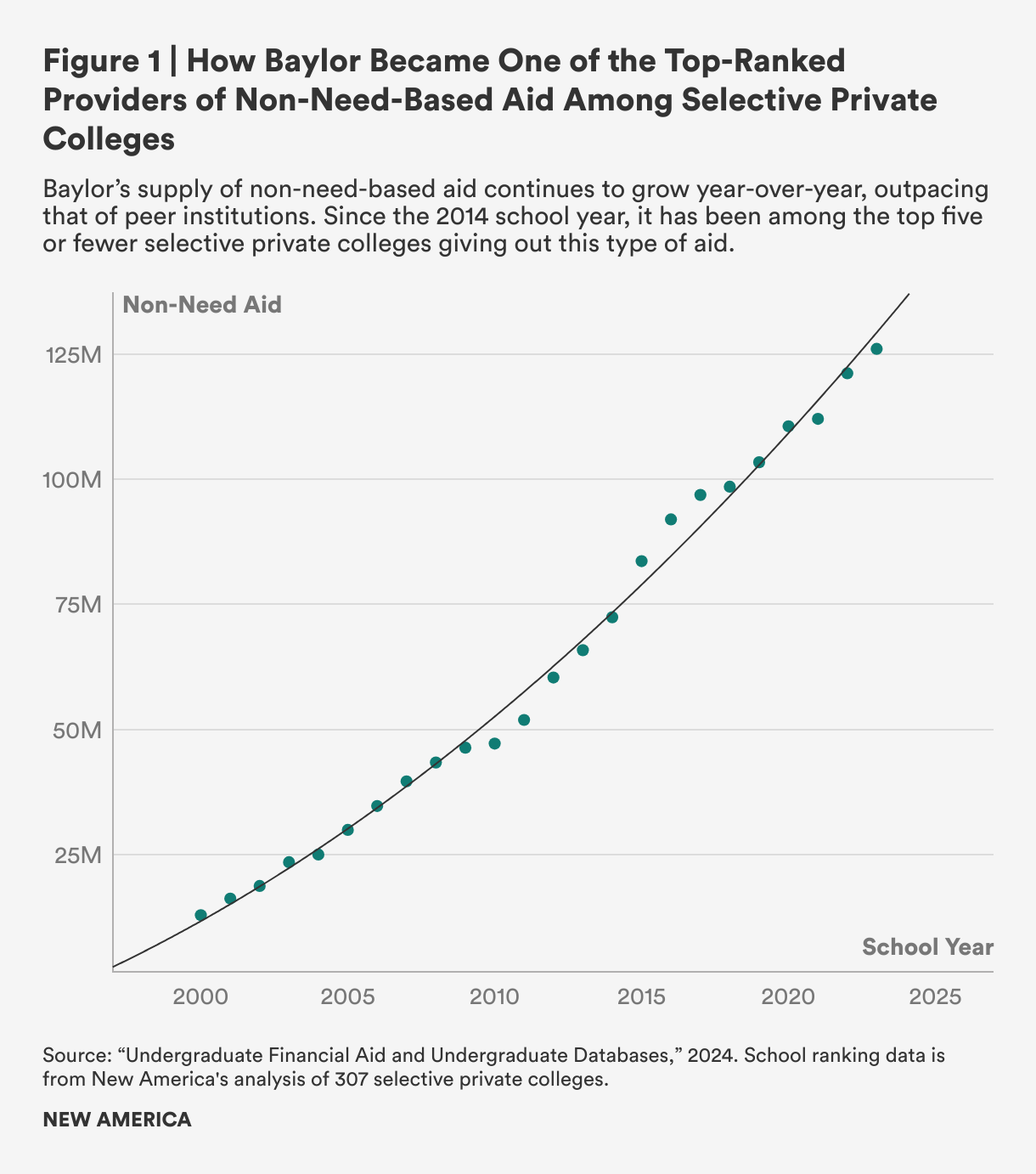
With the rapid rise in applications and the aggressive use of financial aid leveraging, the university became much more selective. Its acceptance rate dropped from 61 percent in 2012 to 55 percent in 2014.12 And because the U.S. News rankings reward selectivity above all else, the university achieved its best ranking to date in 2014, reaching 71, up from 75 in 2007.13
The crushing victory against Southern Methodist in the brand spanking new stadium, with the former U.S. president in the stands, was the high watermark for Starr’s leadership. Soon after, he recorded his feelings in Baylor’s alumni magazine:
We often lift up thanks for our campus situated on the edge of the Brazos River, but the campus never shone so gloriously as it did on August 31 when we grandly opened our stunning McLane Stadium. In vibrant images broadcast on national television to tens of millions of households across the globe, we flung “our green and gold afar.” Viewers beheld firsthand the spectacular beauty not only of McLane Stadium, but of our campus and community as well. This is truly a new era for Baylor…
Just prior to our McLane Stadium opening celebrations, we welcomed the largest incoming class in the University’s history….Combined with similarly strong incoming classes in recent years, this year’s class of new students—one of the most academically prepared and diverse in our long history—has lifted Baylor to its seventh consecutive total enrollment record. We give thanks that demand for a transformational Baylor University education stands at an all-time high.14
However, behind the victories on the football field and in the university’s enrollment management office lurked some terrible secrets that Starr and his colleagues either were unaware of or kept under wraps, hoping that they would never see the light of day. These secrets turned into scandals that not only led to Starr’s downfall and harmed the university’s reputation, but damaged, and may have even destroyed, people’s lives.15
Citations
- Sue Ambrose and David Tarrant, “The Silence of Ken Starr,” The Dallas Morning News, May 5, 2016, .
- Baylor University, “Media and Public Relations: Baylor University Inaugurates Ken Starr as University’s 14th President,” September 17, 2010, .
- Matthew Watkins, “Under Starr’s Presidency, Baylor Watched Golden Age Turn Sour,” The Texas Tribune, May 31, 2016, .
- Ambrose and Tarrant, “The Silence of Ken Starr,” .
- Watkins, “Under Starr’s Presidency, Baylor Watched Golden Age Turn Sour,” .
- Baylor University, “Baylor 2012, Imperative X: Build with Integrity a Winning Athletic Tradition in All Sports,” .
- Marc Tracy and Dan Barry, “The Rise, Then Shame, of Baylor Nation,” The New York Times, March 9, 2017, .
- Watkins, “Under Starr’s Presidency, Baylor Watched Golden Age Turn Sour,” .
- Tracy and Barry, “The Rise, Then Shame, of Baylor Nation,” .
- Peterson’s, “Undergraduate Financial Aid and Undergraduate Databases.”
- Peterson’s, “Undergraduate Financial Aid and Undergraduate Databases.”
- Colleges and universities report annual data on their acceptance rates to the U.S. Department of Education’s Integrated Postsecondary Education Data System (IPEDS).
- Baylor University, “Baylor Reaches Highest-Ever U.S. News Ranking,” Baylor Magazine, November 1, 2014, .
- Ken Starr, “From the President,” Baylor University, Baylor Magazine, November 1, 2014, .
- Paula Lavigne and Mark Schlabach, Violated: Exposing Rape at Baylor University Amid College Football’s Sexual Assault Crisis (Center Street, 2017).
Losing Its “Moral Compass”
The first signs of trouble came in 2014 when a former linebacker with the Baylor Bears was charged with and convicted of raping a female classmate. A year later, a defensive end, who had a troubled history before Baylor recruited him for the team, stood trial over similar allegations. That case drew national attention and soon it became clear that these were not isolated incidents.1 The university’s Board of Regents eventually acknowledged that 19 football players had sexually assaulted 17 female students from 2011 to 2016, including carrying out four gang rapes.2 A lawsuit against the university alleged that the number of players and victims involved was far higher.3
And it also became clear that these crimes were not limited to the football team. An official who was brought on eventually to investigate these cases calculated that students had made over 400 allegations of sexual assault or harassment during this time, 90 percent of which did not involve athletes.4 These revelations sent shock waves through the Baptist campus, which forbade undergraduates from engaging in premarital sex as well as from drinking. These prohibitions appear to have discouraged women from reporting sexual assaults because they feared or were even told by university officials that they could be penalized for violating them. “A number of victims were told that if they made a report of rape, their parents would be informed of the details of where they were and what they were doing,” an attorney told journalists in 2016.5
“By God’s grace, we are living in the golden era at Baylor,” Ken Starr had declared to the university community in August 2015.6 Less than a year later, he was out of his job. The university demoted Starr (who left Baylor soon afterward) after a law firm he hired to investigate the university’s handling of sexual assault cases concluded that “Baylor was making its students less safe.”7 The report found that the university “failed to consistently support” women who had been raped, discouraging them from filing reports.8 And the report found that Briles, the football coach, and his staff had repeatedly met with rape victims without alerting other university officials of the allegations. The university regents fired Briles after receiving the report.
These horrors have done lasting damage to Baylor’s reputation and standing. As Matthew Watkins of The Texas Tribune wrote, the narrative around the institution shifted: “Suddenly, the national story of a private university out-punching its weight was replaced by one of a Christian school whose outsize ambitions caused it to lose its moral compass.”9
Citations
- Luther, “How Baylor Happened,” .
- Brad Reagan, “Baylor Regents Found Alleged Sexual Assaults by Football Players ‘Horrifying,’” The Wall Street Journal, October 28, 2016, .
- Luther, “How Baylor Happened,” .
- Michael Powell, “Baylor’s Handling of Rape Cases Still Follows Ken Starr,” The New York Times, January 19, 2020, .
- Luther, “How Baylor Happened,” .
- Powell, “Baylor’s Handling of Rape Cases,” .
- Watkins, “Under Starr’s Presidency, Baylor Watched Golden Age Turn Sour,” .
- Watkins, “Under Starr’s Presidency, Baylor Watched Golden Age Turn Sour,” .
- Watkins, “Under Starr’s Presidency, Baylor Watched Golden Age Turn Sour,” .
An Enrollment Management Scandal
The sexual assault catastrophe was not the only scandal at Baylor under Starr’s watch. A separate scandal, news of which did not break until long after the former independent counsel had left campus, received far less attention than the first but threatened to do great financial harm to vulnerable students and their families. And it too showed how the university had, in its quest for greater status and glory, “lost its moral compass.”1
In October 2021, The Wall Street Journal revealed that Baylor had been steering low- and lower-middle income families to take out “no limit” Parent PLUS loans as part of the university’s efforts to help pay for the costs associated with its ambitions “to transform itself from a regionally known Baptist college into a national brand.”2 By pushing low-income parents to take out PLUS loans, Baylor would receive the money up front from the government, without having to worry whether the families would be capable of paying the debt back.
The article cited U.S. Department of Education College Scorecard data showing that about 47 percent of PLUS loan borrowers with kids who graduated from Baylor in 2018 and 2019 were the parents of Pell Grant recipients.3 They incurred a median of $43,500 in PLUS debt while their children were in college. Meanwhile, the Scorecard data showed that “only about a quarter of Baylor parents paid down any of what they originally borrowed after two years,” the article stated.4
This situation likely started before Starr arrived at Baylor, as university officials were desperate to make payments on the $250 million bonds the university had issued when Sloan was president.5 However, it accelerated under Starr, as the university became more aggressive in recruiting low-income students. From 2009–10 through 2014–15, recipients of Pell Grants, the federal government’s primary source of funding for low-income students, made up 20 percent or more of the university’s students (see Figure 2). In two of those years, 2010–11 and 2011–12, they made up nearly one-quarter of the student body.6
The Wall Street Journal reporters revealed that some of the university’s recruiters had serious reservations about the institution’s aggressive pursuit of low- and lower-middle-income students:
Annabeth Mohon, a former Baylor admissions counselor and 2014 graduate, felt so conflicted about visiting poor neighborhoods in Texas to sell prospective students on a college they couldn’t afford that she left after a year on the job in 2015. “I felt like a real jerk,” said Ms. Mohon.7
Normally college access advocates would applaud a school for enrolling so many low-income students. It is important to remember, however, that Baylor did not make available the resources to adequately support them. During the Starr years, the university regularly met less than 70 percent of the financial need of student aid recipients at the university, far less than many other wealthy private colleges and universities covered at the time.8
It is also important to remember that under the financial aid leveraging programs that private enrollment management firms aggressively market to colleges, institutional aid is not used to meet financial need. With enrollment managers primarily focused on increasing colleges’ net revenue and rankings, covering low-income students’ financial need is considered inefficient and wasteful. Instead, enrollment managers are concerned with using aid to reel in the students they most desire, without spending a dollar more than necessary.9 By 2016, Baylor awarded about $92 million in non-need-based aid. ¹ú²úÊÓƵ two-fifths of freshmen received a non-need-based aid award of nearly $18,000 each.10
“Aid leveraging is an analytical tool that enables admissions and financial aid administrators to estimate the amount of financial aid (regardless of formal need formulas) that would be necessary to increase the probability that a student with a specified set of characteristics would enroll,” Donald Hossler wrote in 2000, when he was Indiana University at Bloomington’s vice chancellor of enrollment services. “This approach raises tuition and uses large portions of the increase to provide financial aid to prospective colleges students to induce them to matriculate,” he explained. “Although these financial aid inducements might be used to meet student financial need, the intent behind the strategy is to use the award as a merit award that will help individual campuses more effectively ‘court’ or recruit students with higher grades, with more talent, or with lower levels of financial need.”11
Ever since the introduction of the “Baylor 2012” plan in 2002, the financial aid funding gaps (the yearly cost of attendance minus the amount of grants and scholarships offered) that the lowest-income students faced grew steadily because the university had become so much more expensive. “Though Baylor still charges less than many other wealthy [private] colleges, its tuition grew the most among wealthy schools in the Journal’s analysis of available federal data,” The Wall Street Journal article stated. “Baylor charges about 2.6 times as much as it did two decades ago, accounting for inflation.”12 During Starr’s presidency, students from families making $30,000 or less paid an average net price of about $32,000, after adjusting for inflation—which was more than they earned in a year.13 As a result, these families had little choice but to borrow PLUS loans if they wanted to send their children to Baylor.
In their quest for institutional greatness, Baylor’s leaders turned a blind eye to the collateral damage their policies caused. Just as they tried to bury the complaints of women who had been sexually assaulted, they did not give a second thought about the possibility of putting families who were already struggling economically into severe financial distress.
But it is hard to see how encouraging low-income parents to take on debt they most likely won’t be able to repay will end in anything but disaster for these families.
Citations
- Watkins, “Under Starr’s Presidency, Baylor Watched Golden Age Turn Sour,” .
- Hobbs and Fuller, “How Baylor Steered Lower-Income Parents,” .
- The PLUS loan borrowing data are produced for rolling two-year pooled cohorts for the U.S. Department of Education’s College Scorecard. In this case, the cohort consists of PLUS loan borrowers who are the families of Pell Grant recipients who graduated in 2017–18 and 2018–19.
- The PLUS loan borrowing data are produced for rolling two-year pooled cohorts for the U.S. Department of Education’s College Scorecard. In this case, the cohort consists of PLUS loan borrowers who are the families of Pell Grant recipients who graduated in 2017–18 and 2018–19.
- Luther, “How Baylor Happened,” .
- Colleges and universities report annual data on the share of Pell Grant recipients in their student bodies to the U.S. Department of Education’s Integrated Postsecondary Education Data System (IPEDS).
- Hobbs and Fuller, “How Baylor Steered Lower-Income Parents,” .
- Hobbs and Fuller, “How Baylor Steered Lower-Income Parents,” .
- Burd, “The Dangerous Game of Financial Aid Leveraging.”
- Peterson’s, “Undergraduate Financial Aid and Undergraduate Databases.”
- Donald Hossler, “The Role of Financial Aid in Enrollment Management” in The Role Student Aid Plays in Enrollment Management, ed. Michael D. Coomes (Jossey-Bass Publishers, 2000), 83.
- Hobbs and Fuller, “How Baylor Steered Lower-Income Parents,” .
- Colleges report the average net-price-by-income data annually the U.S. Department of Education’s Integrated Postsecondary Education Data System (IPEDS), which displays the school-by-school data on its College Navigator site. Baylor’s data can be found at .
Conclusion
When Linda Livingstone became Baylor’s fifteenth president in 2017, she took on an enormous task: to clean up the sexual assault scandal that brought down her predecessor and restore the university’s reputation.1 To her credit, Livingstone came to see, even before The Wall Street Journal article came out, that the university had been putting low- and lower-middle-income students’ families in harm’s way and made it a priority to do better by them.
As a result, the university steadily reduced the share of Pell Grant recipients it enrolled, from 19 percent in 2018–19 to 13 percent by 2022–23. And university administrators began contacting incoming students who had financial aid funding gaps exceeding $5,000 “to discuss lower cost options,” such as “starting at a community college and transferring to Baylor, or sitting out a semester to work,” according to The Wall Street Journal.2 In addition, they began considering options for lowering the price for low-income students, including waiving tuition and fees.
All of these changes were aligned with Livingstone’s goal to improve student retention and graduation rates. Livingstone still had high aspirations for Baylor—to be a top-tier research university—but she wanted to approach these aspirations in a more responsible manner than her predecessors.
And that’s, in part, why The Wall Street Journal exposé was such a gut punch to university officials, who felt that they had turned a page on the Starr era. “My reaction was that Baylor was a very different institution at the time I was reading the article than the time the article was discussing,” Wesley Null, Baylor’s vice provost for undergraduate education and institutional effectiveness, said in an interview. “The article used three-, four-, or five-year-old data, so I was reading about an institution that didn’t exist anymore,” he said.3
While the article stung, it did have a positive effect: It built support within the institution for the proposal to lower the cost of attendance for low-income students. The university put the Baylor Benefit Scholarship Program in place in 2023, waiving tuition and fees for students from families with annual incomes of $50,000 or less. The program covers about half of the Pell Grant recipients who attend the institution. Low-income students who transfer to Baylor are not yet eligible for the benefit.
Baylor officials have been excited to see that student outcomes have substantially improved since the program’s inception. Pell Grant recipients have historically dropped out of Baylor after their freshman year at much higher rates than the overall student body. But now they are outperforming their classmates in terms of coming back for a second year. “For the first time in Baylor’s history, Pell students are pulling up the university’s average retention rates,” said Null. “The program is working.”4
Null and his colleagues would like to expand the program, either by widening eligibility for it or by making the program more beneficial for current recipients, by covering books or even housing. But they said that it’s difficult to fight for such changes at the same time the Trump administration is considering reducing federal student aid spending and slashing research funding. “Right now, there are so many pressures,” Null said. “It’s just a matter of what you’re going to pay for.”5
While university officials have turned the page on the Starr years, not everyone is so lucky. Take Kayla Foots, who was the first in her family to go to a four-year college when she entered Baylor in 2010, and her mother, a school bus driver.6
Kayla Foots’s mother and stepfather took out about $157,000 in Parent PLUS loans to send her to Baylor. Her family has been scrimping and saving to try to make payments on these loans since Kayla graduated in 2014. They did not make a lot of progress until the federal government wiped away about $100,000 of the debt when her stepfather died in 2020. “That is so crazy and so sad that that was the silver lining out of the situation,” Kayla told The Wall Street Journal.7
The Foots family is one of thousands that Baylor steered to Parent PLUS loans while it was on its quest for national recognition. Many of these families are struggling to make payments or have given up already. And they are not alone, because many other colleges and universities use enrollment management firms’ financial aid leveraging products and strategies that encourage them to engage in the same kind of predatory inclusion tactics as Baylor.8 These institutions have padded their bottom lines by putting low-income families in harm’s way.
We will not know the full extent of the crisis for a while, because students and parents did not have to make payments on loans for three years during the COVID pandemic. And the Biden administration did not collect on defaulted student loans for the next two years. President Trump has resumed student and parent loan collections, with much fanfare. Kayla’s family and many others may be caught in the crosshairs.
Citations
- Matthew Watkins, “How Baylor’s New President Plans to Move the School Past Scandal,” The Texas Tribune, June 13, 2017, .
- Hobbs and Fuller, “How Baylor Steered Lower-Income Parents,” .
- Null, in discussions with the author.
- Null, in discussions with the author.
- Null, in discussions with the author.
- Hobbs and Fuller, “How Baylor Steered Lower-Income Parents,” .
- Hobbs and Fuller, “How Baylor Steered Lower-Income Parents,” .
- Burd, “The Dangerous Game of Financial Aid Leveraging.”
More ¹ú²úÊÓƵ the Authors

Stephen Burd
Senior Writer & Editor, Higher Education
Issues
Programs/Projects/Initiatives
Related