The Realistic Promise of Multiparty Democracy in the United States
Abstract
In April 2023, ¹ú²úÊÓƵ, the Center for Ballot Freedom, Protect Democracy, Lyceum Labs, and Stanford University’s Center for Democracy, Development and the Rule of Law convened a conference at Stanford University on the future of political parties in the United States. The conference, titled “More Parties, Better Parties,” focused on the idea that U.S. democracy would benefit from stronger and more representative parties and that essential to that vision was opportunity for more parties beyond the current party duopoly to emerge. The essays in this collection, derived from papers prepared for the conference, trace the following argument: Parties are essential institutions in a democracy; there is an unjustified hostility to parties in much American political discourse; and fluid and overlapping coalitions of a multiparty system can improve governance and confidence. We then look at the promise of fusion voting, a practice once widespread and now prohibited in most states, which could allow new parties to gain a foothold by cross-endorsing candidates from established parties.
Acknowledgments
This report would not have been possible without the “More Parties, Better Parties” conference organizing committee, which included Maresa Strano, Mark Schmitt, Lee Drutman, Oscar Pocasangre, Lizbeth Lucero, Didi Kuo, Beau Tremitiere, Daniel Stid, Dave Palmer, Dan Cantor, Joel Rogers, Nate Ela, and Micah Sifry.
Many thanks also to Kelley Gardner, Jodi Narde, Joe Wilkes, Naomi Morduch Toubman, Simon Brown, and David Lanham for their communications and editorial support.
Finally, we would like to thank Additional Ventures for their generous support of the “More Parties, Better Parties” conference, Political Reform program at ¹ú²úÊÓƵ, and our research on multiparty democracy.
Editorial disclosure: The views expressed in this report are solely those of the authors and do not reflect the views of ¹ú²úÊÓƵ, its staff, fellows, funders, or its board of directors.
Downloads
Introduction (Mark Schmitt)
Democracy as we practice it in the United States looks quite different from the roughly 100 other democracies in the world. The most notable trait unique to the U.S. is that, while political parties emerge in all democracies, ours has had just two meaningful parties—the same two—for more than 170 years. There is no other democracy in which not one sustainable, influential new party has emerged at the national or even regional level in the last 100 years.
Because democratic self-government is a collaborative venture, political parties are essential institutions, as Didi Kuo demonstrates in her essay in this collection. Parties enable people to work together toward shared or overlapping policy goals. Parties help voters clarify policy choices and broader ideological agendas, appreciate what’s possible, and identify candidates and ideas compatible with their views. Political parties, at their best, also help people develop those views by offering them a coherent agenda and bringing them into solidarity with others, either within their geographic communities or across their state or the country. Without parties that offer a consistent agenda, voters—or those who choose not to vote—are left entirely on their own to figure out the issues, their own preferences, and the candidates. That’s a difficult task for anyone in a complex world.
At times in the twentieth century, parties have even served as core institutions of civil society, forging social and community bonds and acting as direct intermediaries between people and government. At other moments, parties have challenged the political consensus of the time, or introduced new ideas or moral claims to the agenda. And contrary to the conventional wisdom in America that partisanship is the opposite of compromise, parties actually facilitate compromise because they create formal structures in which leaders can effectively negotiate on behalf of their constituents—whether legislators (as in the case of bargaining among congressional leaders) or voters—and form new coalitions.
But parties cannot perform these functions effectively in a stagnant framework in which there are only two, representing broad but starkly opposed ideological visions and aligned with distinct racial and regional constituencies.1 That’s particularly true in an electoral and legislative structure governed by winner-take-all elections. Today’s Democratic and Republican blocs are “hollow parties,” as Daniel Schlozman and Sam Rosenfeld argue in a book of that name; they are at once “overbearing and ineffectual.”2 They are too ideologically variegated to present a clear national program and too professionalized to reach voters directly where they live, instead becoming largely vehicles to raise and allocate money.
Partisan alliances are tight and unyielding: The vast majority of voters now support one party or the other exclusively, in national as well as local elections that increasingly turn on national issues. All but a few congressional districts cast their votes for presidential, senatorial, congressional, and state-level candidates of the same party. But for all the apparent loyalty they engender from voters, these conglomerate parties no longer serve as meaningful civic institutions or embodiments of a coherent ideological platform. Both major parties are clearer about what they’re against—the culture and ideas of the other party and its adherents—than about what they’re for. Thus political scientists find that “negative partisanship,” even more than affirmative party allegiances, drives political behavior and makes conflicts difficult to reconcile.
“These conglomerate parties no longer serve as meaningful civic institutions or embodiments of a coherent ideological platform.”
One of the major parties, the Republican bloc, is now composed of so many factions that in the House of Representatives they refer to “five families” of legislators that in 2023 descended into a month-long struggle to elect a Speaker of the House. While the party once took pride in being guided by an “elevator pitch” policy agenda of smaller government, economic libertarianism, and social conservatism, its shared consensus seems, at the time of writing, to consist of loyalty to the impulses and grudges of a single political figure. Another elite faction that nominally remains within the party, often referred to as “Never-Trump Republicans,” is similarly defined by their feelings about that same individual. Neither of these views forms a sound basis for a political party.
The Democratic coalition in Congress and the electorate is also deeply factionalized, although even in opposition during the first two years of the Trump administration, and more recently while holding full or partial control of government since 2021, they have worked far more successfully than Republicans to find shared consensus on legislative priorities. Still, Rep. Alexandria Ocasio-Cortez’s comment, “In any other country, Joe Biden and I would not be in the same party, but in America, we are,” succinctly describes the dilemma faced by those who would like their viewpoint to be represented by something more concrete than a vaguely defined caucus.3
While Ocasio-Cortez’s “squad” and comparable factions, such as the House GOP Freedom Caucus, have some voice in Congress, they have no tangible presence among voters, who know them on the ballot only as Democrats or Republicans—or in some cases as individuals, in the case of candidates who have some celebrity, such as from appearances on Fox News or a career before politics. If these factions were parties, allying and forming coalitions with other parties on some issues but not all, they would be represented not only in the legislative body but matched by a coherent constituency in the electorate. As parties, they would present visible policy agendas and could be held accountable by voters with the same agendas. Other parties might emerge that seek to put new issues or perspectives on the agenda, such as a more ambitious approach to climate change or drug legalization. These would be parties that stand for something.
The political coalitions that would emerge in such a multiparty democracy would likely be shifting and overlapping. A socially conservative party that also favored strong government supports for families, such as an expanded child tax credit, might find common ground with Democrats on that point and conservative Republicans on others. Single-issue parties might emerge to find allies in both the major parties, and in turn, as smaller parties emerged, they would form coalitions with one another as well as the two incumbent parties. As Will Horne shows in his paper here, drawing on international comparisons, such fluid and overlapping coalitional models of governance tend to have a positive effect on confidence in government and trust in the parties.
A political environment composed of two stagnant parties, professionalized and overbroad, or “ineffectual and overbearing,” is one in which we should expect new parties to emerge and find their footing, just as we would in a market dominated by two older corporations with outdated business models. Yet this has not happened. Two parties with ballot access in many or most states, the Libertarian and Green parties, seem content to play marginal roles and participate primarily as potential spoilers at the presidential level. Other efforts, such as the possible presidential candidacy sponsored by the organization No Labels, specifically disclaim any intent to form a lasting political party or to operate at any level other than the presidential.
Because our parties are too broad, professionalized, and focused on fundraising, they lead voters not only to dislike the party they’re less aligned with—the negative partisanship that has driven recent elections—but also to dislike political parties in general, inducing voters to insist, “I vote for the person, not the party.” (In practice, those voters usually vote for candidates of one party.4) Americans’ hostility to parties also often leads to reform ideas that minimize the role of parties, such as the nonpartisan top-two primaries in California and Washington. This hostility, and preference for an idealized politics of pure individualism, is in itself a barrier to the formation of meaningful parties, as Julia Azari and Jennifer Wendling show in their essay.
“Our parties … lead voters not only to dislike the party they’re less aligned with … but also to dislike political parties in general.”
There is a basic feature of our electoral system that pushes it toward a two-party equilibrium: winner-take-all elections and the single-member districts that characterize Congress and our state legislatures. Both inherently lead to a stable two-party system, as the sociologist Maurice Duverger established in the 1950s with such strong evidence that it is known as Duverger’s Law. But while it is a good guide, it is not literally a law; it has not always held true, and there are other features of our system that reinforce the duopoly. Restrictive ballot access laws in many states make it difficult for a new party to qualify. States with public financing for campaigns often advantage established parties. Media-sponsored debates often exclude third-party candidates.
If having a larger number of parties capable of forming fluid coalitions and better representing voters is a worthy goal, there are two paths that might get us there. If we start by looking at other countries, we would find the solution in proportional representation and multi-member legislative districts. If seats were allocated by the share of the vote across a state or a large multi-member district, then the dominant party would win a majority or plurality of seats, and a second would win seats roughly in proportion to their share of the vote. And a third party that won just 10 percent of the vote might win some seats in Congress or a state legislature, putting them in a position to negotiate on behalf of their meaningful constituency. Coalitions would be built from the grassroots up, rather than just in Congress. Racial minorities would also be more likely to gain representation equivalent to their share of the population in a proportional system.
Proportional representation and multi-member districts would represent a dramatic change from current practice and would involve significant new legislation—which would have to be enacted by those elected under and vested in the existing system—as well as potential litigation. Proportional representation is a useful north star for building a robust multiparty, multiracial democracy, but it is not the only way to make it easier for new parties to get started and have some influence.
If instead of looking at other countries we look at our own past, we’ll see periods when new parties emerged, split, grew, and sometimes merged, despite the inherent limitations of winner-take-all elections. One such period was before the Civil War, when a number of parties, including the Whigs, the Free Soil Party, and the Liberty Party, competed before their effective consolidation into what became the anti-slavery Republican Party. Later in the nineteenth century, the People’s Party embodied the agrarian populist challenge to the oligarchy of the Gilded Age, and a decade later, Theodore Roosevelt’s Progressive Party and Eugene Debs’ Socialist Party created the most competitive four-way presidential election since 1860. (It is no coincidence that these periods coincided with moments of political crisis and democratic reinvention, not unlike our own time.)
What allowed those parties to form and evolve, despite the obstacles? One answer is fusion voting, a system that allows parties to endorse candidates who also appeared on the ballot lines of other parties. (In practice, until the 1890s, each party printed its own ballots, so a candidate might appear on more than one party’s ballot.) Fusion means that new parties do not have to be spoilers in every election; they might endorse a viable major party candidate for some offices and run their own candidates for others. In the 1890s in particular, the People’s Party fused with Democrats in some states and with progressive Republicans in others. Worry about the anti-establishment majorities that might be forged by these fusion tickets led to the major parties banning fusion in all but a few states. Lisa Disch’s article below shows how the history of fusion is relevant to the challenges of our moment.
While the Supreme Court in 1997 declined to overturn bans on fusion in all states, any state is free to reverse its ban and allow parties to cross-endorse on the ballot. In some cases, state courts might find that the fusion ban violates provisions of the state’s own constitution. In others, change might be achieved by voter initiative or referendum. In two states that still allow fusion, New York and Connecticut, the practice has allowed a variety of parties to emerge over decades, including the Liberal and Conservative parties in New York and the Working Families Party in both states. Oscar Pocasangre’s essay digs deep into the history of those two states to show the actual effects of fusion in elections since 1976, which has been considerable.
Together, these essays show the importance of strong political parties to a functioning democracy, the benefits of having more than two of them forming fluid coalitions, and a clear and viable path to opening the system up in a way that is likely to lead to a multiparty democracy in which all are represented.
Citations
- APSA Presidential Task Force on Political Parties, More than Red and Blue: Political Parties and American Democracy (Washington, DC: American Political Science Association and Protect Democracy, 2023), .
- Daniel Schlozman and Sam Rosenfeld, The Hollow Parties: The Many Pasts and Disordered Present of American Party Politics (Princeton, NJ: Princeton University Press, 2024).
- David Feelander, “One Year in Washington,” New York Magazine, January 6, 2020, .
- Lee Drutman, “The Moderate Middle is a Myth,” FiveThirtyEight, September 24, 2019, .
Political Parties Are Essential Democratic Institutions (Didi Kuo)
Americans are fed up with political parties. In poll after poll, they report trusting any number of institutions—including business leaders, the police, and journalists—more than they trust elected officials or the parties.1 The number of self-proclaimed independents is rising; many of them are turned off by the party system entirely, even if they tend to vote for one of the main parties.2 These trends parallel those in other longstanding democracies. In Western Europe, for example, parties have been losing members, with fewer voters joining parties or participating in party activities. Citizens of Asia, Africa, and Europe feel less trusting of parties today than in previous decades.3
In the United States, as organized advocacy for political reform has grown over the past decade, much of the focus has been on reforms that would circumvent or eliminate the role and influence of the two main parties. These reforms include open or blanket primaries—such as those in which the top two, four, or five finishers in the primary move on to the general election—as well as totally nonpartisan primaries. But weakening the role of parties in politics would diminish the crucial role they play in our democracy, and would likely only serve to make more Americans feel disconnected from politics. This essay provides a brief history of parties and democracy, focusing on the role of parties as sites both of representation and of political participation and deliberation.
Strong parties with roots in society are considered essential to long-term democratic stability and economic growth.4 Historically, ideological debates manifested themselves in the party system, with parties competing by offering distinct policies and visions to voters. The mass party organization—densely networked, local, labor-intensive parties that date from the late nineteenth to mid-twentieth century—was itself embedded in the lives of citizens.
The history of parties is the history of democracy itself—the history of how representation is built and how it becomes stable and permanent. Because parties emerged with, and in some cases, predated, the extension of suffrage, their histories are inextricably intertwined.5 Parties began as narrow legislative factions in limited democracies of the West. As democracy expanded to include non-property-owning males, parties connected candidates and representatives to voters, on the one hand, and to legislative coalitions on the other.6 As parties became national organizations, the “mass” in mass party referred not to the collective masses (i.e., a party that wins decisive majorities) but instead denoted a party with extensive networks within specific segments of society. These parties placed a premium on representational integrity—how well they channeled the interests of their base—rather than on how savvily they conducted campaigns.7
“The history of parties is the history of democracy itself—the history of how representation is built and how it becomes stable and permanent.”
Over time, parties became responsible for most of the work of democracy: They recruit and field candidates, manage election campaigns, aggregate and mediate competing interests, devise and pass policies, and mobilize the citizenry into politics. But we tend to focus exclusively on the electoral-legislative dimension of parties, both as scholars and as policy reformers. Parties today perform some of their responsibilities effectively. They are ideologically sorted and coherent; they vote together in the legislature; they are incredibly effective at campaigning and winning elections. But historically, parties have faced trade-offs in how they prioritize different tasks—whether maintaining local party organizations, fostering relationships with civic associations and community groups, selecting good candidates capable of winning elections, or passing policies that might address the needs of voters. Parties cannot do all of these things well, all of the time.
As Joseph Schumpeter famously argued, parties are engaged in a competitive struggle for the people’s vote. Much of the scholarship on parties therefore focuses on campaigns, elections, and legislative politics. The foremost theory of parties in the study of American politics tells us that parties are not intermediary organizations at all—they are merely “groups of policy demanders.”8 This makes parties susceptible to capture by narrowly organized private interests. As a result, they are more likely to be vehicles of political and economic inequality than they are vehicles of mass representation. Today’s “hollow parties” are a far cry from the organizational party of the mid-century.9
Attention devoted to the electoral-legislative dimension of parties neglects an equally important dimension: parties as membership and linkage organizations, rooted in society. Parties are critical to democratic stability not because they win elections, but because of their representational integrity—their ability to channel voters’ interests and translate them into the substance of party competition and policy. As parties have built up their capacities in the electoral arena, they have neglected many of the social ties once considered integral to their work. As Russell Muirhead and Nancy Rosenblum describe it, we now see “a failure of the elemental linkage function once attributed to parties…if parties cannot link the groups vying for power in the legislature with groups in the larger society, then legislatures, which are the heart of representative government, lose their connection to popular interests, wants, and passions, and representative government loses something of its legitimacy.”10
An alternative approach is to examine the capacity of parties to serve as intermediaries. Parties mediate the relationship between society and government, a responsibility that no other organizations perform. While social movements and issue organizations may represent interests, they do not govern. As the sociologist Stephanie Mudge has written, what matters are the dynamics of party representation, and “the key problematic, or concern, of the historical social science of parties, party politics, and party-political institutional order should be representation—as opposed to policies, votes and elections, demographics, or ideas—and within that concern, parties’ capacity to mediate.”11
Are parties effective intermediaries today? Few citizens feel connected to parties. A “relationship” to a party might entail receiving emails soliciting campaign contributions or following candidates on social media. It is not clear to voters or even to aspiring candidates how to access their local party offices, if and when they exist. While parties still claim to represent and speak for the people, they may have no connection to actual people. Instead, the campaign is a branding and advertising exercise. Candidates rely on support not from residents of their districts, but from far-away fans willing to donate money. The parties market their candidates through a vast network of political strategists and consultants.
While parties once reached citizens through membership and local party offices, they now rely on a politics industry—pollsters, strategists, and increasingly, data scientists—to target potential voters. As parties became more professional and campaign-oriented, they also became less responsive, shedding the representation and mobilization functions they once performed. Citizens are no longer recruited and socialized into parties through active engagement and community networks. Indeed, parties have outsourced many of their traditional intermediary and mobilization functions to outside groups.12 Advocacy coalitions, non-governmental organizations, lobbying firms, media, and social movements now provide messages and information to voters, rather than parties. As a result, voters are likely to hear about the failures of parties, rather than hear parties defend and justify how political decisions are made. As parties have abdicated their traditional intermediary roles, trust in parties has plummeted and party membership has reached historic lows.
“As parties became more professional and campaign-oriented, they also became less responsive, shedding the representation and mobilization functions they once performed.”
In 1988, Angelo Panebianco described the rise of the “electoral-professional party.”13 These parties were oriented toward issues, rather than ideology, and toward leaders, rather than members. These parties were likely to become more dependent on interest groups and single-advocacy groups to do the work of representing citizens and to depend on technicians, rather than party bureaucrats, to formulate policy.
Panebianco’s description of the electoral-professional party led him to predict the “dissolution of parties as organizations….[They will] be only convenient tags for independent political entrepreneurs.”14 Mass media and television made campaigns more candidate-centered, and as a result, parties would increasingly specialize in public relations and advertising. Communications technology also made parties more dependent on pollsters, who could now gauge public opinion in more efficient, supposedly accurate ways.15
A deep suspicion of political parties indicates a broader erosion of faith in liberal democracy. Increasing numbers of voters feel that parties are corrupt and cannot be trusted or that they care only about short-term goals rather than the public good. Many politicians spend their time currying favor with donors, lobbyists, and allies who help them maintain their hold on power.16 There is also ample empirical evidence of a gap in responsiveness. Wealthy voters are more likely to get their preferences implemented into policy, particularly on redistribution and taxation issues.17 Issues of policy responsiveness are not limited to the United States; policies tend to reflect the preferences of high-income voters in Western European countries as well.18
Parties with a traditional working-class base or ties to organized labor—which, in the past, have been important channels for recruiting and electing working-class representatives—have also become more elite, and not only in the United States. Elected representatives come from highly educated, professional backgrounds, with incomes far above those of their constituents.19 In 1945, 56 percent of representatives in the House and 75 percent of Senators had college degrees, while in 2021, 94 percent of House members and all Senators graduated from college—and 66 percent and 75 percent, respectively, have graduate degrees.20 Education is a salient political cleavage, with college-educated voters increasingly more likely to support Democrats than Republicans. While 60 percent of white voters without college degrees voted for Bill Clinton, in 2020, only 27 percent supported Joe Biden.21
The blurring of class distinctions and the emerging educational divide has made both U.S. parties seem captured by the elite and nonresponsive to the working classes. There is a structural imbalance of power at the heart of the wealthy democracies today that seems insurmountable through routine politics alone.22 Further, the anti-democratic ideas and individuals mobilizing on the far-right are attempting hostage takeovers of mainstream center-right parties as well as democratic governments themselves.
“There is a structural imbalance of power at the heart of the wealthy democracies today that seems insurmountable through routine politics alone.”
This simply makes the issue of party reform more urgent, rather than more hopeless. A democracy of the future that is more inclusive, more equitable, and more just will require reasserting and repurposing parties, rather than rejecting or displacing them. As Theda Skocpol has written, “there cannot be any going back to the civic world we have lost. But Americans can and should look for ways to recreate the best of our civic past in new forms suited to a renewed democratic future.”23
Citations
- Lee Rainie, Scott Keeter, and Andrew Perrin, “Trust and Distrust in America,” Pew Research Center, July 22, 2019, .
- Samara Klar and Yanna Krupnikov, Independent Politics: How American Disdain for Parties Leads to Political Inaction (Cambridge: Cambridge University Press, 2016).
- The Global State of Democracy 2019: Addressing the Ills, Reviving the Promise (Stockholm: International Institute for Democracy and Electoral Assistance, 2019), .
- Steven Levitsky and Daniel Ziblatt, How Democracies Die (New York: Crown Publishers, 2018); Seymour M. Lipset and Stein Rokkan, Party Systems and Voter Alignments: Cross-National Perspectives (New York: Free Press, 1967); Scott Mainwaring and Timothy Scully, Building Democratic Institutions: Party Systems in Latin America (Cambridge: Cambridge University Press, 1995): 1–34; Nancy Bermeo and Deborah J. Yashar, Parties, Movements, and Democracy in the Developing World (Cambridge: Cambridge University Press, 2017); Fernando Bizzarro John Gerring, Carl Henrik Knutsen, Allen Hicken, Michael Bernhard, Svend-Erik Skaaning, Michael Coppedge, and Staffan I. Lindberg, “Party Strength and Economic Growth,” World Politics 70, no. 2 (2018): 275–320, .
- One of the pithiest and most popular quips about parties comes from the political scientist E. E. Schattschneider, who wrote in his 1942 volume Party Government that “the political parties created democracy, and…modern democracy is unthinkable save in terms of the parties.”
- Political scientist V.O. Key famously distinguished between party organizations, parties in office, and parties in the electorate.
- Maurice Duverger, Political Parties: Their Organization and Activity in the Modern State (London: Methuen, 1951); Moisei Ostrogorski, Democracy and the Organization of Political Parties (Garden City, NY: Anchor Books, 1903); Robert Michels, “Political Parties: A Sociological Study of the Oligarchical Tendencies of Modern Democracy,” translated by Eden Paul and Cedar Paul (New York: Hearst’s International Library Co., 1915), ; Otto Kirchheimer, “The Transformation of the Western European Party Systems,” in Political Parties and Political Development, ed. Joseph LaPalombara and Myron Weiner (Princeton, NJ: Princeton University Press, 1966): 177–200.
- Kathleen Bawn, Martin Cohen, David Karol, Seth Masket, Hans Noel, and John Zaller, “A Theory of Political Parties: Groups, Policy Demands and Nominations in American Politics,” Perspectives on Politics 10, no. 3 (2012): 571–597, .
- Daniel Schlozman and Sam Rosenfeld, “The Hollow Parties,” in Can America Govern Itself?, ed. Frances E. Lee and Nolan McCarty (Cambridge: Cambridge University Press, 2019): 120–152; Julia R. Azari, “Weak Parties, Strong Partisanship,” presented at the Annual Meeting of the American Political Science Association, 2018.
- Russel Muirhead and Nancy L. Rosenblum, “The Political Theory Of Parties and Partisanship: Catching Up,” Annual Review of Political Science 23 (May 2020): 95–110, .
- Stephanie L. Mudge, Leftism Reinvented: Western Parties from Socialism to Neoliberalism (Cambridge, MA: Harvard University Press, 2018).
- Bruce E. Cain and Cody Gray, “Parties by Design: Pluralist Party Reform in a Polarized Era,” New York University Law Review 93 (October 2018): 621–646, ; Joseph Fishkin and Heather K. Gerken, “The Party’s Over: McCutcheon, Shadow Parties, and the Future of the Party System,” Supreme Court Review 2014, no. 1 (2015): 175–214, ; Richard H. Pildes, “Romanticizing Democracy, Political Fragmentation, and the Decline of American Government,” Yale Law Journal (2014): 806–852, ; Samuel Issacharoff, “Outsourcing Politics: the Hostile Takeover of our Hollowed-Out Political Parties,” Houston Law Review Frankel Lecture Series 54 (April 2017), .
- Angelo Panebianco, Political Parties: Organization and Power (Cambridge: Cambridge University Press, 1988).
- Panebianco, Political Parties, 274.
- See also work by Otto Kirchheimer, The Transformation of the Western European Party Systems (Princeton: Princeton University Press, 1966): 177–200, ; Richard Katz and Peter Mair, “Changing Models of Party Organization and Party Democracy: The Emergence of the Cartel Party,” Party Politics 1, no. 1 (1995): 5–28, .
- Nicholas Carnes, White-Collar Government: The Hidden Role of Class in Economic Policy Making (Chicago: University of Chicago Press, 2013); Tabatha Abu El-Haj, “Networking the Party: First Amendment Rights and the Pursuit of Responsive Party Government,” Columbia Law Review 118, no. 1 (2018): 1–76, ; Adam Bonica and Maya Sen, The Judicial Tug of War: How Lawyers, Politicians, and Ideological Incentives Shape the American Judiciary (Cambridge: Cambridge University Press, 2020).
- Jacob Hacker and Paul Pierson, Winner-Take-All Politics: How Washington Made the Rich Richer—and Turned Its Back on the Middle Class (New York: Simon & Schuster, 2011); Jacob Hacker and Paul Pierson, Let them Eat Tweets: How the Right Rules in an Age of Extreme Inequality (New York: Liveright, 2020); Benjamin Page and Martin Gilens, Democracy in America?: What Has Gone Wrong and What We Can Do ¹ú²úÊÓƵ It (Chicago: University of Chicago Press, 2017).
- Mikael Persson, “From opinions to policies: Examining the links between citizens, representatives, and policy change,” Electoral Studies 74 (December 2021), ; Lea Elsässer, Svenja Hense, and Armin Schäfer, “Not Just Money: Unequal Responsiveness in Egalitarian Democracies,” Journal of European Public Policy 28, no. 12 (2021): 1890–1908, ; Noam Lupu and Alejandro Tirado Castro, “Unequal Policy Responsiveness in Spain,” Socio-Economic Review 21, no. 3 (2022): 1697–1720, ; Mads Andreas Elkjaer, “What Drives Unequal Policy Responsiveness? Assessing the Role of Informational Asymmetries in Economic Policy Making,” Comparative Political Studies 53, no. 14 (2020): 2213–2245, .
- Bonica and Sen, The Judicial Tug of War; Geoffrey Evans and James Tilley, The New Politics of Class: The Political Exclusion of the British Working Class (Oxford: Oxford University Press, 2017); Jonathan Klick, “The Wealth of Congress,” Harvard Journal of Law & Public Policy 40, no. 3 (2017): 603–637, .
- Katherine Shaeffer, “The changing face of Congress in 8 charts,” Pew Research Center, February 7, 2023, .
- Nate Cohn, “How Educational Differences Are Widening America’s Political Rift,” New York Times, September 8, 2021, .
- Hacker and Pierson, Let Them Eat Tweets; Robert Kuttner, Can Democracy Survive Global Capitalism? (New York: W. W. Norton, 2018); Wolfgang Streeck, Buying Time: The Delayed Crisis of Democratic Capitalism (London: Verso, 2014); Fred Block, Capitalism: The Future of an Illusion (Berkeley, CA: University of California Press, 2018); Wendy Brown, Undoing the Demos: Neoliberalism’s Stealth Revolution (New York: Zone Books, 2015).
- Theda Skocpol, “Advocates without Members: The Recent Transformation of American Civic Life,” in Civic Engagement in American Democracy, ed. Theda Skocpol and Morris P. Fiorina (Washington, DC: Brookings Institution Press, 1999): 461–510.
Do Americans Hate Political Parties? (Julia Azari and Jennifer Wendling)
That Americans bear a unique antipathy toward political parties is a familiar, uncontroversial idea. But what does it really mean? The classic and contemporary literature on this topic incorporates many different causes for skepticism about parties.
One persistent idea is that political parties create division and undermine the public good. Richard Hofstadter identifies three strains of anti-party political thought in the eighteenth century: that parties create conflict where it wouldn’t exist otherwise, preventing society from being governed by consensus; that the creation of parties and factions could allow for a narrow segment of society to impose tyranny on others; and that party politics would run counter to civic virtue and detract from the pursuit of the public good.1 John Hibbing and Elizabeth Theiss-Morse find that the American public “is ecstatically supportive” of reforms that include the disempowerment of party leaders in Congress.2 Also writing about public evaluations of Congress, Mark Ramirez observes, “the public perceives partisan conflict as a waste of time and resources that could be spent trying to solve the nation’s problems rather than trying to put the other party down for personal or partisan electoral gains.”3
In a study of political independents, Samara Klar and Yanna Krupnikov examined the psychological motivations of independents who are really “closet partisans”—consistent in their partisan behavior but attentive to social cues about the pitfalls of parties. Klar and Krupnikov observe that “individuals are more likely to perceive parties negatively when they believe partisanship as a whole is associated with negative traits.” They place these perceptions into a larger political context, arguing, “In recent years, parties have been portrayed by media less as principled representatives and more as cranky children who do not want to share.”4 In other words, the contemporary impression that parties are trivia-minded, divisive, and motivated by blind team loyalty appear to be both historically informed and prevalent in contemporary discourse about parties.
The second idea is what Nancy Rosenblum calls “progressive anti-partisanship.” Around the turn of the twentieth century, cartoonists pilloried “bosses” as corrupt fat cats who controlled politics and diverted public resources for their own benefit. The perception of parties as corrupt, devoid of meaningful ideas, and run by elites who are self-interested, unaccountable, and greedy has not only been the source of anti-party reforms of the kind seen in the early twentieth century. It has also spurred anti-party movements like Ross Perot’s Reform party. The idea that twenty-first century parties are too much alike seems beyond comprehension to all but the most committed ideologues. But the sense that parties are corrupt, unresponsive, and impenetrable institutions with goals other than serving the people has not fallen away from contemporary discourse.
The dynamics of the 2016 election refocused scholarly attention on parties as organizations. A recent body of scholarship has sought to illuminate how the parties and their nomination processes are perceived by both voters and party activists.5
There are two important points to take away from the existing literature on the anti-party question. First, there are many potential explanations for U.S. antipathy toward parties, each with very different theoretical implications, and implications for the attitudes about parties under conditions of hyper-partisanship. Second, recent studies about parties and nomination rules have mixed findings about how partisans and even party activists perceive the role of parties as institutions. By looking at how Americans answer open-ended questions about their level of confidence in parties, we can get more insight into some of these questions.
The Puzzle of Anti-Partyism
Despite the place of anti-party feelings in the conventional wisdom about American political culture, anti-party attitudes are not well-understood. A sweep of poll questions in the Roper iPoll archive reveals responses to poll questions about parties that vary widely and are vulnerable to the structure of question wording and options. Throughout the past fifty years, parties and party systems have received ambivalent reviews. Polls about the 2016 process revealed suspicion about excessive elite involvement in nominations. Yet when asked if they would like more political parties, U.S. respondents often say yes. In Stealth Democracy, Hibbing and Theiss-Morse found that a substantial number of Americans say they want to ban political parties—but an even higher percentage want to see a new party emerge.6 This pattern of responses reveals a puzzle: Americans want parties to offer lots of choice, yet not be too divisive. Taken together, these responses reveal an appreciation for the role of political parties, despite deep distrust of parties as institutions.
“A substantial number of Americans say they want to ban political parties—but an even higher percentage want to see a new party emerge.”
Our analysis of attitudes about political parties draws primarily from the Baker Institutional Confidence poll. This poll was conducted by the survey firm YouGov in 2018, when the project surveyed 5,400 respondents, with an oversample of Black, Latinx, and Asian Americans.7 The researchers asked about levels of institutional confidence in a variety of political, social, and economic institutions. These questions were also accompanied by open-ended responses for some of the institutions.
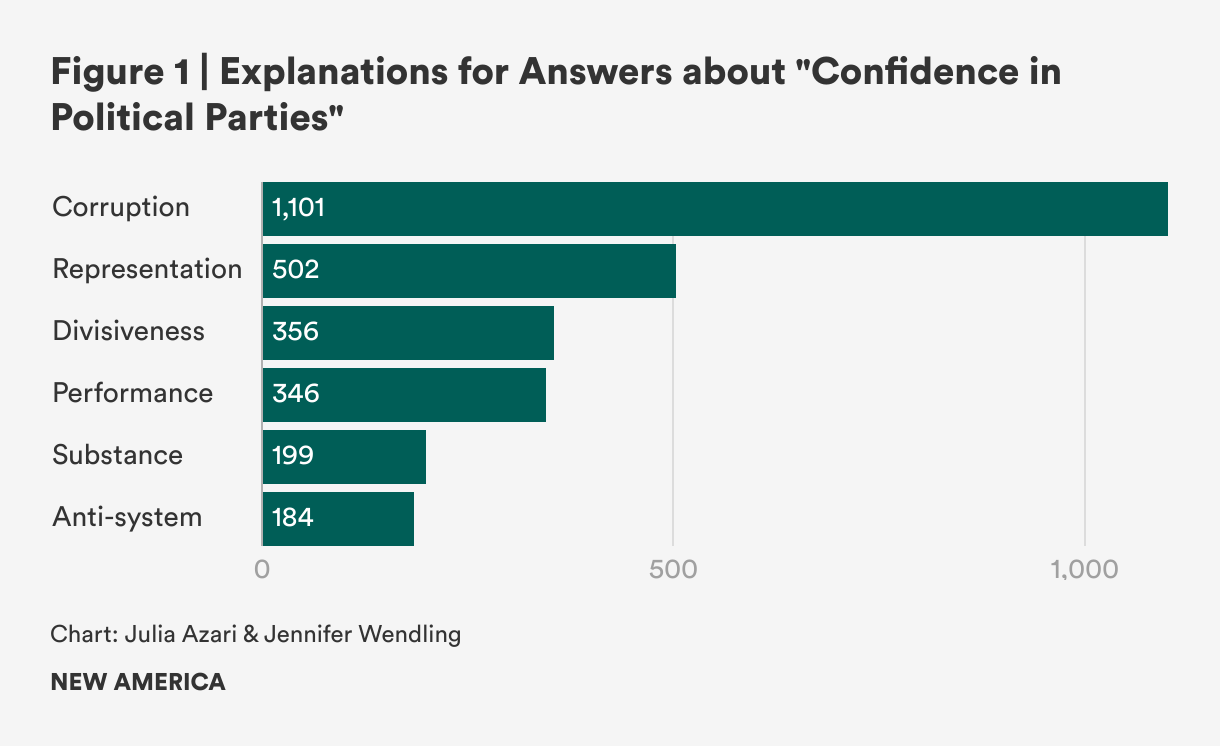
Below we examine responses to the question that asks respondents to explain their confidence in political parties. We coded the open-ended responses for six categories: money and corruption; lack of substance; performance; representation; anti-system; and divisiveness. These categories were based on the reasoning in the literature on both confidence and distrust, and party distrust specifically. The quotations below illustrate typical responses in each of the categories and indicate the partisan identification of the respondent.
Money and Corruption
Many respondents described parties as corrupt and beholden to large donors, such as corporations and lobbyist groups, to maintain their elite political status. One respondent wrote, “power hungry money grabbers not wanting to lose their elite status.” Another pointed to corruption as a recent development: “Lobbyists, millionaires, and corporations have turned a country built on laws and values into a country built on profits.”
Lack of Substance
Responses coded as “lack of substance” were those that indicated that political parties do not stand for anything or lack meaningful positions on issues.
“Political parties used to mean something. Nowadays, it seems as though the words ‘Republican’ and ‘Democrat’ are so far from what they originally meant, they have virtually no meaning.”—Strong Democrat
Performance
Responses in this category reflect one perspective in a long-standing debate about the causes of institutional distrust. Some of the classic works in the study of governmental trust suggest that, as Hetherington and Rudolph summarize, “governmental performance drives trust.”8 The crises of the twenty-first century might suggest that respondents would have many and detailed complaints about how the different institutions of government have performed.
“They get so stuck in the rhetoric that they DON’T DO ANYTHING!!”—Strong Democrat
Representation
As with corruption, responses that identify poor representation reflect respondents’ opinions that institutions failed to voice either the respondents’ own interests or those of the population in general. The difference is that these comments did not invoke wealth, institutional corruption, or economic inequality.
“All political parties are all promises. But they do nothing for the people. They do things in favor for themselves. Just so hard to trust one bit.”—Independent
“It doesn’t seem like politicians have as much desire to serve the people as they did in the past.”—Weak Democrat
Anti-System
Responses in this category differed from others in that their responses to a question about a single institution implicated the entire political system. These respondents expressed the belief that the two-party system is broken and only favors extremists from both parties, thus not representing true democratic processes.
“We have a bought-and-paid-for political system. They service their own power desires over the needs of the very public they claim to serve. There are talking points, and agendas…and no true love of country.…And a false picture constantly being created to get the masses to feel and think the way that the powerful wish them to feel and think… and they seek to support and protect their own power. Why would anyone feel confident in this?”—Independent
Divisiveness
Some respondents claimed that too often parties love to fight and disagree with one another. In addition, respondents argued that the pure hatred each party has for the other destroys any attempts of compromise and bipartisanship, while also fostering growing divisions.
“Their inability to work together to get things done. Their absolute hatred for those who disagree with them and their attempts to destroy those with whom they disagree.”—Strong Republican
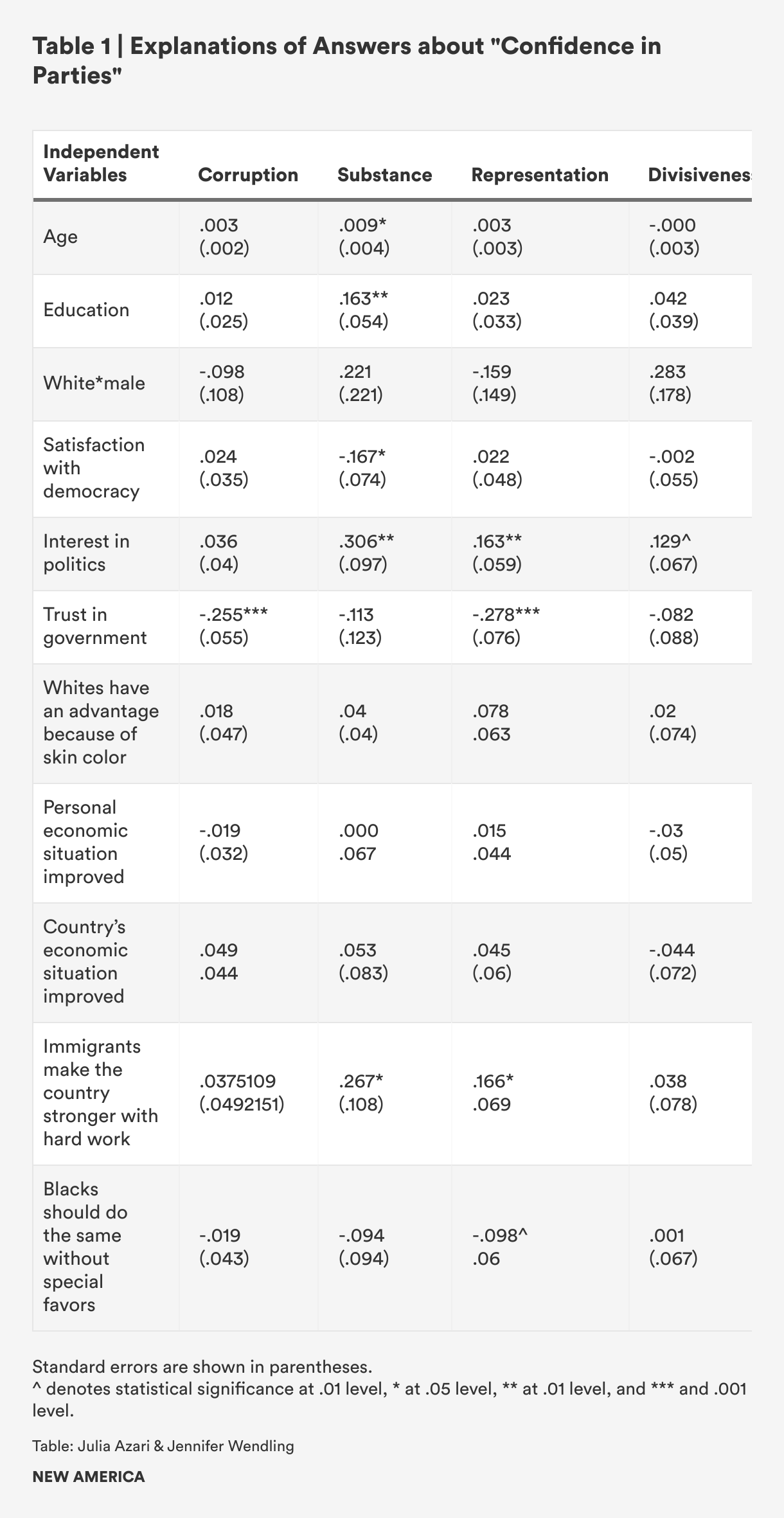
The models shown in Table 1 are logistic regressions assessing the impact of each variable on the likelihood of providing an answer in each of the six categories. As expected, there is a great deal of noise in these categories of responses, and our models do not explain much of the overall variation. However, they reveal something of a systematic logic behind different responses to the prompt to explain confidence in parties.
The analysis includes several demographic and attitudinal variables: race, gender, education, satisfaction with democracy, and interest in politics. The table also includes questions about whether the respondent perceived their personal and the country’s economic situation to have changed for the better. Finally, the model includes the responses to questions about whether the respondent agreed with the following statements: “white [Americans] have an advantage because of skin color”; “immigrants make the country stronger with their hard work and talents”; and “Black [Americans] should do the same without any special favors.” These were rated on a 1 to 4 scale, with “4” indicating strong agreement. The model also controlled for ideology and partisanship.
The Implications of Anti-Partyism
The analysis shown in Table 1 has several implications for understanding anti-party sentiment in the United States.
- Money and Corruption: Only one variable had a statistically significant relationship: trust in government. Unsurprisingly, higher trust in government meant that respondents were less likely to cite corruption as a reason for their confidence in parties.
- Lack of Substance: Several factors were associated with citing lack of substance as a reason for flagging confidence in parties. Being older, with a higher level of interest in politics, higher levels of education, greater support for immigration, and lower satisfaction with democracy were all associated with this response, at conventional levels of statistical significance.
- Performance: Interestingly, while no other variables were statistically significant, higher satisfaction with democracy was associated with the likelihood of giving a response related to the performance of parties.
- Representation: Like corruption, respondents who reported low levels of trust in government were more likely to respond with complaints about parties’ failures of representation. Positive attitudes about immigration were also statistically significant, as was Republican identification.
- Divisiveness: Republicans were more likely to cite divisiveness in their open-ended comments.
- Anti-System: Respondents who cited distrust or dislike for the entire political system also stood out in several ways. White men were more likely than other groups to provide these responses, and this response was associated with agreement with the statement that Black Americans should not expect “special favors.” Those who reported low levels of satisfaction with democracy, unsurprisingly, were more likely to offer an anti-system response.
Our findings have several implications for the theoretical questions posed at the start of the essay. First, corruption is by far the most cited reason for distrust in political parties, with no particular demographic or attitude patterns connected to that response. However, trust in government was related to responses about both corruption and representation, suggesting that we should think about anti-party attitudes in terms of broader questions about institutional and governmental trust.
Second, the types of variables related to critiques of party substance reveal another type of anti-partyism: the highly educated and engaged citizen who sees parties as lacking real commitments or ideological cores. This suggests that scholars of anti-partyism should also be attuned to the debates about the “diploma divide” and political attentiveness.
Finally, the relatively small number of anti-system responses nevertheless seems to represent a distinct brand of anti-partyism: Respondents who offered these kinds of comments were more likely to be white and male, to express racially resentful attitudes, and to be dissatisfied with democracy. The “angry white male” political archetype from circa 1994 may be relevant to a minor, but persistent, strain of anti-partyism as well.
Citations
- Richard Hofstadter, The Idea of a Party System: The Rise of Legitimate Opposition in the United States, 1780–1840 (Berkeley, CA: University of California Press, 1969): 12.
- John R. Hibbing and Elizabeth Theiss-Morse, Congress as Public Enemy: Public Attitudes toward Political Institutions (Cambridge: Cambridge University Press, 1995).
- Mark D. Ramirez, “The Dynamics of Partisan Conflict on Congressional Approval,” American Journal of Political Science 53, no. 3 (2009): 683, .
- Samara Klar and Yanna Krupnikov, Independent Politics: How American Disdain for Parties Leads to Political Inaction (Cambridge: Cambridge University Press, 2016): 26–27.
- Zachary Albert and Raymond J. La Raja, “Who should decide the party’s nominee? Understanding public attitudes toward primary elections,” Party Politics 27, no. 5 (2021): 928–941, ; Caitlin Jewitt and Gregory Shufeldt, “A Rigged Game? How Candidate, Partisan, and Electoral Factors Shape Elite Support for the Party Nomination Process,” American Politics Research 49, no. 6 (2021): 681–694, ; Caitlin E. Jewitt, The Primary Rules: Parties, Voters, and Presidential Nominations (Ann Arbor, MI: University of Michigan Press, 2019).
- John R. Hibbing and Elizabeth Theiss-Morse, Stealth Democracy: Americans’ Beliefs about How Government Should Work (Cambridge: Cambridge University Press, 2002): 76.
- 2018 American Institutional Confidence Poll: The Health of American Democracy in an Era of Hyper Polarization (Washington, DC: The Baker Center, 2018), .
- Marc J. Hetherington and Thomas J. Rudolph, “Priming, Performance, and the Dynamics of Political Trust,” Journal of Politics 70, no. 2 (April 2008), .
What Fusion Politics Could Mean for Third Political Parties Today (Lisa Disch)
Political fusion, also known as “cross-endorsement” or “multiple-party nomination,” refers to a system that allows a single candidate to receive the nominations of more than one political party and to run in the general election on more than one ballot line. In the nineteenth century, prior to the adoption of the Australian ballot, fusion candidacies were “commonplace,” and typically took the form of “cooperation between a minor party and a major one.”1 Back then, fusion politics helped to sustain a more complex party system that was more representative of voters’ ideologies and preferences and increased the competitiveness of the electoral system.2
This essay revisits the rich history of fusion politics in the late nineteenth century to show how widespread beliefs about two-party politics are historically contingent. Both the significance of the fusion practice, and its benefits for representative democracy, are difficult to appreciate from the vantage point of the present. Today, the two-party system strikes its opponents and champions alike as an inherent, inescapable, and desirable outcome of single-member plurality voting. Political science textbooks promote this system as “one of the oldest political institutions in the history of democracy,” a duopolistic pattern of political conflict that was consolidated only in the first decades of the twentieth century.3
In 1933, populist historian John D. Hicks took a first shot at this package of misconceptions that discredited third political parties and rendered the practice of fusion unfathomable. He called attention to “something peculiarly sacred about” two-party competition, whose cultural status he (ironically) compared to the “decalogue, or the practice of monogamy, or the right of the Supreme Court to declare a law of Congress unconstitutional.” “Right-minded citizens never question the wisdom of such a [binary] division of political forces,” he wrote, but see in it “a sort of guarantee of good government.”4
Two-party democracy looked very different to third-party voters in the final third of the nineteenth century. When antifusion laws were first introduced, one Michigan Populist vigorously protested that the legislation “practically disfranchises every citizen who does not happen to be a member of the party in power.” He rightly predicted that, absent fusion, dissenters would be “compelled to either lose their vote (as that expression is usually understood)” or else to join forces with the least objectionable major party. To this Michigan Populist the reform would have a strange and appalling consequence: "There could only be two parties at one time."5
To the fusion voters of yesterday, today’s two-party system is neither a sacred political inheritance nor a foreordained outcome of single-member plurality voting. They identify it as a legislative contrivance, the product of protectionist ballot and election reforms that major-party dominated legislatures appended to the good government initiatives that swept the nation from the mid- to late 1890s. Third parties, which were leaders in election reform during this period, advocated for these reforms even though they proved to put an end to fusion politics and to third parties as the nineteenth century knew them: robust grassroots political organizations that won majorities in state legislatures and enacted meaningful reforms.
Fusion Politics, Electoral Victory, and Democratic Reform in the Late Nineteenth-Century U.S.
In the final third of the nineteenth century, the fusion option ensured that a third-party vote was much more than a gesture of protest. When fusion was legal, citizens could cast a ballot for a third political party without the risk of “wasting” a vote or contributing indirectly to the victory of their least favorite establishment party candidate. Fusion nominations and the strategies they enabled made third-party voting a consequential force in what we think of as the U.S. “two-party system” and a crucial agent of small-d democratic economic and political transformation.
Fusion politics had a well-documented impact on the electoral system. In 1870, 250 fusion candidacies took place in congressional and gubernatorial races in more than 20 states. In 1890, 210 fusions occurred in 30 states.6 From 1874 to 1892, minor parties received at least 20 percent of the vote in one or more elections in more than half of the non-southern states. Even when their vote share was smaller, they continued to play a critical role because during this period the two major political parties were closely matched. “Between 1878 and 1892 minor parties held the balance of power at least once in every state but Vermont, and from the mid-1880s they held that power in a majority of states in nearly every election.”7
Do not be misled into dismissing the importance of fusion politics because these successes occurred largely in state-level elections. During the era of fusion, state legislatures possessed far more power over economic and infrastructure development than they do today. In the nineteenth century, a third-party vote was much more than a gesture of protest. Fusion nominations and the strategies they enabled gave third-party legislators the ability to create change in important areas of public policy, particularly regarding economic development and basic political rights. Small-d democrats used fusion to fight racist, corrupt, and elitist political institutions in the late nineteenth century.
“Fusion nominations and the strategies they enabled gave third-party legislators the ability to create change in important areas of public policy.”
In North Carolina, fusionists overthrew the conservative Bourbon Democrats for a brief period from 1895 to 1901 and achieved democratic victories “obtained in no other Southern state”: promoting a “resurgence” of Black political participation and office holding; instituting a fair and impartial election system; fighting voter suppression by repealing obstructionist election laws; and constraining anti-democratic police and employers to secure the voting rights of “tenant farmers, sharecroppers, [and] city workers, white and Black.”8
In Kansas, where fusion voting established People’s Party control over both houses of the state legislature, that third party passed major progressive legislation regulating railroads, stockyards, and banks; protecting laborers and unions; and liberalizing public education and criminal justice.9 Populists in the Kansas Senate also successfully “voted down a harsh bill for capital punishment,” while a Populist in the House anticipated today’s most advanced sexual harassment laws by introducing “a bill making it a felony for any employer ‘to make improper advances to any woman working under his charge.’”10
Contrary to Duverger’s Law, the end of this vibrant period of third-party activity was not foreordained by single-district plurality voting. Nor did third parties bring it on themselves by their unpopularity or lack of political skill. Major political parties used adoption of the Australian ballot at the end of the nineteenth century to implement ballot qualification thresholds and to prohibit multiple listings of a candidate’s name. These antifusion regulations cloaked a major-party power play under the guise of good government reform. Fusion historian Peter H. Argersinger emphasizes how antifusion law changed the culture of political possibility: Once its political effects “became evident, [antifusion] law became so widely adopted in other states—and so useful politically to the dominant party—that its provisions came to be seen as logically necessary and unexceptionable.”11 Antifusion law transformed a competitive political system where fusion made sense into a duopoly where fusion, if it happened at all, could be spun as deceptive and fraudulent.12
What Fusion Could Mean in the United States Today
Fusion provides a means of representing policy differences within the two “Big Tent” major parties. In New York, where fusion is commonly practiced, third parties make fine distinctions between fiscal conservatives and social conservatives within the Republican parties. Such specificity can be a positive political force as it makes voters feel that they are casting a meaningful vote in a conflict that is particularly important to them; interest in a conflict is one of the principal forces motivating citizens to vote.13 Fusion candidacies, like third-party candidacies generally, can boost voter turnout through grassroots campaigning. Research found that in a 2000 special election for a seat in the Nassau County legislature, sustained organizing by the Working Families Party six weeks prior to the election, including door-to-door canvassing and telephone banking, induced people to come to the polls who would not otherwise have voted; that third party produced an increase in turnout and a net gain in votes for their endorsed candidate.14
Most powerfully, fusion offers a weapon against widespread representations of “sorted” or “red v. blue” America because it provides an electoral vehicle that works by representing the points of consensus that major political party voters share rather than exaggerating the gulf between them. Former U.S. Representative from New Jersey and would-be fusion candidate summoned his prospective constituency in November 2022, calling out to “Democrats of all stripes, independents, and moderate Republicans,” voters who do not want to abolish the police or demonize immigrants, who support clean energy and closing corporate tax loopholes, and whose views “defy tribal party stereotypes.”15 A 2022 poll of New Jersey voters conducted by ¹ú²úÊÓƵ found that 68 percent of 800 respondents believed that fusion voting would better express their views than two-partyism, which further entrenches polarization and other partisan dysfunction.16
Citations
- Howard A. Scarrow, “Duverger’s Law, Fusion and the Decline of American ‘Third’ Parties,” Western Political Quarterly 39, no. 4 (1986): 634–647, .
- Scarrow, “Duverger’s Law,” .
- Theodore Lowi and Benjamin Ginsberg, American Government: Freedom and Power (New York: Norton, 1998): 474.
- John D. Hicks, “The Third Party Tradition in American Politics,” Journal of American History 20 (June 1933): 3, .
- Kalamazoo Weekly Telegraph, March 20, 1895, cited in Peter H. Argersinger, “‘A Place on the Ballot’: Fusion Politics and Antifusion Laws,” American Historical Review 85, no. 2 (1980): 304, .
- Scarrow, “Duverger’s Law,” 635–36, .
- Argersinger, “‘A Place on the Ballot,” 289, .
- Helen G. Edmonds, The Negro and Fusion Politics in North Carolina, 1894-1901 (Chapel Hill, NC: The University of North Carolina Press, 1951): 218, 70, 77.
- Peter H. Argersinger, The Limits of Agrarian Radicalism: Western Populism and American Politics (Lawrence, KS: University Press of Kansas, 1995).
- Argersinger, The Limits of Agrarian Radicalism, 185.
- Argersinger, The Limits of Agrarian Radicalism, 165, 161.
- Scarrow, “Duverger’s Law,” 639, .
- Elmer Eric Schattschneider, The Semisovereign People (New York: Holt, Reinhard and Winston, 1960).
- Melissa R. Michelson and Scott J. Susin, “What’s in a Name: The Power of Fusion Politics in a Local Election,” Polity 36, no. 2 (2004): 301–23, .
- Tom Malinowski, “A Viable Third Party is Coming, and It’s Starting With a New Jersey Lawsuit,” New York Times, July 6, 2022, .
- Lee Drutman, New Jersey Voters on Political Extremism, Political Parties, and Reforming the State’s Electoral System (Washington, DC: ¹ú²úÊÓƵ, 2022), source.
How Multiparty Coalition Governance Moderates Partisan Hostility (Will Horne)
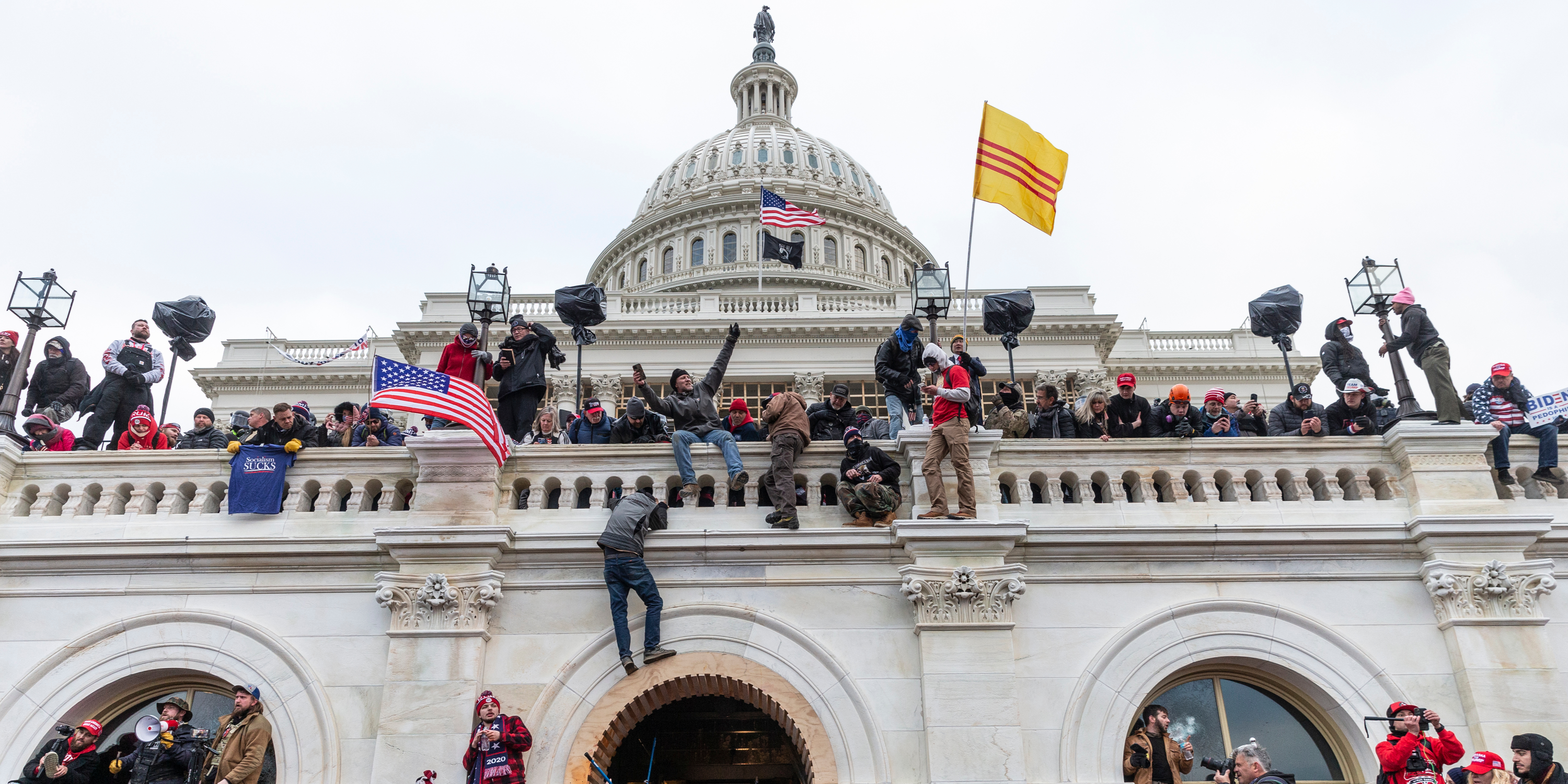
Partisan polarization in the United States now seems to go beyond ideological or policy differences to deep resentment and dislike across party lines. The negative implications of partisan hostility became evident during the divisive 2020 election campaign and the subsequent violent insurrection at the U.S. Capitol. It is no surprise that in President Biden’s inauguration speech he implored Americans to “show respect to one another” and reminded his nation that “politics need not be a raging fire destroying everything in its path.”1 This essay highlights recent research on how alternative electoral institutions can promote cooperation among political elites and reduce out-party hostility and negative partisanship.
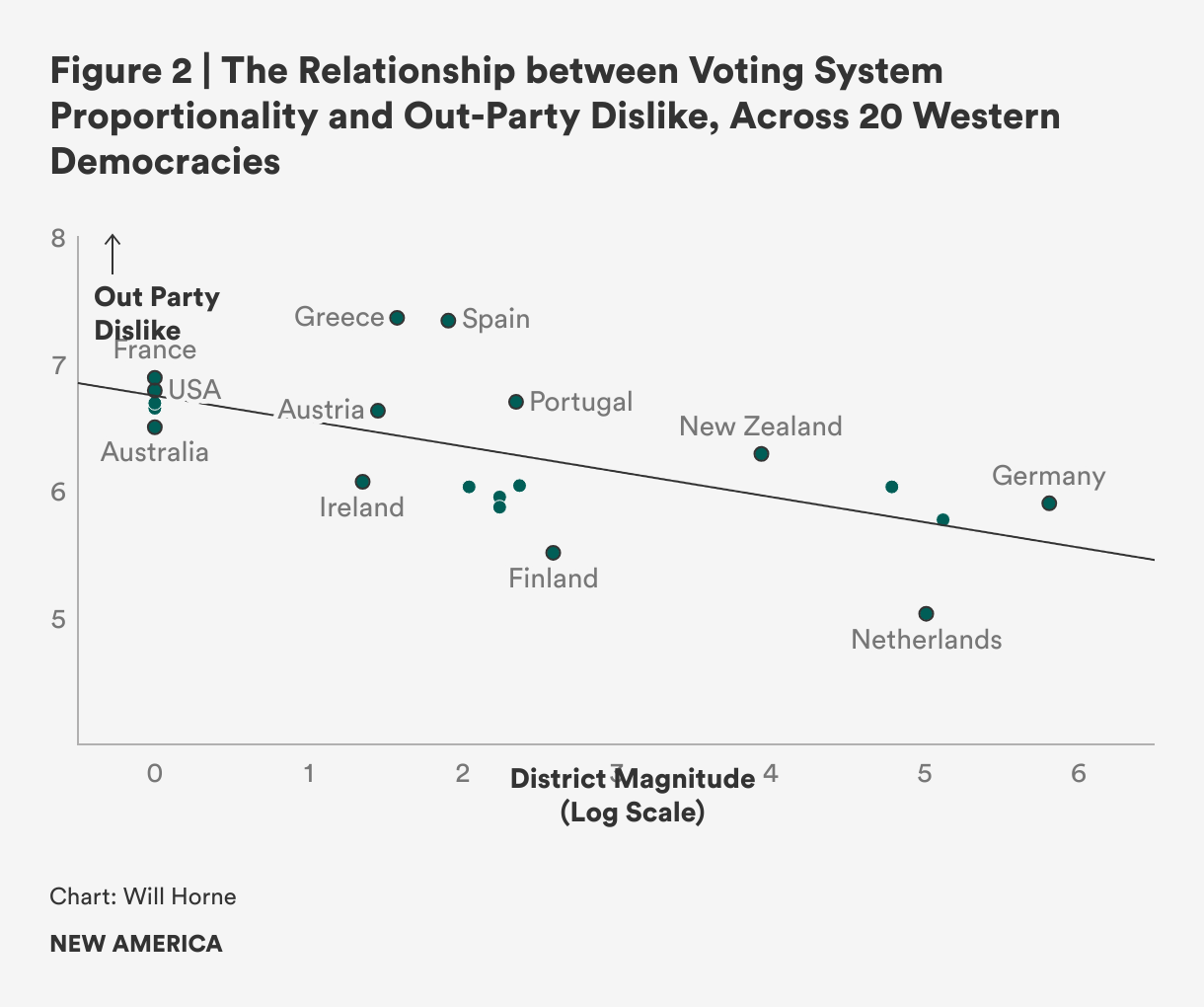
While the bulk of research on out-party hostility and the related phenomenon of affective polarization has been focused on the United States, the emerging comparative scholarship leverages the existence of different institutional arrangements to analyze its structural underpinnings.2 A consistent finding is that voters in more proportional electoral systems show less hostility toward out-partisans.3 Figure 2 below demonstrates that relationship by plotting the average level of out-party dislike in a country against its average logged district magnitude—meaning the number of electoral seats assigned to each district within a country.
In a paper co-authored with James Adams and Noam Gidron, we built on previous research to examine how electoral systems influence partisan resentment by focusing on party coalitions. We explored two ideas: first, that citizens feel more positively toward parties that co-govern with their preferred party, regardless of that party’s policy stances; second, that the emotional benefits of co-governance persist, with positive feelings lasting even after the coalition ends.
The first argument, that supporters of parties in coalitions feel more warmth toward their coalition partners, is intuitive. Citizens often believe co-governing parties have more similar ideologies than their manifestos suggest, which can increase positive feelings toward out-parties.4 Partisans witness their party and coalition partners defending government performance against opposition and media criticism. This public display of mutual support likely enhances partisans’ perceptions of coalition partners’ character, leading to warmer emotional evaluations. This suggests that politics is less “us versus them” or zero-sum in proportional systems. A recent study by Lotem Bassan-Nygate and Chagai Weiss uses a clever survey experiment which takes advantage of the ambiguity surrounding coalition formation in the 2019 Israeli elections—priming voters to expect party cooperation in the formation of a unity government promoted tolerance across partisan lines, even in the hyper-polarized Israeli setting.5 Our own results, based on observational data, suggest that this tolerance promoting effect of coalitions generalizes to western democracies more broadly.
Our second argument is less intuitive. We argue that there are at least three reasons to expect that the impacts of coalitions will be durable even once the coalitions themselves have dissolved.
- First, party identification, as Morris Fiorina describes, can be thought of as a “running tally” of citizens’ evaluations of parties’ policies and performance. This can encompass events spanning decades and may influence partisans’ out-party evaluations long after the coalition ends.6
- Second, David Fortunato and Randolph Stevenson find that past co-governance impacts citizens’ current perceptions of party policies, causing them to overestimate policy affinity between their party and former coalition partners. We expect a similar impact on partisan affect.7
- Third, past co-governance may affect party elites’ public interactions with former coalition partners. Opposition party elites may maintain cooperative relationships to signal a willingness to co-govern in the future. These signals can impact citizens’ perceptions of their own party and previous coalition partners.
To understand why the lingering impact of coalitions may potentially have a more powerful impact on a country’s level of partisan hostility than solely focusing on a country’s current coalitions, consider that while only 8 percent of current party-pairs in our sample share in governance, another 16 percent of parties have co-governed at some time in the last twenty years.
For a stylized example, consider the United States and the Netherlands. The Democratic Party, in a winner-take-all electoral system, experiences zero-sum politics with little bipartisan cooperation. Conversely, the Dutch Christian Democratic Appeal (CDA), a center-right party, operates in a highly proportional electoral system, leading to frequent multiparty coalitions. For instance, prior to the 2010 election, the CDA had governed in various coalitions with parties spanning the political spectrum, including the center-left Labour Party, the center-right People’s Party for Freedom and Democracy, and the centrist liberal Democrats 66. Unlike the United States, where no two parties have experience governing in coalition, Dutch CDA had co-governed with parties capturing over 60 percent of the non-CDA votes in 2010. Similarly, Germany’s proportional system has seen multiple “Grand Coalition” governments, as well as other multiparty coalitions, showcasing the differences between winner-take-all and proportional electoral systems. Politics in these countries is much less zero-sum than the United States as “us” and “them” shifts from election to election. As Figure 3 shows, this relationship between district magnitude and proportionality of electoral system generalizes to our 20 western democracies.
“Politics in these countries is much less zero-sum than the United States as ‘us’ and ‘them’ shifts from election to election.”
To test our expectations, we analyze data from 77 election surveys across 19 Western democracies since the mid-1990s. We utilize the widely used “feeling thermometers,” which ask respondents to rank how warmly they feel about a given party from “0” to “10.” We find that partisans evaluate former coalition partners more warmly, controlling for both the past and present ideological positions taken by these parties. The effect size for past coalition status is roughly one unit on the 0 to 10 feeling thermometer, depending on the specific model specification and we detect effects even for coalitions 10 to 15 years in the past. In one specification, we include party-pair fixed effects to show that as the coalition histories of the same two parties evolve, so do their partisan’s evaluation.
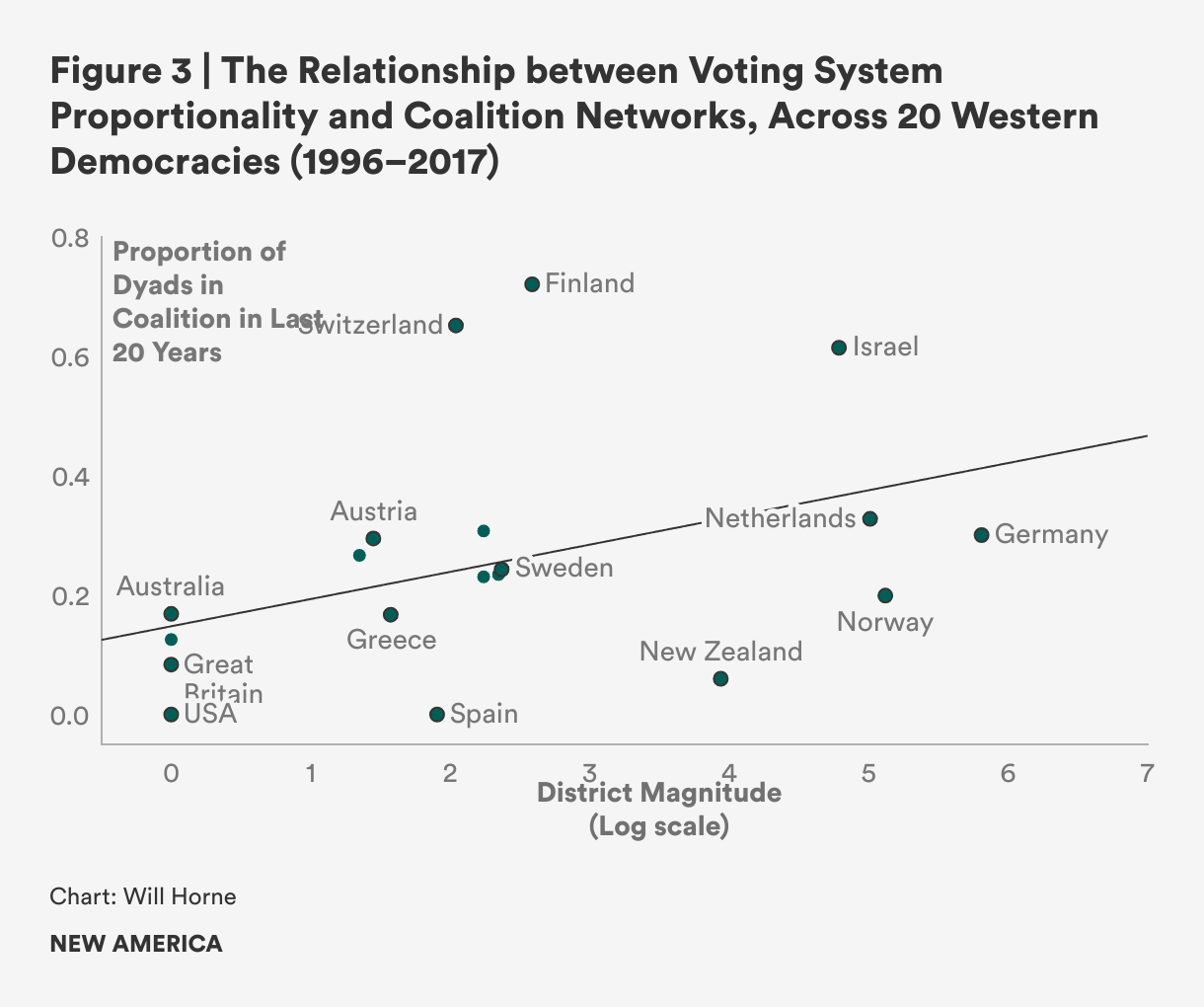
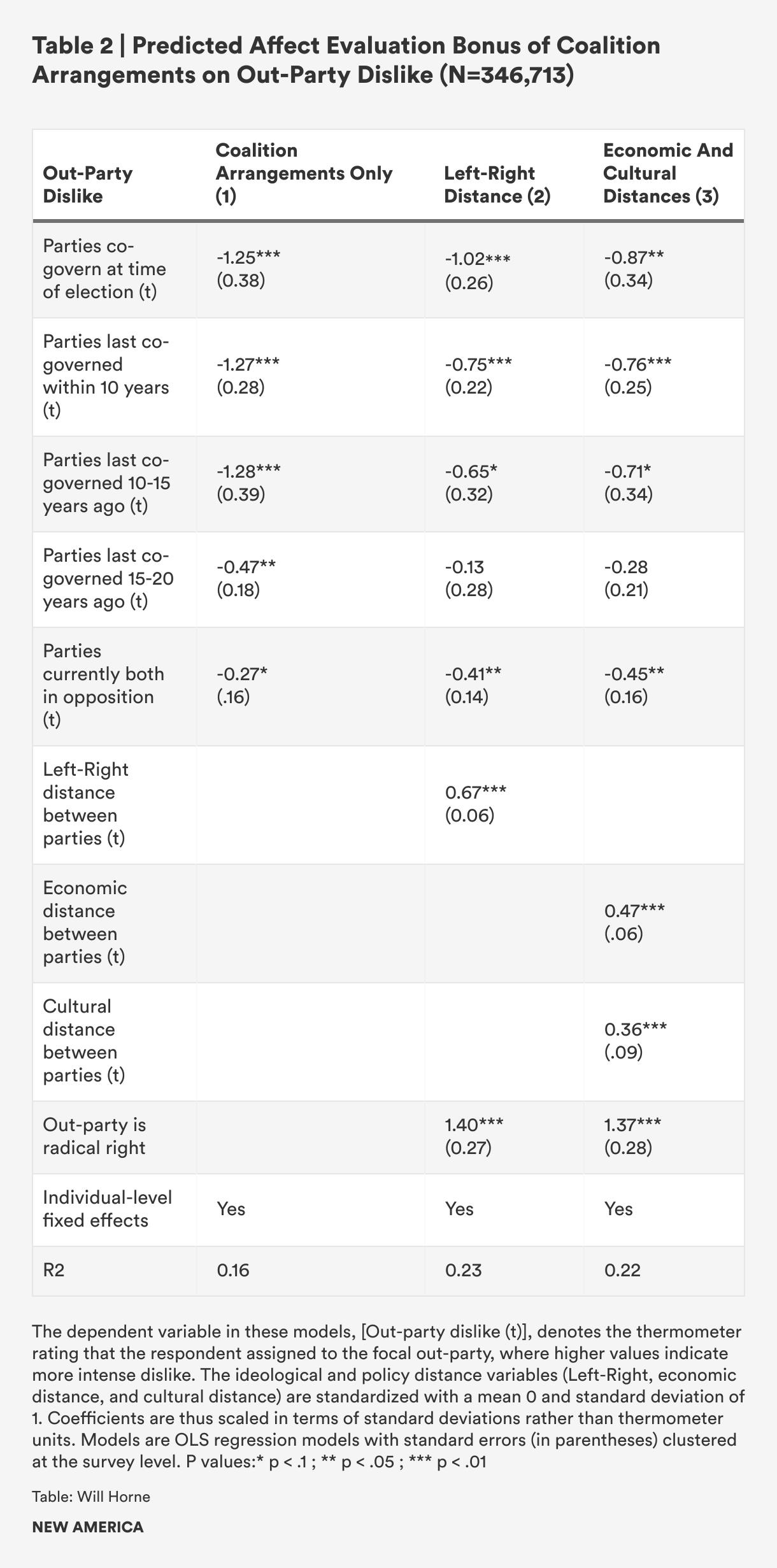
Summing up, we find that more proportional systems have denser networks of current and past co-governance, leading to warmer out-party evaluations across Western publics. Proportional representation fosters party systems with rich coalition histories, contributing to the warmer cross-party evaluations observed in these systems. This aligns with arguments for a more proportional electoral system in the United States.
Citations
- President Joseph R. Biden, Jr., “Inaugural Address,” (speech, Washington, DC, January 20, 2021), .
- Will Horne, James Adams, and Noam Gidron, “The Way we Were: How Histories of Co-Governance Alleviate Partisan Hostility,” Comparative Political Studies 56 (March 2023): 299–325, ; Noam Gidron, James Adams, and Will Horne, American Affective Polarization in Comparative Perspective (Cambridge: Cambridge University Press, 2020); Andres Reiljan, “‘Fear and Loathing across Party Lines’ (Also) in Europe: Affective Polarisation in European Party Systems,” European Journal of Political Research 59, no. 2 (2020): 376–96, .
- Arendt Lijphart, Patterns of Democracy: Government Forms and Performance in Thirty-Six Countries (New Haven, CT: Yale University Press, 2012); Gidron et al., American Affective Polarization in Comparative Perspective.
- David Fortunato and Randolph T. Stevenson, “Perceptions of Partisan Ideologies: The Effect of Coalition Participation,” American Journal of Political Science 57, no. 2 (2013): 459–77, .
- Lotem Bassan-Nygate and Chagai Weiss, “Party Competition and Cooperation Shape Affective Polarization: Evidence from Natural and Survey Experiments in Israel,” Comparative Political Studies, 55, no. 2 (2021): 287–318, .
- Morris P. Fiorina, Retrospective Voting in American National Elections (New Haven, CT: Yale University Press, 1981).
- David Fortunato and Randolph Stevenson, “Perceptions of Partisan Ideologies,” American Journal of Political Science 57 (April 2013): 459–477, .
Fusion Voting in New York and Connecticut: An Analysis of Congressional Races From 1976–2022 (Oscar Pocasangre)
Introduction
Today, fusion voting is only legal in New York and Connecticut. This essay provides a descriptive analysis of how fusion has played out in these two states at the congressional level, focusing on how often fusion is used by parties, differences in electoral performance, and voter turnout. The main findings of this analysis are that fusion voting has historically been bipartisan—used as much by Democrats and by Republicans—but it has provided a greater boost to the vote shares of Republican candidates. The analysis also finds that votes from third parties on fused ballots are rarely decisive for the outcome of an election. From 1976 to 2022, votes from fusion lines changed the outcome of only 23 races for Congress in these states.
Fusion voting is thought to increase voter turnout by providing greater choice to voters, making elections more competitive, and creating incentives for third parties to mobilize voters to vote on their ballot line. By comparing the turnout rates over time of the same districts when they have fused ballots and when they have not, I find that fused ballots are associated with an increase in turnout when Democratic candidates run on fusion tickets, but these effects disappear once accounting for incumbency status for New York races.
The analysis in this essay uses electoral data from congressional elections in New York and Connecticut from 1976 to 2022 obtained from the MIT Election Lab. For estimating turnout rates, I complement this data with the voting age population for each congressional district in these two states since 1976 from the decennial census. This data comes from the National Historical Geographic Information System and the U.S. Census Bureau. For races in New York, I also included data on whether there was an incumbent running in each race. This data comes from Benjamin Kantack,1 who collected data on the incumbency for each race up to 2014, and I added data on incumbency from that year onward.
Fusion in New York and Connecticut
Fusion ballots in New York and Connecticut in recent years typically take the form of the Democratic Party candidate receiving the endorsement of the Working Families Party (WFP) and the Republican Party candidate receiving the endorsement of the Conservative Party in New York or the Independent Party in Connecticut. The endorsement of the WFP is thought to help Democrats garner more votes from the left and the support of more progressive constituencies, while the endorsement of the Conservative Party is thought to help Republicans get more votes from the right.
Historically, candidates from both the Democratic and Republican parties have received and accepted nominations from third parties. In this sense, fusion ballots are not a partisan strategy used only by parties on the left or only by parties on the right. The share of Democratic and Republican candidates who run on fusion tickets, however, has varied over time.
“Fusion ballots are not a partisan strategy used only by parties on the left or only by parties on the right.”
As seen in Figure 4 below, there are periods when Republican candidates have run on fusion tickets more often than Democrats and periods when the opposite occurs. In the 1980s and 1990s, with the exception of elections in 1988 and 1990, more Republican candidates were running on fusion tickets than Democratic candidates. This pattern flipped by 2004, and from that year on, Democratic candidates started running on fusion tickets far more often than Republican ones. By 2020, there were slightly more Republican candidates running on fusion tickets, and in the 2022 elections, 81 percent of Republicans running for Congress did so on a fused ticket. In contrast, 58 percent of Democratic candidates in 2022 appeared on a fusion ticket.
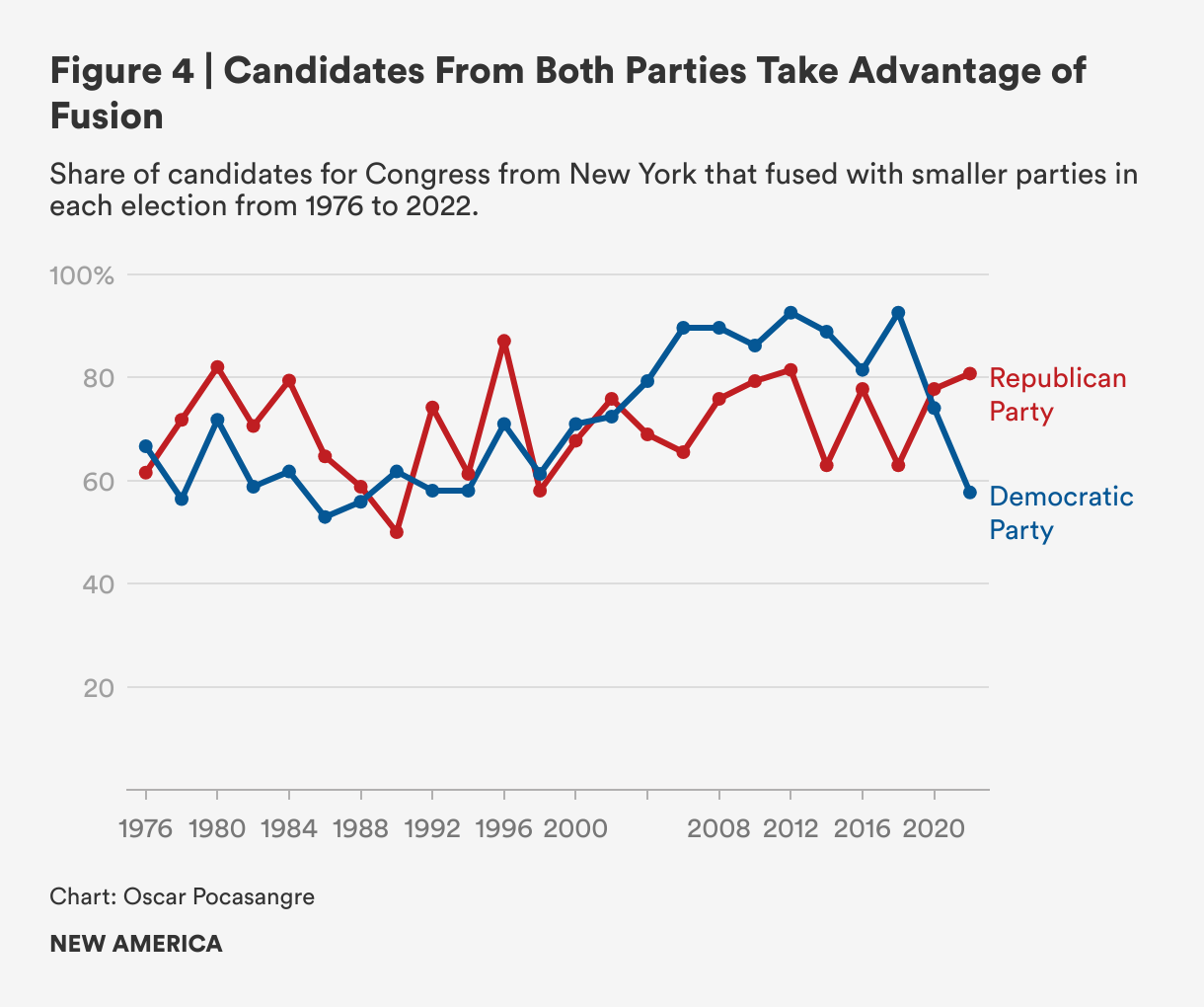
The use of fusion tickets looks quite different in Connecticut, where the small number of congressional districts—six up to 2002 and five since—does not allow for as much variation as in New York. In Connecticut, fused tickets were not used at all up until the 1990s, when three Democratic candidates ran on a fusion ticket in 1992 and 1994 and one Republican candidate ran on a fusion ticket in 1994. Fusion was not used by parties from 1998 to 2006, with the sole exception of one Republican candidate in 2000. From 2008 to 2014, all Democratic candidates were cross-endorsed by the WFP. In the 2022 elections, two of the five Democratic and Republican candidates for Congress ran on fusion tickets.
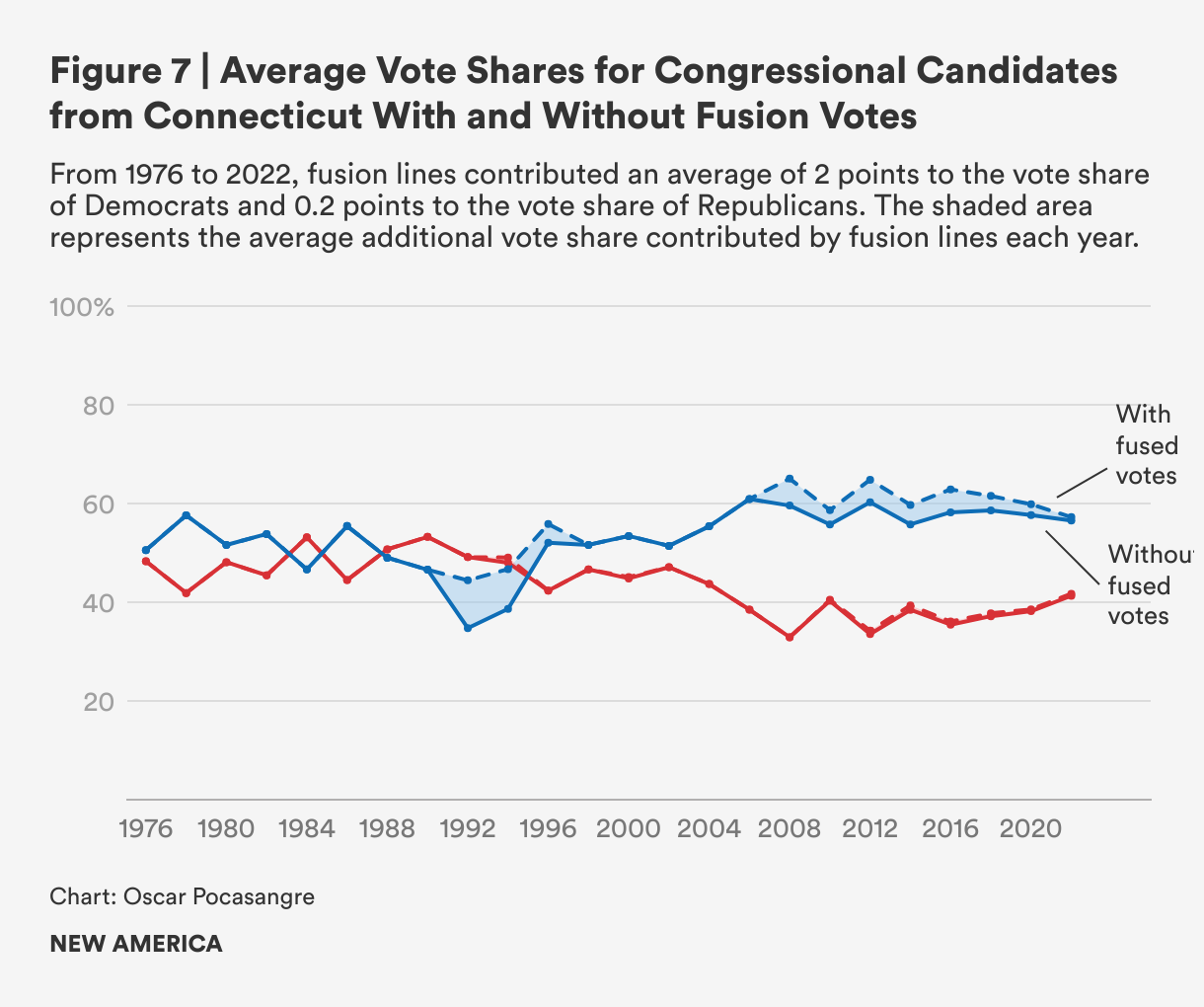
How often do elections flip thanks to the votes brought in by a smaller party on a fusion ticket? The answer is not often. From 1976 to 2022, the votes contributed by smaller parties on fusion tickets have only flipped an election in 2.6 percent of congressional races in New York and Connecticut. To be clear, this is not to say that fusion tickets do not matter. As explained before, fusion can increase the vote share of the main endorsed party by increasing turnout, a dynamic that wouldn’t be captured by comparing vote shares with and without the contributions of the smaller parties. Moreover, these are races happening in districts in New York and Connecticut, which include many safe Democratic districts that are easily won by Democratic candidates with or without fusion.
Where fusion does matter in the context of these states is in helping Republicans in competitive districts. Most of the times that fusion has made a difference in the outcome of an election, it has resulted in the Republican candidate winning an election instead of the Democratic candidate. In 2022, three congressional seats were won by Republican candidates in NY-04 (D’Esposito), NY-17 (Lawler), and NY-22 (Williams) once the votes of the Conservative Party were factored in. The question of whether the Democratic candidate would have won in a counterfactual where there had been no fusion tickets is, of course, difficult to answer. It’s possible that without fusion, voters would have voted directly for the Republican candidate since they had no other option and fusion just gave them the option of expressing their vote in a different way.
Analyzing the Effects of Fusion
What is the effect of fusion tickets on the vote share of Democratic and Republican candidates? How does fusion affect the margin of victory of parties? How does it affect turnout? Answering these questions is tricky because candidates are not randomly assigned to a fusion ticket. Rather, fusion can be endogenous to a variety of processes that are difficult to capture. For instance, higher quality candidates may be more likely to obtain cross-endorsements—in which case the effects of fusion would reflect the effects of candidate quality and not of fusion itself. Or maybe fusion is more used in highly competitive races or in years coinciding with a presidential election, both of which tend to see higher turnout—in which case the effects of fusion would be muddled with the impact of, say, a presidential election year.
For these reasons, comparing outcomes between a fused ticket and an unfused ticket can provide biased results. To address these issues, the analyses presented in this section take advantage of the temporal and cross-sectional variation in the use of fusion tickets and incorporate congressional district and decade fixed effects. Fixed effects help account for unobserved, fixed or slow-changing characteristics of districts. Maybe fusion has different effects in districts in New York City compared to districts upstate or it may have different effects in districts with higher shares of voters of color. Fixed effects account for this by restricting comparisons to tickets with and without fusion within the same district.
The decade fixed effect accounts for changes in the geography of districts from redistricting. As a result, the comparisons over time are limited to the same district within the same decade, which essentially means that the analysis treats, say, NY-14 from 2002 to 2010 as different from NY-14 from 2012 to 2020. While these techniques help ensure that comparisons are done across similar units, there may still be other sources of bias, so I do not make any causal claims about the effects of fusion. Rather, the analysis provides a descriptive analysis of the differences across elections, with and without fused tickets by party, that accounts for factors like district characteristics.
Results
I analyze the effects of fusion on several outcomes of interest: the Democratic margin of victory, the vote share of Democratic and Republican candidates, and turnout. I find evidence that fusion voting helps candidates from both parties in terms of increasing their margins of victories and vote shares. But, overall in New York and Connecticut, fused tickets tend to benefit Republican candidates more than Democratic ones. I also find that fusion tickets are associated with small increases in turnout rates, although these effects on turnout disappear once candidate incumbency is factored in.
“Fusion voting helps candidates from both parties in terms of increasing their margins of victories and vote shares.”
Table 3 below presents the results of fusion tickets for each party on the Democratic margin of victory. The different columns show different specifications of the regression models, incorporating different control variables. In races where Democratic candidates run on fusion tickets, the margin of victory of Democratic candidates is about 4.3 to 5.5 percentage points higher than in races where Democratic candidates do not run on fusion tickets. When Republicans run on fusion tickets, there is an associated reduction in the vote share of Democrats of between 4.3 to 6.3 percentage points, depending on the model specification.
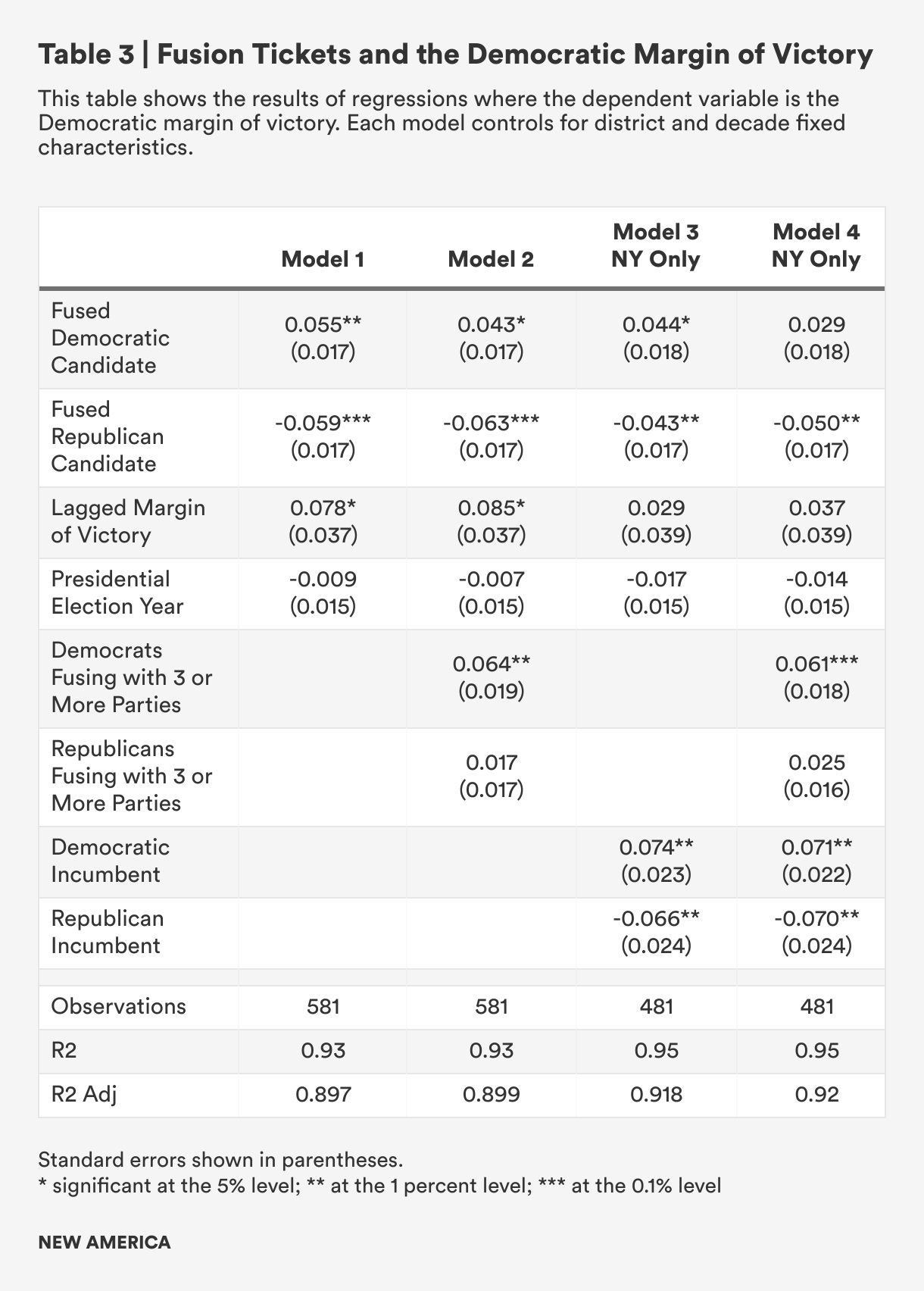
Running a similar statistical analysis—but this time with the Democratic vote share as the dependent variable—shows that when Democrats run on a fusion ticket, compared to when they don’t, their vote share is about 2 percentage points higher. There is also an associated reduction in the vote share of Democrats when Republicans run on a fusion ticket. We see a similar dynamic when the outcome is the Republican Party vote share. In this case, when Democrats run on a fusion ticket they reduce the vote share of Republicans by about 2 percentage points, but when Republicans run on fusion tickets they are able to increase their vote share by around 5 percentage points. These findings suggest that fusion helps both parties draw in more votes through the smaller parties, although it is not possible to distinguish whether these are votes that would have gone to the main endorsed party either way or if fusion is drawing in voters that would have not voted otherwise. The output for these regressions is omitted for space considerations.
Finally, using a regression analysis, I also show that fusion tickets are associated with higher turnout rates when Democratic candidates fuse with a third party—but that does not seem to be the case when Republican candidates do so. Table 4 below shows the effects of fusion tickets on turnout. Democratic fusion tickets are associated with an increase in turnout of about 2 to 3 percentage points. The effects for Republican fusion tickets are not statistically significant, except in Model 2 where it is significant at the 0.1 level. Elections in which Democratic and Republican candidates fuse with more than one party are also associated with higher turnout rates. Fused tickets of three or more parties only happened 15 percent of the time among Democratic candidates and 22 percent of the time among Republican candidates.
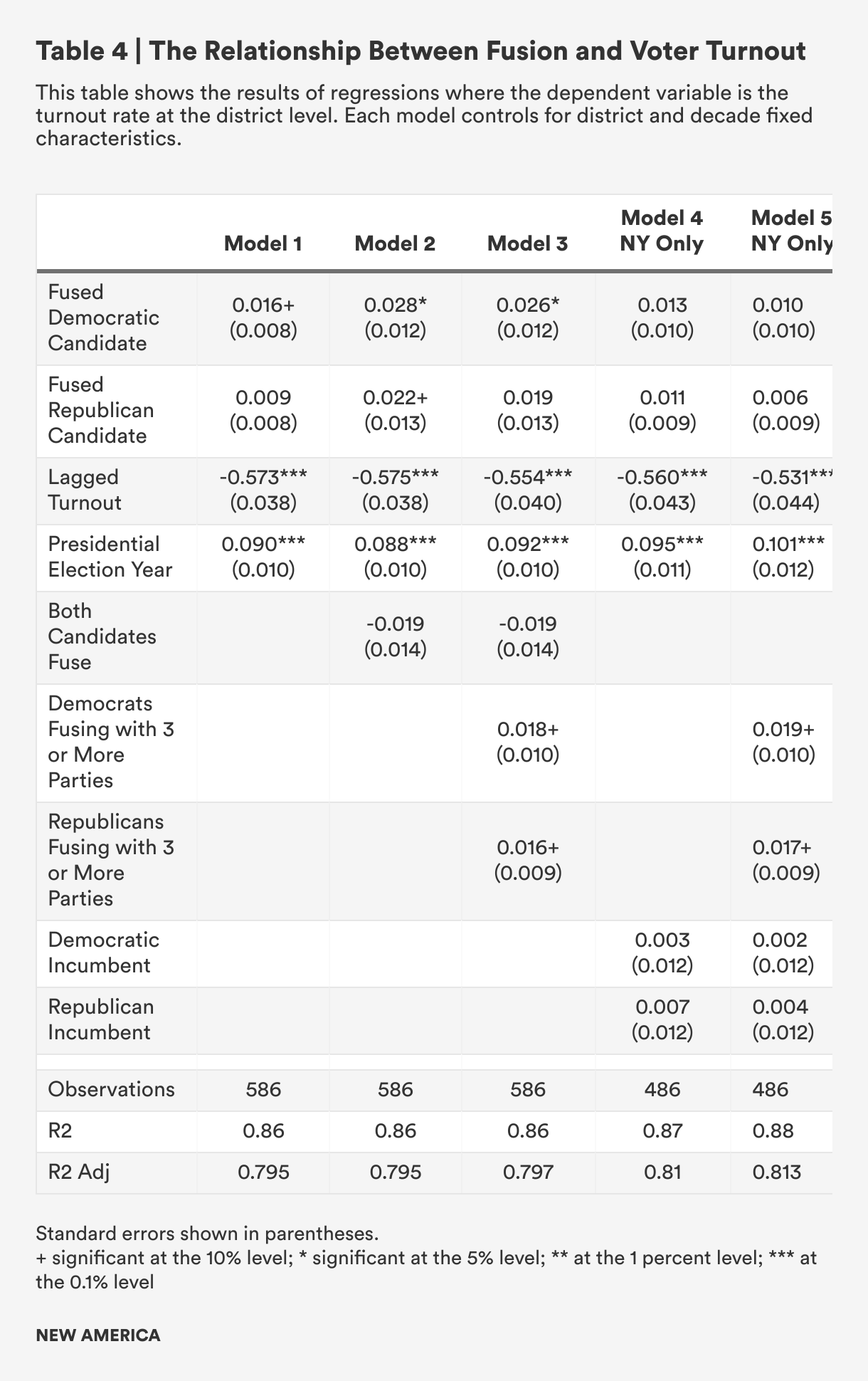
Overall, these effects on turnout are small. Other variables in the models have bigger and more significant effects on turnout than fused tickets. Turnout levels are higher in years that coincide with presidential elections by an average of about 9 to 10 percentage points and higher turnout in the previous election. The effects also disappear when accounting for incumbency in New York.
The analyses presented in this essay show that fusing ballots is a widely used electoral practice by both Democrats and Republicans that is able to garner additional votes for each party and increase electoral turnout in certain cases. The added votes from fusion lines are usually not enough to change an electoral outcome, but they allow minor parties to participate in races without spoiling elections. As such, fusion voting could be a useful first step in transitioning toward a multiparty democracy.
Citations
- Benjamin R. Kantack, “Fusion and Electoral Performance in New York Congressional Elections,” Political Research Quarterly 70, no. 2 (2017): 291–300, .
- Introduction (Mark Schmitt)
- Political Parties Are Essential Democratic Institutions (Didi Kuo)
- Do Americans Hate Political Parties? (Julia Azari and Jennifer Wendling)
- What Fusion Politics Could Mean for Third Political Parties Today (Lisa Disch)
- How Multiparty Coalition Governance Moderates Partisan Hostility (Will Horne)
- Fusion Voting in New York and Connecticut: An Analysis of Congressional Races From 1976–2022 (Oscar Pocasangre)
More ¹ú²úÊÓƵ the Authors

Mark Schmitt
Senior Director, Political Reform Program

Didi Kuo
Fellow, Political Reform Program; Eric & Wendy Schmidt Fellow, 2018

Julia Azari
Jennifer Wendling
Former Congressional Policy Analyst
Lisa Disch
Professor of Political Science, University of Michigan
Will Horne
Postdoctoral Research Fellow, Georgia State University

Oscar Pocasangre
Senior Data Analyst, Political Reform Program