How Multiparty Coalition Governance Moderates Partisan Hostility (Will Horne)
Partisan polarization in the United States now seems to go beyond ideological or policy differences to deep resentment and dislike across party lines. The negative implications of partisan hostility became evident during the divisive 2020 election campaign and the subsequent violent insurrection at the U.S. Capitol. It is no surprise that in President Biden鈥檚 inauguration speech he implored Americans to 鈥渟how respect to one another鈥� and reminded his nation that 鈥減olitics need not be a raging fire destroying everything in its path.鈥�1 This essay highlights recent research on how alternative electoral institutions can promote cooperation among political elites and reduce out-party hostility and negative partisanship.
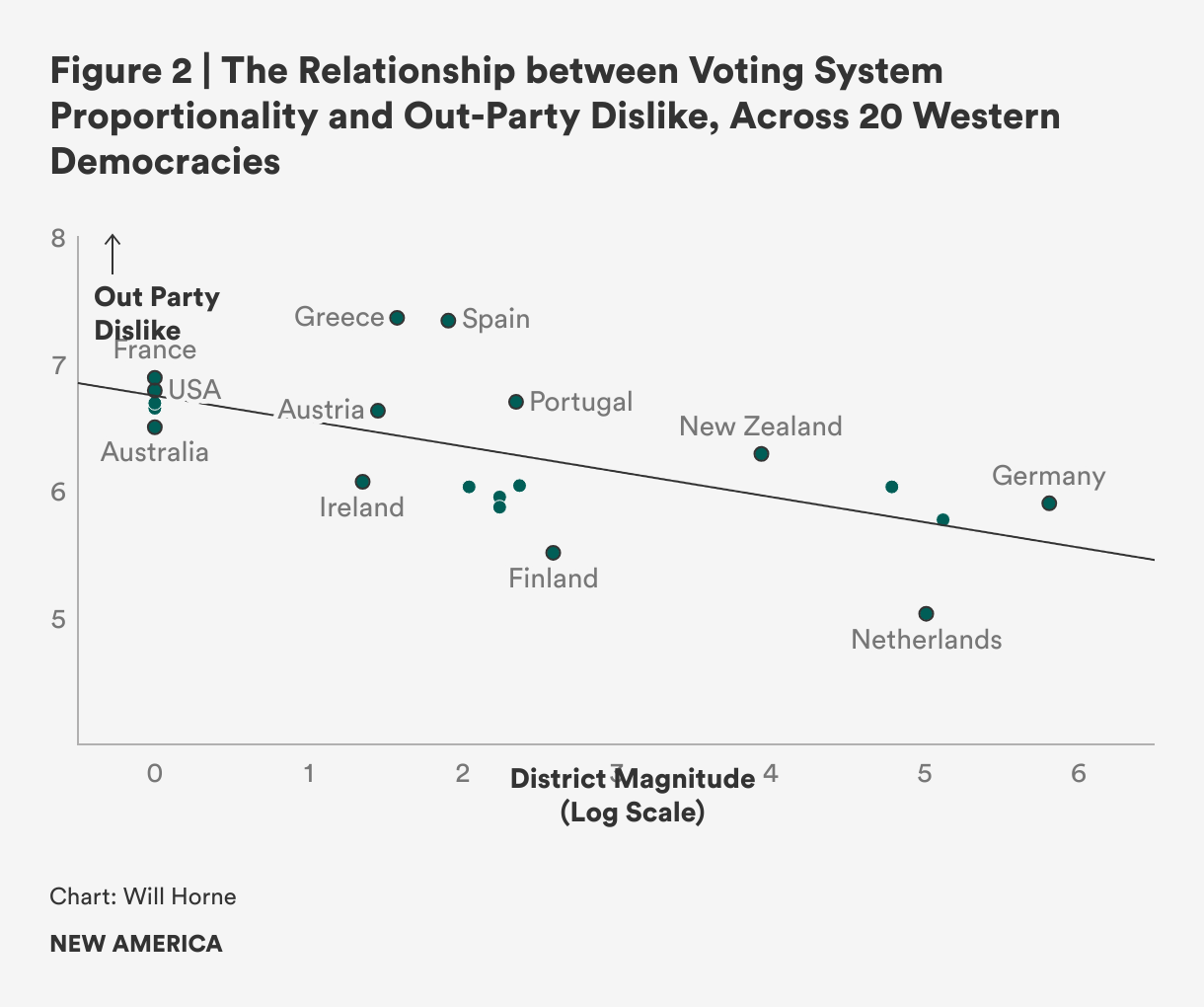
While the bulk of research on out-party hostility and the related phenomenon of affective polarization has been focused on the United States, the emerging comparative scholarship leverages the existence of different institutional arrangements to analyze its structural underpinnings.2 A consistent finding is that voters in more proportional electoral systems show less hostility toward out-partisans.3 Figure 2 below demonstrates that relationship by plotting the average level of out-party dislike in a country against its average logged district magnitude鈥攎eaning the number of electoral seats assigned to each district within a country.
In a paper co-authored with James Adams and Noam Gidron, we built on previous research to examine how electoral systems influence partisan resentment by focusing on party coalitions. We explored two ideas: first, that citizens feel more positively toward parties that co-govern with their preferred party, regardless of that party鈥檚 policy stances; second, that the emotional benefits of co-governance persist, with positive feelings lasting even after the coalition ends.
The first argument, that supporters of parties in coalitions feel more warmth toward their coalition partners, is intuitive. Citizens often believe co-governing parties have more similar ideologies than their manifestos suggest, which can increase positive feelings toward out-parties.4 Partisans witness their party and coalition partners defending government performance against opposition and media criticism. This public display of mutual support likely enhances partisans鈥� perceptions of coalition partners鈥� character, leading to warmer emotional evaluations. This suggests that politics is less 鈥渦s versus them鈥� or zero-sum in proportional systems. A recent study by Lotem Bassan-Nygate and Chagai Weiss uses a clever survey experiment which takes advantage of the ambiguity surrounding coalition formation in the 2019 Israeli elections鈥攑riming voters to expect party cooperation in the formation of a unity government promoted tolerance across partisan lines, even in the hyper-polarized Israeli setting.5 Our own results, based on observational data, suggest that this tolerance promoting effect of coalitions generalizes to western democracies more broadly.
Our second argument is less intuitive. We argue that there are at least three reasons to expect that the impacts of coalitions will be durable even once the coalitions themselves have dissolved.
- First, party identification, as Morris Fiorina describes, can be thought of as a 鈥渞unning tally鈥� of citizens鈥� evaluations of parties鈥� policies and performance. This can encompass events spanning decades and may influence partisans鈥� out-party evaluations long after the coalition ends.6
- Second, David Fortunato and Randolph Stevenson find that past co-governance impacts citizens鈥� current perceptions of party policies, causing them to overestimate policy affinity between their party and former coalition partners. We expect a similar impact on partisan affect.7
- Third, past co-governance may affect party elites鈥� public interactions with former coalition partners. Opposition party elites may maintain cooperative relationships to signal a willingness to co-govern in the future. These signals can impact citizens鈥� perceptions of their own party and previous coalition partners.
To understand why the lingering impact of coalitions may potentially have a more powerful impact on a country鈥檚 level of partisan hostility than solely focusing on a country鈥檚 current coalitions, consider that while only 8 percent of current party-pairs in our sample share in governance, another 16 percent of parties have co-governed at some time in the last twenty years.
For a stylized example, consider the United States and the Netherlands. The Democratic Party, in a winner-take-all electoral system, experiences zero-sum politics with little bipartisan cooperation. Conversely, the Dutch Christian Democratic Appeal (CDA), a center-right party, operates in a highly proportional electoral system, leading to frequent multiparty coalitions. For instance, prior to the 2010 election, the CDA had governed in various coalitions with parties spanning the political spectrum, including the center-left Labour Party, the center-right People鈥檚 Party for Freedom and Democracy, and the centrist liberal Democrats 66. Unlike the United States, where no two parties have experience governing in coalition, Dutch CDA had co-governed with parties capturing over 60 percent of the non-CDA votes in 2010. Similarly, Germany鈥檚 proportional system has seen multiple 鈥淕rand Coalition鈥� governments, as well as other multiparty coalitions, showcasing the differences between winner-take-all and proportional electoral systems. Politics in these countries is much less zero-sum than the United States as 鈥渦s鈥� and 鈥渢hem鈥� shifts from election to election. As Figure 3 shows, this relationship between district magnitude and proportionality of electoral system generalizes to our 20 western democracies.
鈥淧olitics in these countries is much less zero-sum than the United States as 鈥榰s鈥� and 鈥榯hem鈥� shifts from election to election.鈥�
To test our expectations, we analyze data from 77 election surveys across 19 Western democracies since the mid-1990s. We utilize the widely used 鈥渇eeling thermometers,鈥� which ask respondents to rank how warmly they feel about a given party from 鈥�0鈥� to 鈥�10.鈥� We find that partisans evaluate former coalition partners more warmly, controlling for both the past and present ideological positions taken by these parties. The effect size for past coalition status is roughly one unit on the 0 to 10 feeling thermometer, depending on the specific model specification and we detect effects even for coalitions 10 to 15 years in the past. In one specification, we include party-pair fixed effects to show that as the coalition histories of the same two parties evolve, so do their partisan鈥檚 evaluation.
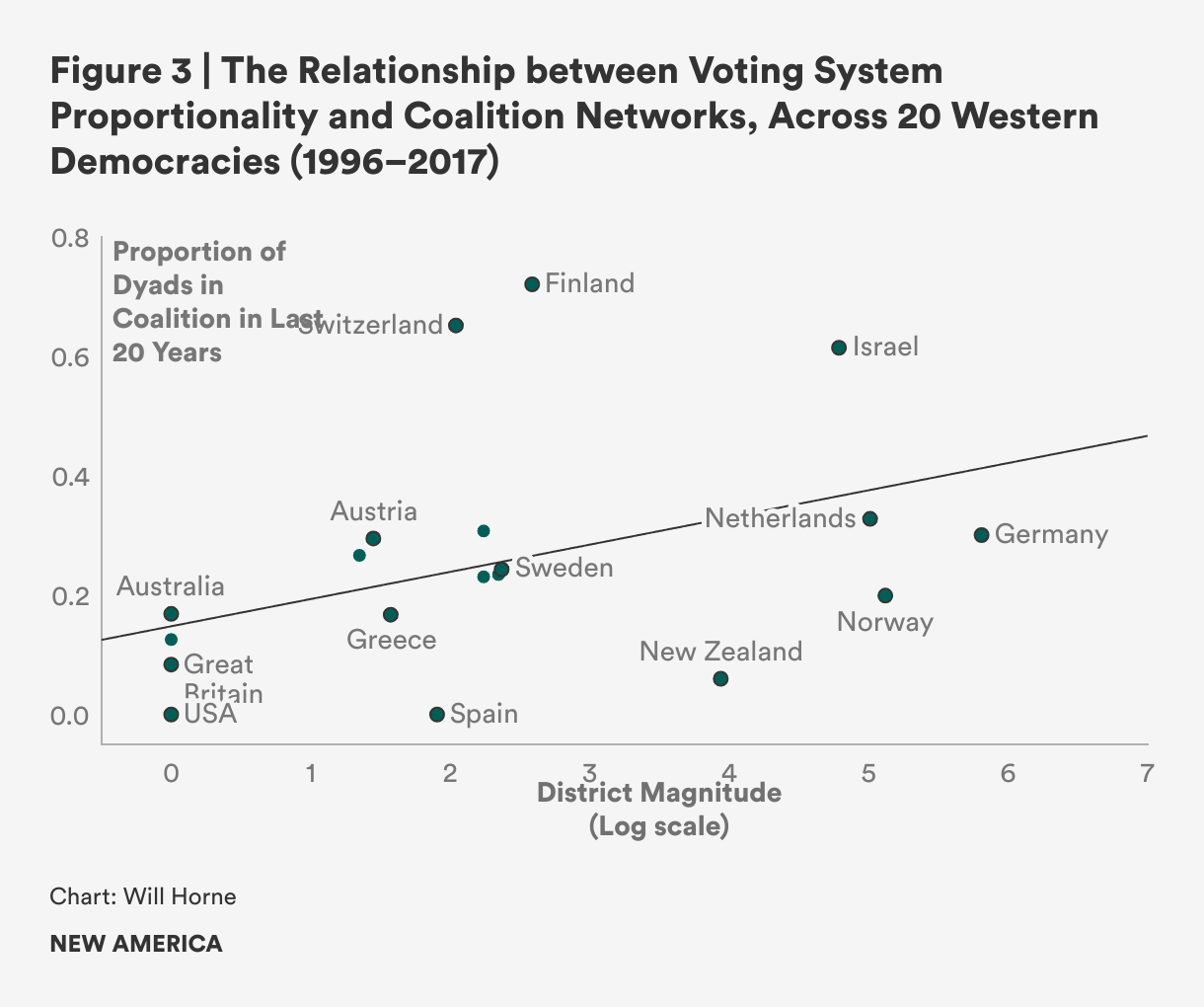
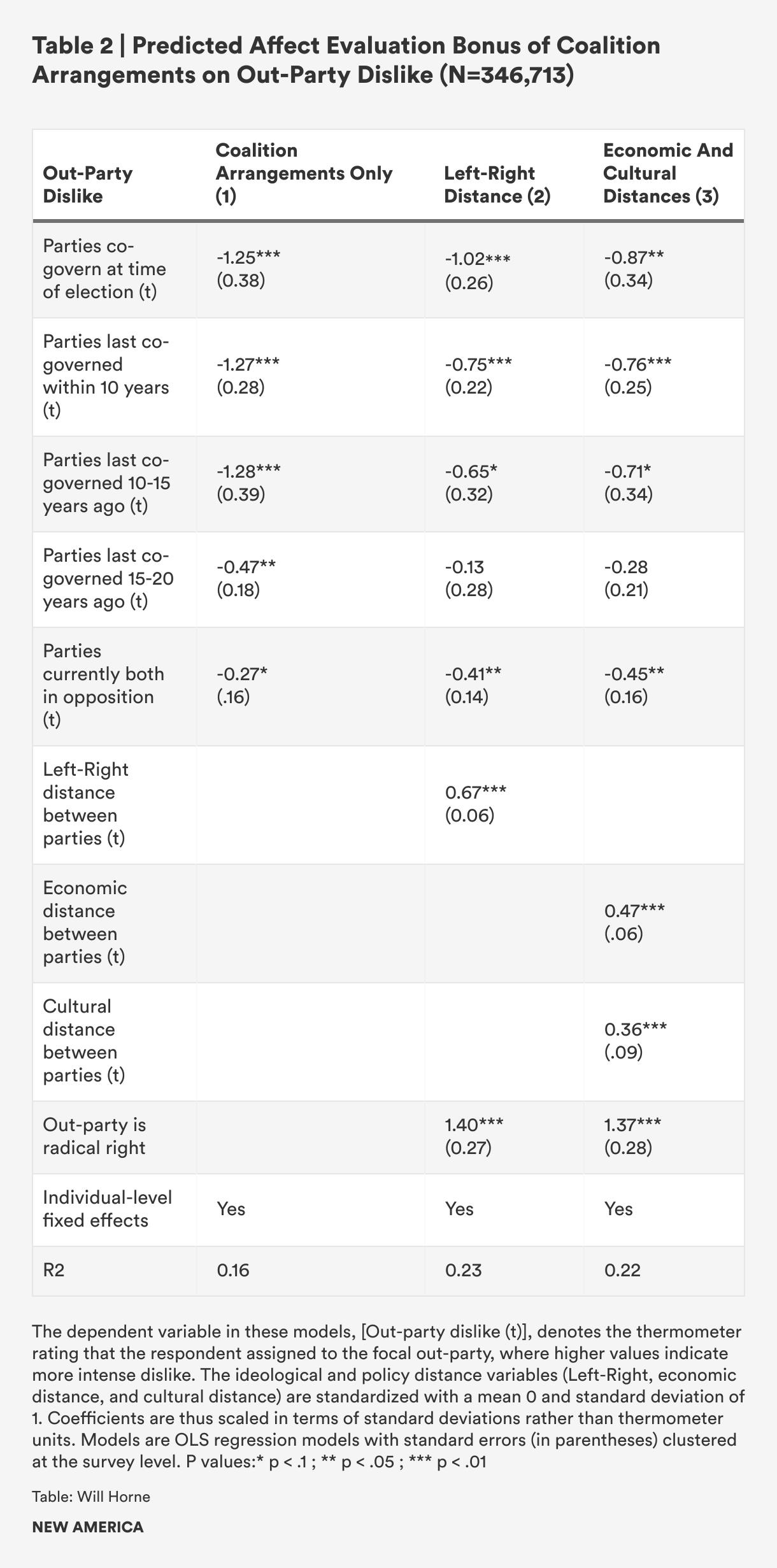
Summing up, we find that more proportional systems have denser networks of current and past co-governance, leading to warmer out-party evaluations across Western publics. Proportional representation fosters party systems with rich coalition histories, contributing to the warmer cross-party evaluations observed in these systems. This aligns with arguments for a more proportional electoral system in the United States.
The Realistic Promise of Multiparty Democracy in the United States
- Introduction (Mark Schmitt)
- Political Parties Are Essential Democratic Institutions (Didi Kuo)
- Do Americans Hate Political Parties? (Julia Azari and Jennifer Wendling)
- What Fusion Politics Could Mean for Third Political Parties Today (Lisa Disch)
- How Multiparty Coalition Governance Moderates Partisan Hostility (Will Horne)
- Fusion Voting in New York and Connecticut: An Analysis of Congressional Races From 1976鈥�2022 (Oscar Pocasangre)
Citations
- President Joseph R. Biden, Jr., 鈥淚naugural Address,鈥� (speech, Washington, DC, January 20, 2021), .
- Will Horne, James Adams, and Noam Gidron, 鈥淭he Way we Were: How Histories of Co-Governance Alleviate Partisan Hostility,鈥� Comparative Political Studies 56 (March 2023): 299鈥�325, ; Noam Gidron, James Adams, and Will Horne, American Affective Polarization in Comparative Perspective (Cambridge: Cambridge University Press, 2020); Andres Reiljan, 鈥溾�楩ear and Loathing across Party Lines鈥� (Also) in Europe: Affective Polarisation in European Party Systems,鈥� European Journal of Political Research 59, no. 2 (2020): 376鈥�96, .
- Arendt Lijphart, Patterns of Democracy: Government Forms and Performance in Thirty-Six Countries (New Haven, CT: Yale University Press, 2012); Gidron et al., American Affective Polarization in Comparative Perspective.
- David Fortunato and Randolph T. Stevenson, 鈥淧erceptions of Partisan Ideologies: The Effect of Coalition Participation,鈥� American Journal of Political Science 57, no. 2 (2013): 459鈥�77, .
- Lotem Bassan-Nygate and Chagai Weiss, 鈥淧arty Competition and Cooperation Shape Affective Polarization: Evidence from Natural and Survey Experiments in Israel,鈥� Comparative Political Studies, 55, no. 2 (2021): 287鈥�318, .
- Morris P. Fiorina, Retrospective Voting in American National Elections (New Haven, CT: Yale University Press, 1981).
- David Fortunato and Randolph Stevenson, 鈥淧erceptions of Partisan Ideologies,鈥� American Journal of Political Science 57 (April 2013): 459鈥�477, .